Eric Trump Sets A “Beyond Catastrophic” Bar To Sell Bitcoin — How Far Are We From That?

bitcoinistОпубліковано о 2026-05-25Востаннє оновлено о 2026-05-25

Анотація

Eric Trump, Chief Strategy Officer of American Bitcoin Corp., has declared that the company would only sell its Bitcoin holdings under circumstances he describes as "beyond catastrophic." In an interview, he framed this as a strategic commitment to permanent accumulation, driven by the goal of increasing "satoshis per share" and competing in both the race for the largest Bitcoin holdings and the lowest acquisition cost. The company mines its Bitcoin at a claimed 53% below spot price and retains all coins, drawing a distinction from Michael Saylor's MicroStrategy, which has signaled some flexibility. Trump's stance sets a new benchmark for long-term commitment in the Bitcoin treasury sector. As of the report, Bitcoin trades near $82,000, with American Bitcoin's treasury holding over 7,000 BTC.

Eric Trump, co-founder and Chief Strategy Officer of American Bitcoin Corp., has revealed the conditions under which he would sell Bitcoin — and the threshold he has set is so extreme it amounts to a declaration that, under any foreseeable market scenario, he is not selling.

Speaking in an interview for the Bonnie Blockchain channel published on May 12, Trump was asked directly about the circumstances that could force American Bitcoin to liquidate its holdings. His answer was unambiguous.

Selling would require something “beyond catastrophic,” per the interview — a framing that places the sell threshold so far outside normal market volatility, regulatory pressure, or even prolonged bear markets that it functions less as a risk management policy and more as a philosophical commitment to permanent accumulation.

The Two Races — And Why Selling Bitcoin Loses Both

The broader context behind Trump’s sell-never posture is the dual competitive framework he laid out in the same interview. According to Trump, the Bitcoin treasury space is defined by two simultaneous races: one for the largest total Bitcoin holdings, and one for the lowest possible acquisition cost. American Bitcoin, he argued, is competing in both — and selling Bitcoin loses ground in the first race immediately while undermining the entire logic of the second.

The company’s north star metric, per Trump’s interview, is growing “satoshis per share” — a measurement of how much Bitcoin each outstanding share of ABTC represents. Every Bitcoin sold dilutes that figure. Every Bitcoin mined and retained compounds it. The accumulation model only works if the coins stay, which makes the “beyond catastrophic” sell threshold not a rhetorical flourish but a structural requirement of the strategy itself.

The Saylor Reference — And The Divergence

Trump acknowledged Michael Saylor’s role in building the Bitcoin treasury category, describing him as a visionary and praising Strategy’s approach, per the interview. But he drew a pointed distinction. Saylor recently suggested that Strategy could sell some Bitcoin to help fund dividend payments — a hint of flexibility in the accumulation model that Trump appears unwilling to replicate.

American Bitcoin, he made clear, is following a stricter retention framework. Where Strategy accumulates primarily through capital markets and has signaled some exit flexibility, ABTC accumulates through mining — at a cost it claims is approximately 53% below spot — and holds without exception, per the interview.

The distinction matters for how investors read both companies. A sell-never posture from a mining-integrated treasury firm is more operationally credible than the same posture from a pure accumulator, because the marginal cost of each new coin is structurally lower and the balance sheet pressure to monetize is reduced accordingly.

For the nascent sector’s growing cohort of Bitcoin treasury companies, Trump’s “beyond catastrophic” framing marks a pivotal benchmark — the most unambiguous long-term accumulation commitment any publicly listed executive has put on record this cycle. Whether the market rewards that conviction or punishes the rigidity will depend on where Bitcoin trades over the next several years.
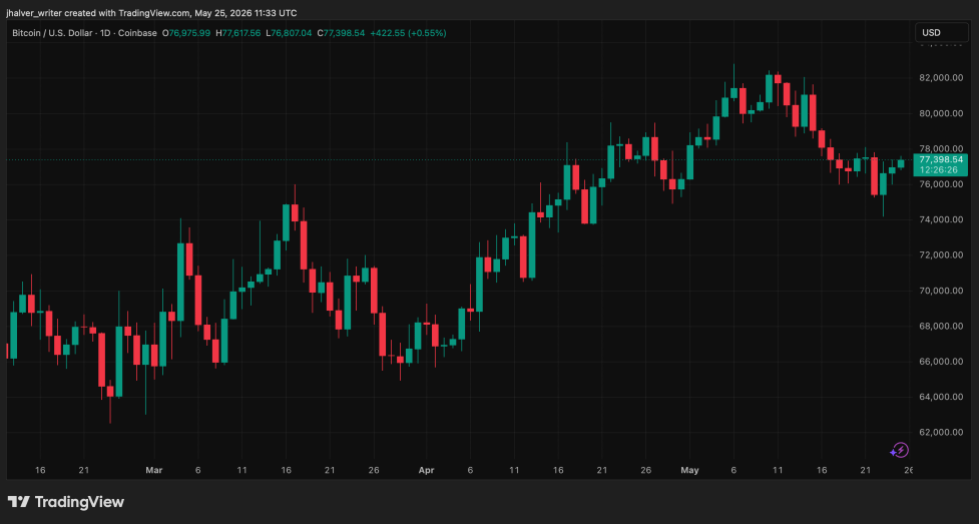
BTC's price trends to the upside, as seen on the daily chart. Source: BTCUSD on Tradingview

As of this writing, Bitcoin trades at around $82,000, with American Bitcoin’s treasury holding over 7,000 BTC as the company continues what its co-founder has now publicly described as an unconditional accumulation strategy.

Cover image from Grok, BTCUSD Chart from Tradingview

Пов'язані питання

QAccording to the article, what is the specific condition under which Eric Trump says he would sell Bitcoin?

AEric Trump would only sell Bitcoin under conditions he describes as "beyond catastrophic," a threshold so extreme it effectively amounts to a commitment to never sell under any foreseeable market scenario.

QWhat are the two key competitive races in the Bitcoin treasury space as outlined by Eric Trump in the interview?

AThe two key competitive races are: 1) the race for the largest total Bitcoin holdings, and 2) the race for the lowest possible acquisition cost for Bitcoin.

QWhat is the key metric American Bitcoin Corp. focuses on, and how does selling Bitcoin affect it?

AAmerican Bitcoin Corp.'s key metric is growing "satoshis per share," which measures how much Bitcoin each outstanding share represents. Selling Bitcoin immediately dilutes this figure.

QWhat is the main operational difference between American Bitcoin Corp.'s and MicroStrategy's Bitcoin accumulation strategies mentioned in the article?

AThe main difference is that American Bitcoin Corp. (ABTC) accumulates Bitcoin primarily through mining at a claimed low cost and follows a strict 'sell-never' policy, while MicroStrategy accumulates primarily through capital markets and has signaled some flexibility to potentially sell Bitcoin to fund dividends.

QHow does the article characterize the credibility of a 'sell-never' posture from a mining company compared to a pure accumulator?

AThe article states that a 'sell-never' posture from a mining-integrated treasury firm is more operationally credible than from a pure accumulator because the marginal cost of each new coin is structurally lower, reducing balance sheet pressure to monetize the holdings.

Пов'язані матеріали

Qualcomm: AI Hype Subsides, When Will Smartphones Emerge from the Gloom?

Qualcomm reported its Q3 FY2026 results (ending June 2026), with revenue of $9.95B, down 4% YoY but above expectations. Gross margin declined to 53.1%, pressured by rising costs across manufacturing and memory. Key business segments showed mixed performance: Handset revenue fell 19.6% YoY to $5.09B, dragged by an 11% decline in non-Apple Android shipments and weaker high-end mix. Conversely, Automotive revenue surged 61% to $1.59B, and IoT grew 9% to $1.83B. Core operating profit dropped 41% YoY due to margin compression and higher expenses. Management's Q4 FY2026 guidance projects revenue of $9.7B-$10.5B, in line with consensus, but Non-GAAP EPS guidance of $2.05-$2.25 fell short of expectations. Amidst persistent weakness in its core handset market, Qualcomm is pursuing growth in AI, focusing on Edge AI (smartphones, PCs, automotive) and Data Center AI. Its data center strategy includes four pillars: AI accelerators (e.g., AI200), commercial CPUs (Dragonfly C1000), custom silicon, and connectivity solutions. While these initiatives initially boosted its stock, concerns over AI capital expenditure sustainability have since erased those gains. The company targets $5B in data center revenue for FY2027 and $15B for FY2029. The report concludes that with the traditional handset business still under pressure, the data center opportunity is currently viewed as a longer-term option, and a more conservative valuation based on core operations may be warranted until AI contributions materialize.

marsbit2 хв тому

Qualcomm: AI Hype Subsides, When Will Smartphones Emerge from the Gloom?

marsbit2 хв тому

From TPU to Self-Evolving Agents: How Jeff Dean Predicts the Next Step in AI

At the 2026 YC Startup School, Jeff Dean outlined his vision for AI's next phase, shifting focus from simply scaling models to building intelligent, autonomous systems. He believes AI's progress is no longer just about creating smarter models, but about integrating them into systems capable of long-term, iterative work, automated experimentation, and continuous learning. This evolution moves the competition from "who has the bigger model" to "who can best organize intelligence." Dean suggests AI capabilities are now comparable to a junior engineer, enabling the automation of complex workflows. However, the true challenge and opportunity lie in managing these AI "workers" at scale. He emphasizes the importance of **context engineering**—structuring tools, memory, and feedback loops—over raw model power. For startups, this means building deep expertise in niche domains where general models currently fail (near 0-1% success rates), leveraging proprietary data, specialized tools, and domain-specific evaluators. A recurring theme is re-examining fundamental constraints. Dean's past work, like moving Google's search index to memory or creating the TPU, stemmed from questioning outdated assumptions about hardware and cost. He sees similar inflection points today, particularly in **specialized inference hardware** to drastically reduce latency and energy consumption for real-time Agent operation. Notably, he points out that in modern AI systems, the dominant cost is often not computation but **data movement**. Reliable, long-running Agents require robust system design, borrowing concepts from distributed computing like checkpointing, state management, and parallel exploration to handle failures and maintain progress over days or weeks. As AI automates execution, the scarcest human skills will shift to **defining clear specifications**, **judging what problems are worth solving** (taste), and designing effective feedback loops. Ultimately, Dean's framework prioritizes understanding the problem deeply, identifying the true bottlenecks, and systematically building closed-loop systems where AI can not only perform tasks but also improve AI itself.

marsbit2 хв тому

From TPU to Self-Evolving Agents: How Jeff Dean Predicts the Next Step in AI

marsbit2 хв тому

Торгівля

Спот
活动图片





