Eric Trump Goes to War With Big Banks Over ‘Anti‑American’ Crypto Lobbying

bitcoinistОпубліковано о 2026-03-05Востаннє оновлено о 2026-03-05

Анотація

Eric Trump has publicly criticized major U.S. banks, including JPMorgan Chase, Wells Fargo, and Bank of America, accusing them of pursuing an "anti-American" agenda by lobbying against crypto and stablecoins. He claims these institutions are trying to block Americans from earning higher yields on savings—often 4–5% in crypto platforms—to protect their low-interest monopoly and prevent deposit flight. According to Trump, banks are supporting bills like the Clarity Act to restrict yields and rewards on stablecoins, undermining competition and consumer freedom. He argues this contradicts American ideals and reflects the banking industry's panic over losing dominance in digital finance. The conflict centers on the GENIUS Act, which allowed stablecoins but banned interest payments, and the proposed Clarity Act, which aims to further limit yields.

Eric Trump lashed out against Big Banks for targeting Crypto and stablecoins, essentially not letting Americans make as much money as they could be.

An “Anti-American” Crypto Agenda

In a post on social network X on March 4, following his father Donald Trump’s message accusing banks of “undermining” the GENIUS Act, Eric Trump subsequently called out big banks like JPMorgan Chase, Wells Fargo and Bank of America.

He claims these banks are actively blocking Americans from “getting higher yields on their savings” and preventing “any rewards or perks from being given to customers,” arguing this is happening because they are “desperately targeting crypto/stablecoins, where platforms plan to offer 4–5% yields or rewards.” He goes as far as saying this stance betrays America’s freedom ideals:

The ABA and other lobbyists are spending millions trying to ban or restrict those yields via bills like the Clarity Act, crying “fairness” and using words like “stability”—when it’s really about protecting their low-rate monopoly and preventing deposit flight. his is anti-retail, anti-consumer, and straight-up anti-American.

The Greatest Hypocrites

In a different post from the same day, Eric Trump doubled down, accusing Big Banks of “doing everything they can to block the crypto industry” and branding them institutions that have “held a monopoly and screwed their customers for years.”

As Eric Trump sees it, this comes as a sort of tantrum, the last-ditch effort of a scared institution to keep control of Americans’ savings:

They are the greatest hypocrites and are in mass panic given they know they are losing the digital finance race!

The GENIUS Act vs. The Clarity Act

Both Donald and Eric Trump’s rants respond to a broader context: two flagship Trump-era bills are being weaponized against each other by the TradFi institutions.

The GENIUS Act, last year’s “big win” for payment stablecoins, legalized fully‐backed dollar tokens while explicitly banning issuers from paying interest on customer balances, a compromise that pushed yield into exchanges, fintech apps and DeFi protocols instead of killing it outright.

Now the banking lobby wants the CLARITY Act to finish the job: they are demanding a blanket prohibition on “yields, rewards or inducements” for stablecoin holders, closing the GENIUS loophole that still lets platforms compete with near‐zero bank accounts.

This is the fight the Trumps are now front running: an active opposition against those that are trying to make sure digital dollars can never pay ordinary savers more than the legacy system does.
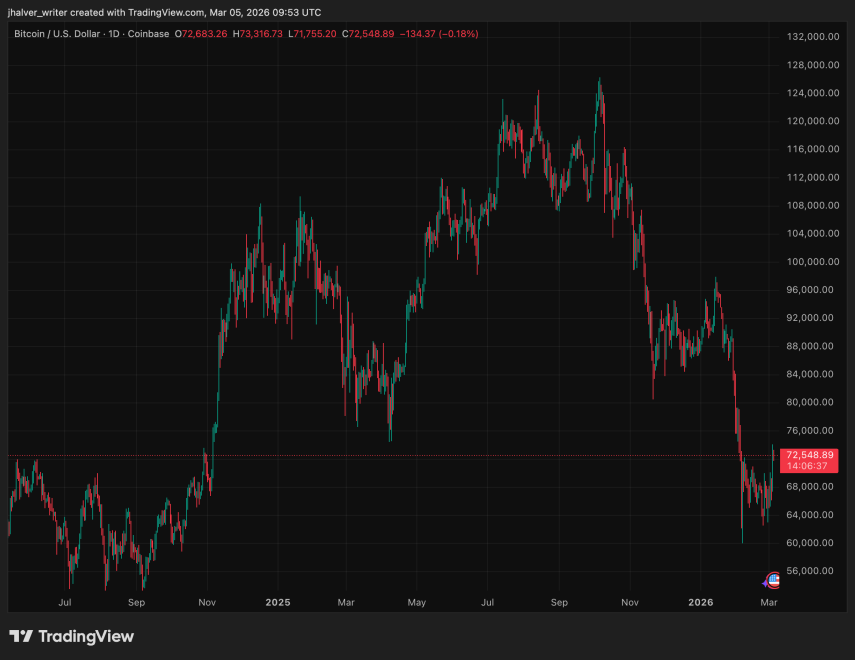
BTC’s price trends to the downside on the daily chart. Source: BTCUSD on Tradingview

Cover image from ChatGPT, BTCPUSD chart from Tradingview

Пов'язані питання

QWhat did Eric Trump accuse big banks like JPMorgan Chase, Wells Fargo, and Bank of America of doing?

AEric Trump accused big banks of actively blocking Americans from getting higher yields on their savings and preventing rewards or perks from being given to customers, claiming they are desperately targeting crypto and stablecoins to protect their low-rate monopoly.

QWhich two acts are central to the conflict between the Trump family and big banks regarding crypto and stablecoins?

AThe GENIUS Act and the Clarity Act are central to the conflict, with the GENIUS Act legalizing fully-backed dollar tokens but banning interest on customer balances, while the Clarity Act seeks to prohibit yields, rewards, or inducements for stablecoin holders.

QWhy does Eric Trump label the actions of big banks and their lobbyists as 'anti-American'?

AHe labels them as 'anti-American' because he believes they are undermining America's freedom ideals by protecting their monopoly, preventing deposit flight, and restricting consumers from earning higher yields through crypto and stablecoins.

QWhat does Eric Trump claim is the real motivation behind the banking lobby's support for bills like the Clarity Act?

AHe claims the real motivation is to protect their low-rate monopoly and prevent deposit flight, rather than genuine concerns about fairness or stability.

QHow does Eric Trump describe the big banks' response to the rise of digital finance?

AHe describes it as a mass panic and tantrum, accusing them of being hypocrites who are desperately trying to block the crypto industry because they are losing the digital finance race.

Пов'язані матеріали

Bitcoin Withdrawals Continue: 8 Years of Storage in a Coldcard Cold Wallet Ended in Zero

Coldcard Hardware Wallet Hacked: Losses Mount Due to Vulnerable Seed Generation A critical vulnerability in Coldcard hardware wallets has led to a continued wave of fund thefts. According to Galaxy Research, the total stolen has reached 1,367.05 BTC (approx. $88.6 million) from 4,585 addresses, a significant increase from the initial 594.5 BTC reported on July 30, 2026. Most of the stolen funds remain on the attackers' addresses. The issue is not with the current firmware, which Coinkite has updated, but with seed phrases generated on vulnerable devices between March 2021 and the release of fixed firmware versions. Due to a programmer error, devices switched from using a hardware random number generator to the software-based Yasmarang generator, which was initialized with publicly accessible data like the chip's serial number. This made the seed phrases predictable through offline brute-force attacks, meaning wallets remain at risk until funds are moved to a new wallet generated with the patched firmware. Affected devices include Mk2/Mk3 with firmware 4.0.1–4.1.9 (and up to 5.0.3), Mk4/Mk5 up to version 5.6.0, and Q models up to 1.5.0Q. The only exceptions are seeds created with a high-entropy method like at least 50 independent dice rolls or a strong unique BIP-39 passphrase. All other owners must generate a new seed on the fixed firmware and transfer their assets. A case highlighting the human impact involves a 39-year-old long-term investor who lost 2 BTC (approx. $130,000) in minutes. He had accumulated the Bitcoin over eight years through physical labor, viewing it as a financial lifeline and a retirement plan in a country suffering from hyperinflation. His story underscores that even conservative "buy and hold in cold storage" strategies can be compromised by such underlying technical flaws. From a technical perspective, this incident echoes historical failures where weak random number generators undermined cryptographic security, challenging the assumption that offline storage is automatically foolproof.

cryptonews.ru3 год тому

Bitcoin Withdrawals Continue: 8 Years of Storage in a Coldcard Cold Wallet Ended in Zero

cryptonews.ru3 год тому

Торгівля

Спот
活动图片





