ENI Officially Announces Completion of Strategic Brand Upgrade: Evolving from Underlying Protocol to Global Institutional-Grade Financial Infrastructure

marsbitОпубліковано о 2026-04-22Востаннє оновлено о 2026-04-22

Анотація

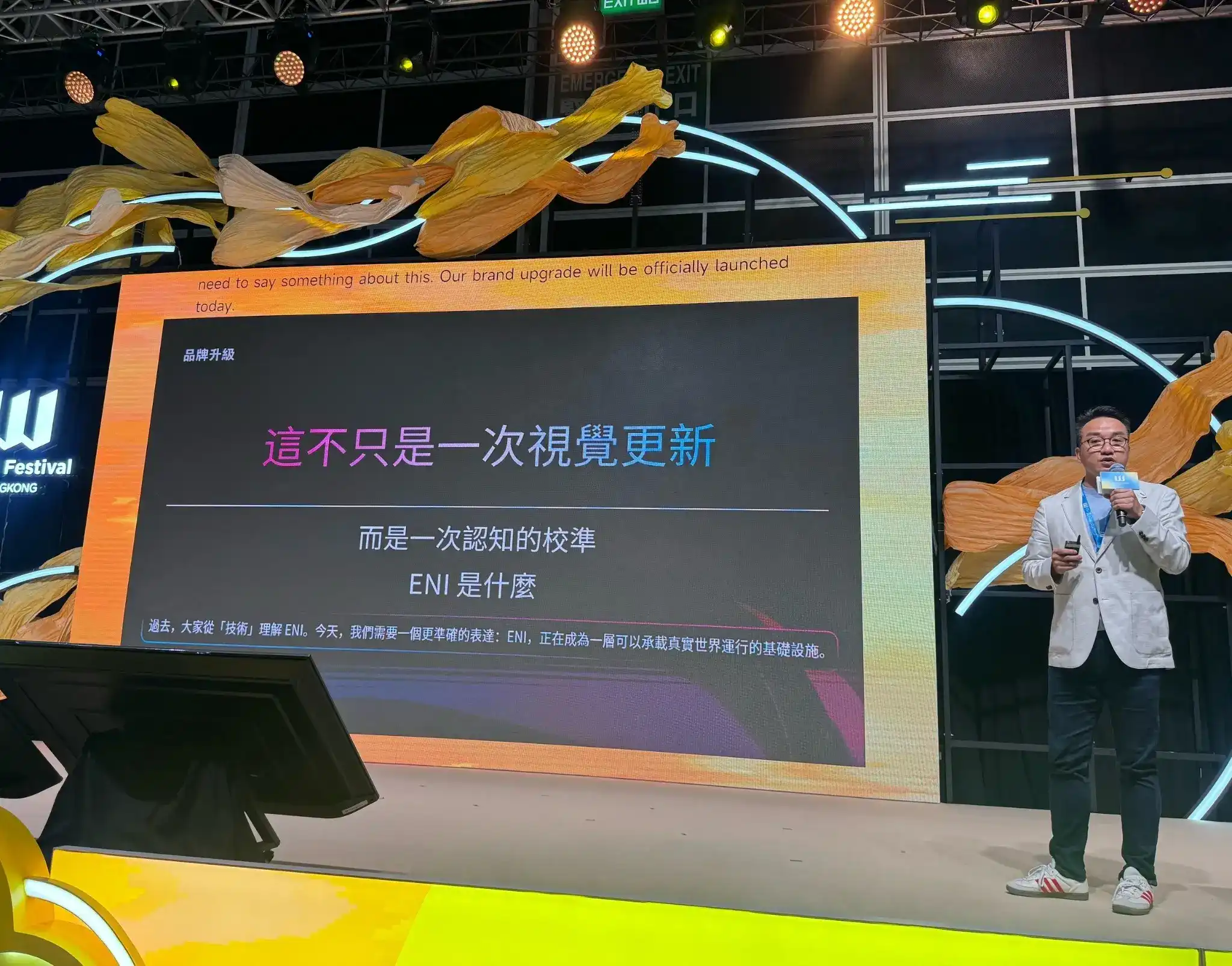
ENI Announces Strategic Brand Upgrade: Evolving from Underlying Protocol to Global Institutional-Grade Financial Infrastructure At the Hong Kong Web3 Festival on April 20, 2026, ENI founder and CEO Arion Ho announced the completion of a comprehensive brand, website, and visual system upgrade. This marks a significant shift from being an "underlying public chain" to an enterprise-grade Blockchain-as-a-Service (BaaS) platform, positioning ENI as a key infrastructure provider bridging traditional finance (TradFi) and Web3. The rebranding emphasizes precision and professionalism, reflected in a refined visual identity featuring a 25-degree tilt and a 1:4 golden ratio in its design elements. This aesthetic upgrade, led by a top-tier design team with experience from Hermès and ByteDance, underscores ENI’s commitment to institutional-grade trust and global sophistication. ENI now functions as a bridge between technological innovation and real-world business applications. It offers tailored architecture solutions for large institutions and standardized, low-friction BaaS tools for SMEs, enabling seamless integration of Web3 capabilities into existing business models. The announcement in Hong Kong, a global financial hub, signals ENI’s matured, global-ready approach to supporting the commercial adoption of Web3. By providing a stable, standardized platform, ENI aims to facilitate the secure migration of real-world assets and operations into the digital economy.

On April 20, 2026, at the Hong Kong Web3 Carnival venue, ENI founder and CEO Arion Ho delivered a keynote speech titled "Bridging Traditional Finance and Web3: Building the Infrastructure for the Real-World Financial System." During the speech, Arion officially announced that ENI has comprehensively completed the simultaneous update of its brand, official website, and visual system. This is not merely an aesthetic leap but also a milestone signaling ENI's transition from an "underlying technology public chain" to a "Blockchain-as-a-Service (BaaS) platform for enterprise onboarding." It signifies that ENI is redefining its role in the next phase of Web3 commercialization in a more mature and globalized manner.

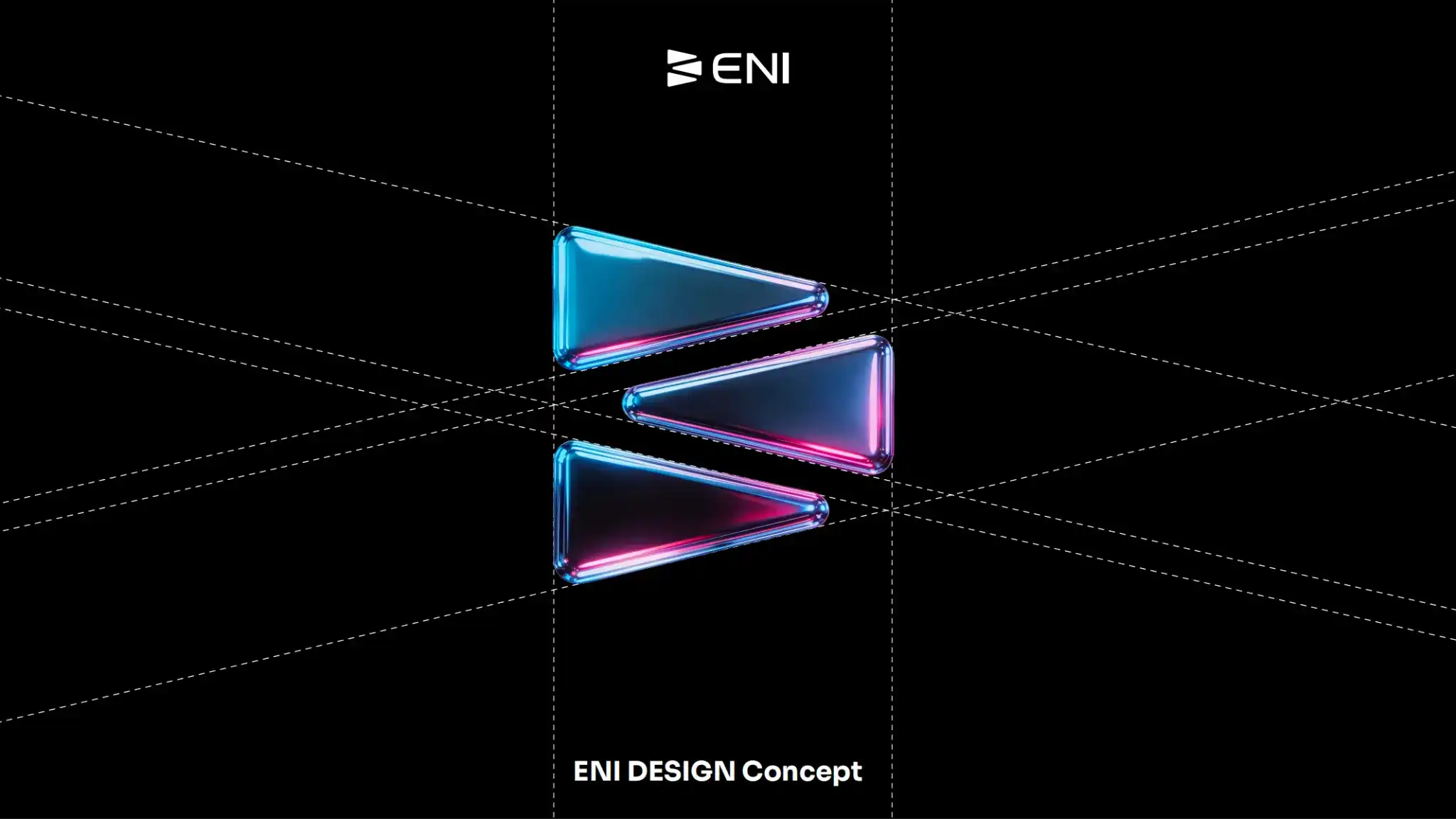
The Beauty of Mathematics: Defining "Precision in Fine-Tuning" with a 25-Degree Obsession

In this brand upgrade, ENI exemplifies what it means to achieve "precision through fine-tuning." For infrastructure projects pursuing "institutional-grade" trust, this precision is not only a visual requirement but also the foundation of professionalism.

While retaining the basic triangular module, the design team created a more visually proportional symmetrical form by tilting the original straight lines by 25 degrees. The spacing and height between the main elements are strictly fixed at a golden ratio of 1:4. The numerical echo of 25% and the 25-degree angle together form a minimal modular order under advanced aesthetics. This extreme control over proportion and geometric logic is backed by a design team comprising top graduates from Harvard, the University of Pennsylvania, London College of Art, Parsons School of Design, and other prestigious institutions. These multinational talents, who have previously served international brands like Hermès and ByteDance, have infused ENI with an international and trustworthy visual foundation by merging elite global aesthetics with the logic of financial engineering.
From Public Chain to System: Building a Bridge Connecting Technology and Commercial Reality

The core of this transformation lies in ENI moving beyond the realm of a mere "underlying protocol" and evolving toward a comprehensive system standard. Arion emphasized that ENI is not just providing foundational technology but aims to become a bridge—a bridge connecting technological concepts with commercial reality, and a bridge linking traditional finance (TradFi) with Web3.

In practical implementation, ENI adopts differentiated approaches to bridge the gap in business adoption: For large institutions, ENI offers deeply customized architectural solutions, ensuring that Web3 capabilities can be precisely integrated into complex business logic and organizational processes, achieving a leap from point solutions to system-level operational structures; for small and medium-sized enterprises, standardized BaaS matrices and low-loss integration technologies enable "one-click" on-chain deployment and efficient collaboration. This model, which accurately maps to different business scales, is significantly reducing the friction for global enterprises entering Web3, allowing complex commercial realities to seamlessly migrate to efficient on-chain systems.
Global Signal: Leading Web3 Commercialization with a Mature Stance

Announcing the completion of the upgrade in Hong Kong, a financial hub connecting East and West, precisely signals ENI's entry into a globalized and institutionalized phase. As the Web3 industry shifts from technological fervor to commercial implementation, institutional users' requirements for infrastructure have evolved from "usable" to "stable and standardized."

ENI's simultaneous evolution of its brand and visual system is precisely aimed at meeting these institutional-grade standards. Through more logical design language and a comprehensive BaaS matrix, ENI is acting as the chief architect, providing reliable on-chain support for global enterprises. As Arion conveyed in his speech, ENI will serve as the standard bridge for enterprise onboarding, escorting the steady migration of real-world assets and businesses into the next-generation digital economic system.

Пов'язані питання

QWhat major announcement did ENI's founder and CEO Arion Ho make at the Hong Kong Web3 Carnival?

AArion Ho announced that ENI has completed a comprehensive strategic brand upgrade, transitioning from an underlying protocol to a global institutional-grade financial infrastructure, including updates to its official website and visual identity system.

QHow did ENI incorporate mathematical precision into its brand redesign?

AENI's design team applied a 25-degree tilt to the original straight lines, creating a more symmetrical visual form with intervals and heights strictly fixed at a 1:4 golden ratio. The 25-degree angle and 25% numerical echo together form a minimal modular order under advanced aesthetics.

QWhat is ENI's new strategic positioning after the brand upgrade?

AENI has evolved from being an underlying public chain to an enterprise blockchain-as-a-service (BaaS) platform, aiming to serve as a bridge connecting traditional finance (TradFi) with Web3 and enabling businesses to migrate seamlessly to efficient on-chain systems.

QHow does ENI tailor its services for different types of businesses?

AFor large institutions, ENI offers deeply customized architecture solutions to embed Web3 capabilities into complex business logic. For small and medium enterprises, it provides standardized BaaS matrices and low-loss integration technologies for one-click on-chain deployment.

QWhy did ENI choose Hong Kong as the location to announce its brand upgrade?

AHong Kong is a financial hub connecting East and West, making it an ideal location to signal ENI's entry into a new phase of globalization and institutionalization, aligning with the industry's shift from technological enthusiasm to commercial adoption.

Пов'язані матеріали

Who Funds the Agents?

**Summary: Who Funds AI Agents?** OpenAI recently shut down a feature allowing AI agents to shop for users, highlighting the challenge of creating a secure and regulated environment for agent-driven transactions. While payment infrastructure exists, a crucial governance layer—defining spending limits, fraud detection, tax handling, and return policies—is largely missing. The potential is enormous: AI agents already processed $73M across 176M transactions last year, with McKinsey forecasting this could grow to $3-5T in global consumer commerce by 2030. The core competition isn't just about processing payments, which can be very cheap (especially with crypto-based settlement), but about controlling the rules that govern agent spending. Key players like Stripe and Coinbase are racing to dominate this governance layer. Stripe's acquisition of wallet provider Privy allows it to set spending policies, identity checks, and human-in-the-loop approvals directly at the wallet level. Similarly, Coinbase's stack, including its x402 protocol and AgentKit, embeds governance rules. This vertical integration across settlement, wallet, and governance layers is becoming the dominant strategy. Control over the governance layer is where significant future value lies. If agents handle trillions in transactions, even a small fee for managing compliance, fraud prevention, and policy enforcement could generate billions in annual revenue. The companies that successfully integrate across the payment stack will capture value from idle agent balances, transaction fees, and governance services, positioning themselves as the foundational banks of the AI agent economy.

marsbit10 хв тому

Who Funds the Agents?

marsbit10 хв тому

A Nation Blocks Chips, a Giant Buys a Nuclear Power Plant: Why It's Time to Seriously Consider DeAI

**Title: Great Powers Blockade Chips, Giants Buy Nuclear Plants: Why It's Time to Seriously Consider DeAI** In May 2026, the US closed loopholes for Chinese firms to acquire advanced NVIDIA chips via overseas subsidiaries. That same month, Kenya halted a $1B geothermal data center project involving Microsoft, fearing its immense energy consumption. Meanwhile, Huawei announced mass production of its Ascend AI chip. These disparate events underscore a new reality: the competition for computing power ("compute") has escalated beyond the tech industry, becoming a geopolitical and infrastructural battleground. A new era of oligopoly is forming, with control over the AI stack—from GPU chips (NVIDIA) and cloud platforms (AWS, Azure, Google Cloud) to foundational models (OpenAI, Anthropic)—concentrating in a few Western "AI Octopus" corporations. This centralization creates systemic risks: pricing power and platform lock-in for users, infrastructure fragility, and a widening "compute divide" that threatens to marginalize nations without independent AI capacity. An "AI Iron Curtain" is deepening through export controls. In response, some nations like Saudi Arabia and the UAE are investing heavily to buy compute power, aiming to transition from oil to AI economies. The EU seeks to triple its compute capacity by 2030 to reduce dependency. However, the spending gap is vast, with four US tech giants alone planning ~$750B in AI capex for 2026. The race is increasingly constrained by energy, with AI tasks consuming up to 1000x more power than web searches, pushing firms to even acquire nuclear plants. This landscape is fueling interest in Decentralized AI (DeAI). It proposes a third way: using open protocols to coordinate a global network of idle GPUs, independent developers, and data centers, creating an AI infrastructure without a single controlling entity. Leveraging blockchain and cryptographic verification, DeAI aims to break market concentration, disperse energy demands, reduce geopolitical dependencies, and enhance transparency. While still nascent in performance and stability, DeAI's core promise is not immediate superiority but providing a crucial alternative architecture to resist monopoly, censorship, and centralized power. As specialized AI hardware costs fall and open-source models flourish, the window to build this foundation is open. The very existence of such competition serves as a vital check against the inevitable abuse of concentrated power.

marsbit1 год тому

A Nation Blocks Chips, a Giant Buys a Nuclear Power Plant: Why It's Time to Seriously Consider DeAI

marsbit1 год тому

Outpoll Review: A Prediction Market Platform Built for Active Traders

Outpoll Review: A Prediction Market Platform Built for Active Traders In recent years, prediction markets have grown from a niche sector to a mainstream arena, attracting billions in trading volume and institutional capital. However, the user experience and tools for traders have not kept pace. Outpoll, a new global prediction market platform, aims to fill this gap by providing enhanced trading infrastructure for active and professional traders. Built on standard prediction market principles, Outpoll allows users to trade on the outcome of specific events. It uses fully collateralized contracts with USDC settlement, charges a competitive 0.1% fee per trade, and provides clear settlement rules upfront to minimize disputes. A key focus for Outpoll is its professional-grade trading tools. The platform supports limit and market orders, as well as take-profit and stop-loss orders for open positions—features uncommon in prediction markets. For automated trading, Outpoll offers comprehensive REST and WebSocket APIs, enabling portfolio management, price arbitrage, and integration with existing tools. The platform also features a creator-led market model, where approved experts and community leaders can create and manage markets for niche topics under platform supervision. Its integrated interface combines news feeds directly with trading functions, allowing users to monitor events and manage positions seamlessly. Outpoll launched with a native Android app (available on Google Play) and plans an iOS version later this year. In summary, Outpoll distinguishes itself with trader-focused tools, practical APIs, transparent and collateralized markets, integrated news, and an expanding creator program. For active traders, its advanced order types and API access alone make it a platform worth watching. Outpoll is now globally accessible via outpoll.com and Google Play.

marsbit1 год тому

Outpoll Review: A Prediction Market Platform Built for Active Traders

marsbit1 год тому

Торгівля

Спот
Ф'ючерси

Популярні статті

Як купити AR

Ласкаво просимо до HTX.com! Ми зробили покупку Arweave (AR) простою та зручною. Дотримуйтесь нашої покрокової інструкції, щоб розпочати свою криптовалютну подорож.Крок 1: Створіть обліковий запис на HTXВикористовуйте свою електронну пошту або номер телефону, щоб зареєструвати обліковий запис на HTX безплатно. Пройдіть безпроблемну реєстрацію й отримайте доступ до всіх функцій.ЗареєструватисьКрок 2: Перейдіть до розділу Купити крипту і виберіть спосіб оплатиКредитна/дебетова картка: використовуйте вашу картку Visa або Mastercard, щоб миттєво купити Arweave (AR).Баланс: використовуйте кошти з балансу вашого рахунку HTX для безперешкодної торгівлі.Треті особи: ми додали популярні способи оплати, такі як Google Pay та Apple Pay, щоб підвищити зручність.P2P: Торгуйте безпосередньо з іншими користувачами на HTX.Позабіржова торгівля (OTC): ми пропонуємо індивідуальні послуги та конкурентні обмінні курси для трейдерів.Крок 3: Зберігайте свої Arweave (AR)Після придбання Arweave (AR) збережіть його у своєму обліковому записі на HTX. Крім того, ви можете відправити його в інше місце за допомогою блокчейн-переказу або використовувати його для торгівлі іншими криптовалютами.Крок 4: Торгівля Arweave (AR)Легко торгуйте Arweave (AR) на спотовому ринку HTX. Просто увійдіть до свого облікового запису, виберіть торгову пару, укладайте угоди та спостерігайте за ними в режимі реального часу. Ми пропонуємо зручний досвід як для початківців, так і для досвідчених трейдерів.

495 переглядів усьогоОпубліковано 2024.12.11Оновлено 2026.06.02

Як купити AR

Обговорення

Ласкаво просимо до спільноти HTX. Тут ви можете бути в курсі останніх подій розвитку платформи та отримати доступ до професійної ринкової інформації. Нижче представлені думки користувачів щодо ціни AR (AR).

活动图片