Ending 'Subsidized Growth': The Logic of Ultimate Capital Efficiency Behind Berachain's 'Fiscal' Reform

marsbitОпубліковано о 2026-03-10Востаннє оновлено о 2026-03-10

Анотація

Berachain has implemented a major reform of its Proof-of-Liquidity (PoL) mechanism, reducing the annual inflation rate of its non-transferable governance token $BGT from 8% to 5%—a 46% cut in emissions. This move, described as a "fiscal reform," signals the end of the initial subsidy-driven growth phase and a shift toward a more capital-efficient economic model. The update also involves removing around 200 underperforming reward vaults and introducing stricter, performance-based criteria for vault eligibility. Key tokens in the PoL system include $BERA (gas token), $HONEY (native stablecoin), and $BGT (governance token). The reforms aim to enhance the value and utility of $BGT by directing incentives toward protocols that demonstrate real user activity, sustainable demand, and measurable contributions to the ecosystem—such as boosting transaction volume or deepening liquidity. This restructuring is designed to prioritize quality over quantity, encouraging projects with stronger product-market fit and business models. By making $BGT emissions more scarce and targeted, Berachain aims to build a self-sustaining economy where incentives function as productive capital rather than subsidies, ultimately supporting long-term growth and value creation for token holders.

Author: Black Mario

Recently, Berachain's PoL mechanism underwent a reform, reducing the annual inflation rate of $BGT from 8% to 5% (an active cut of approximately 46% in emissions), while clearing a series of "ghost vaults" and updating the vault access standards. This move has been hailed by the community as a sovereign fiscal reform.

This seems to signal that Berachain is officially ending the subsidy era of its cold start, and through ultimate "capital efficiency" and a "business closed-loop," it is beginning to build a mature economic system with higher ROI certainty.

The Logical Evolution from Cold Start Strategy to Sovereign Value Return

In traditional PoS systems, security is directly tied to the scale of staking, and "staking coins equals participation in governance" is the core logic. Focusing on the PoL (Proof-of-Liquidity) mechanism itself, it is a highly complex financial engineering design that binds network security, governance power, and ecological liquidity together with liquidity as the core element, attempting to redefine the internal power distribution and incentive flow within a public chain.

The operation of the PoL system relies on three types of tokens with clear functions and mutual checks and balances.

  • $BERA (Fuel Base): The operating fuel of the system, carrying basic security functions, is the asset foundation of the entire Berachain.
  • $HONEY (Value Scale): An over-collateralized native stablecoin, serving as the financial settlement medium within the ecosystem, ensuring the stability of on-chain economic activities.
  • $BGT (Governance Hub): As a non-transferable soul-bound token, $BGT is the soul of the PoL system. It deeply binds governance rights with "real ecological contributions." Holding and delegating $BGT means mastering the distribution rights of network incentive routing.

Validators, by receiving delegated $BGT, can dynamically influence which Reward Vaults the incentives flow to. This is not only a symbol of power but also the most critical value lever in Berachain's sovereign economic system.

In the early stages of the mainnet launch, Berachain adopted a high inflation model of approximately 8%–10%. As a typical cold start strategy, it successfully achieved primitive accumulation of liquidity in the short term and verified the实战 resilience of the PoL mechanism.

However, as the ecosystem matures, some potential issues have emerged:

  • The high-yield environment in the early stage attracted a large amount of highly sensitive capital. While this capital completed the task of attracting funds during the cold start phase, its contribution to long-term retention and commercial co-building still has room for optimization.
  • Some vaults in the ecosystem are operating inefficiently, and there are even some self-circulating distribution paths. This, to some extent, disperses the precious $BGT budget and fails to fully transform into long-term stickiness of the ecosystem.
  • Sustained high emission rates have somewhat affected the marginal value of $BGT as a sovereign asset. For long-term builders, optimizing the inflation structure is an inevitable choice to protect their long-term rights and enhance the network's risk resistance.

If the PoL incentive mechanism eventually evolves into a pure operating cost, no matter how good the short-term data looks, the long-term value of the entire ecosystem will face limitations. Incentives should not be just subsidies, nor should they be indiscriminate airdrops. Instead, they should be regarded as productive capital capable of generating ROI. Every unit of $BGT emission should be exchanged for sustainable transactions, user retention, and real cash flow potential. This is perhaps the true meaning behind the slogan "Bera Builds Businesses."

Under this consensus, this reform aimed at "eliminating the false and retaining the true" and重构 sovereign fiscal efficiency officially kicked off at the beginning of the new year 2026.

Berachain's "Fiscal" Reform

$BGT Emission Optimization: Anchoring the Long-Term Value Coordinates of the Ecosystem

In fact, in any mature economy, adjustments in monetary policy often signal a qualitative change in the growth logic. Berachain's reduction of the annual $BGT inflation rate from about 8% to 5% is essentially a key step towards "value sovereignty."
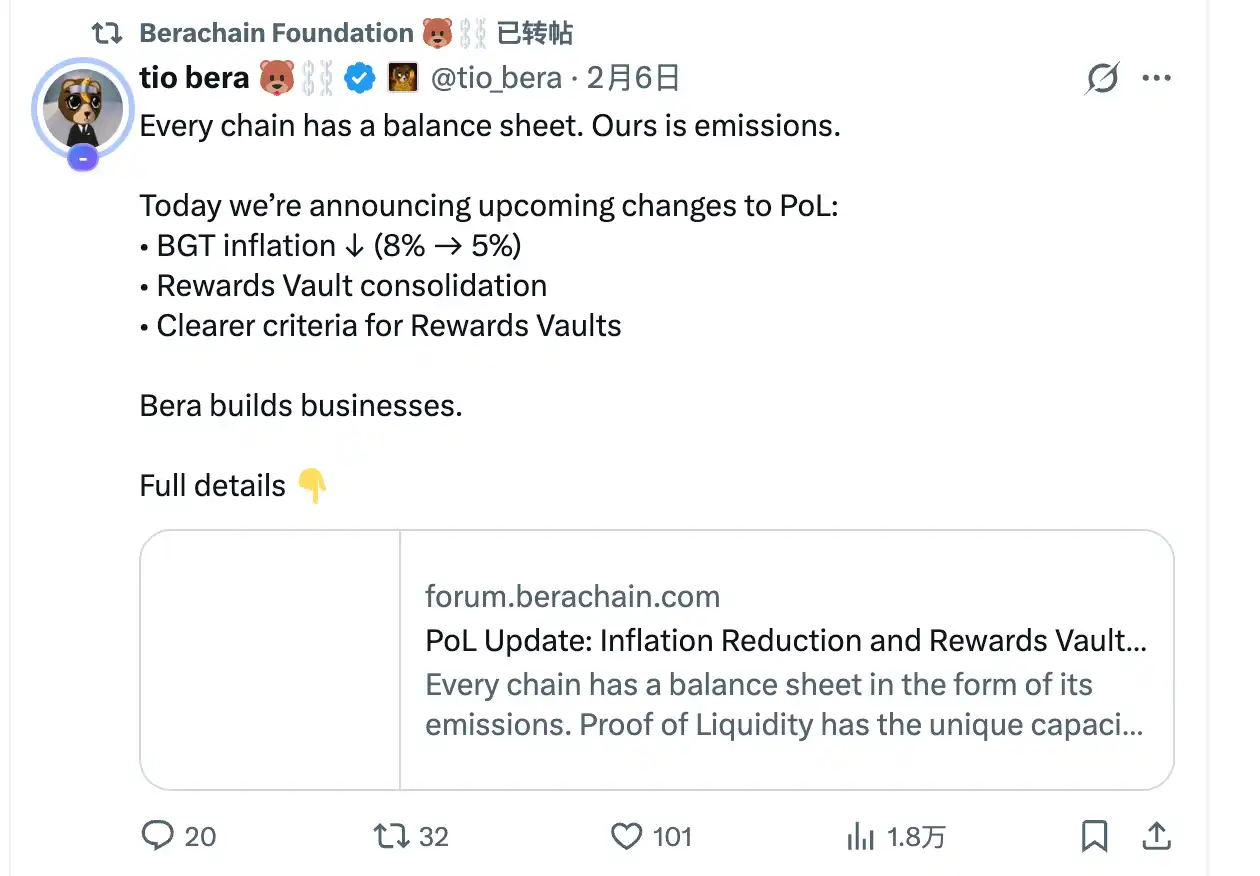
We see that the earlier 8% inflation rate was more like an "expansionary credit" for the ecosystem's startup phase, successfully completing the primitive accumulation of liquidity in the short term. Now, reducing PoL-related emissions by approximately 46% (reward rate reduced from 1.2 to 0.65) not only reflects its precise control over the current ecosystem's carrying capacity and incentive efficiency but also embodies a refinement of liquidity management:

That is, while maintaining the stability of the network security base rate, by moderately tightening new emissions, ensuring that every $BGT injected into the ecosystem gains a higher value anchor.

For $BGT, a governance asset with the attributes of a soul-bound token, scarcity is the core pillar for exercising its引流 power. As the emission rate slows, the marginal dilution pressure faced by holders and delegators is significantly reduced. This "active balance sheet reduction" directly strengthens the hard currency属性 of $BGT as a core governance asset, further promoting the rebalancing of value capture:

Of course, if we observe the development paths of Ethereum or various top L1s, a steady decline in the inflation rate is often the entry ticket to the "golden maturity period." Berachain's turn at this moment actually sends a clear signal that the ecosystem has already achieved stability driven by "endogenous growth" and no longer relies solely on scale expansion.

Then, as the total incentive becomes more precious, protocols within the ecosystem will spontaneously initiate an efficiency competition.

This "tight" incentive budget is actually creating higher溢价 space for high-quality protocols. Under the new economic model, $BGT emission rights will flow more to those "high-productivity protocols" that can generate real interactions and have a deep user base.

Reward Vault Integration—Ecological Value Sedimentation from "Scale Expansion" to "Quality and Depth"

If inflation reduction is a "balance sheet reduction" at the macro level, then the further integration of reward vaults is a precise drip irrigation targeting micro-efficiency within the ecosystem.

The Berachain Foundation stated in its latest tweet that the ecosystem plans to remove about 200 reward vaults with low operational efficiency. Of course, the plan itself is not simply a negation of early projects but more of a resource rebalancing expected after the Berachain ecosystem enters a specific stage.

In fact, during the cold start phase, a wide distribution of vaults helps探测 different market demands. When the ecosystem enters maturity, withdrawing incentive resources from长期闲置 or functionally overlapping pools and re-injecting them into core protocols with real trading activity is an inevitable choice to enhance the network's overall competitiveness.

Similarly, with the integration, Berachain immediately enacted more rigorous and dynamic vault access standards. This means that future incentive distribution will no longer be based on the first-come-first-served inertia of the early days but will更多的是 based on a multi-dimensional KPI evaluation system. Some potential standards may include:

  • Sustained Demand: Examining whether the protocol has generated real transaction volume and user interaction, not just static沉淀 of funds.
  • External Incentive Coordination: Encouraging protocol parties to use their own resources and external financing to form a synergy with $BGT emissions, jointly energizing the ecosystem.
  • Verifiable Contribution: Every unit of incentive emission must be transformed into an observable network effect, such as the depth of $HONEY liquidity or the value回流 of transaction fees.

By clearing some self-circulating or inefficient incentive paths, Berachain is actually making room for growth for teams with real product strength. This process of "discarding the dross and selecting the essential" aims to end models that rely solely on system subsidies for survival,转而扶持 business entities with independent profitability capabilities.

This is also perhaps the embodiment of the "Bera Builds Businesses" vision: the incentive mechanism is no longer an indiscriminate温床 but a precise capital accelerator. Projects筛选ed through this mechanism will have stronger risk resistance and commercial value, thereby providing $BGT holders with more确定性 value support in the fierce L1 competition.

Evolution is the Only Way Out

This major reform of Berachain's PoL marks the ecosystem's official paradigm shift towards a "mature L1 with real output." By optimizing emission efficiency, the ecosystem is彻底重构 $BGT emissions into productive capital with ROI certainty. While pushing the network towards the ultimate capital efficiency interval, it is also anchoring a more solid value signal for $BGT and $BERA holders.

Under the new pilot mechanism, incentives are endowed with precise引流 properties: every unit of injected liquidity will激发超额 real transaction fees, interest income, or ecological溢价 at the protocol layer, thereby constructing a positive value closed-loop of "incentive cost < protocol收益".

This "1 > 1 capital alchemy" is a public chain-level active asset management system,正在 transforming every bit of inflation into KPIs that drive commercial prosperity, fundamentally locking in the return of Berachain's long-term sovereign value, and establishing a leading position towards real economic growth and business闭环 in the highly homogeneous L1 track.

Thus, "Bera Builds Businesses" is also transforming from a grand narrative into a precise financial engine.


Пов'язані питання

QWhat is the core change in Berachain's PoL mechanism as described in the article?

AThe core change is a reduction in the annual inflation rate of $BGT from 8% to 5%, which is an active cut of approximately 46% in emissions.

QWhat are the three tokens in the PoL system and their primary functions?

AThe three tokens are: $BERA (the gas token and base for security), $HONEY (an over-collateralized native stablecoin for financial settlement), and $BGT (a non-transferable soulbound token that serves as the governance hub, binding governance power to 'real contributions' to the ecosystem).

QWhat was the main purpose of the high inflation model (8-10%) used by Berachain at its mainnet launch?

AIt was a cold-start strategy designed to achieve the primitive accumulation of liquidity in the short term and validate the practical resilience of the PoL mechanism.

QWhat are some of the new potential criteria for a vault to gain access to incentives after the reform?

APotential criteria include: Sustainable Demand (real transaction volume and user interaction), Coordination with External Incentives (using the protocol's own resources and external financing alongside $BGT emissions), and Verifiable Contribution (converting each unit of incentive into observable network effects like $HONEY liquidity depth or fee value回流).

QHow does the article characterize the ultimate goal of Berachain's incentive mechanism after this reform?

AThe goal is to transform the incentive mechanism from a blanket subsidy into a precise capital accelerator, ensuring every unit of $BGT emission is productive capital with a high certainty of ROI, ultimately building a positive value closed-loop where 'incentive cost < protocol revenue' and realizing the vision of 'Bera Builds Businesses'.

Пов'язані матеріали

La Liga Team Bets $1 Million Against Themselves Before Match: Does Using Prediction Markets for Insurance Comply with Sports Regulations?

A Spanish La Liga club, reportedly Osasuna, purchased insurance against relegation and was linked to a transaction of over $1 million on the prediction market platform Kalshi, betting against its own victory in a crucial season-ending match. While Osasuna confirmed buying €1.2 million insurance for a potential €6 million payout in case of relegation through broker Howden, it did not confirm involvement with Kalshi. The reported trade involved intermediaries like Game Point Capital and Greenlight Commodities, with quant firm Susquehanna as the counterparty. This incident highlights the blurring line between financial hedging and gambling in prediction markets. Such markets allow trading on future event outcomes, like sports results. In the US, Kalshi operates as a regulated event contract market under the CFTC. However, Spanish authorities recently initiated penalties against Kalshi and Polymarket, considering their activities unlicensed gambling. The case raises core questions about prediction markets: who can trade, how insider information is handled, and whether participants can influence outcomes, especially in sports where results are human-driven. While leagues like La Liga and Serie A have partnered with Polymarket in North America, the regulatory clash and potential for conflicts of interest, as seen in this club's alleged transaction, present significant challenges as prediction markets evolve toward institutional risk management.

Foresight News8 хв тому

La Liga Team Bets $1 Million Against Themselves Before Match: Does Using Prediction Markets for Insurance Comply with Sports Regulations?

Foresight News8 хв тому

From Shouting 150 Dollars to Liquidating HYPE in Just Three Days, How Much Credibility Does Arthur Hayes Have Left?

How much of Arthur Hayes's market credibility remains? Recently, the "godfather of crypto perpetual swaps" and BitMEX co-founder has faced public criticism, including accusations from on-chain investigator ZachXBT about creating exit liquidity for his followers. Starting last week, Hayes executed multiple sudden sell-offs. He had repeatedly publicly predicted the HYPE token would reach $150. After a $100,000 bet defending Hyperliquid on June 1st, he announced just three days later that he had completely sold his HYPE and NEAR holdings, successfully exiting near the peak. He also sold ZEC and WLD. His sale of WLD appeared to be a classic "pump and dump" maneuver. On June 3rd, he publicly set a $10 target for WLD, causing its price to surge over 35%. By June 6th, he announced he had sold his WLD, citing "anomalous" SpaceX pre-IPO price action, which triggered a sharp price drop. On June 9th, Hayes published a lengthy article explaining his actions, citing factors like rising energy costs and a potential AI bubble burst. Consequently, his family office, Maelstrom, now holds positions in US energy producers and only core crypto assets BTC and ETH, having sold AI-related stocks and non-core cryptocurrencies. This pattern is not new. In 2025, he similarly touted HYPE before selling it at what turned out to be a cycle peak, only to repurchase it at the next cycle's low. Similar scenarios played out with tokens like ETHFI and ENA. Long-term observers have developed a strategy: ignore Hayes's public statements but closely monitor his on-chain actions—be cautious following his buys, but decisively follow his sells. If he continues these tactics, especially as seen with the WLD case, his market credibility risks being permanently damaged. As Hayes himself admitted in his latest article, "I remain an unapologetic gambler."

marsbit26 хв тому

From Shouting 150 Dollars to Liquidating HYPE in Just Three Days, How Much Credibility Does Arthur Hayes Have Left?

marsbit26 хв тому

Fundraising is Like a Strange Dance: The 'Absurd Drama' of Silicon Valley Founders' Capital Raises

The article details a series of absurd and revealing anecdotes shared by Silicon Valley founders about their venture capital fundraising experiences, sparked by Greg Isenberg's story of pitching to a sleeping a16z partner. Founders describe surreal pitch meetings: one faced a barefoot, peanut-eating investor who offered triple the requested amount after 30 seconds; another performed a pitch in a VC's parked car; a founder discovered his audience understood no English beyond "yes." These stories highlight the often irrational and performative nature of fundraising. Beyond the absurdity, darker power imbalances are exposed. Stories include investors suggesting founders fire co-founders for their equity, blatant market misjudgments, disrespectful behavior from LPs, and discriminatory remarks. A debate also emerges around "Sequoia's" practice of splitting a round into two valuations. However, the thread isn't solely critical. Positive counter-narratives celebrate supportive VCs who offered crucial advice during crises, respected founders' timelines, and showed simple gestures of respect—like a partner personally fetching coffee before a major pitch. Ultimately, the collective sharing acts as a pressure release, illustrating that fundraising is a complex dance of power, trust, and sometimes sheer theater. It underscores that beyond capital, mutual respect and integrity remain the most enduring foundations of the founder-investor relationship.

marsbit40 хв тому

Fundraising is Like a Strange Dance: The 'Absurd Drama' of Silicon Valley Founders' Capital Raises

marsbit40 хв тому

Торгівля

Спот
Ф'ючерси

Популярні статті

Як купити POL

Ласкаво просимо до HTX.com! Ми зробили покупку Polygon Ecosystem Token (POL) простою та зручною. Дотримуйтесь нашої покрокової інструкції, щоб розпочати свою криптовалютну подорож.Крок 1: Створіть обліковий запис на HTXВикористовуйте свою електронну пошту або номер телефону, щоб зареєструвати обліковий запис на HTX безплатно. Пройдіть безпроблемну реєстрацію й отримайте доступ до всіх функцій.ЗареєструватисьКрок 2: Перейдіть до розділу Купити крипту і виберіть спосіб оплатиКредитна/дебетова картка: використовуйте вашу картку Visa або Mastercard, щоб миттєво купити Polygon Ecosystem Token (POL).Баланс: використовуйте кошти з балансу вашого рахунку HTX для безперешкодної торгівлі.Треті особи: ми додали популярні способи оплати, такі як Google Pay та Apple Pay, щоб підвищити зручність.P2P: Торгуйте безпосередньо з іншими користувачами на HTX.Позабіржова торгівля (OTC): ми пропонуємо індивідуальні послуги та конкурентні обмінні курси для трейдерів.Крок 3: Зберігайте свої Polygon Ecosystem Token (POL)Після придбання Polygon Ecosystem Token (POL) збережіть його у своєму обліковому записі на HTX. Крім того, ви можете відправити його в інше місце за допомогою блокчейн-переказу або використовувати його для торгівлі іншими криптовалютами.Крок 4: Торгівля Polygon Ecosystem Token (POL)Легко торгуйте Polygon Ecosystem Token (POL) на спотовому ринку HTX. Просто увійдіть до свого облікового запису, виберіть торгову пару, укладайте угоди та спостерігайте за ними в режимі реального часу. Ми пропонуємо зручний досвід як для початківців, так і для досвідчених трейдерів.

231 переглядів усьогоОпубліковано 2024.12.11Оновлено 2026.06.02

Як купити POL

Обговорення

Ласкаво просимо до спільноти HTX. Тут ви можете бути в курсі останніх подій розвитку платформи та отримати доступ до професійної ринкової інформації. Нижче представлені думки користувачів щодо ціни POL (POL).

活动图片












