Encrypted Super Apps Arrive: Coinbase and Others Are Reconstructing an All-in-One Financial Ecosystem

深潮Опубліковано о 2025-12-22Востаннє оновлено о 2025-12-22

Анотація

Coinbase has launched a new all-in-one financial application enabling 24/7 stock trading, crypto exchange, futures, perpetual contracts, and AI-powered financial analysis—all accessible via a single account. Similarly, Robinhood has expanded into tokenized stocks, crypto yield, and plans to introduce social trading. This shift signals a move away from fragmented financial apps toward integrated "super apps" that unify access to multiple asset classes. Key drivers include tokenization (enabling 24/7 stock trading), clearer regulations (e.g., Bitcoin ETFs, stablecoin laws), and improved mobile wallet infrastructure. By consolidating liquidity, these platforms reduce transfer delays, minimize idle capital, and improve execution efficiency. However, this recentralization raises concerns: users must trust platforms with custody and private keys, tokenized assets may not represent real ownership, and gamified interfaces could encourage impulsive trading. While these apps offer convenience and higher yields, they also reintroduce counterparty risk and may simply replace traditional banks with new centralized gatekeepers. The core question remains: Is this true financial democratization or a more efficient form of financial enclosure?

Written by: Nishil Jain

Compiled by: Luffy, Foresight News

Last week, Coinbase launched a new product touted as the "Future of Finance." A single app now offers five major functions: 24/5 stock trading, centralized exchange and on-chain cryptocurrency trading, futures and perpetual contract trading, prediction markets, and is even equipped with an AI financial analyst. All functions are accessible via mobile, and a user's single account balance can be instantly switched between different asset classes for use.

Not long ago, Robinhood had already made a preemptive move: launching tokenized stock trading in Europe, 24/5 futures trading, cryptocurrency interest-earning services, and plans to launch the social trading feature Robinhood Social in 2026.

The mainstream discourse on platform X interprets this trend as the evolution of "super apps," but a key point is being overlooked: this is far from a simple stacking of functions; it's breaking down the boundaries between financial asset categories that were created due to regulatory and technological limitations.
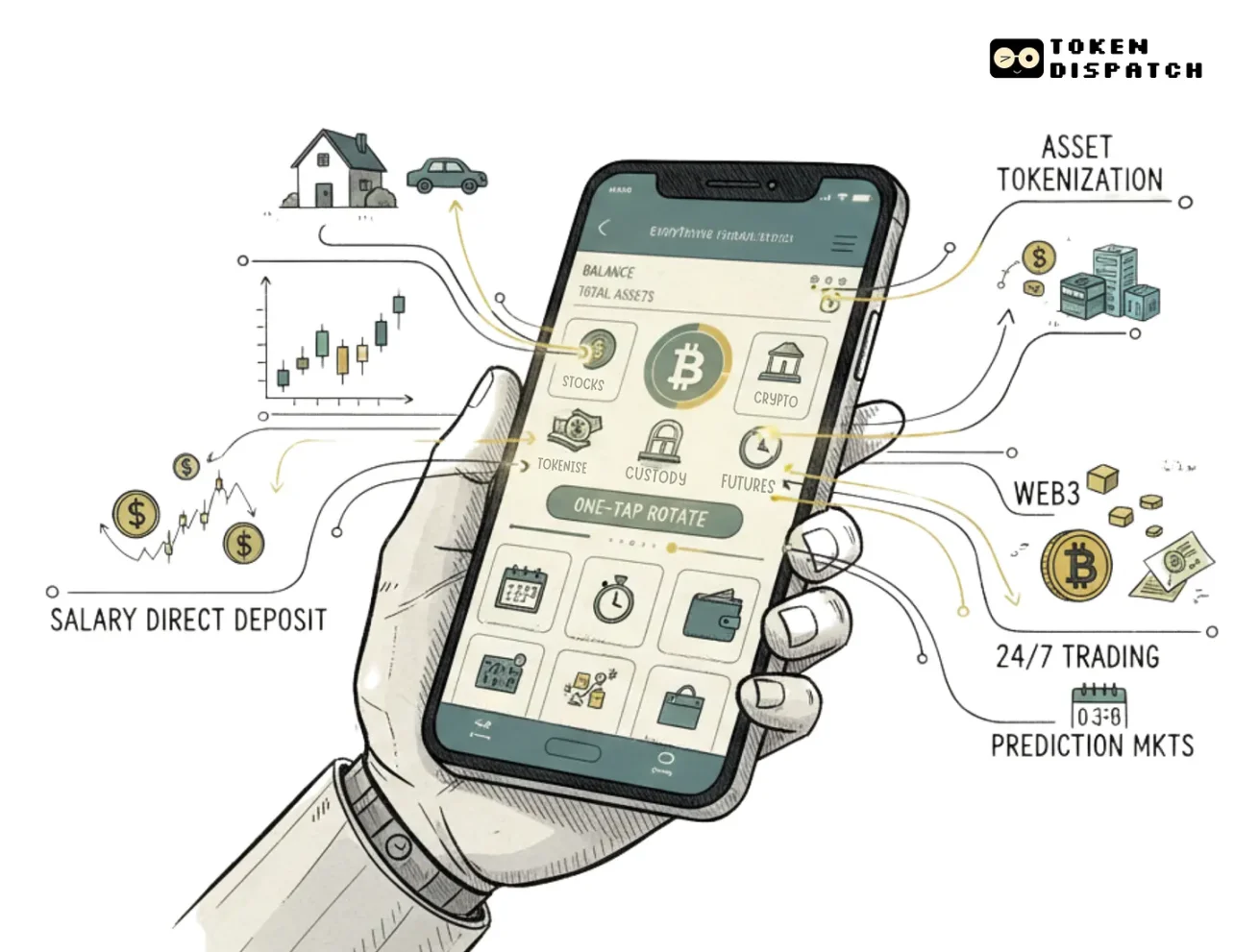
Why, after a decade of fragmented development, are financial applications now experiencing a wave of consolidation? What does this mean for the users and platforms involved? Let's now delve into the main topic.

The Pain Points of Fragmentation

Over the past decade, numerous fintech applications have emerged, yet most only cover a single aspect of financial services, with functions like stock trading, cryptocurrency, payments, and savings scattered across different apps.

While this model provided users with more choices and allowed companies to focus on refining single solutions, it proved problematic in practice.

Want to sell stocks and buy cryptocurrency? The stock trade needs to be executed on Monday, with T+1 settlement not completing until Tuesday; then initiating a withdrawal takes 2-3 days for the funds to reach your bank account; transferring the funds to Coinbase then takes another 1-2 days. From "deciding to reallocate funds" to "funds actually being available," the entire process takes about 5 days. And during those 5 days, the investment opportunity you originally spotted has likely vanished, while your capital sits idle in a cumbersome process.

For example, you might want to buy Bitcoin at $86,000 on December 18th, but end up buying it 5 days later at $90,000 due to process delays. For more volatile investment opportunities like meme coins, Initial Coin Offerings (ICOs), or Initial Public Offerings (IPOs), the losses from such delays can be even more severe.

The problem of fragmentation isn't limited to a single region. An Indian investor wanting to buy NVIDIA stock would need to complete KYC verification multiple times, open an account with a broker that supports Indian users investing in US stocks, and deposit additional funds, all just to buy this one stock.

We've all felt this operational friction, but it's only recently that the infrastructure capable of solving this problem has begun to take shape.

The Cornerstones of Change: Infrastructure Matures

Three structural changes have made the birth of integrated financial platforms possible.

Tokenization Breaks Time Barriers

Traditional stocks can only be traded during New York Stock Exchange (NYSE) hours (9:30 AM to 4:00 PM ET, 5 days a week), while cryptocurrencies enable 24/7 trading. By achieving stock tokenization on Layer 2 networks, it has been proven that, with the right technical mechanisms, stocks can theoretically be traded around the clock.

Today, Robinhood's tokenized stocks launched in Europe support 24/5 trading, and Coinbase is set to follow this model.

Regulatory Frameworks Become Clearer

In recent years, Bitcoin spot ETFs have successfully launched, stablecoin legalization has progressed, tokenization regulatory frameworks have entered deliberation stages, and prediction markets have gained approval from the U.S. Commodity Futures Trading Commission (CFTC). Although the regulatory environment isn't perfect, it is clear enough for platforms to confidently develop multi-asset products without fear of being completely shut down.

Mobile Wallet Infrastructure Matures

Embedded wallets can now seamlessly handle complex cross-chain operations. Privy, acquired by Stripe, allows users to create a wallet using an existing email address without touching seed phrases; the recently launched crypto trading app Fomo enables non-crypto users to trade tokens on Ethereum, Solana, Base, Arbitrum, and other chains without manually selecting networks, and supports Apple Pay deposits. The backend automatically handles all complex processes—the user simply clicks "Buy Token" to complete the operation.

The Core Logic of Liquidity Integration

The core driver behind this change is: funds scattered across different applications are essentially idle capital.

In an integrated model, a user only needs to maintain one account balance: after selling stocks, the funds can be instantly used to buy cryptocurrency, eliminating the wait for settlement windows, withdrawal review periods, and intermediaries like banks. The 5-day opportunity cost vanishes entirely.

Platforms that integrate liquidity are more efficient. With deeper liquidity pools, they can offer better execution speeds; since all trading pairs share the same underlying liquidity, they can support more pairs; they can provide yield on idle capital, much like banks; furthermore, reduced friction leads to increased user trading volume, generating more fee income for them.

Coinbase's Integration Blueprint

Coinbase is the most typical case study in this wave of financial integration. The company was founded in 2012, starting as a simple cryptocurrency exchange supporting only Bitcoin and Ethereum buying and selling. In the following years, Coinbase gradually added institutional custody, staking services, and cryptocurrency lending/interest-earning products, evolving into a full-service crypto platform by 2021.

Its expansion didn't stop there: it launched the Coinbase Card for crypto spending, the Coinbase Commerce payment solution for merchants, and built its own Layer 2 blockchain, Base.

The new product launch on December 17th marked the full realization of Coinbase's "super app" vision. Today, Coinbase supports 24/5 stock trading, plans to launch Coinbase Tokenize—a tokenization service for real-world assets for institutions—early next year, has integrated prediction markets through a partnership with Kalshi, launched futures and perpetual contract trading, and integrated Solana ecosystem decentralized exchange (DEX) trading functionality within the app. Additionally, the Base app has expanded to 140 countries and enhanced the social trading experience.
Coinbase is gradually becoming the operating system for on-chain finance. Through a single interface and a single account balance, it covers trading needs for all asset classes, aiming to allow users to complete all financial operations without leaving the platform.

Robinhood is following a similar development path: starting with commission-free stock trading, gradually adding cryptocurrency trading, a Gold subscription service offering 3% cashback and 3.5% deposit interest, futures trading, and subsequently launching tokenized stocks in Europe.

Both platforms are betting on the same core logic: users don't want to download different apps for stocks, crypto, and derivatives; they need a single account balance, a unified interface, and the ability to instantly reallocate funds.

Social Trading: An Emerging Differentiator

Asset integration solves the liquidity problem, but it doesn't solve the user's asset discovery challenge.

When there are millions of assets available in the market, how should users filter potential trades? How should they build their investment portfolio?

This is where social features add value. Coinbase's Base app includes a dynamic feed where users can see others' buy actions; Robinhood plans to launch Robinhood Social in 2026; eToro has offered social trading since 2007, paying copy traders a 1.5% commission on the assets they hold.

A wave of apps exploring social trading features has also emerged in the on-chain space, such as Fomo, 0xPPL, and Farcaster. These apps allow users to see what their friends are investing in, follow them, and copy their trades.

Fomo's leaderboard page

Social trading allows users to see others' trading behavior in real-time and copy it with one click. This significantly reduces decision-making friction: no need for independent research, just follow trusted trading strategies. Once a platform forms a stable community ecosystem—where users follow trading influencers and build personal reputations—it becomes very difficult for users to migrate to other platforms, creating a strong competitive moat and user stickiness for the trading app.

Centralized exchanges have offered copy trading since 2022, but usage rates have consistently remained below 2%. Mobile app platforms are betting that optimizing the user experience will increase the adoption of this feature. Whether their judgment is correct will determine if social trading becomes a true differentiator or just another commonplace feature.

A Pessimistic View: Potential Risks and Controversies

Let's be frank about the current state: the original intention of cryptocurrency was to achieve financial decentralization, remove intermediaries, and let users control their own assets.

And now, we are rebuilding centralized platforms: Coinbase controls asset custody, trade execution, and social graphs; Robinhood holds the private keys for embedded wallets; users need to trust the platform's solvency, security, and ongoing operational capability. All of this carries underlying counterparty risk.

Robinhood's tokenized stocks are essentially derivatives that track stock prices, not actual shares. If the platform collapses, what users hold is merely an IOU.

The problems caused by gamification are also becoming more severe: 24/7 trading means you might make impulsive trades at 3 AM; social feeds can induce FOMO when you see others profiting; push notifications alert you to every market swing in real-time. This is essentially scaled-up casino psychology, meticulously optimized by designers who understand how to trigger dopamine responses.

Is this progress in financial democratization, or just a repackaged system of exploitation? This is a philosophical question worth pondering.

The Essence Behind the Phenomenon

We spent a decade unbundling financial services, operating under the assumption that fragmentation would foster competition and bring more choice.

But it turned out that fragmentation also caused inefficiency: idle funds, dispersed liquidity, and users forced to hold more idle capital due to cumbersome fund transfer processes. The new era is changing this reality.

Coinbase and Robinhood are gradually becoming the new banks: they hold your salary, savings, investments, and spending patterns; they control trade execution, asset custody, and access; they intermediate every transaction. The only difference compared to traditional banks is: a prettier interface, 24/7 trading markets, and deposit rates 50 basis points higher.

Whether we are achieving financial democratization by lowering barriers and increasing efficiency, or merely changing the gatekeepers while keeping the barriers themselves, the era of fragmentation is over. In the coming years, we will witness whether financial integration based on open underlying technology can deliver better outcomes than the traditional banks we fled from, or if it just changes the logo that locks users in.


Пов'язані питання

QWhat are the three main structural changes that have enabled the emergence of integrated financial platforms like Coinbase's new product?

AThe three main structural changes are: 1) Tokenization breaking time barriers, enabling 24/7 trading of assets like stocks. 2) A clearer regulatory framework, with approvals for Bitcoin ETFs, stablecoins, and prediction markets. 3) Mature mobile wallet infrastructure, allowing seamless cross-chain operations and simplified user onboarding.

QAccording to the article, what was the core problem with the fragmented fintech landscape of the past decade?

AThe core problem was inefficiency and opportunity cost. Moving money between different apps for different asset classes (e.g., selling stocks to buy crypto) could take up to 5 days due to T+1 settlement, bank transfer delays, and platform processing times. This delay often caused users to miss out on volatile investment opportunities.

QHow does the 'super app' model fundamentally change the user experience compared to using separate apps for different financial services?

AThe 'super app' model provides a single interface and a single account balance. This allows users to instantly switch and allocate funds between different asset classes (stocks, crypto, derivatives) without waiting for transfers or settlements, eliminating the friction and opportunity cost of the fragmented model.

QWhat role does 'social trading' play in the strategy of these new integrated platforms?

ASocial trading addresses the 'asset discovery' problem by allowing users to see what others are buying and to copy their trades. This reduces decision-making friction, builds community, and creates powerful user stickiness and competitive barriers for the platforms that successfully implement it.

QWhat are some of the potential risks and philosophical concerns raised about these new integrated financial platforms?

AThe risks include reintroducing centralization and counterparty risk (users must trust the platform's solvency and security), the fact that tokenized assets may not represent real ownership, and the use of gamification and 24/7 trading that can exploit psychological triggers and encourage impulsive behavior, akin to a 'scaled-up casino psychology'.

Пов'язані матеріали

KOL's Perspective: Why Is SOL Set to Rise from This Point?

**Summary: Why SOL is Positioned for Growth at This Level** The article argues that SOL is poised for an upward move from its current price point, citing several key factors. Primarily, SOL has just broken out of a 4-month consolidation phase. This breakout signals a return of risk appetite to the broader crypto market, as SOL is seen as a key indicator of overall crypto health. The token's ownership has reportedly shifted from short-term traders and tourists to long-term accumulators, leading to low volume. Any meaningful increase in trading activity could thus trigger significant upward momentum. Fundamental strengths include strong institutional adoption, integration with DeFi and RWAs (Real-World Assets), and the potential benefits from the Clarity Act. Despite its high volatility—having dropped 70% from its all-time high but still up 12x from its bear market low—SOL is highlighted as one of the few tokens from the last cycle to reach new highs. It boasts a robust ecosystem of applications, users, and protocols. Future catalysts include the expected influx of AI developers following the Miami Accelerate conference, which focused on AI on Solana. Furthermore, Solana is positioned as the premier chain for memecoin activity, a trend expected to continue and drive network usage and fees. The article concludes that recent price action reflects a healthy transfer to long-term holders, setting the stage for growth.

marsbit21 хв тому

KOL's Perspective: Why Is SOL Set to Rise from This Point?

marsbit21 хв тому

Those Pre-Bitcoin PoW Protocols Have Recently Been Reimplemented

This article details a recent surge in replicating pre-Bitcoin Proof-of-Work (PoW) protocols, specifically focusing on Hal Finney's 2004 RPOW (Reusable Proofs of Work). Within five days in May 2026, multiple independent builders in the Bitcoin/cypherpunk community launched projects inspired by this early electronic cash proposal. The initiative began with Fred Krueger's `rpow2.com`, a centralized but auditable system that replaced RPOW's original IBM 4758 hardware with Ed25519 signatures. Initially a faithful replica, it later adopted Bitcoin-like features (21M supply cap, difficulty adjustment) and a controversial 5.24% founder allocation. This sparked rapid forks, including `rpow4.com` which incorporated full Bitcoin parameters, a prediction market (`rpowmarket.com`), and a DEX (`rpow2swap.com`). Concurrently, Mike In Space created a prototype of Wei Dai's 1998 b-money proposal (`b-money.replit.app`), pushing the historical exploration even further back. The article contrasts these centralized, server-dependent experiments with Bitcoin's core innovation of decentralized, trustless consensus. It also highlights a parallel development: the `HASH` project on Ethereum, which uses smart contract hooks to enable a purely fair-launch, browser-mineable PoW token with 0% allocations to team or VCs. The collective activity is framed as a meme-driven, educational exploration of cypherpunk history rather than a serious financial movement, with all projects heavily disclaiming any investment value.

marsbit26 хв тому

Those Pre-Bitcoin PoW Protocols Have Recently Been Reimplemented

marsbit26 хв тому

South Korean Exchanges 'Battle' Regulators, Challenging the Boundaries of Enforcement and Legislation

South Korea's cryptocurrency industry is engaged in a rare, direct confrontation with regulators. The Financial Intelligence Unit (FIU), the primary anti-money laundering (AML) watchdog, has recently imposed heavy penalties on major exchanges like Upbit and Bithumb for alleged violations involving unregistered overseas VASPs and AML procedures. However, exchanges are now actively challenging these actions in court and through industry associations. In a significant shift, the Seoul Administrative Court ruled in favor of Upbit's operator, Dunamu, overturning part of an FIU-ordered business suspension. The court found the FIU's penalty criteria and justification insufficiently clear. Similarly, the court suspended the enforcement of a six-month business suspension against Bithumb pending a final ruling, citing potential irreversible harm to the exchange. Beyond legal battles, the industry is contesting proposed legislative amendments. The Digital Asset eXchange Alliance (DAXA) strongly opposes a draft rule that would mandate Suspicious Transaction Reports (STRs) for all crypto transfers over 10 million KRW (~$6,800). DAXA argues this "poison pill" clause violates legal principles and would overwhelm the STR system, increasing reports from 63,000 to an estimated 5.45 million annually for major exchanges, thereby crippling effective AML monitoring. This conflict highlights a structural tension in South Korea's crypto governance: comprehensive digital asset laws are still developing, while regulators rely heavily on AML enforcement. The industry's move from passive compliance to active legal and legislative challenges signifies a new phase, pressing for clearer rules and more proportionate enforcement. While short-term disputes may intensify, this clash could ultimately lead to a more mature and sustainable regulatory framework for South Korea's vibrant crypto market.

marsbit1 год тому

South Korean Exchanges 'Battle' Regulators, Challenging the Boundaries of Enforcement and Legislation

marsbit1 год тому

After 50x Storage Surge, Justin Sun Always Looks to the Next Decade

Sun Yuchen, known for his controversial stunts like a $30 million lunch with Warren Buffett (canceled due to a kidney stone) and eating a $6.2 million duct-taped banana, is often overshadowed by a significant fact: his decade-long track record of spotting major investment trends. In 2016, he famously advised young people to invest in Bitcoin, Nvidia, Tesla, and Tencent instead of buying property. A hypothetical $20,000 investment in Nvidia and Tesla from that list would now be worth over 50 million RMB. His latest major call was on November 6, 2025, predicting a "50x storage opportunity" tied to the AI boom, which materialized with Sandisk's stock surging nearly 50-fold by 2026. Looking ahead, Sun now focuses on the next frontier: Physical AI. He identifies four key areas: 1. **Embodied AI/Robotics**: He sees this reaching its "iPhone moment," with companies like UBTech and Galaxy General leading in commercialization. 2. **Drones**: Viewed as the first commercially viable form of Physical AI, revolutionizing sectors from warfare (e.g., AeroVironment's Switchblade) to logistics. 3. **Spatial Computing**: Beyond VR, it's about AI understanding physical space, a foundational technology for robotics and autonomous systems, exemplified by Apple's Vision Pro. 4. **Space Exploration**: After a 2025 suborbital flight with Blue Origin, Sun advocates for space as the ultimate frontier, discussing blockchain's potential role in space asset management and data transactions. His investment philosophy involves betting on entire, inevitable trends rather than single companies. For robotics, he sees Tesla (the body/manufacturer) and Nvidia (the brain/AI platform) as complementary plays. In defense drones, he highlights companies making tanks obsolete (AeroVironment) and those augmenting fighter jets (Kratos). For space, he participated in Blue Origin's flight and anticipates SpaceX's potential IPO to redefine the sector's valuation. Sun Yuchen's vision frames the next two decades not as a revolution in information flow (like the internet), but in the fundamental operation of the physical world through AI-powered robots, autonomous systems, and spatial intelligence, ultimately extending human and AI activity into space. While many still focus on conventional assets, he continues to look toward the next technological horizon.

marsbit2 год тому

After 50x Storage Surge, Justin Sun Always Looks to the Next Decade

marsbit2 год тому

Торгівля

Спот
Ф'ючерси

Популярні статті

Як купити SUPER

Ласкаво просимо до HTX.com! Ми зробили покупку SuperFarm (SUPER) простою та зручною. Дотримуйтесь нашої покрокової інструкції, щоб розпочати свою криптовалютну подорож.Крок 1: Створіть обліковий запис на HTXВикористовуйте свою електронну пошту або номер телефону, щоб зареєструвати обліковий запис на HTX безплатно. Пройдіть безпроблемну реєстрацію й отримайте доступ до всіх функцій.ЗареєструватисьКрок 2: Перейдіть до розділу Купити крипту і виберіть спосіб оплатиКредитна/дебетова картка: використовуйте вашу картку Visa або Mastercard, щоб миттєво купити SuperFarm (SUPER).Баланс: використовуйте кошти з балансу вашого рахунку HTX для безперешкодної торгівлі.Треті особи: ми додали популярні способи оплати, такі як Google Pay та Apple Pay, щоб підвищити зручність.P2P: Торгуйте безпосередньо з іншими користувачами на HTX.Позабіржова торгівля (OTC): ми пропонуємо індивідуальні послуги та конкурентні обмінні курси для трейдерів.Крок 3: Зберігайте свої SuperFarm (SUPER)Після придбання SuperFarm (SUPER) збережіть його у своєму обліковому записі на HTX. Крім того, ви можете відправити його в інше місце за допомогою блокчейн-переказу або використовувати його для торгівлі іншими криптовалютами.Крок 4: Торгівля SuperFarm (SUPER)Легко торгуйте SuperFarm (SUPER) на спотовому ринку HTX. Просто увійдіть до свого облікового запису, виберіть торгову пару, укладайте угоди та спостерігайте за ними в режимі реального часу. Ми пропонуємо зручний досвід як для початківців, так і для досвідчених трейдерів.

190 переглядів усьогоОпубліковано 2024.12.11Оновлено 2025.03.21

Як купити SUPER

Обговорення

Ласкаво просимо до спільноти HTX. Тут ви можете бути в курсі останніх подій розвитку платформи та отримати доступ до професійної ринкової інформації. Нижче представлені думки користувачів щодо ціни SUPER (SUPER).

活动图片