Embodied Intelligence Breakthrough: Amap Fully Open-Sources Universal Robot Base Model ABot-M0

marsbitОпубліковано о 2026-04-01Востаннє оновлено о 2026-04-01

Анотація

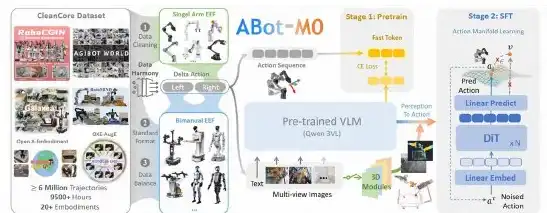
Embodied Intelligence Breakthrough: AutoNavi Open-Sources Universal Robot Base Model ABot-M0 AutoNavi has announced the full open-source release of ABot-M0, the world's first unified architecture-based embodied manipulation base model. This model is designed to enable "one general brain to adapt to multiple forms of robots," aiming to break down barriers between heterogeneous hardware and accelerate the adoption of embodied intelligence in industrial and household settings. ABot-M0 demonstrated exceptional performance in industry tests, achieving a task success rate of 80.5% on the Libero-Plus benchmark—a nearly 30% improvement over the previous benchmark, Pi0. It also set new state-of-the-art records on benchmarks like Libero and RoboCasa. The open-source release addresses long-standing challenges in the field, such as data isolation and deployment difficulties, by providing resources across three key dimensions: - **Data:** The UniACT dataset, the largest of its kind, with over 6 million real operation trajectories and full data pipeline tools. - **Algorithm:** The model architecture and training framework, featuring innovative components like Action Manifold Learning (AML) and a dual-stream perception architecture. - **Model:** End-to-end pre-trained models and a complete toolchain for out-of-the-box deployment, significantly lowering the barrier to adaptation. According to AutoNavi's ABot-M0 technical lead, this open-source initiative aims to build a bridge between ac...

The field of embodied intelligence has reached a milestone. Amap today officially announced the full open-source release of the world's first unified architecture-based robot operation base model ABot-M0. The core positioning of this model is to achieve "one universal brain adaptable to various forms of robots," aiming to break down barriers between heterogeneous hardware and accelerate the transition of embodied intelligence from the laboratory to industrial and home scenarios.

Core Technology and Performance

ABot-M0 has demonstrated outstanding performance in multiple industry authoritative benchmark tests. Data shows that the model achieved a task success rate of up to 80.5% on the Libero-Plus benchmark, a nearly 30% improvement over the previous industry benchmark solution Pi0. Furthermore, it set new SOTA (State-of-the-Art) records in tests such as Libero and RoboCasa.
Full Open-Source Across Three Dimensions

To address the long-standing pain points of "data silos" and "deployment difficulties" in the field of embodied intelligence, Amap's open-source release covers three key dimensions: underlying data, core algorithms, and pre-trained models:

  • Data Level: Open-sourced the currently largest universal robot dataset UniACT. This dataset integrates over 6 million real operation trajectories and provides a complete processing pipeline from heterogeneous data to standardized training data.

  • Algorithm Level: Simultaneously released the model architecture and training framework. Core highlights include Amap's innovative Action Manifold Learning (AML) algorithm and Dual-Stream Perception Architecture, endowing robots with exceptional spatial understanding and action execution capabilities.

  • Model Level: Provided end-to-end pre-trained models and a complete toolchain. Developers can achieve "out-of-the-box" usability without building a framework from scratch, significantly lowering the barrier to adapting to industrial collaborative or home service robots.

Industry Impact

Amap's ABot-M0 technical lead stated that true general embodied intelligence requires the collective refinement of global developers. The open-sourcing of ABot-M0 is not just a sharing of technology but also aims to build a bridge connecting academic research and industrial application, enabling every robot of different forms to possess a smart, reliable, and universal "brain".


Пов'язані питання

QWhat is the name of the general-purpose robotic base model that AutoNavi has fully open-sourced?

AThe model is called ABot-M0.

QWhat is the core positioning or main goal of the ABot-M0 model?

AIts core positioning is to achieve 'one general-purpose brain adapted to various forms of robots', aiming to break down barriers between heterogeneous hardware.

QWhat is the name of the large-scale dataset that was open-sourced alongside the model, and how many real operation trajectories does it contain?

AThe dataset is called UniACT, and it integrates over 6 million real operation trajectories.

QOn which benchmark did ABot-M0 achieve a task success rate of 80.5%, and what was the performance improvement over the previous benchmark solution?

AIt achieved an 80.5% success rate on the Libero-Plus benchmark, which is a nearly 30% improvement over the previous benchmark solution, Pi0.

QName two core technical highlights of the algorithm that were open-sourced.

AThe two core technical highlights are the Action Manifold Learning (AML) algorithm and the Dual-Stream Perception architecture.

Пов'язані матеріали

GitHub, Transfixed by AI

On the night of February 9th, GitHub suffered a major outage caused by a simple configuration change—reducing a cache refresh interval from 12 to 2 hours—that triggered a cascade of failures. This was not an isolated event, but part of a broader pattern. In early 2026, GitHub experienced at least 8 major incidents, failing to meet its promised 99.9% availability. These outages stemmed from structural issues: explosive growth in load, tight service coupling, and insufficient protection against abnormal traffic. This unprecedented load is driven by AI Agents. In 2025, GitHub handled ~1 billion commits. By 2026, weekly commits reached 275 million, projecting to ~14 billion for the year—a 14x increase. AI tools like Claude Code now contribute 4.5% of all public repository commits, with weekly submissions surging 25x in just three months. AI-generated pull requests jumped from 4 million to 17 million per month in half a year. Unlike human developers, AI Agents work continuously, generating commits at a scale that overwhelms infrastructure designed for human rhythms. The surge also shattered GitHub's business model. Copilot's flat-rate pricing, based on assisting human developers, became unsustainable as Agentic AI sessions consumed resources worth hundreds of dollars for a few dollars in fees. In response, GitHub imposed usage limits and, by June 1st, shifted to a pay-per-use "AI Credits" system. Facing this new reality, GitHub realized a 10x scaling plan was insufficient. It announced a need to *redesign* its architecture for 30x current scale—decoupling services, adding fault isolation, and improving change management to prevent cascading failures. Other platforms like Stripe and AWS are facing similar challenges with AI Agents. Fundamentally, GitHub is transitioning from a human collaboration platform to an "exhaust pipe" for automated AI workflows. Its detailed post-mortem reports aim to maintain trust during this turbulent rebuild. The February outage was not just a technical glitch, but a signal of the software industry's entry into a new, AI-driven era.

marsbit35 хв тому

GitHub, Transfixed by AI

marsbit35 хв тому

Both Suffer Massive Losses Exceeding $90 Billion, Which Is in Greater Peril: Strategy or Bitmine?

Facing massive paper losses exceeding $90 billion each amidst a sharp market downturn, "Digital Asset Treasury" (DAT) giants Strategy and Bitmine find themselves in a precarious position, but with different underlying risks. Strategy, heavily invested in Bitcoin (BTC), faces significant financial strain. Its strategy relies heavily on debt, including convertible notes and preferred stock (STRC) requiring substantial dividend payments. With its cash reserves dwindling and BTC offering no staking yield for cash flow, Strategy's high leverage makes it vulnerable. A continued price decline could force asset sales to meet obligations, potentially creating a negative feedback loop. Its market value has already fallen sharply. In contrast, Bitmine, an Ethereum (ETH) holder, appears on firmer financial ground. It primarily funds its purchases through equity offerings (like ATM programs), avoiding debt pressure. It also generates income by staking a large portion of its ETH holdings. While not immune to market drops and shareholder dilution concerns, Bitmine maintains more flexibility, recently announcing a new preferred share offering to raise further capital. The core divergence lies in their financing: Bitmine uses equity (investor money), while Strategy uses debt (borrowed money). Consequently, Bitmine currently faces less immediate liquidity pressure than Strategy, which must navigate the dual challenge of servicing debt/dividends and a declining core asset (BTC) price.

marsbit42 хв тому

Both Suffer Massive Losses Exceeding $90 Billion, Which Is in Greater Peril: Strategy or Bitmine?

marsbit42 хв тому

Торгівля

Спот
Ф'ючерси
活动图片




