Eight Years of Turbulence in Web3 Phones: From 'Geek Toy' to Xiaomi's 'Factory Standard'

marsbitОпубліковано о 2025-12-11Востаннє оновлено о 2025-12-11

Анотація

Web3 Smartphones: An 8-Year Evolution from 'Geek Toy' to Xiaomi's 'Standard Feature' On December 10th, high-performance blockchain Sei announced a partnership with Xiaomi, the world's third-largest smartphone manufacturer. The Sei Foundation will develop a next-gen crypto wallet and DApp discovery platform, which will be pre-installed on Xiaomi's new smartphones for global markets (excluding mainland China and the US). Utilizing MPC technology, the collaboration aims to allow users to log in directly via Google or Xiaomi accounts, eliminating intimidating seed phrases. A pilot stablecoin payment system is also slated for 2026, enabling purchases at Xiaomi's retail stores with tokens like USDC. The journey of Web3 phones began around 2018 with devices like Sirin Labs' Finney and HTC's Exodus 1, which focused on "hardware sovereignty" and extreme security, often featuring physical safeguards or trusted execution environments (TEE). These early attempts, including niche projects like Pundi X's communication-focused BOB phone and Electroneum's low-cost "cloud mining" M1, were commercially unsuccessful due to high costs and poor user experience, remaining confined to tech enthusiasts. Mainstream manufacturers like Samsung cautiously entered the space around 2019, integrating features like the Samsung Blockchain Keystore into flagship models. A notable early example was the "KlaytnPhone" edition of the Galaxy Note 10, which included free KLAY, prefiguring the later "airdrop" mod...

On December 10th, the high-performance public chain Sei announced a partnership with Xiaomi, the world's third-largest smartphone manufacturer. The Sei Foundation will develop a new generation of crypto wallets and a decentralized application (DApp) discovery platform, which will be pre-installed directly on Xiaomi's new smartphones targeting the global market (excluding Mainland China and the United States).

The two parties plan to utilize Multi-Party Computation (MPC) technology, allowing users to log into the wallet directly via their Google or Xiaomi accounts, eliminating the intimidating 'seed phrases' for average users. They also plan to pilot a stablecoin payment system in regions like Hong Kong and the European Union in the second quarter of 2026, enabling users to directly use tokens like USDC to purchase electronics at Xiaomi's over 20,000 offline retail stores.


Retrospective: The Seven-Year Evolution of Web3 Phones


First-Generation Attempts (2018–2020): Hardcore Security and Wild Imagination
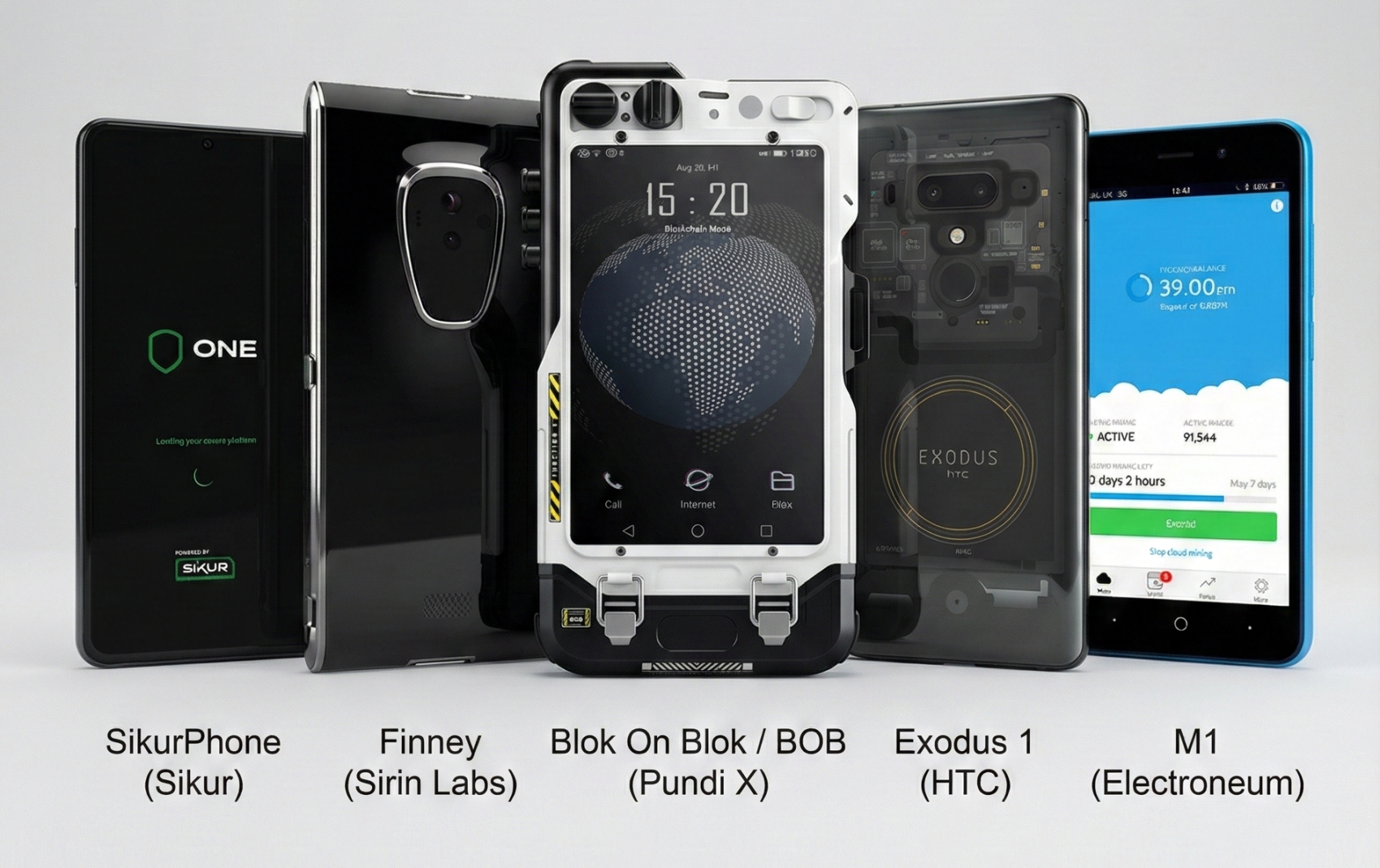

Image source: Internet, compiled by AI


Around 2018, alongside the first major crypto market bull run, the first batch of 'blockchain phones' was born. The representatives of this era were Sirin Labs' Finney and HTC's Exodus 1, whose design philosophies were 'hardware sovereignty' and 'ultimate security'.


Taking Sirin Labs' Finney as an example, this phone featured a unique slide-out 'security screen' that used physical isolation specifically for displaying transaction details and entering passwords, ensuring funds remained safe even if the main system was compromised. HTC, in collaboration with Binance, developed the Exodus 1, introducing the 'Zion Vault', which utilized the phone chip's Trusted Execution Environment (TEE) to store private keys.


Besides Sirin and HTC, another device worth mentioning is the SikurPhone, which represented an attempt at a 'closed system' at the time. Launched by a Brazilian security company, the SikurPhone focused on being 'hacker-proof' and having a built-in cold wallet. Its extreme approach was running the highly closed SikurOS, which did not allow users to install third-party applications themselves (requiring manufacturer evaluation), thereby reducing the attack surface.


Beyond secure storage, entrepreneurs of the time had even more cyberpunk imaginations. Pundi X launched the Blok On Blok (BOB) phone, attempting to solve the problem of decentralized communication. This modular phone allowed users to switch between 'Android mode' and 'blockchain mode', claiming to enable calls and data transmission over a decentralized network without going through mobile carriers.


During this phase, Electroneum released the M1 phone priced at just $80. It targeted developing countries, allowing users to perform 'cloud mining' on the phone to earn tokens for paying phone bills. Although it didn't gain traction at the time due to poor user experience, it was actually the precursor to the later 'phone-as-a-miner' and JamboPhone models.


However, these devices ultimately could not escape commercial failure. The Finney was priced as high as $999 and had dismal sales, while Pundi X's decentralized communication failed to take off due to a lack of user base. The technological features of the time overly emphasized turning the phone into a 'cold wallet' or 'full node', which posed too high a barrier for ordinary users, resulting in products that only circulated within geek circles.


Mainstream Manufacturers Testing the Waters (2019–2022): Cautious Exploration


Image source: Internet, compiled by AI


Seeing the attempts of early startups, mainstream phone manufacturers began testing the waters in a more cautious manner. Samsung integrated the Samsung Blockchain Keystore into its Galaxy S10 series, theoretically giving tens of millions of flagship phone users a hardware-level encrypted wallet.


It is worth noting that Samsung actually laid the groundwork for 'buy a phone, get tokens' as early as 2019. In its 'KlaytnPhone' special edition of the Galaxy Note 10, Samsung partnered with the Korean internet giant Kakao to randomly include 2,000 KLAY tokens. This can be seen as the earliest雏形 (prototype) of the later successful Solana Saga model, although it was confined to the Korean market at the time and did not cause a global sensation.


This period also saw attempts targeting specific niche markets. For example, Vertu launched the Metavertu, priced at tens of thousands of dollars, promoting 'dual-system' switching and luxury services, aiming to attract crypto tycoons. HTC also pivoted to launch the Desire 22 Pro, focusing on the metaverse concept.


Although the involvement of major manufacturers brought better hardware experiences, the limitations of this stage were still evident: Web3 functions were often hidden in deep menus or used merely as marketing gimmicks, failing to fundamentally change user habits.


Besides the 'hardware wallet' attempts by big manufacturers (Samsung) and 'luxury gimmicks' (Vertu), this stage also saw a lightweight path of 'software-defined membership' with the Nothing Phone. Nothing Phone partnered with Polygon to establish a decentralized membership loyalty program through the 'Black Dot' NFT.


The New Wave (2023–2025): Ecosystem Binding and Infrastructure-ization
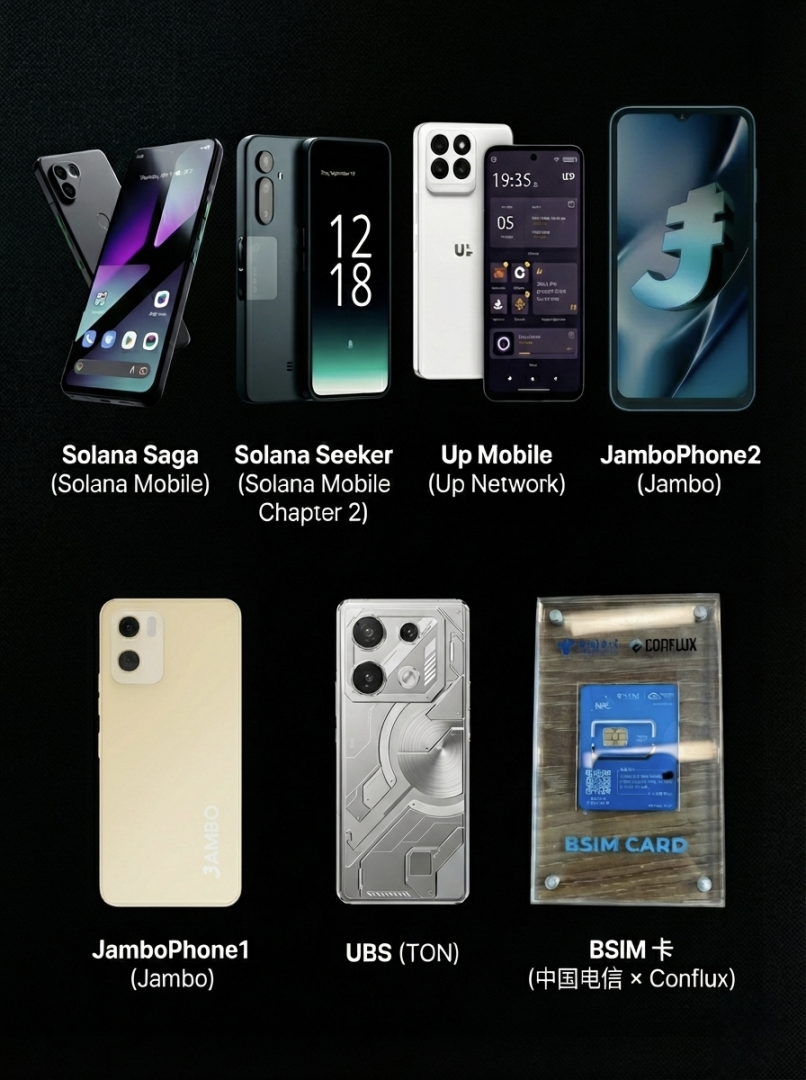

Image source: Internet, compiled by AI


Entering 2023, the Web3 phone market was completely activated by the Solana Saga, ushering in a new era of 'ecosystem binding' and 'token incentives'. The Solana Saga initially had stagnant sales due to poor cost-performance, but after the value of the included BONK token airdrop exceeded the phone's price, it sold out instantly, earning the nickname 'dividend phone'.


The subsequent Solana Seeker (Chapter 2) continued this airdrop logic, using 'Soulbound Tokens' (SBT) to prevent scalping and introducing the TEEPIN architecture to support decentralized infrastructure networks.


Meanwhile, ecosystem competition intensified. The TON ecosystem launched the Universal Basic Smartphone (UBS), also priced at $99, directly challenging the JamboPhone. The TON phone leverages Telegram's massive user base, focusing on 'data dividends', allowing users not only to earn money by completing tasks but also to profit from selling their own data. Binance Labs-incubated Coral Phone also joined the fray, aiming to build a dedicated hardware entry point for the BNB Chain ecosystem, focusing on multi-chain aggregation and AI functions.


In the low-end market, the JamboPhone entered the arena with an ultra-low price of $99, serving as an entry point for 'super apps' and attracting users in Africa and Southeast Asia through a 'Learn to Earn' model. New players like Up Mobile also began to get a piece of the pie by combining AI and Move language technology. Jambo has already launched its second-generation product. While maintaining the $99 price, it upgraded the RAM to 12GB (although the processor remains entry-level), which is already capable of handling more Web3 tasks and 'super app' demands in emerging markets.


The BSIM card launched by China Telecom and Conflux showcased another path: a SIM card with a built-in high-performance security chip. Users simply need to replace their SIM card to transform any ordinary Android phone into a higher-security Web3 device. This 'Trojan Horse' strategy provides a new approach for large-scale adoption in compliant markets.


Trends: Shifts in Five Directions


Looking at the development over these eight years, we can clearly see five key shifts happening with Web3 phones.


Hardware capabilities and security architectures are upgrading. Early security relied mainly on software or simple TEE isolation, whereas now, technology is evolving towards more complex directions. Solana Seeker introduced the TEEPIN (Trusted Execution Environment Platform Infrastructure Network) architecture, enabling the phone to act as a trusted node participating in DePIN network construction. The BSIM card launched by China Telecom and Conflux integrates private key generation and storage directly into the SIM card, achieving telecom-grade hardware security. The collaboration between Xiaomi and Sei employs MPC technology, allowing users to log in with one click via their Google account, enabling secure management without seed phrases.


Ecosystem binding has become standard. Today's Web3 phones are not just generic crypto devices but entry points to specific public chain ecosystems. Saga is bound to Solana, Up Mobile is bound to Movement Labs, while JamboPhone, based on Aptos, further aggregates the Solana and Tether payment ecosystems, becoming a super app entry point for emerging markets. The phone has become a channel for public chains to distribute applications and retain users.


Airdrops or incentives dominate user growth. The motivation for users to buy Web3 phones has shifted from 'secure storage' to 'obtaining收益 (returns/profits)'. Saga's success proved that hardware can be used as a 'loss-leading' tool, compensating users with subsequent token airdrops or other incentives. This economic model of 'phone-as-a-miner' or 'phone-as-a-golden-shovel' has become the strongest driving force in the current market.


Application scenarios take precedence over technical concepts. Early products were obsessed with geeky functions like 'running a full node', while the current focus has shifted to practical applications. The core of the Xiaomi-Sei collaboration is stablecoin payments, and JamboPhone focuses on流量变现 (monetizing traffic) through built-in apps. Solving real payment and application distribution problems is more attractive than pure technological stacking.


Channel and scale effects are beginning to show. Selling 20,000 Solana Saga units was considered a huge success, but it's a drop in the bucket compared to Xiaomi's annual shipment volume of 168 million units. When a major manufacturer like Xiaomi starts pre-installing wallets via system updates, the growth scale of Web3 users will leap from 'ten-thousands' to 'hundreds of millions'. This scale effect is unmatched by any vertical crypto phone manufacturer.


Conclusion: Tearing Down the Walls, Integrating into the Mainstream


Throughout this eight-year evolution, we attempted to build expensive, closed Web3 phones as secure fortresses. But reality has proven that the real 'wall' hindering Web3 adoption is not security, but the complexity of seed phrases and the fragmented user experience.


Truly valuable Web3 phones will eventually no longer need to label themselves as 'Web3 phones'. They should be like today's 5G phones; you don't need to understand the underlying communication protocols, you just enjoy the high-speed experience they bring.


Solana Mobile proved that breaking through driven by利益 (interest/profit) is feasible, while SEI's partnership with Xiaomi is attempting to prove that integration driven by experience is the long-term solution. In this evolution from 'hardcore toy' to 'mass tool', whoever lowers the technical barrier of Web3 the most, whoever彻底推倒 (completely tears down) this cognitive wall, will hold the ticket to the next hundred-million user base.


Трендові криптовалюти

Пов'язані питання

QWhat is the significance of the recent partnership between Sei and Xiaomi in the Web3 phone market?

AThe partnership signifies a major shift towards mainstream adoption, as Sei will develop a next-gen crypto wallet and DApp discovery platform pre-installed on Xiaomi's global smartphones (excluding China and the US). It leverages MPC technology for seamless login via Google or Xiaomi accounts, eliminating seed phrases, and plans to pilot a stablecoin payment system (e.g., USDC) in Xiaomi's retail stores by 2026.

QHow did the early Web3 phones (2018-2020) differ from the current generation in terms of focus and user experience?

AEarly Web3 phones like Sirin Finney and HTC Exodus 1 focused on 'hardware sovereignty' and 'extreme security' through features like physical isolation screens and trusted execution environments (TEE). They were expensive, complex, and targeted at tech-savvy users, whereas current models prioritize user incentives (e.g., airdrops), practical applications (e.g., payments), and seamless integration, lowering barriers for mainstream users.

QWhat role did Solana Saga play in revitalizing the Web3 phone market in 2023?

ASolana Saga activated the market by introducing an 'ecosystem binding' and 'token incentive' model. Initially slow-selling, it gained massive popularity when the included BONK token airdrop exceeded the phone's price, making it a 'dividend phone.' This success demonstrated that hardware could be used as a loss-leading tool for user acquisition through future airdrops and rewards.

QWhat are the five key shifts in Web3 phone development highlighted in the article?

AThe five shifts are: 1) Upgraded hardware security (e.g., TEEPIN, MPC, BSIM cards); 2) Ecosystem binding (phones as entry points for specific chains like Solana or Aptos); 3) Airdrop/incentive-driven user growth; 4) Focus on practical applications (e.g., payments) over technical concepts; 5) Emergence of scale and channel effects, with major manufacturers like Xiaomi enabling billion-user reach.

QHow does the BSIM card developed by China Telecom and Conflux represent an alternative approach to Web3 phone integration?

AThe BSIM card is a 'Trojan horse' strategy that embeds a high-performance security chip into a SIM card. By simply replacing the SIM, any standard Android phone can be transformed into a Web3 device with enhanced security for private key storage and management, offering a compliant and scalable solution for mass adoption without requiring specialized hardware.

Пов'язані матеріали

Claude Accused of Becoming Dumber by the Entire Internet, Anthropic Steps In to Reveal: It’s Not the Model That’s Tricking You

When users complained that Claude was "getting dumber," the root cause wasn't the AI model itself. In an official blog post, Anthropic clarified the critical difference between two key settings in Claude Code: Model and Effort. Model refers to the core "brain"—the fixed, trained weights of a specific AI (like Sonnet, Opus, or Fable). Changing the Model addresses *capability* ("can it do this?"), but its knowledge is static post-training. Effort, however, controls the AI's *approach and thoroughness* for a specific task. A higher Effort level instructs Claude to read more files, run tests, perform verification, and complete multi-step reasoning before responding, significantly increasing its "work output" for that job. Conversely, low Effort leads to quicker, less thorough replies. This distinction explains the March 2024 uproar where users experienced a sudden drop in Claude's performance. The cause was not a model change but Anthropic quietly lowering the *default* Effort setting from "high" to "medium" to reduce latency, which was later reverted. The key insight is that a smaller, capable model (like Sonnet) on high Effort can often outperform a larger, more powerful model (like Opus) on low Effort for many tasks. The article provides a practical troubleshooting framework: if Claude makes an error, first check the context and instructions. If it seems to skip necessary steps or validations, increase Effort. If it diligently attempts the task but fails conceptually or makes consistent factual errors despite good context, then consider switching to a more capable Model. The takeaway is a shift in focus: effective AI programming is less about always choosing the "strongest" model and more about intelligently *orchestrating* models and effort levels—acting like a project manager to assign the right "brain" with the right level of diligence for each job, optimizing both results and cost.

marsbit1 год тому

Claude Accused of Becoming Dumber by the Entire Internet, Anthropic Steps In to Reveal: It’s Not the Model That’s Tricking You

marsbit1 год тому

Will the Ethereum Foundation Evolve into a 'Mascot'? Diversified Organizations Are Fragmenting Its Functions

The Ethereum Foundation (EF) is undergoing significant internal turmoil and functional erosion. Following its largest-ever layoff of 54 staff (20% of its workforce) and a major organizational restructuring announced in June, its Protocol Support Team has been officially dissolved. This comes alongside the high-profile resignation of key figures like co-executive director Xiaowei Wang, bringing senior departures this year to at least eight. Criticism of EF's rigid structure, opaque decision-making, and perceived lack of a clear value narrative for ETH has intensified within the community. The layoffs have catalyzed the emergence of independent, non-profit organizations like Ethlabs and Ethereum Institutional, founded by former EF researchers and members. These entities are now taking on core functions such as protocol research/development and institutional adoption, effectively fragmenting the EF's traditional leadership role. Concurrently, EF's security team is adapting to technological change, deploying specialized AI agents to audit Ethereum's codebase, which successfully discovered a critical vulnerability (CVE-2026-34219). While EF states AI complements rather than replaces researchers, it signals a potential future shift in its operational model. Faced with these challenges—internal restructuring, talent drain, the rise of competing organizations, and AI integration—the Ethereum Foundation appears to be stepping back from a central commanding role. Analysts and community observers speculate it may increasingly transition towards a symbolic "ecosystem mascot" function, while decentralized initiatives drive Ethereum's future growth and institutional adoption.

marsbit1 год тому

Will the Ethereum Foundation Evolve into a 'Mascot'? Diversified Organizations Are Fragmenting Its Functions

marsbit1 год тому

Nearly a Hundred Players Rush into Embodied Data: With 4.47 Billion Yuan in Financing in One Year, Who Can Really Make Money by 'Selling Data'?

The domestic embodied AI data industry has attracted nearly 100 players, with 70 focused on data collection and 27 on data infrastructure. In the past year, 15 independent embodied data service providers raised approximately 4.47 billion yuan. Despite this growth, the sector remains early-stage, fragmented, and faces significant challenges. Data collection methods are diverse, categorized into four main routes: teleoperation of real robots, human demonstration without a robot (using motion capture, exoskeletons, etc.), simulation synthesis, and distillation from internet videos. Most companies (43%) adopt hybrid approaches, combining multiple routes, as no single method can meet all training needs. Teleoperation alone is pursued by 31% of players, often by state-owned platforms and robot companies, while newer firms favor asset-light, no-hardware human demonstration. Independent data service providers now form the largest player group (40%), indicating the emergence of a distinct industry segment rather than just a subsidiary function for robot makers. Two-thirds of all players are "embodied-native" startups, while one-third are companies that pivoted from fields like AI data annotation, which are more prevalent in the data infrastructure layer. Current annual industry capacity is estimated at 1.6-1.8 million hours plus 70-80 million data points, with a short-term goal to increase this 15-20 fold within 1-3 years. Data collection factories are spread across 20 provinces in China, concentrated in the Yangtze River Delta, Beijing-Tianjin-Hebei, and Pearl River Delta regions. Financially, the 4.47 billion yuan raised in the past year pales compared to the 43.8 billion yuan raised by the broader embodied intelligence sector in just the first half of 2026, highlighting that data remains a less "sexy" bet for investors. The 15 funded independent providers show clear stratification: a top tier led by a unicorn (Lightwheel Intelligence, 3.1 billion yuan), a middle tier of 11 firms raising tens to hundreds of millions, and an early-stage tier of 3 companies. Sixty-nine investment institutions have participated, but none have made concentrated bets, reflecting uncertainty about viable business models. Over half of these funded companies are less than a year old, most are at pre-A or A rounds, and profitability remains largely unproven. In summary, the embodied data industry has become an independent track creating jobs and local economic activity. However, it is still nascent, with unformed consensus, unsolved problems, and unproven business models. The coming 1-2 years will be a critical validation window to see if companies can build sustainable, profitable businesses purely by "selling data."

marsbit4 год тому

Nearly a Hundred Players Rush into Embodied Data: With 4.47 Billion Yuan in Financing in One Year, Who Can Really Make Money by 'Selling Data'?

marsbit4 год тому

Торгівля

Спот

Популярні статті

Що таке $S$

Розуміння SPERO: Комплексний огляд Вступ до SPERO Оскільки ландшафт інновацій продовжує еволюціонувати, виникнення технологій web3 та криптовалютних проектів відіграє ключову роль у формуванні цифрового майбутнього. Один з проектів, який привернув увагу в цій динамічній сфері, — це SPERO, позначений як SPERO,$$s$. Ця стаття має на меті зібрати та представити детальну інформацію про SPERO, щоб допомогти ентузіастам та інвесторам зрозуміти його основи, цілі та інновації в рамках web3 та крипто-сектору. Що таке SPERO,$$s$? SPERO,$$s$ — це унікальний проект у криптопросторі, який прагне використати принципи децентралізації та технології блокчейн для створення екосистеми, що сприяє залученню, корисності та фінансовій інклюзії. Проект розроблений для полегшення взаємодії між користувачами новими способами, надаючи їм інноваційні фінансові рішення та послуги. У своїй основі SPERO,$$s$ прагне надати можливості індивідам, забезпечуючи інструменти та платформи, які покращують користувацький досвід у криптовалютному просторі. Це включає в себе можливість більш гнучких методів транзакцій, сприяння ініціативам, що підтримуються спільнотою, та створення шляхів для фінансових можливостей через децентралізовані додатки (dApps). Основна концепція SPERO,$$s$ обертається навколо інклюзивності, прагнучи зменшити розриви в традиційній фінансовій системі, використовуючи переваги технології блокчейн. Хто є творцем SPERO,$$s$? Особистість творця SPERO,$$s$ залишається дещо невідомою, оскільки є обмежені публічно доступні ресурси, що надають детальну інформацію про його засновників. Ця відсутність прозорості може бути наслідком зобов'язання проекту до децентралізації — етики, яку багато проектів web3 поділяють, ставлячи колективні внески вище за індивідуальне визнання. Зосереджуючи обговорення навколо спільноти та її колективних цілей, SPERO,$$s$ втілює суть наділення без виділення конкретних осіб. Таким чином, розуміння етики та місії SPERO є більш важливим, ніж ідентифікація єдиного творця. Хто є інвесторами SPERO,$$s$? SPERO,$$s$ підтримується різноманітними інвесторами, починаючи від венчурних капіталістів до ангельських інвесторів, які прагнуть сприяти інноваціям у крипто-секторі. Зосередження цих інвесторів зазвичай узгоджується з місією SPERO — пріоритет надається проектам, які обіцяють технологічний прогрес у суспільстві, фінансову інклюзію та децентралізоване управління. Ці інвесторські фонди зазвичай зацікавлені в проектах, які не лише пропонують інноваційні продукти, але й позитивно впливають на спільноту блокчейн та її екосистеми. Підтримка з боку цих інвесторів підкріплює SPERO,$$s$ як значного конкурента в швидко змінюваній сфері крипто-проектів. Як працює SPERO,$$s$? SPERO,$$s$ використовує багатогранну структуру, яка відрізняє його від традиційних криптовалютних проектів. Ось деякі ключові особливості, які підкреслюють його унікальність та інноваційність: Децентралізоване управління: SPERO,$$s$ інтегрує моделі децентралізованого управління, надаючи користувачам можливість активно брати участь у процесах прийняття рішень щодо майбутнього проекту. Цей підхід сприяє відчуттю власності та відповідальності серед членів спільноти. Корисність токена: SPERO,$$s$ використовує свій власний криптовалютний токен, розроблений для виконання різних функцій в екосистемі. Ці токени дозволяють здійснювати транзакції, отримувати винагороди та полегшувати послуги, що пропонуються на платформі, підвищуючи загальну залученість та корисність. Шарова архітектура: Технічна архітектура SPERO,$$s$ підтримує модульність та масштабованість, що дозволяє безперешкодно інтегрувати додаткові функції та додатки в міру розвитку проекту. Ця адаптивність є надзвичайно важливою для збереження актуальності в постійно змінюваному крипто-ландшафті. Залучення спільноти: Проект підкреслює ініціативи, що підтримуються спільнотою, використовуючи механізми, які стимулюють співпрацю та зворотний зв'язок. Підтримуючи сильну спільноту, SPERO,$$s$ може краще задовольняти потреби користувачів та адаптуватися до ринкових тенденцій. Фокус на інклюзію: Пропонуючи низькі комісії за транзакції та зручні інтерфейси, SPERO,$$s$ прагне залучити різноманітну базу користувачів, включаючи осіб, які раніше не брали участі в крипто-просторі. Це зобов'язання до інклюзії узгоджується з його загальною місією наділення через доступність. Хронологія SPERO,$$s$ Розуміння історії проекту надає важливі уявлення про його розвиток та етапи. Нижче наведено пропоновану хронологію, що відображає значні події в еволюції SPERO,$$s$: Етап концептуалізації та ідеації: Початкові ідеї, що стали основою SPERO,$$s$, були сформовані, тісно пов'язані з принципами децентралізації та фокусом на спільноті в індустрії блокчейн. Запуск білого паперу проекту: Після концептуального етапу був випущений комплексний білий папір, що детально описує бачення, цілі та технологічну інфраструктуру SPERO,$$s$, щоб залучити інтерес та зворотний зв'язок від спільноти. Створення спільноти та ранні залучення: Активні зусилля були спрямовані на створення спільноти ранніх прихильників та потенційних інвесторів, що полегшило обговорення цілей проекту та отримання підтримки. Подія генерації токенів: SPERO,$$s$ провів подію генерації токенів (TGE) для розподілу своїх рідних токенів серед ранніх прихильників та встановлення початкової ліквідності в екосистемі. Запуск початкового dApp: Перший децентралізований додаток (dApp), пов'язаний з SPERO,$$s$, став доступним, дозволяючи користувачам взаємодіяти з основними функціями платформи. Постійний розвиток та партнерства: Безперервні оновлення та вдосконалення пропозицій проекту, включаючи стратегічні партнерства з іншими учасниками блокчейн-простору, сформували SPERO,$$s$ у конкурентоспроможного та еволюціонуючого гравця на крипто-ринку. Висновок SPERO,$$s$ є свідченням потенціалу web3 та криптовалют для революціонізації фінансових систем та наділення індивідів. Завдяки зобов'язанню до децентралізованого управління, залучення спільноти та інноваційно спроектованих функцій, він прокладає шлях до більш інклюзивного фінансового ландшафту. Як і з будь-якими інвестиціями в швидко змінюваному крипто-просторі, потенційним інвесторам та користувачам рекомендується ретельно досліджувати та обдумано взаємодіяти з поточними подіями в SPERO,$$s$. Проект демонструє інноваційний дух крипто-індустрії, запрошуючи до подальшого дослідження його численних можливостей. Хоча подорож SPERO,$$s$ ще триває, його основні принципи можуть справді вплинути на майбутнє того, як ми взаємодіємо з технологією, фінансами та один з одним у взаємопов'язаних цифрових екосистемах.

124 переглядів усьогоОпубліковано 2024.12.17Оновлено 2024.12.17

Що таке $S$

Що таке AGENT S

Агент S: Майбутнє автономної взаємодії в Web3 Вступ У постійно змінюваному ландшафті Web3 та криптовалюти інновації постійно переосмислюють, як люди взаємодіють з цифровими платформами. Один з таких новаторських проектів, Агент S, обіцяє революціонізувати взаємодію людини з комп'ютером через свою відкриту агентну структуру. Прокладаючи шлях для автономних взаємодій, Агент S прагне спростити складні завдання, пропонуючи трансформаційні застосування в штучному інтелекті (ШІ). Це детальне дослідження заглиблюється в складності проекту, його унікальні особливості та наслідки для сфери криптовалюти. Що таке Агент S? Агент S є революційною відкритою агентною структурою, спеціально розробленою для вирішення трьох основних викликів в автоматизації комп'ютерних завдань: Набуття специфічних знань у галузі: Структура інтелектуально навчається з різних зовнішніх джерел знань та внутрішнього досвіду. Цей подвійний підхід дозволяє їй створити багатий репозиторій специфічних знань у галузі, покращуючи її продуктивність у виконанні завдань. Планування на довгих горизонтах завдань: Агент S використовує планування з підкріпленням досвіду, стратегічний підхід, який полегшує ефективний розподіл та виконання складних завдань. Ця функція значно підвищує її здатність ефективно та результативно управляти кількома підзавданнями. Обробка динамічних, неоднорідних інтерфейсів: Проект представляє Інтерфейс Агент-Комп'ютер (ACI), інноваційне рішення, яке покращує взаємодію між агентами та користувачами. Використовуючи багатомодальні великі мовні моделі (MLLMs), Агент S може безперешкодно орієнтуватися та маніпулювати різноманітними графічними інтерфейсами користувача. Завдяки цим новаторським функціям Агент S надає надійну структуру, яка вирішує складнощі, пов'язані з автоматизацією людської взаємодії з машинами, прокладаючи шлях для численних застосувань у ШІ та за його межами. Хто є творцем Агент S? Хоча концепція Агент S є фундаментально новаторською, конкретна інформація про його творця залишається невідомою. Творець наразі невідомий, що підкреслює або початкову стадію проекту, або стратегічний вибір зберегти засновників у таємниці. Незважаючи на анонімність, акцент залишається на можливостях та потенціалі структури. Хто є інвесторами Агент S? Оскільки Агент S є відносно новим у криптографічній екосистемі, детальна інформація про його інвесторів та фінансових спонсорів не задокументована. Відсутність публічно доступних відомостей про інвестиційні фонди або організації, що підтримують проект, викликає питання щодо його фінансової структури та дорожньої карти розвитку. Розуміння підтримки є критично важливим для оцінки стійкості проекту та потенційного впливу на ринок. Як працює Агент S? В основі Агент S лежить передова технологія, яка дозволяє йому ефективно функціонувати в різних умовах. Його операційна модель побудована навколо кількох ключових функцій: Взаємодія з комп'ютером, подібна до людської: Структура пропонує розширене планування ШІ, прагнучи зробити взаємодії з комп'ютерами більш інтуїтивними. Імітуючи людську поведінку при виконанні завдань, вона обіцяє підвищити досвід користувачів. Наративна пам'ять: Використовується для використання високорівневого досвіду, Агент S використовує наративну пам'ять для відстеження історій завдань, тим самим покращуючи свої процеси прийняття рішень. Епізодична пам'ять: Ця функція надає користувачам покрокові інструкції, дозволяючи структурі пропонувати контекстуальну підтримку в міру виконання завдань. Підтримка OpenACI: Завдяки можливості працювати локально, Агент S дозволяє користувачам зберігати контроль над своїми взаємодіями та робочими процесами, узгоджуючи з децентралізованою етикою Web3. Легка інтеграція з зовнішніми API: Його універсальність і сумісність з різними платформами ШІ забезпечують те, що Агент S може безперешкодно вписатися в існуючі технологічні екосистеми, роблячи його привабливим вибором для розробників та організацій. Ці функціональні можливості колективно сприяють унікальному положенню Агент S у крипто-просторі, оскільки він автоматизує складні, багатоступеневі завдання з мінімальним втручанням людини. У міру розвитку проекту його потенційні застосування в Web3 можуть переосмислити, як відбуваються цифрові взаємодії. Хронологія Агент S Розробка та етапи Агент S можуть бути узагальнені в хронології, яка підкреслює його значні події: 27 вересня 2024 року: Концепція Агент S була представлена в комплексній науковій статті під назвою “Відкрита агентна структура, яка використовує комп'ютери як людина”, що демонструє основи проекту. 10 жовтня 2024 року: Наукова стаття була опублікована на arXiv, пропонуючи детальне дослідження структури та її оцінки продуктивності на основі бенчмарку OSWorld. 12 жовтня 2024 року: Було випущено відеопрезентацію, що надає візуальне уявлення про можливості та особливості Агент S, ще більше залучаючи потенційних користувачів та інвесторів. Ці маркери в хронології не лише ілюструють прогрес Агент S, але й вказують на його прихильність до прозорості та залучення громади. Ключові моменти про Агент S У міру розвитку структури Агент S кілька ключових характеристик виділяються, підкреслюючи її новаторський характер та потенціал: Інноваційна структура: Розроблена для забезпечення інтуїтивного використання комп'ютерів, подібного до людської взаємодії, Агент S пропонує новий підхід до автоматизації завдань. Автономна взаємодія: Здатність автономно взаємодіяти з комп'ютерами через GUI означає стрибок до більш інтелектуальних та ефективних обчислювальних рішень. Автоматизація складних завдань: Завдяки своїй надійній методології він може автоматизувати складні, багатоступеневі завдання, роблячи процеси швидшими та менш схильними до помилок. Безперервне вдосконалення: Механізми навчання дозволяють Агенту S покращуватися на основі минулого досвіду, постійно підвищуючи свою продуктивність та ефективність. Універсальність: Його адаптивність до різних операційних середовищ, таких як OSWorld та WindowsAgentArena, забезпечує його здатність служити широкому спектру застосувань. Оскільки Агент S займає своє місце в ландшафті Web3 та криптовалюти, його потенціал покращити можливості взаємодії та автоматизувати процеси означає значний прогрес у технологіях ШІ. Завдяки своїй інноваційній структурі Агент S є прикладом майбутнього цифрових взаємодій, обіцяючи більш безперешкодний та ефективний досвід для користувачів у різних галузях. Висновок Агент S представляє собою сміливий крок вперед у поєднанні ШІ та Web3, з можливістю переосмислити, як ми взаємодіємо з технологією. Хоча проект все ще на ранніх стадіях, можливості для його застосування є величезними та переконливими. Завдяки своїй комплексній структурі, що вирішує критичні виклики, Агент S прагне вивести автономні взаємодії на передній план цифрового досвіду. У міру того, як ми заглиблюємося в сфери криптовалюти та децентралізації, проекти, подібні до Агент S, безсумнівно, відіграватимуть ключову роль у формуванні майбутнього технологій та співпраці людини з комп'ютером.

751 переглядів усьогоОпубліковано 2025.01.14Оновлено 2025.01.14

Що таке AGENT S

Як купити S

Ласкаво просимо до HTX.com! Ми зробили покупку Sonic (S) простою та зручною. Дотримуйтесь нашої покрокової інструкції, щоб розпочати свою криптовалютну подорож.Крок 1: Створіть обліковий запис на HTXВикористовуйте свою електронну пошту або номер телефону, щоб зареєструвати обліковий запис на HTX безплатно. Пройдіть безпроблемну реєстрацію й отримайте доступ до всіх функцій.ЗареєструватисьКрок 2: Перейдіть до розділу Купити крипту і виберіть спосіб оплатиКредитна/дебетова картка: використовуйте вашу картку Visa або Mastercard, щоб миттєво купити Sonic (S).Баланс: використовуйте кошти з балансу вашого рахунку HTX для безперешкодної торгівлі.Треті особи: ми додали популярні способи оплати, такі як Google Pay та Apple Pay, щоб підвищити зручність.P2P: Торгуйте безпосередньо з іншими користувачами на HTX.Позабіржова торгівля (OTC): ми пропонуємо індивідуальні послуги та конкурентні обмінні курси для трейдерів.Крок 3: Зберігайте свої Sonic (S)Після придбання Sonic (S) збережіть його у своєму обліковому записі на HTX. Крім того, ви можете відправити його в інше місце за допомогою блокчейн-переказу або використовувати його для торгівлі іншими криптовалютами.Крок 4: Торгівля Sonic (S)Легко торгуйте Sonic (S) на спотовому ринку HTX. Просто увійдіть до свого облікового запису, виберіть торгову пару, укладайте угоди та спостерігайте за ними в режимі реального часу. Ми пропонуємо зручний досвід як для початківців, так і для досвідчених трейдерів.

1.6k переглядів усьогоОпубліковано 2025.01.15Оновлено 2026.06.02

Як купити S

Обговорення

Ласкаво просимо до спільноти HTX. Тут ви можете бути в курсі останніх подій розвитку платформи та отримати доступ до професійної ринкової інформації. Нижче представлені думки користувачів щодо ціни S (S).

活动图片