Eight Global Central Banks Enter the Fray, Aiming to Claim a Piece of the Stablecoin Pie?

marsbitОпубліковано о 2026-06-02Востаннє оновлено о 2026-06-02

Анотація

The article discusses the Agorá project, a global cross-border payment system initiative led by the Bank for International Settlements (BIS) with participation from eight major central banks (including the Federal Reserve Bank of New York, Bank of England, and Bank of Japan) and over 40 private financial institutions like JPMorgan and SWIFT. Agorá aims to create a unified platform for the instant settlement of cross-border transactions using tokenized commercial bank deposits. A key feature is its strict "permissioned" design, where funds are pre-labeled by country and smart contracts enforce AML and sanctions checks. This contrasts with the "permissionless" ideal suggested by its ancient Greek namesake. The system employs a two-tier architecture: central banks retain full control over sovereign reserves on separate ledgers, while private entities manage a shared ledger for multi-currency clearing. The project, which completed a prototype in May 2026, seeks to streamline the slow, multi-step process of traditional cross-border payments. It is positioned as a centralized, regulatory-compliant alternative to decentralized stablecoins like Tether, targeting large-scale institutional transfers. The analysis highlights a potential future market split: projects like Agorá could dominate wholesale institutional payments, while public blockchain-based stablecoins retain their role in retail, remittance, and emerging market use cases. This represents an effort by traditional financ...

Author: Thejaswini M A

Compilation: Chopper, Foresight News

Thousands of years ago, the ancient Greek Agorá was the public marketplace in Athens, a place where anyone could come and trade freely, with no entry barriers, not bound by any local jurisdiction. The concept of "permissionlessness" lies at the very heart of this word.

The Bank for International Settlements (BIS) named its project Agorá, a choice laden with meaning. However, the actual design of the Agorá project, spearheaded by the BIS and implemented jointly by seven central banks and over forty private institutions, stands in stark contrast to the word's original association with a "free market."

In this system, funds are tagged with their country of origin before they are transferred; smart contracts perform anti-money laundering screening and sanctions list verification at the token layer; each central bank retains full control over its own reserves, and cross-border fund flows must pass through a compliance validation layer embedded within the token.

In short, this is a programmable fiat currency system where permission must be granted beforehand for everything.

The seven central banks participating in the Agorá project are: the Federal Reserve Bank of New York, the Bank of England, the Bank of Japan, the Bank of Korea, the Bank of Mexico, the Swiss National Bank, and the Banque de France representing the Eurozone; the Bank of Canada joined the ranks just four days ago. Financial giants such as JPMorgan Chase, HSBC, Deutsche Bank, UBS, Mastercard, Visa, and the Society for Worldwide Interbank Financial Telecommunication (SWIFT), along with more than forty other institutions, are jointly involved in the development.

A project mobilizing such a massive institutional force prompted me to delve deeper into dissecting this system.

The project employs a two-tier separated architecture: one tier is fully controlled by the respective central banks, managing the underlying base currency reserves; the other tier is operated by commercial banks, handling daily transactions for end-users. Tokenized commercial bank deposits are consolidated onto a shared platform, processed collaboratively by multiple private institutions for multi-currency clearing; meanwhile, each central bank's reserves are stored independently on its own sovereign ledger, with sovereignty firmly retained by each respective central bank.
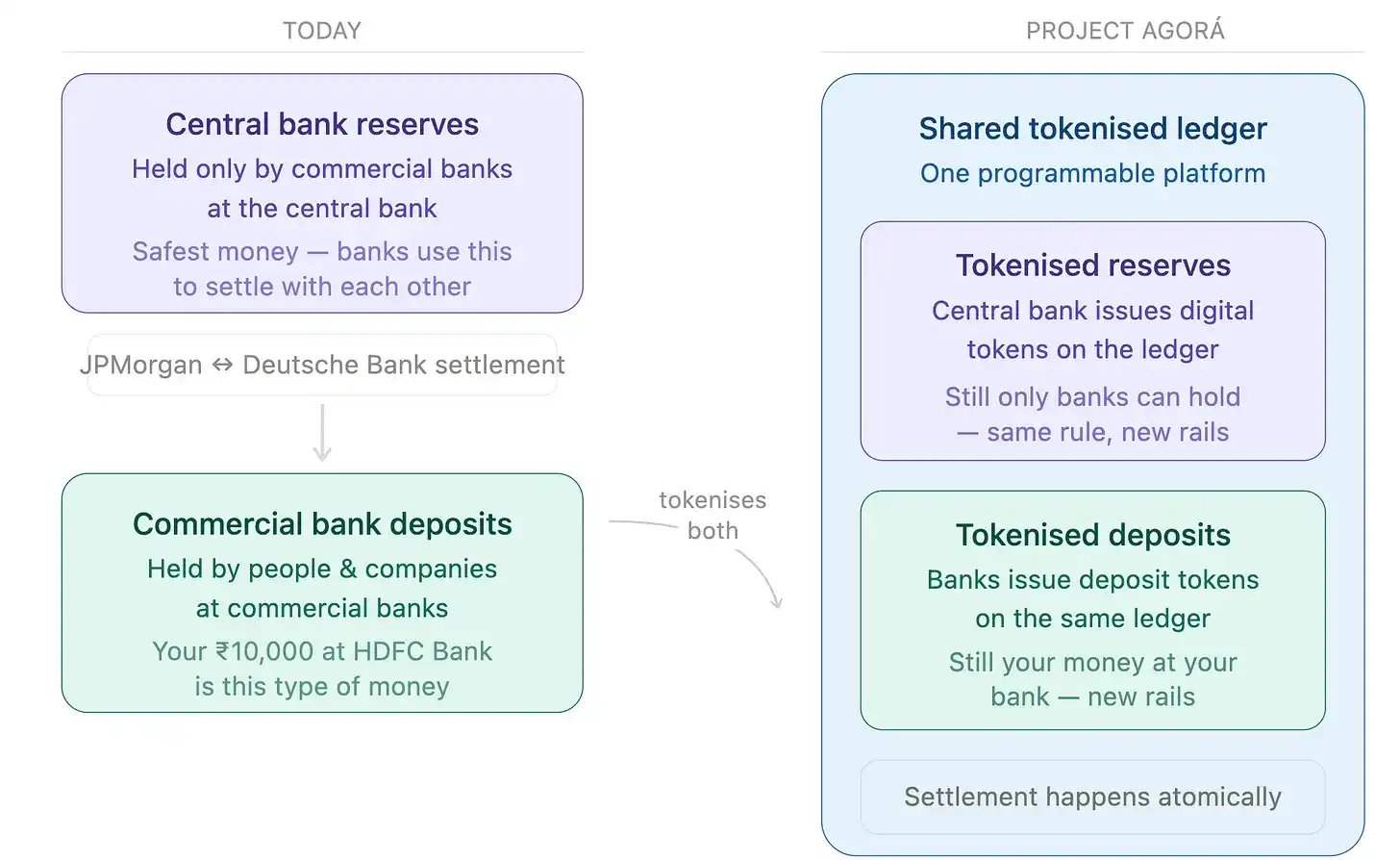
The BIS aims to build a state-controlled, closed-loop payment system by integrating commercial bank ledgers and anchoring sovereign reserves. Institutions are accelerating the implementation of a compliant framework, intending to establish it before decentralized stablecoins like Tether completely sever global commerce from the traditional banking system.

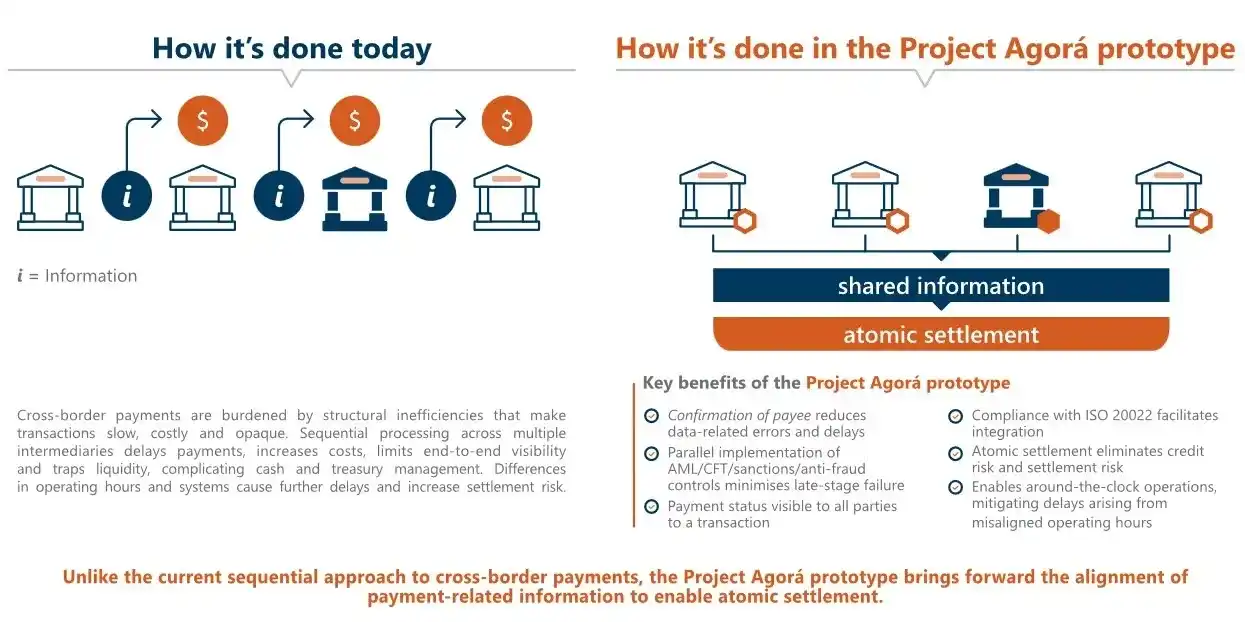
Current cross-border payments are akin to a relay race: message transmission, manual compliance checks, and ledger clearing belong to different institutional systems, often taking days. The Agorá project compresses this lengthy multi-step collaboration into a single on-chain, real-time operation. This prototype concluded on May 27, 2026, with the Bank of Canada promptly announcing its participation.

Organizers emphasize that the current phase remains infrastructure testing, with no formal timeline for commercial deployment, but the next stage will involve pilot tests with real funds.

Unlike previous central bank initiatives that only released research papers, seven major currency authorities spent two years developing and testing this real-time cross-border clearing system. The underlying code is functional. The existing challenge is no longer technical but rather how multiple governments will implement regulation and delineate responsibilities for the shared network, facing immense administrative coordination hurdles.
Meanwhile, the established cross-border messaging giant SWIFT is concurrently advancing its own underlying transformation, positioning its layout precisely within the commercial banking layer. On March 30, 2026, SWIFT finalized the design for its blockchain-based shared ledger, entering Minimum Viable Product (MVP) development, with plans to launch real-time transactions within the year. The ledger is built on Hyperledger Besu, which is compatible with the Ethereum Virtual Machine (EVM), with final fund clearing still performed off-chain using traditional Real-Time Gross Settlement systems.

However, SWIFT and Agorá are not in competition: the SWIFT ledger focuses on reconciling tokenized deposits between commercial banks, while Agorá handles the final large-value clearing of central bank reserves. The BIS ensured interoperability standards between the two systems from the outset, methodically transforming the traditional cross-border clearing system into a programmable digital network in two steps.

A closer look at the participant list reveals significant overlap: Deutsche Bank, a core Agorá member, also formed an alliance with Goldman Sachs, Bank of America, Barclays, Santander, and nine other banks to explore issuing 1:1 reserve-backed tokens on public blockchains; UBS and Citigroup are similarly involved in both; JPMorgan Chase participates in Agorá, operates its own JPM Coin, and recently piloted cross-border clearing on the Ripple ledger.

Such parallel investments are highly unusual in finance: the standard practice for institutions is to concentrate technical resources on one technological path. Top teams simultaneously developing two potentially competing frameworks on separate tracks reflects internal division within bank management. Giants holding vast data and enormous capital cannot predict which framework will ultimately prevail. The technological paths are clear, but policy directions remain uncertain.

Ripple, after a decade of effort, has consistently argued that "atomic settlement" (where a transaction either completes in full or fails entirely) is the optimal solution for cross-border payments. Now, the BIS's Agorá project has implemented this settlement logic, albeit replacing XRP as the bridging asset with central bank reserve tokens, directly undermining XRP's necessity as a cross-border bridge asset.

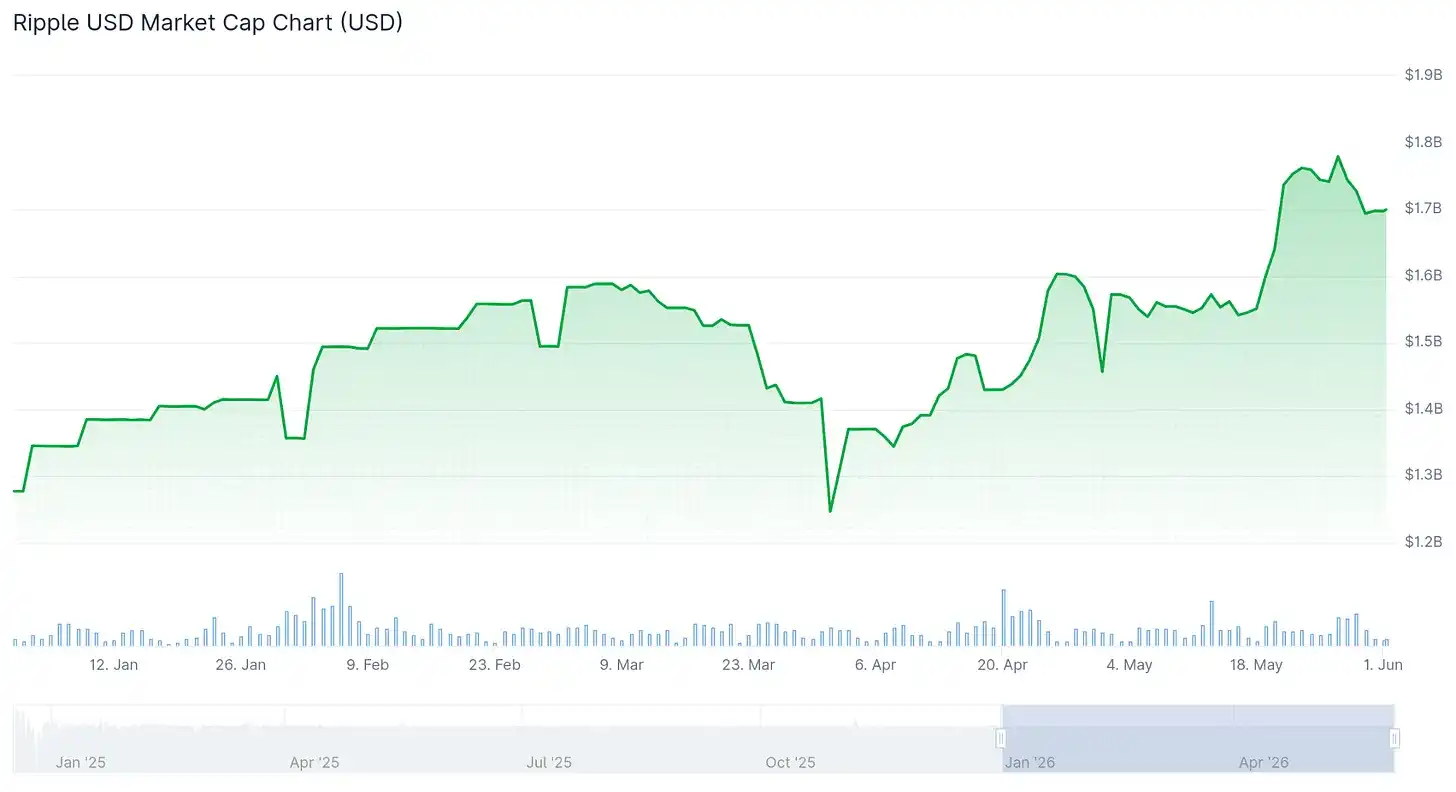
Nevertheless, the Ripple ledger continues to permeate traditional finance. On May 6, JPMorgan's Kinetyx, Mastercard, Ripple, and Ondo Finance completed the first cross-border redemption of tokenized U.S. Treasury bonds on Ripple, with the entire clearing process taking less than five seconds. The Ripple USD stablecoin RLUSD's market capitalization surpassed $1.4 billion; in January 2026, the total value of tokenized assets on Ripple exceeded $2 billion; Société Générale issued a Euro stablecoin on Ripple in February; and in December 2025, Ripple obtained a limited-purpose trust bank charter from the U.S. Office of the Comptroller of the Currency (OCC).
While Ripple's architectural logic is validated, the assertion that "XRP is indispensable" has not materialized. Even so, Ripple's ongoing integration into institutional clearing systems holds far greater significance for long-term value than debates over whether Ripple or central bank reserve tokens are superior.

Setting aside commercial rhetoric, on the Ripple network, transaction fees are extremely low and permanently waived, not flowing to node operators. Increased institutional transaction volume does not generate revenue for validators or token holders like Ethereum's Gas fees; it only results in a slight burn of the existing XRP supply. When institutions like JPMorgan transfer tokenized assets on-chain, they utilize their own liquidity pools and do not rely on XRP circulating in the market for liquidity support; the network merely provides high-speed transfer and cryptographic security.

The core value of this model lies in ecosystem lock-in. Once financial institutions trust the network to custody fiat and stablecoin assets, the technology becomes embedded in global financial infrastructure, compelling the deployment of bank-grade node facilities, and the ledger becomes a permanent component of the global financial system. In the long run, deep technological integration with global banking is far more important than the price fluctuations of a single token.

All these variables ultimately converge on the stablecoin arena. Tether's daily trading volume consistently ranges between $40-50 billion, with the total stablecoin market exceeding $320 billion. While Agorá is still in the pilot stage with deployment seemingly distant, SpaceX already uses stablecoins to manage cross-border corporate funds, and Western Union has launched remittance services on the Solana public blockchain; market competition has already taken the lead.

Agorá targets large-scale, wholesale cross-border clearing for institutions. If successfully deployed, it could divert corporate cross-border funding needs currently served by stablecoins. However, this is just one segment of stablecoin applications: Brazil's Central Bank issued Resolution 561, prohibiting local financial institutions from using stablecoins for cross-border payments, yet it cannot stop Brazilian citizens from holding dollar stablecoins as a store of value; Turkish retail investors buy USDT to hedge against lira inflation—these fragmented needs fall outside Agorá's intended scope.

In the short term, stablecoins and Agorá are more complementary than competitive, with almost non-overlapping use cases: Agorá is a closed institutional network, accessible only to central banks or licensed banks authorized by them; ordinary people hoarding dollars for safety or small payment companies using public blockchains for remittances cannot access this system. The official closed-loop system cannot achieve the inclusive access speed of public blockchains, nor can public chain stablecoins achieve the final settlement authority required by central banks.

The medium-term landscape is more complex. Currently, corporate treasury teams choose USDC or USDT for cross-border settlements primarily due to the lengthy cycles and high fees of traditional correspondent banking. If Agorá is successfully deployed in the future with sufficient liquidity, some corporate funds may shift. Given comparable clearing efficiency, corporate treasurers would likely prioritize official channels that are sovereign-regulated and free from third-party counterparty risk.

However, unifying governance rules among seven sovereign central banks is a monumental global challenge, and many past cross-border projects have failed at this hurdle. Simultaneously, major corporations have already integrated USDC systems and established mature risk control processes; they will not overhaul existing operations simply because of a theoretically superior new system.

The market will likely evolve towards stratification: Agorá monopolizes large-value institutional cross-border channels, while public chain stablecoins retain the retail and fragmented business segments. This appears to be a market split, but in reality, the sovereign system completes the boundary-setting for public chains, confining decentralized networks to areas that cannot challenge the foundations of traditional intermediaries—remittances, individual savings, and small-value payments in emerging markets. These markets are sizable but not the core concentration points of global financial leverage.

This market stratification theory is about to face real-world testing: the EU's Pontes framework is set to connect various distributed ledgers with Europe's core clearing system, TARGET, by September 2026—just three months away. Once successfully integrated, European institutional tokenized payments will gain direct access to central banks, marking the formal beginning of direct competition between the official system and open public blockchains.

The ancient Athenian Agorá marketplace ultimately perished because people stopped going there to trade. That, ultimately, is the final metric by which all financial networks are judged.


Пов'язані питання

QWhat is the BIS Agorá project, and how does it differ from the concept of an 'open market'?

AThe BIS Agorá project is a real-time cross-border payment system developed by the Bank for International Settlements (BIS) in collaboration with eight major central banks (like the New York Fed, Bank of England, Bank of Japan) and over 40 private financial institutions. Despite being named after the ancient Greek 'Agorá' (a free, open market), the system is designed to be a 'permissioned' or controlled framework. It uses tokenized bank deposits and national central bank reserves on a shared platform but mandates regulatory checks (like anti-money laundering screening) at the token layer and maintains strict control of reserves with each sovereign central bank, contrasting with a fully open and permissionless system.

QWhat is the two-tier design of the Agorá project?

AThe Agorá project features a two-tier, separate design. The first tier is controlled by national central banks, which are solely responsible for managing the underlying base currency reserves. The second tier is operated by commercial banks, which handle the daily transactions of end-users. Tokenized commercial bank deposits are consolidated on a shared platform for multi-currency clearing by private institutions, while the national central bank reserves are kept independently on each country's own ledger, ensuring sovereign control is maintained.

QHow does the Agorá project aim to improve the current cross-border payment process?

AThe current cross-border payment process is often slow, involving multiple steps like message transmission, manual compliance checks, and ledger clearing across different systems, which can take days. The Agorá project compresses this lengthy multi-step collaboration into a single, instantaneous on-chain operation. It aims to create a real-time cross-border settlement system by using tokenized bank deposits and linking them to national central bank reserves on a shared ledger, significantly reducing transaction time.

QWhat potential impact could the Agorá project have on existing stablecoins like USDT and USDC in the medium term?

AIn the medium term, if the Agorá project is successfully implemented with sufficient liquidity, it could divert some large-scale corporate cross-border payment flows away from stablecoins like USDC and USDT. Businesses might prefer the sovereign-backed, regulated, and potentially lower-risk official channel offered by Agorá for wholesale settlements. However, it is unlikely to replace stablecoins entirely, as they serve different retail and decentralized finance (DeFi) use cases that Agorá does not target. The market is expected to become segmented, with Agorá handling large institutional transactions and stablecoins dominating retail, remittance, and emerging market payments.

QAccording to the article, what is the relationship between the Agorá project and Ripple's technology?

AThe article suggests that the BIS Agorá project has effectively implemented the 'atomic settlement' logic that Ripple has long advocated for as the optimal solution for cross-border payments. However, Agorá uses central bank reserve tokens instead of XRP as the settlement asset, which potentially undermines the necessity of XRP as a bridge currency. Despite this, Ripple's ledger continues to see adoption in traditional finance (e.g., for tokenized treasury settlements), and its long-term value lies in the deep integration of its technology into the global financial infrastructure, creating a network effect that binds institutions, rather than just the price performance of XRP itself.

Пов'язані матеріали

After Three Consecutive Quarters of Decline, Can the Crypto Market Find a Window for Stabilization in Q3?

The cryptocurrency market has just concluded its worst-performing quarter since 2022, with total capitalization dropping 12.6% to $2.1 trillion. All core metrics indicate capital is leaving the sector, not just rotating within it. Bitcoin fell 14.2% and Ethereum dropped 25.4% in Q2, breaking their previous correlation with US tech stocks. A key driver is the reversal in US spot Bitcoin ETF flows, which saw a net outflow of approximately $4.67 billion in Q2, including a record monthly outflow near $4.5 billion in June. While recent data suggests long-term holders are accumulating again, sustained ETF outflows mean continued selling pressure. Market focus is now singularly on the Federal Reserve. The upcoming July FOMC meeting is seen as the most critical event for Q3. A dovish signal could support Bitcoin reclaiming a $68,000-$84,000 range, while a hawkish stance might establish a new trading band around $50,000-$56,000. Additionally, regulatory uncertainty persists, with the progress of the crucial *CLARITY Act* stalling in the Senate, reducing its perceived 2026 passage probability to 40-45%. Despite the broad downturn, a few sectors showed growth. Prediction markets saw nominal volume surge 48.7% year-over-year to $113.8 billion, and tokenized collectibles transaction volume rose 143% quarterly to $1.4 billion. The Real-World Asset (RWA) tokenization sector also continued steady growth, now representing ~$28.1 billion in on-chain value. The market's foundation for an extreme crash appears limited, with Bitcoin price hovering near its 200-week moving average. However, the trading paradigm has shifted from narrative-driven speculation to decisions based on price action, policy developments, and interest rate expectations, making a broad sentiment-driven rally unlikely in the near term.

marsbit57 хв тому

After Three Consecutive Quarters of Decline, Can the Crypto Market Find a Window for Stabilization in Q3?

marsbit57 хв тому

BIT Trading Moment: BTC Still Suppressed by Weekly 200 EMA, Rejection May Restart Decline; Storage and Semiconductors that Surged Last Night Begin Falling in Evening Trading

**Crypto & Stock Market Wrap: Bitcoin Tests Resistance, Stocks Retreat After AI Surge** Bitcoin consolidates around $66,000, facing key resistance near $68,000—an area seen as a major psychological and technical hurdle where previous rallies have failed. Analysts note the cryptocurrency is caught between its 200-week moving average (~$63,333) and 200-week EMA (~$68,328). A clear break above $68k is needed to signal a stronger bullish trend, while a rejection could lead to a retest of $63k support. Market sentiment remains cautious, with low futures open interest pointing to a low-liquidity rebound rather than a full bull market. Bitcoin spot ETFs saw another $203 million inflow. US stock futures pointed lower after a strong Tuesday session led by a massive rebound in semiconductors and memory stocks. The rally was fueled by renewed optimism about AI-driven hardware demand, with Micron, SanDisk, and SK Hynix surging. However, those gains reversed in pre-market trading. Super Micro Computer (SMCI) soared over 20% after hours on strong guidance and a record backlog. Other standouts included Rocket Lab and nuclear energy plays Oklo and X-Energy. Rising oil prices (Brent above $91) and climbing Treasury yields (10-year near 4.64%), however, are reigniting inflation concerns and acting as a headwind for equities. In Asia, markets were mixed. South Korea's KOSPI pared early gains to close slightly higher as semiconductor stocks like SK Hynix gave back initial surges. Japan's Nikkei edged lower as the yen hit a fresh 38-year low against the dollar, raising fears of potential market intervention. Key events to watch include the Samsung Galaxy launch, AMD's AI event, and a slew of major tech earnings from Alphabet, Tesla, and IBM after the close on Wednesday, followed by the ECB meeting and Intel's earnings on Thursday.

marsbit1 год тому

BIT Trading Moment: BTC Still Suppressed by Weekly 200 EMA, Rejection May Restart Decline; Storage and Semiconductors that Surged Last Night Begin Falling in Evening Trading

marsbit1 год тому

Former CFTC Chairman, Circle President Tarbert: Preaching Long-Termism While Cashing Out $30 Million Himself

Former CFTC Chairman and Circle President Heath Tarbert has consistently advocated for a long-term vision in public, urging patience from investors as Circle’s stock price has fallen significantly from its peak. However, it has been revealed that since Circle’s IPO, Tarbert has continuously sold his CRCL shares through pre-arranged trading plans, cashing out approximately $30 million, without making any public market purchases. This contrast between his public messaging and personal actions has drawn criticism. Tarbert joined Circle in July 2023 as Chief Legal Officer, leveraging his regulatory experience to help guide the company through its IPO and expansion. Despite promoting stablecoins as long-term infrastructure, he established a 10b5-1 trading plan just before Circle went public, leading to substantial stock sales over the following year. In March 2026, he initiated another plan to sell more shares. His career trajectory highlights a pattern of moving between high-level regulatory roles and influential positions in the financial sector. After resigning as CFTC Chairman in early 2021, he joined Citadel Securities as Chief Legal Officer just 27 days later, during a period of intense regulatory scrutiny for the firm. He later joined Circle, aiding its efforts to navigate regulatory challenges for its public listing. While Tarbert's expertise in policy and compliance is valuable to companies like Circle, his actions—advocating long-term confidence while personally divesting—raise questions about the alignment between his public statements and his private financial decisions, leaving investors who followed his advice to bear the market risks.

marsbit1 год тому

Former CFTC Chairman, Circle President Tarbert: Preaching Long-Termism While Cashing Out $30 Million Himself

marsbit1 год тому

Gate Research Institute: The 'Wall Street-ization' Wave of Crypto Financial Products – Competition or Integration?

The article titled "Gate Research Institute: Are Crypto Financial Products Sparking a 'Wall Street' Wave—Competition or Convergence?" explores the evolving relationship between the crypto ecosystem and traditional finance (TradFi). The piece begins by reflecting on Bitcoin's original 2009 vision of decentralization, disintermediation, and moving away from banks. It then contrasts this with the 2024 landscape, where key crypto assets like Bitcoin are increasingly held through Wall Street products like ETFs issued by giants like BlackRock. The article questions whether this signifies that TradFi is systematically taking over the rights to issue, price, custody, and distribute crypto financial assets. The core argument is that this is not a zero-sum takeover but rather a bidirectional convergence where each side addresses the other's weaknesses. Crypto offers 24/7 global markets, programmable settlement, and open access but lacks compliant channels, institutional-grade custody, deep fiat liquidity, and mainstream distribution. TradFi possesses these but is constrained by legacy systems, limited operating hours, and slow settlement. Two primary convergence paths are highlighted: * **Path A (CEX to TradFi):** Exemplified by Gate, which has progressed from offering tokenized stocks and CFDs to providing direct, real stock trading (US, Hong Kong, South Korea) within its platform, using USDT. * **Path B (TradFi to Crypto):** Exemplified by Robinhood, which has integrated crypto trading, acquired exchanges like Bitstamp, and is moving traditional assets like stocks onto the blockchain via tokenization and its own Layer 2. Both paths are ultimately competing to become the next-generation, unified financial account—a "super account" where users can seamlessly trade cryptocurrencies, stocks, ETFs, RWA (Real World Assets), and tokenized treasury products in one interface. The growth of RWA and tokenized treasuries (e.g., BlackRock's BUIDL) is presented as the asset-layer fusion, providing stable, yield-bearing assets on-chain and acting as a bridge between the two worlds. In conclusion, the "Wall Street-ization" of crypto is framed as a mutual transformation. Decentralized ideals persist in the protocol layer, while at the application layer, a more efficient, global, and accessible unified capital market is emerging from this convergence. The future competition lies not between crypto exchanges and stockbrokers, but between platforms vying to offer the most comprehensive asset coverage, liquidity, and user experience within a single account.

marsbit1 год тому

Gate Research Institute: The 'Wall Street-ization' Wave of Crypto Financial Products – Competition or Integration?

marsbit1 год тому

Торгівля

Спот
活动图片




