EF's Epic Reorganization: 20% Layoffs, Budget Halved, Is Ethereum Gearing Up for a Leaner Future?

Odaily星球日报Опубліковано о 2026-06-24Востаннє оновлено о 2026-06-24

Анотація

The Ethereum Foundation (EF) has announced a major organizational restructuring, involving a 20% staff reduction (approx. 54 employees) and a division into functional clusters like Protocol, Access, User, Community, and Institutional layers. Co-founder Vitalik Buterin further revealed plans to cut the EF's budget by around 40% over the coming years, aiming to reduce its annual spending rate from about 15% to roughly 5% by 2030, transitioning to an endowment-driven model. This overhaul is seen as a long-overdue correction to the EF's ambiguous role. As Ethereum grew, the foundation faced persistent criticism over ETH sales, perceived lack of execution, and unclear strategy, often becoming a focal point for community frustration amid ETH's price stagnation. The reform aims to redefine the EF's boundaries, narrowing its focus to core protocol research, public goods funding, and ecosystem coordination, while offloading more applied development work to the broader market. Concurrently, ecosystem forces like the newly formed Ethlabs (founded by ex-EF researchers) and other independent groups are stepping in to fill the space, signaling a shift from a centralized model to a more distributed, collaborative ecosystem structure. The move was notably praised by Solana co-founder toly, who viewed a "leaner" EF as potentially more decisive and agile.

Original | Odaily Planet Daily (@OdailyChina)

Author | Azuma (@azuma_eth)
The Ethereum Foundation (EF) has undergone its most significant organizational restructuring in recent years.

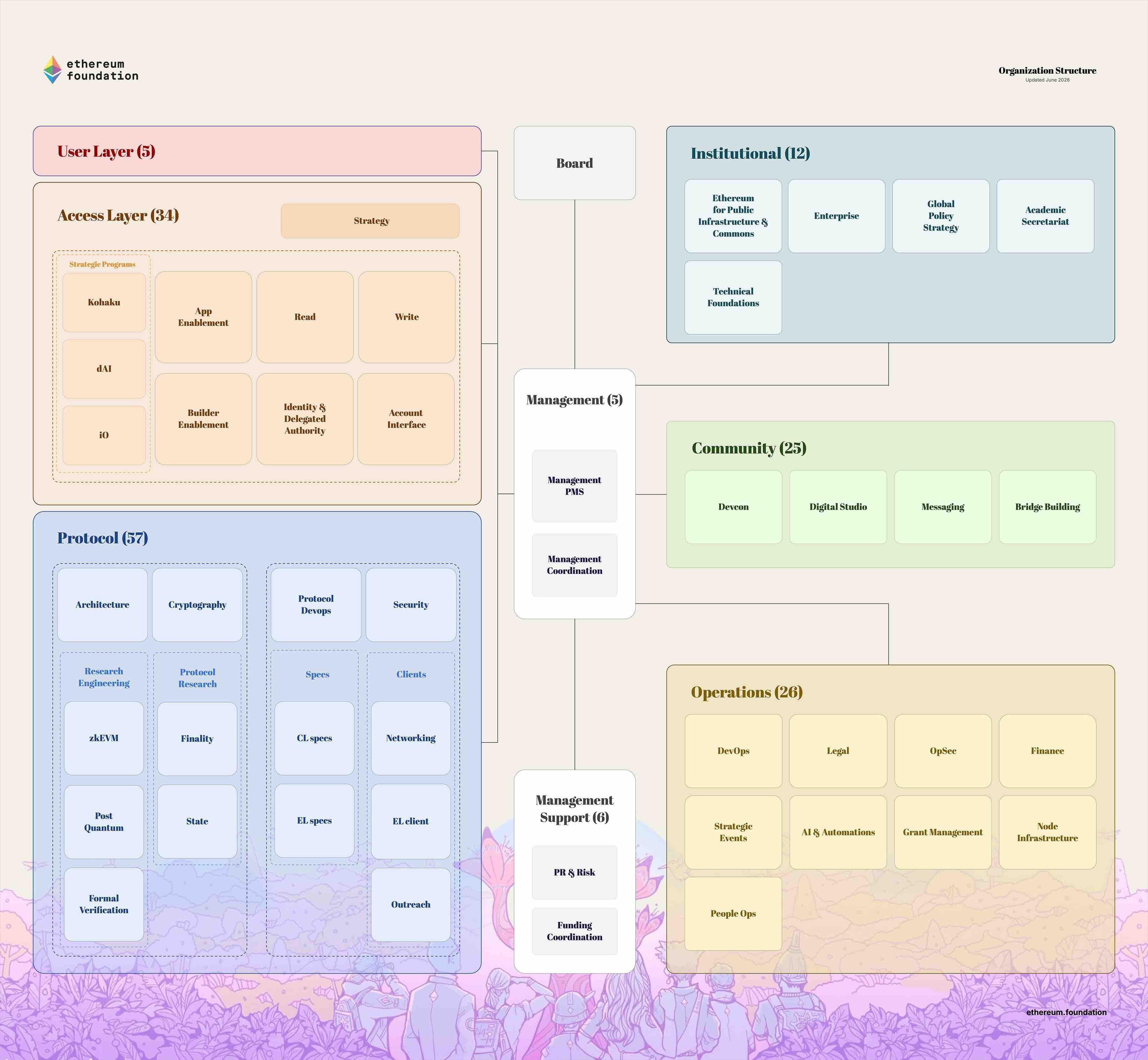
On the evening of June 23rd, EF officially announced a comprehensive internal restructuring, dividing into several functional clusters including the Protocol Layer, Access Layer, User Layer, Community Layer, and Institutional Layer. Simultaneously, the foundation laid off approximately 20% of its staff, with about 54 employees departing.
At the same time, Ethereum co-founder Vitalik Buterin also disclosed more detailed reform ideas on X: EF will gradually reduce its expenditure scale in the coming years, cutting its budget by about 40% compared to before, and plans to decrease its annual spending rate from the previous roughly 15% to about 5% post-2030, transitioning towards an endowment-driven operational model.

Clearly, this is an unconventional major organizational overhaul. Considering the controversies and challenges Ethereum has faced over the past year, this reform seems more like a long-overdue correction of its positioning.

From ETH's prolonged price slump to debates over the success or failure of scaling solutions; from the community's persistent questioning of the foundation's execution capabilities to the successive departures of core members... over the past year, criticism surrounding EF has hardly ceased. This round of layoffs, restructuring, and budget adjustments by EF is seen by many as its first systematic response to these issues.

Why is EF Always Mired in Controversy?

Over the past few years, as the most influential central entity within the entire Ethereum ecosystem, EF's every move has been accompanied by controversy.

Some criticize the foundation for selling ETH long-term, undermining community confidence; others question EF's overemphasis on public goods and long-term research, neglecting market competition and ecosystem growth; still others believe that faced with increasingly fierce industry competition, EF has consistently lacked sufficiently clear strategic articulation and execution capabilities... Whenever market dissatisfaction arises towards Ethereum, EF often becomes the most direct target of criticism.

While these controversies appear varied, they point to the same underlying reality — for over a decade, EF has played an extremely unique role. It is both a key driver of protocol research and a funder of ecosystem development; it undertakes the responsibility of coordinating diverse interests and, to a large extent, also represents the external perception of Ethereum.

In Ethereum's early development stages, such a role was crucial. However, as Ethereum has evolved into a global network with a vast developer community, hundreds of billions in asset value, and numerous institutional participants, market expectations of EF have quietly shifted.

What role should EF actually play? Is it merely a non-profit organization focused on research, or the de facto coordinating center for the entire ecosystem? Is it accountable to ETH holders? Should it also respond to market expectations for growth, adoption, and value accumulation?

To these questions, EF has long failed to provide clear answers. Consequently, controversies over token sales, execution, governance, and even personnel attrition continue to accumulate, eventually evolving into a war of words centering on the foundation itself. Coupled with ETH's persistently low price, the community needed an outlet for its frustration, and EF happened to be the most suitable target.

EF's Answer: Redefining Boundaries

If all community skepticism towards EF in recent years ultimately points to the ambiguity of the foundation's role, then the core of this reform is that EF has finally begun to redefine itself, clarifying what it should and should not do.

Judging from the newly announced organizational structure, EF has clearly delineated its future priorities into the following five areas:

  • Protocol Layer: Responsible for advancing core protocol R&D and network security.
  • Access Layer: Focuses on wallets, developer tools, and infrastructure experience.
  • User Layer: Concentrates on applications and user experience.
  • Community Layer: Undertakes developer and ecosystem coordination work.
  • Institutional Layer: Responsible for promoting adoption of Ethereum by governments, enterprises, and traditional institutions.

While clarifying functional clusters, EF is also proactively scaling back through measures like 20% layoffs and a 40% budget reduction. Notably, Vitalik did not package this reform as a simple 'efficiency improvement,' but candidly admitted it signifies real losses — some projects will end, certain capabilities will be lost, and some long-term contributors will leave.

Vitalik gave examples, stating that the PSE (Privacy and Scaling Explorations) team, long focused on cutting-edge privacy and scaling research, will gradually fade from the scene; Devcon will transition to a smaller-scale, lower-cost model in the future; the foundation's investment in large projects outside of Ethereum will decrease; and institutional cooperation efforts will also become more focused and scaled back.

However, Vitalik also emphasized that this does not mean overall ecosystem investment in these directions will decrease. On the contrary, much of the work is merely shifting from an 'exploration' phase to an 'implementation' phase, moving from within EF to the broader ecosystem.

For an organization that has long simultaneously shouldered research, funding, coordination, and even some ecosystem-driving responsibilities, this signifies a clear retreat from its role. EF no longer aims to be an all-encompassing ecosystem hub but hopes to return to its core functions: protocol research, public goods support, and ecosystem coordination. As for more specific construction work, it will gradually be undertaken by independent teams within the ecosystem and market forces.

Ecosystem Forces Are Stepping In

If EF's reform signifies a proactive step back, then another question worth noting is: who will fill the void it leaves? The answer is now apparent — the ecosystem itself.

Just before the foundation announced its restructuring, Ethlabs, founded by several former core EF researchers, was officially established and quickly gained support from ecosystem players like BitMine, SharpLink, and Joseph Lubin. (Recommended reading: "Has the Ethereum Foundation Split?! Understanding Ethlabs' 'Bright Future' in One Article")

In the past, such talent outflow might have been interpreted as a sign of the foundation's declining influence, but this time, market reaction has been the opposite. More people now view the emergence of Ethlabs as a positive development for Ethereum, as it signifies that talent, resources, and research capabilities once highly concentrated within the foundation are diffusing to more independent organizations.

Besides Ethlabs, over the past year, several other independent organizations have emerged within the Ethereum ecosystem, such as Argot Collective and Ethereum Applications Guild. Simultaneously, publicly-traded treasury companies like BitMine and SharpLink have also begun participating in ecosystem construction through funding and research grants.

Compared to a decade ago, Ethereum's power structure has fundamentally changed. Ethereum was once almost synonymous with EF. But today, Ethereum's development can no longer rely on a single institution; it increasingly requires collaboration and division of labor among different organizations within the ecosystem.

Recognition from a Competitor

Of course, EF's reform does not mean Ethereum's problems are solved.

Whether it's controversies over ETH's value capture, the pace of institutional adoption, or issues of ecosystem competitiveness and execution efficiency, none will disappear automatically due to an organizational reshuffle. But at least EF has begun acknowledging one thing — as Ethereum has grown, the foundation's capacity has become increasingly limited; it can no longer continue to play the role of "the one who solves all problems."
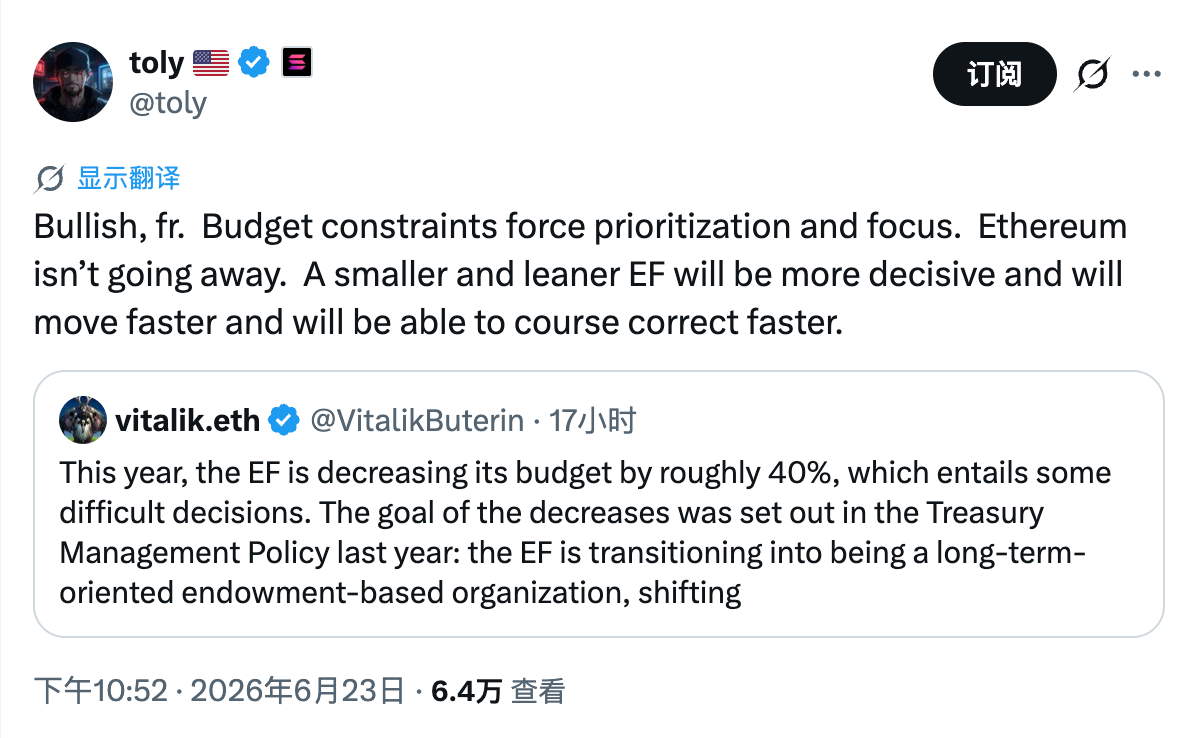
Shortly after EF announced its reform, Solana co-founder toly posted on X, stating: "Bullish. Budget constraints force us to prioritize and focus. Ethereum isn't going away. A smaller, leaner Ethereum Foundation will be more decisive, move faster, and be able to adjust direction more quickly."

Perhaps the recognition from an old rival is the highest praise for EF's current reform.

Трендові криптовалюти

Пов'язані питання

QWhat major organizational changes has the Ethereum Foundation (EF) announced?

AThe Ethereum Foundation has announced a comprehensive internal restructuring, dividing into functional clusters like the Protocol Layer, Access Layer, User Layer, Community Layer, and Institutions Layer. Accompanying this is a reduction in staff by approximately 20% (about 54 employees) and a plan to cut its budget by around 40% in the coming years.

QAccording to the article, what core issue has led to persistent controversy surrounding the Ethereum Foundation?

AThe persistent controversy stems from the EF's historically ambiguous role and unclear strategic positioning. As Ethereum grew, the market's expectations evolved, but the EF failed to definitively answer whether it was primarily a research-focused non-profit, the ecosystem's de facto coordinator, or accountable to ETH holders for market growth and value accumulation.

QHow does Vitalik Buterin characterize the impact of the EF's budget and workforce reductions?

AVitalik Buterin characterizes the impact as involving real losses. He states that the reform is not merely about 'improving quality and efficiency' but will result in the termination of some projects, the loss of certain capabilities, and the departure of long-term contributors.

QWhat is the significance of the emergence of Ethlabs and similar independent organizations, according to the article?

AThe emergence of Ethlabs and other independent organizations signifies a fundamental shift in Ethereum's power structure. It shows that talent, resources, and research capabilities, once highly concentrated within the EF, are now diffusing into the broader ecosystem. This is viewed as a positive development, indicating the ecosystem's maturation and move towards greater collaboration and division of labor among independent entities.

QWhat was Solana co-founder toly's public reaction to the EF's reorganization plan?

ASolana co-founder toly expressed a positive reaction on X, stating 'Bullish.' He commented that budget constraints force prioritization and focus, and that a smaller, leaner Ethereum Foundation would be more decisive, act faster, and adjust direction more quickly, while affirming that 'Ethereum isn't going anywhere.'

Пов'язані матеріали

Warsh Concludes Capitol Hill Visit! A Breakdown: What Did He Say Over These Two Days?

Walsh Concludes Capitol Hill Testimony: Key Takeaways on Independence, Inflation, and AI In his first congressional hearings as Fed Chair, Kevin Walsh faced intense scrutiny over the central bank's independence, internal reforms, and policy transparency. Over two days before House and Senate committees, lawmakers, particularly Democrats, questioned his ties to the Trump administration and recent initiatives like an AI task force led by venture capitalist Marc Andreessen. Walsh staunchly defended the Fed's independence, stating, "Trump selected an independent person to do an independent job," and vowed to ignore political pressure on interest rates. He emphasized a "zero tolerance" approach to inflation, downplaying the significance of a single favorable CPI report and signaling that rate hikes remain an option to restore price stability. He addressed criticism of the Andreessen-led AI working group by clarifying it only has an advisory role. On AI's economic impact, Walsh suggested the investment boom might not be inherently inflationary and could boost productivity and wages over time. Regarding policy, Walsh reiterated his preference to move away from detailed forward guidance, promising all decisions would be released publicly and simultaneously. He framed his internal reform efforts, including five new working groups starting "from a blank slate," as necessary because past Fed policy contributed to current inflation. The hearings ended with a mix of skepticism and a "wait-and-see" attitude from Washington. While Walsh navigated the initial challenge through hawkish rhetoric and debate skills, observers noted his credibility will ultimately depend on concrete actions to fight inflation and safeguard the Fed's autonomy.

marsbit9 хв тому

Warsh Concludes Capitol Hill Visit! A Breakdown: What Did He Say Over These Two Days?

marsbit9 хв тому

Understanding the Q2 Crypto Market in 5 Charts: RWA Booms, Fundamentals Continue to Improve

"5 Charts to Decrypt the Crypto Market in Q2: RWA Explosion and Fundamentals Rebound" In Q2 2026, the crypto market presented a complex picture. While major cryptocurrencies fell 36% in H1, underperforming most major asset classes except gold, crypto-related equities surged 23%, doubling the S&P 500's return. This highlights diverse investment opportunities within the sector, from AI-benefiting miners to Wall Street-linked tokenization platforms. Key takeaways from five crucial charts: 1. **Divergence:** A significant performance gap emerged between crypto assets and publicly traded crypto companies. 2. **Robust Fundamentals:** The top 10 crypto applications generated $5.9B in revenue over the past year, with leaders like PancakeSwap nearing $1B, demonstrating real business traction. 3. **RWA Boom:** Tokenized real-world assets (RWA) reached a record $33B, up 12% QoQ and 45% YTD, fueled by tokenized treasuries, credit, and equities. 4. **Prediction Market Growth:** Prediction market open interest hit a new high of $1.8B, with Q2 volume reaching $43B, driven largely by sports and upcoming political events. 5. **Attractive Correlations:** The Bitwise Crypto Innovators 30 Index showed low or negative 90-day rolling correlations with most major assets (like stocks, bonds, gold), offering potential diversification benefits alongside high returns. Overall, despite bearish price action, the data reveals resilient industry fundamentals with continued growth in users, revenue, and institutional adoption, laying groundwork for future cycles.

marsbit36 хв тому

Understanding the Q2 Crypto Market in 5 Charts: RWA Booms, Fundamentals Continue to Improve

marsbit36 хв тому

Bitcoin's Anti-Spam Data Soft Fork BIP110: Miner Collective Boycott, Already Doomed to Fail?

The article discusses the controversial Bitcoin Improvement Proposal (BIP) 110, a "data reduction" soft fork aimed at limiting non-monetary data, such as certain scripts, within Bitcoin transactions. Proponents argue this data violates network principles, but the author strongly disagrees. The core argument is that Bitcoin's fundamental value lies in its open-access, censorship-resistant ledger. Anyone can write data by paying fees, and attempting to police how data is interpreted externally is both impossible and contrary to Bitcoin's ethos. The author compares this to free speech and notes that Bitcoin's existing protocol limits (block size, sigops) already manage network load effectively, even spurring layer-2 innovation. Technically, BIP110 would impose significant new restrictions on script size, Taproot features, and upgradability, applying to UTXOs created within about a year of activation. Its deployment mechanism is criticized for having an unusually low 55% miner signaling threshold and a forced activation timeline, representing the most aggressive script limitations since 2010. The author finds the rationale weak, stating the "problem" it addresses is already managed, and the fork's rushed process ignores broader ecosystem consensus. Importantly, they note that users of so-called unwanted data have already adapted their software to work around the proposed rules. The conclusion is that BIP110 is destined to fail. It attempts the impossible—controlling how an open ledger is used—based on flawed reasoning and via a reckless process. The article reports that miners, developers, and the broader community have rejected it, and Bitcoin will emerge stronger by continuing its normal operation without this change.

marsbit49 хв тому

Bitcoin's Anti-Spam Data Soft Fork BIP110: Miner Collective Boycott, Already Doomed to Fail?

marsbit49 хв тому

Breaking the Offer Price! SpaceX's Stock Price Falls Below the $135 IPO Price for the First Time, Company Bonds Decline Continuously, Yield Reaches 7.5%, Comparable to Junk Bonds

SpaceX's stock price fell below its $135 IPO price for the first time, trading as low as $132.15 before closing slightly above the offering price. The stock has experienced high volatility typical of new listings, surrendering nearly all its initial 50% surge. Compounding equity pressures, the company's newly issued $25 billion bond due 2056 has also declined in price, pushing its yield to a junk-bond-like 7.5%. Analysts note investor skepticism is growing regarding the costs and distant timeline of SpaceX's xAI and large infrastructure ambitions. A significant 20% of the IPO's $75 billion raise went to retail investors, making the price decline a notable blow to market confidence. Further downside risk looms as lock-up periods for early investors expire soon, potentially triggering significant selling pressure alongside the company's first quarterly earnings report. Initial upward momentum was partly fueled by an estimated $5.4 billion in mandatory buying from index funds after SpaceX's rapid inclusion in major indices like the Nasdaq 100. Despite the current weakness, Wall Street sentiment remains broadly positive. With bank analyst quiet periods ending, over 80% of coverage initiates with a "Buy" rating, and the average price target implies roughly 78% upside from current levels.

链捕手1 год тому

Breaking the Offer Price! SpaceX's Stock Price Falls Below the $135 IPO Price for the First Time, Company Bonds Decline Continuously, Yield Reaches 7.5%, Comparable to Junk Bonds

链捕手1 год тому

Торгівля

Спот

Популярні статті

Що таке $S$

Розуміння SPERO: Комплексний огляд Вступ до SPERO Оскільки ландшафт інновацій продовжує еволюціонувати, виникнення технологій web3 та криптовалютних проектів відіграє ключову роль у формуванні цифрового майбутнього. Один з проектів, який привернув увагу в цій динамічній сфері, — це SPERO, позначений як SPERO,$$s$. Ця стаття має на меті зібрати та представити детальну інформацію про SPERO, щоб допомогти ентузіастам та інвесторам зрозуміти його основи, цілі та інновації в рамках web3 та крипто-сектору. Що таке SPERO,$$s$? SPERO,$$s$ — це унікальний проект у криптопросторі, який прагне використати принципи децентралізації та технології блокчейн для створення екосистеми, що сприяє залученню, корисності та фінансовій інклюзії. Проект розроблений для полегшення взаємодії між користувачами новими способами, надаючи їм інноваційні фінансові рішення та послуги. У своїй основі SPERO,$$s$ прагне надати можливості індивідам, забезпечуючи інструменти та платформи, які покращують користувацький досвід у криптовалютному просторі. Це включає в себе можливість більш гнучких методів транзакцій, сприяння ініціативам, що підтримуються спільнотою, та створення шляхів для фінансових можливостей через децентралізовані додатки (dApps). Основна концепція SPERO,$$s$ обертається навколо інклюзивності, прагнучи зменшити розриви в традиційній фінансовій системі, використовуючи переваги технології блокчейн. Хто є творцем SPERO,$$s$? Особистість творця SPERO,$$s$ залишається дещо невідомою, оскільки є обмежені публічно доступні ресурси, що надають детальну інформацію про його засновників. Ця відсутність прозорості може бути наслідком зобов'язання проекту до децентралізації — етики, яку багато проектів web3 поділяють, ставлячи колективні внески вище за індивідуальне визнання. Зосереджуючи обговорення навколо спільноти та її колективних цілей, SPERO,$$s$ втілює суть наділення без виділення конкретних осіб. Таким чином, розуміння етики та місії SPERO є більш важливим, ніж ідентифікація єдиного творця. Хто є інвесторами SPERO,$$s$? SPERO,$$s$ підтримується різноманітними інвесторами, починаючи від венчурних капіталістів до ангельських інвесторів, які прагнуть сприяти інноваціям у крипто-секторі. Зосередження цих інвесторів зазвичай узгоджується з місією SPERO — пріоритет надається проектам, які обіцяють технологічний прогрес у суспільстві, фінансову інклюзію та децентралізоване управління. Ці інвесторські фонди зазвичай зацікавлені в проектах, які не лише пропонують інноваційні продукти, але й позитивно впливають на спільноту блокчейн та її екосистеми. Підтримка з боку цих інвесторів підкріплює SPERO,$$s$ як значного конкурента в швидко змінюваній сфері крипто-проектів. Як працює SPERO,$$s$? SPERO,$$s$ використовує багатогранну структуру, яка відрізняє його від традиційних криптовалютних проектів. Ось деякі ключові особливості, які підкреслюють його унікальність та інноваційність: Децентралізоване управління: SPERO,$$s$ інтегрує моделі децентралізованого управління, надаючи користувачам можливість активно брати участь у процесах прийняття рішень щодо майбутнього проекту. Цей підхід сприяє відчуттю власності та відповідальності серед членів спільноти. Корисність токена: SPERO,$$s$ використовує свій власний криптовалютний токен, розроблений для виконання різних функцій в екосистемі. Ці токени дозволяють здійснювати транзакції, отримувати винагороди та полегшувати послуги, що пропонуються на платформі, підвищуючи загальну залученість та корисність. Шарова архітектура: Технічна архітектура SPERO,$$s$ підтримує модульність та масштабованість, що дозволяє безперешкодно інтегрувати додаткові функції та додатки в міру розвитку проекту. Ця адаптивність є надзвичайно важливою для збереження актуальності в постійно змінюваному крипто-ландшафті. Залучення спільноти: Проект підкреслює ініціативи, що підтримуються спільнотою, використовуючи механізми, які стимулюють співпрацю та зворотний зв'язок. Підтримуючи сильну спільноту, SPERO,$$s$ може краще задовольняти потреби користувачів та адаптуватися до ринкових тенденцій. Фокус на інклюзію: Пропонуючи низькі комісії за транзакції та зручні інтерфейси, SPERO,$$s$ прагне залучити різноманітну базу користувачів, включаючи осіб, які раніше не брали участі в крипто-просторі. Це зобов'язання до інклюзії узгоджується з його загальною місією наділення через доступність. Хронологія SPERO,$$s$ Розуміння історії проекту надає важливі уявлення про його розвиток та етапи. Нижче наведено пропоновану хронологію, що відображає значні події в еволюції SPERO,$$s$: Етап концептуалізації та ідеації: Початкові ідеї, що стали основою SPERO,$$s$, були сформовані, тісно пов'язані з принципами децентралізації та фокусом на спільноті в індустрії блокчейн. Запуск білого паперу проекту: Після концептуального етапу був випущений комплексний білий папір, що детально описує бачення, цілі та технологічну інфраструктуру SPERO,$$s$, щоб залучити інтерес та зворотний зв'язок від спільноти. Створення спільноти та ранні залучення: Активні зусилля були спрямовані на створення спільноти ранніх прихильників та потенційних інвесторів, що полегшило обговорення цілей проекту та отримання підтримки. Подія генерації токенів: SPERO,$$s$ провів подію генерації токенів (TGE) для розподілу своїх рідних токенів серед ранніх прихильників та встановлення початкової ліквідності в екосистемі. Запуск початкового dApp: Перший децентралізований додаток (dApp), пов'язаний з SPERO,$$s$, став доступним, дозволяючи користувачам взаємодіяти з основними функціями платформи. Постійний розвиток та партнерства: Безперервні оновлення та вдосконалення пропозицій проекту, включаючи стратегічні партнерства з іншими учасниками блокчейн-простору, сформували SPERO,$$s$ у конкурентоспроможного та еволюціонуючого гравця на крипто-ринку. Висновок SPERO,$$s$ є свідченням потенціалу web3 та криптовалют для революціонізації фінансових систем та наділення індивідів. Завдяки зобов'язанню до децентралізованого управління, залучення спільноти та інноваційно спроектованих функцій, він прокладає шлях до більш інклюзивного фінансового ландшафту. Як і з будь-якими інвестиціями в швидко змінюваному крипто-просторі, потенційним інвесторам та користувачам рекомендується ретельно досліджувати та обдумано взаємодіяти з поточними подіями в SPERO,$$s$. Проект демонструє інноваційний дух крипто-індустрії, запрошуючи до подальшого дослідження його численних можливостей. Хоча подорож SPERO,$$s$ ще триває, його основні принципи можуть справді вплинути на майбутнє того, як ми взаємодіємо з технологією, фінансами та один з одним у взаємопов'язаних цифрових екосистемах.

130 переглядів усьогоОпубліковано 2024.12.17Оновлено 2024.12.17

Що таке $S$

Що таке AGENT S

Агент S: Майбутнє автономної взаємодії в Web3 Вступ У постійно змінюваному ландшафті Web3 та криптовалюти інновації постійно переосмислюють, як люди взаємодіють з цифровими платформами. Один з таких новаторських проектів, Агент S, обіцяє революціонізувати взаємодію людини з комп'ютером через свою відкриту агентну структуру. Прокладаючи шлях для автономних взаємодій, Агент S прагне спростити складні завдання, пропонуючи трансформаційні застосування в штучному інтелекті (ШІ). Це детальне дослідження заглиблюється в складності проекту, його унікальні особливості та наслідки для сфери криптовалюти. Що таке Агент S? Агент S є революційною відкритою агентною структурою, спеціально розробленою для вирішення трьох основних викликів в автоматизації комп'ютерних завдань: Набуття специфічних знань у галузі: Структура інтелектуально навчається з різних зовнішніх джерел знань та внутрішнього досвіду. Цей подвійний підхід дозволяє їй створити багатий репозиторій специфічних знань у галузі, покращуючи її продуктивність у виконанні завдань. Планування на довгих горизонтах завдань: Агент S використовує планування з підкріпленням досвіду, стратегічний підхід, який полегшує ефективний розподіл та виконання складних завдань. Ця функція значно підвищує її здатність ефективно та результативно управляти кількома підзавданнями. Обробка динамічних, неоднорідних інтерфейсів: Проект представляє Інтерфейс Агент-Комп'ютер (ACI), інноваційне рішення, яке покращує взаємодію між агентами та користувачами. Використовуючи багатомодальні великі мовні моделі (MLLMs), Агент S може безперешкодно орієнтуватися та маніпулювати різноманітними графічними інтерфейсами користувача. Завдяки цим новаторським функціям Агент S надає надійну структуру, яка вирішує складнощі, пов'язані з автоматизацією людської взаємодії з машинами, прокладаючи шлях для численних застосувань у ШІ та за його межами. Хто є творцем Агент S? Хоча концепція Агент S є фундаментально новаторською, конкретна інформація про його творця залишається невідомою. Творець наразі невідомий, що підкреслює або початкову стадію проекту, або стратегічний вибір зберегти засновників у таємниці. Незважаючи на анонімність, акцент залишається на можливостях та потенціалі структури. Хто є інвесторами Агент S? Оскільки Агент S є відносно новим у криптографічній екосистемі, детальна інформація про його інвесторів та фінансових спонсорів не задокументована. Відсутність публічно доступних відомостей про інвестиційні фонди або організації, що підтримують проект, викликає питання щодо його фінансової структури та дорожньої карти розвитку. Розуміння підтримки є критично важливим для оцінки стійкості проекту та потенційного впливу на ринок. Як працює Агент S? В основі Агент S лежить передова технологія, яка дозволяє йому ефективно функціонувати в різних умовах. Його операційна модель побудована навколо кількох ключових функцій: Взаємодія з комп'ютером, подібна до людської: Структура пропонує розширене планування ШІ, прагнучи зробити взаємодії з комп'ютерами більш інтуїтивними. Імітуючи людську поведінку при виконанні завдань, вона обіцяє підвищити досвід користувачів. Наративна пам'ять: Використовується для використання високорівневого досвіду, Агент S використовує наративну пам'ять для відстеження історій завдань, тим самим покращуючи свої процеси прийняття рішень. Епізодична пам'ять: Ця функція надає користувачам покрокові інструкції, дозволяючи структурі пропонувати контекстуальну підтримку в міру виконання завдань. Підтримка OpenACI: Завдяки можливості працювати локально, Агент S дозволяє користувачам зберігати контроль над своїми взаємодіями та робочими процесами, узгоджуючи з децентралізованою етикою Web3. Легка інтеграція з зовнішніми API: Його універсальність і сумісність з різними платформами ШІ забезпечують те, що Агент S може безперешкодно вписатися в існуючі технологічні екосистеми, роблячи його привабливим вибором для розробників та організацій. Ці функціональні можливості колективно сприяють унікальному положенню Агент S у крипто-просторі, оскільки він автоматизує складні, багатоступеневі завдання з мінімальним втручанням людини. У міру розвитку проекту його потенційні застосування в Web3 можуть переосмислити, як відбуваються цифрові взаємодії. Хронологія Агент S Розробка та етапи Агент S можуть бути узагальнені в хронології, яка підкреслює його значні події: 27 вересня 2024 року: Концепція Агент S була представлена в комплексній науковій статті під назвою “Відкрита агентна структура, яка використовує комп'ютери як людина”, що демонструє основи проекту. 10 жовтня 2024 року: Наукова стаття була опублікована на arXiv, пропонуючи детальне дослідження структури та її оцінки продуктивності на основі бенчмарку OSWorld. 12 жовтня 2024 року: Було випущено відеопрезентацію, що надає візуальне уявлення про можливості та особливості Агент S, ще більше залучаючи потенційних користувачів та інвесторів. Ці маркери в хронології не лише ілюструють прогрес Агент S, але й вказують на його прихильність до прозорості та залучення громади. Ключові моменти про Агент S У міру розвитку структури Агент S кілька ключових характеристик виділяються, підкреслюючи її новаторський характер та потенціал: Інноваційна структура: Розроблена для забезпечення інтуїтивного використання комп'ютерів, подібного до людської взаємодії, Агент S пропонує новий підхід до автоматизації завдань. Автономна взаємодія: Здатність автономно взаємодіяти з комп'ютерами через GUI означає стрибок до більш інтелектуальних та ефективних обчислювальних рішень. Автоматизація складних завдань: Завдяки своїй надійній методології він може автоматизувати складні, багатоступеневі завдання, роблячи процеси швидшими та менш схильними до помилок. Безперервне вдосконалення: Механізми навчання дозволяють Агенту S покращуватися на основі минулого досвіду, постійно підвищуючи свою продуктивність та ефективність. Універсальність: Його адаптивність до різних операційних середовищ, таких як OSWorld та WindowsAgentArena, забезпечує його здатність служити широкому спектру застосувань. Оскільки Агент S займає своє місце в ландшафті Web3 та криптовалюти, його потенціал покращити можливості взаємодії та автоматизувати процеси означає значний прогрес у технологіях ШІ. Завдяки своїй інноваційній структурі Агент S є прикладом майбутнього цифрових взаємодій, обіцяючи більш безперешкодний та ефективний досвід для користувачів у різних галузях. Висновок Агент S представляє собою сміливий крок вперед у поєднанні ШІ та Web3, з можливістю переосмислити, як ми взаємодіємо з технологією. Хоча проект все ще на ранніх стадіях, можливості для його застосування є величезними та переконливими. Завдяки своїй комплексній структурі, що вирішує критичні виклики, Агент S прагне вивести автономні взаємодії на передній план цифрового досвіду. У міру того, як ми заглиблюємося в сфери криптовалюти та децентралізації, проекти, подібні до Агент S, безсумнівно, відіграватимуть ключову роль у формуванні майбутнього технологій та співпраці людини з комп'ютером.

752 переглядів усьогоОпубліковано 2025.01.14Оновлено 2025.01.14

Що таке AGENT S

Як купити S

Ласкаво просимо до HTX.com! Ми зробили покупку Sonic (S) простою та зручною. Дотримуйтесь нашої покрокової інструкції, щоб розпочати свою криптовалютну подорож.Крок 1: Створіть обліковий запис на HTXВикористовуйте свою електронну пошту або номер телефону, щоб зареєструвати обліковий запис на HTX безплатно. Пройдіть безпроблемну реєстрацію й отримайте доступ до всіх функцій.ЗареєструватисьКрок 2: Перейдіть до розділу Купити крипту і виберіть спосіб оплатиКредитна/дебетова картка: використовуйте вашу картку Visa або Mastercard, щоб миттєво купити Sonic (S).Баланс: використовуйте кошти з балансу вашого рахунку HTX для безперешкодної торгівлі.Треті особи: ми додали популярні способи оплати, такі як Google Pay та Apple Pay, щоб підвищити зручність.P2P: Торгуйте безпосередньо з іншими користувачами на HTX.Позабіржова торгівля (OTC): ми пропонуємо індивідуальні послуги та конкурентні обмінні курси для трейдерів.Крок 3: Зберігайте свої Sonic (S)Після придбання Sonic (S) збережіть його у своєму обліковому записі на HTX. Крім того, ви можете відправити його в інше місце за допомогою блокчейн-переказу або використовувати його для торгівлі іншими криптовалютами.Крок 4: Торгівля Sonic (S)Легко торгуйте Sonic (S) на спотовому ринку HTX. Просто увійдіть до свого облікового запису, виберіть торгову пару, укладайте угоди та спостерігайте за ними в режимі реального часу. Ми пропонуємо зручний досвід як для початківців, так і для досвідчених трейдерів.

1.6k переглядів усьогоОпубліковано 2025.01.15Оновлено 2026.06.02

Як купити S

Обговорення

Ласкаво просимо до спільноти HTX. Тут ви можете бути в курсі останніх подій розвитку платформи та отримати доступ до професійної ринкової інформації. Нижче представлені думки користувачів щодо ціни S (S).

活动图片