Edel Finance loses $403K as flash-loan oracle exploit hits xStock lending reserves

ambcryptoОпубліковано о 2026-07-01Востаннє оновлено о 2026-07-01

Анотація

Edel Finance, a programmable market layer for tokenized equities, suffered a $403,000 exploit. An attacker manipulated the wrapped xStocks (wGOOGLx) exchange rate via a flash loan, briefly inflating the collateral's value 78-fold to borrow far beyond its true worth. Although the protocol acted promptly to limit losses, the attack revealed critical oracle and collateral pricing vulnerabilities in tokenized lending markets. The exploit severely impacted liquidity, causing total value locked (TVL) to plummet from around $630,000 to roughly $947 as users withdrew funds. A net outflow of approximately $630,000 followed. Recovery hinges on restoring user confidence through deposit growth, stabilized TVL, and stronger oracle protections and risk management practices.

Edel Finance, a programmable market layer for tokenized equities, suffered a roughly $403,000 exploit. This was after an attacker manipulated the wrapped xStocks exchange rate through a flash loan.

The wGOOGLx collateral briefly gained in value about 78-fold over its true value. The inflated valuation allowed the attacker to borrow far more than the collateral’s true value, leaving the lender with significant bad debt.

Fortunately for the users of Edel Finance, they were able to act promptly to contain the issue before additional loss occurring.
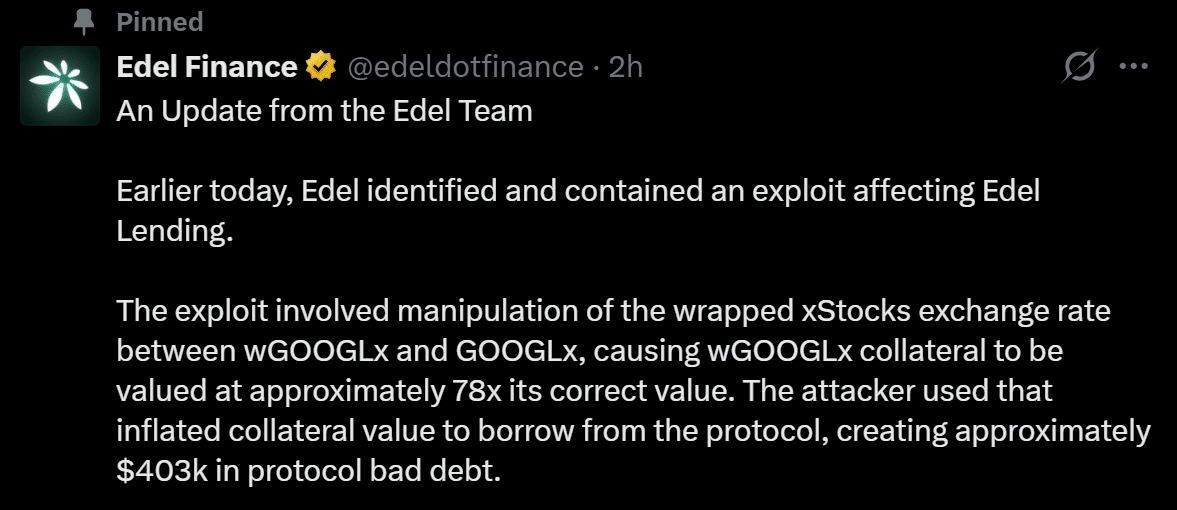
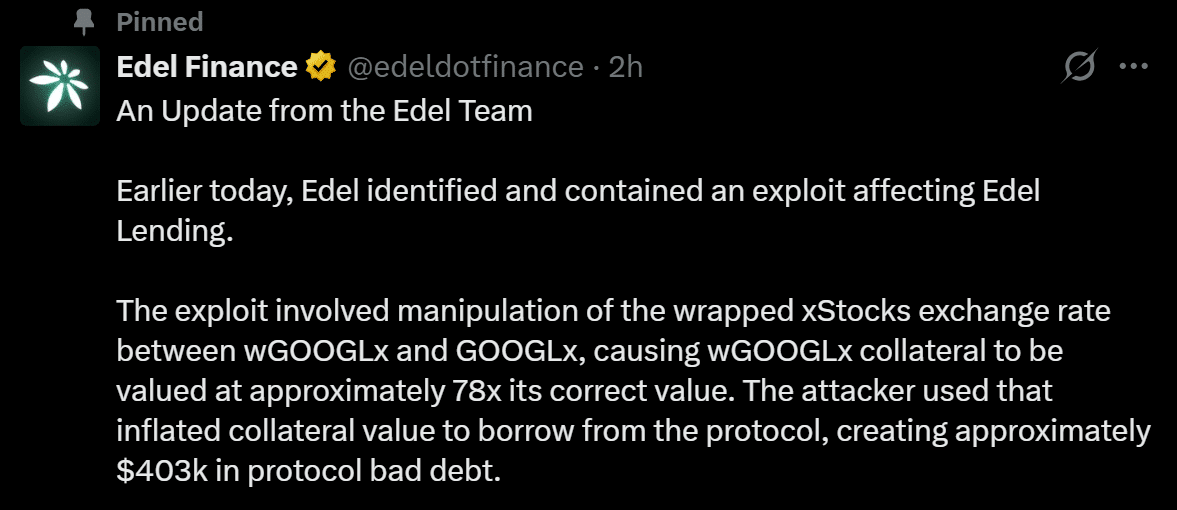
Source: X

In addition, a significant vulnerability was exposed by the attack despite the rapid response by Edel Finance. More importantly, the attack highlighted persistent weaknesses in oracle and collateral pricing across tokenized lending markets.

Conversely, unless the vulnerabilities are fully addressed, confidence remains fragile. Going forward, stronger oracle protections and collateral validation will likely determine how quickly trust returns.

Post-exploit withdrawals leave liquidity under pressure

The aftermath of the exploit quickly spilled into Edel Finance’s liquidity. As confidence deteriorated, total value locked (TVL) plunged from approximately $630,000 to roughly $947, reflecting a rapid wave of user withdrawals.
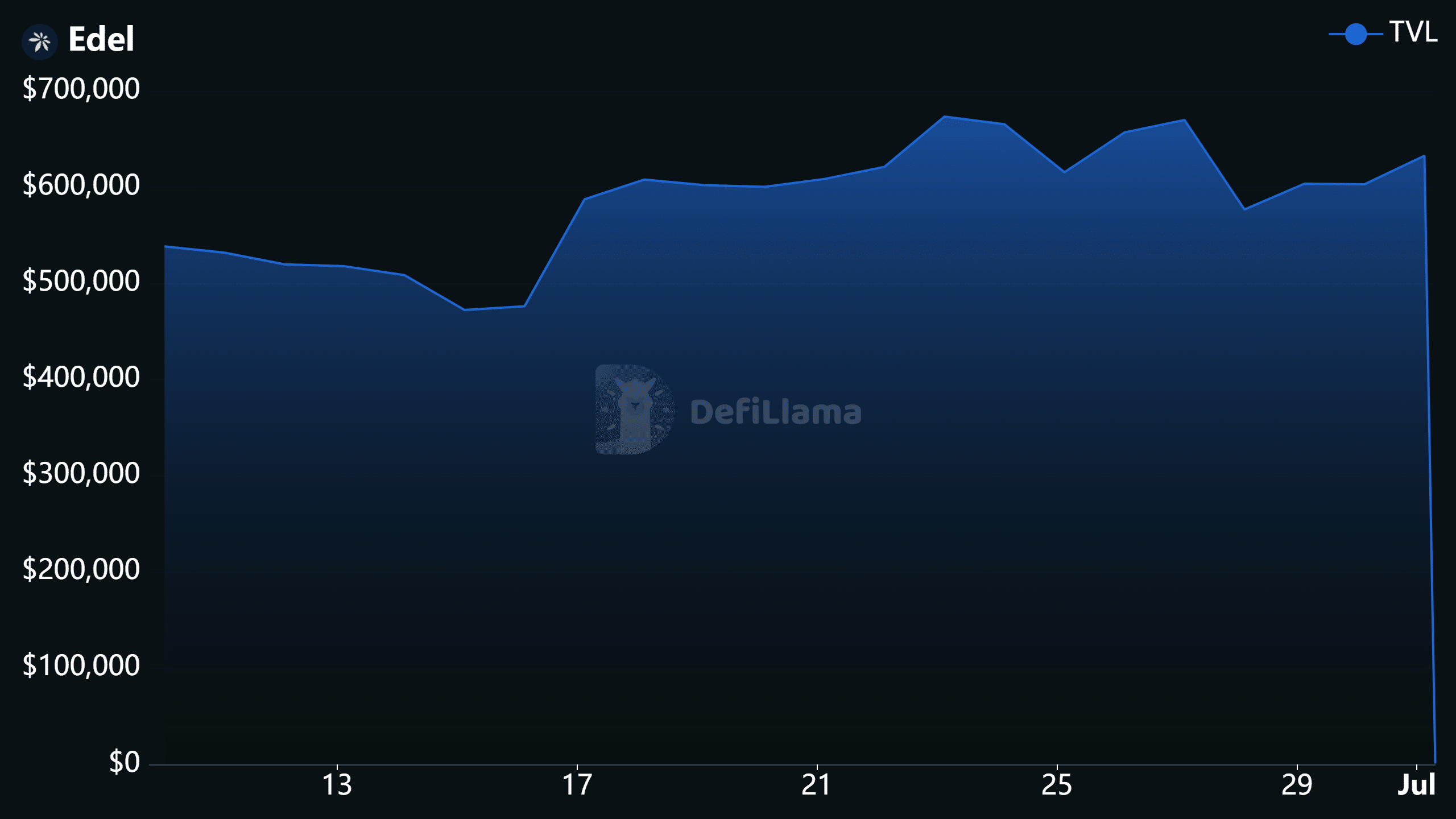
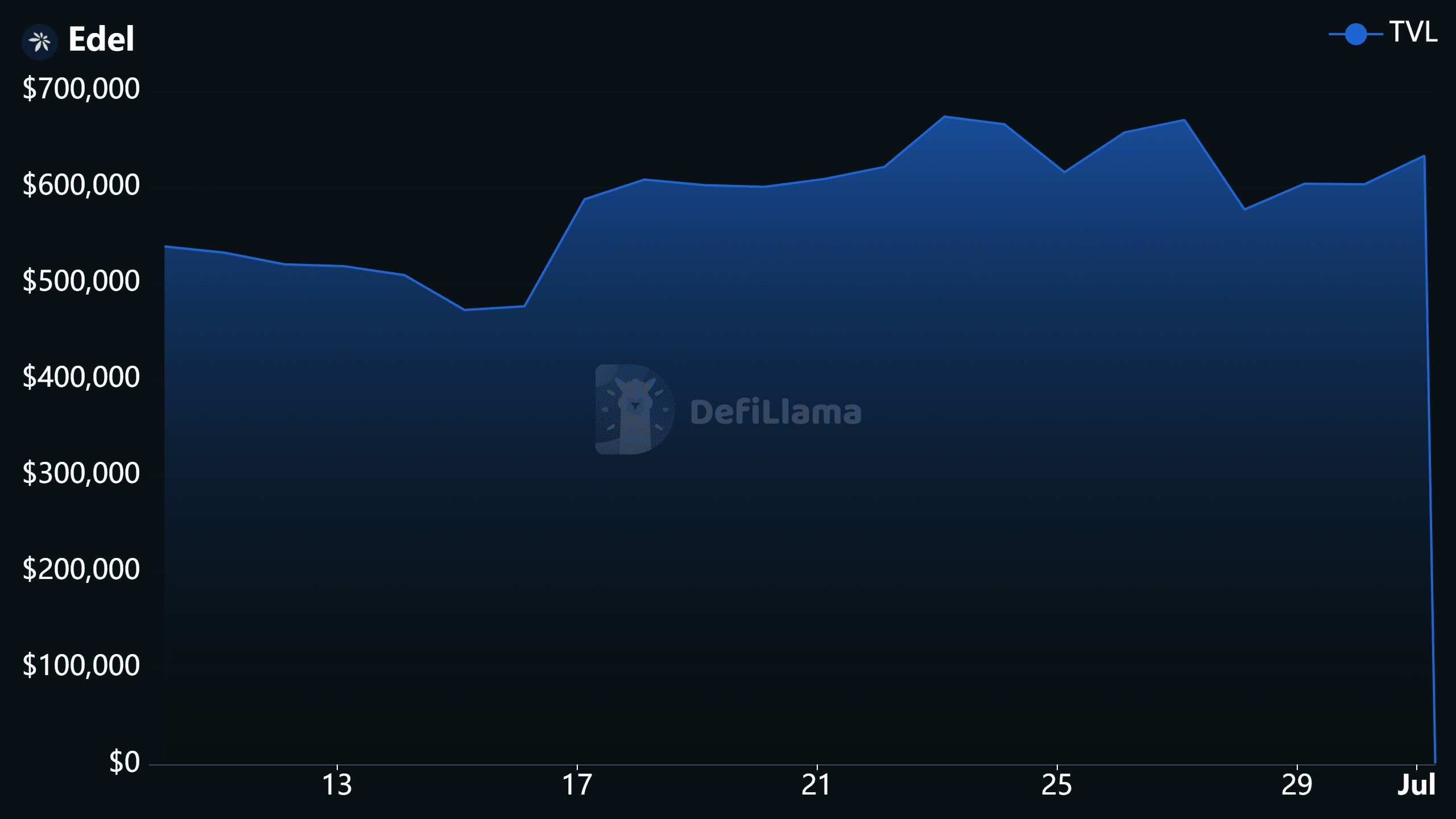
Source: DeFiLlama

Capital flows reinforced the trend further. According to DeFiLlama data, Edel Finance recorded an estimated net outflow of $630,000, the largest on record. Earlier on, a $100,000 inflow had briefly supported liquidity. Even so, it failed to offset the accelerating withdrawals that followed the exploit.
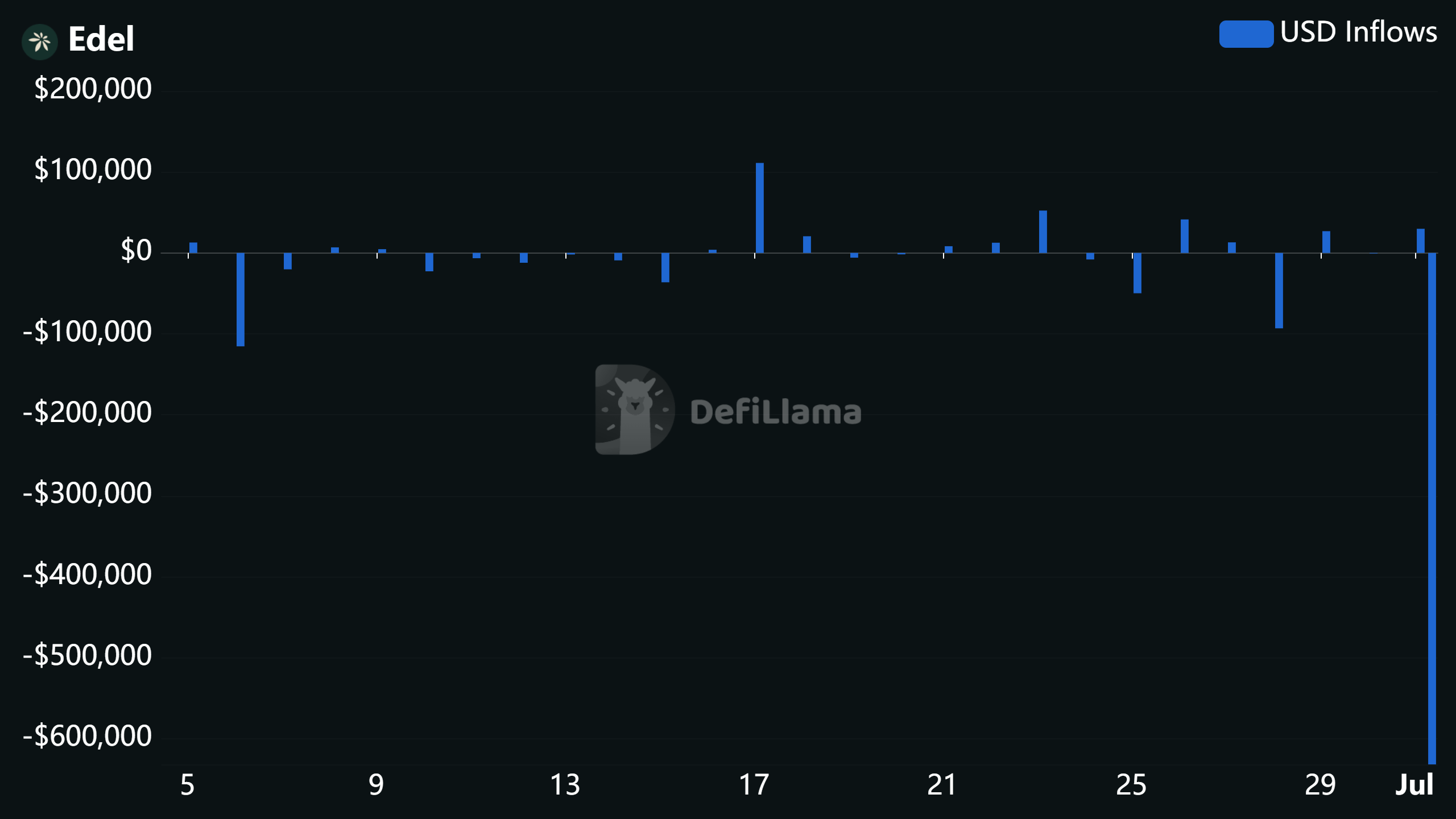
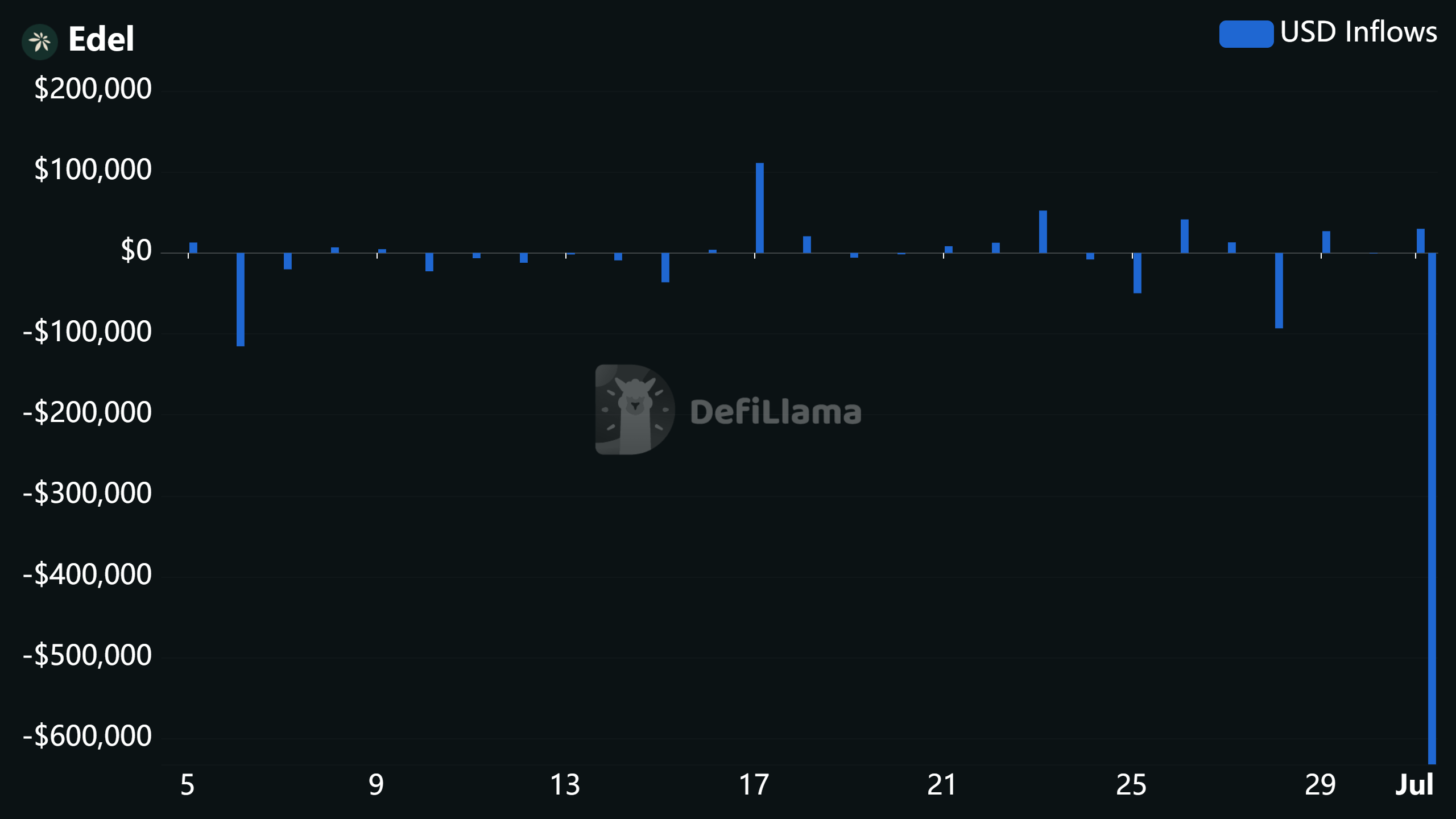
Source: DeFiLlama

These actions suggest that lenders are taking precedence over preserving capital versus supporting the protocol. Going forward, recovery depends on sustained deposit growth, stabilizing TVL, and shrinking daily outflows.

Without continued deposit growth, borrowing will continue to have limited capacity, ultimately limiting the ability of the lending platform to normalize its liquidity and delaying a return to normalcy within the lending markets.

It will take rebuilding confidence among users for meaningful capital to begin returning to Edel Finance through continued use of the lending platform and strengthened risk management practices.


Final Summary

  • Edel Finance’s xStock (wGOOGLx) exploit exposed critical oracle risks, highlighting persistent weaknesses in tokenized lending security.
  • Edel Finance’s recovery now depends on restoring liquidity, rebuilding TVL, and regaining user confidence.


Трендові криптовалюти

Пов'язані питання

QWhat was the primary method used by the attacker to exploit Edel Finance?

AThe attacker manipulated the wrapped xStocks exchange rate through a flash loan, artificially inflating the value of wGOOGLx collateral.

QHow much financial loss did Edel Finance suffer due to this exploit?

AEdel Finance suffered a roughly $403,000 exploit.

QWhat specific vulnerability in the protocol did the attack highlight?

AThe attack highlighted persistent weaknesses in oracle and collateral pricing mechanisms across tokenized lending markets.

QWhat happened to Edel Finance's Total Value Locked (TVL) following the exploit?

AFollowing the exploit and user withdrawals, the TVL plunged from approximately $630,000 to roughly $947.

QWhat is identified as essential for Edel Finance's recovery and the return of user capital?

ARecovery depends on rebuilding user confidence, sustained deposit growth, stabilizing TVL, and implementing stronger oracle protections and risk management practices.

Пов'язані матеріали

Karpathy's Genius Strikes Again, Challenging RAG, Turning Your Notes into a Second Brain

Andrej Karpathy has proposed a revolutionary concept for managing personal knowledge: treating notes as immutable "source code" and using LLMs as "compilers" to build a structured, interlinked wiki. This approach fundamentally shifts the cognitive workflow away from the limitations of RAG (Retrieval-Augmented Generation), which merely retrieves and pieces together fragments, leading to contradictions and "digital mummies"—unused, decaying notes. The LLM-Wiki framework introduces a three-layer architecture: the **Raw Layer** for original, immutable notes; the **Schema Layer** defining rules for structuring knowledge; and the **Wiki Layer**, where the LLM continuously compiles and maintains a coherent, cross-referenced knowledge base. Key operations are **Ingest** (adding new material, which triggers updates across related pages), **Query** (asking the compiled wiki, with answers that can become new pages), and **Lint** (periodic AI audits to find contradictions, outdated claims, or gaps). This system automates the tedious maintenance—updating links, resolving conflicts, keeping summaries fresh—that has historically made large-scale personal knowledge management unsustainable. It realizes Vannevar Bush's 1945 "Memex" vision by finally solving the maintenance problem. Karpathy's proposal represents a third piece in human-AI collaboration, following "Vibe Coding" and "Agentic Engineering." It liberates human attention from organizational drudgery, refocusing it on what matters: deciding what to read and deriving meaning.

marsbit5 хв тому

Karpathy's Genius Strikes Again, Challenging RAG, Turning Your Notes into a Second Brain

marsbit5 хв тому

Claude Science Completes Two Years' Work in a Few Weeks, Is 10x Research Acceleration Really Here?

Claude Science, a new AI workbench from Anthropic, is being tested by scientists, reportedly accelerating specific research workflows by up to 10x. A neuro-scientist at the Allen Institute completed a lengthy literature review in weeks instead of nearly two years using the tool, which automates tasks like citation verification. The platform is an integrated environment for macOS and Linux, connecting to local or remote computing resources. It streamlines the fragmented research process—literature analysis, computation, visualization, and drafting—into a single, auditable workflow. A key feature is its emphasis on reproducibility: every chart generated includes the exact code, environment, and history used to create it. Claude Science uses a multi-agent system. A coordinator manages over 60 pre-configured skills for life sciences (genomics, proteomics, etc.) and can spawn specialized agents. A dedicated reviewer agent checks citations and calculations for accuracy, creating a form of internal AI peer review. The system operates with a human-in-the-loop, requiring user approval for major steps. Initial applications are in life sciences. Examples include target identification for biotech company Manifold Bio and germline variant analysis for glioma research at UCSF, completing analyses in roughly one-tenth the previous time. The approach contrasts with competitors: Google focuses on proprietary models like AlphaFold, while OpenAI is advancing models' scientific reasoning with benchmarks like GeneBench-Pro. Claude Science differentiates by automating and integrating the practical research pipeline, not just the model's intelligence, aiming to make AI-aided science more reproducible and integrated into daily lab work.

marsbit9 хв тому

Claude Science Completes Two Years' Work in a Few Weeks, Is 10x Research Acceleration Really Here?

marsbit9 хв тому

The Invisible Force in Bitcoin's Bear Market: Accelerating On-Chain Payments and Institutional Adoption

Amidst ongoing Bitcoin price volatility, the quiet acceleration of on-chain payments and tokenized trading holds significant importance for investors and policymakers, especially with legislation like the CLARITY Act on the horizon. Major traditional financial institutions adopting these technologies are driving crucial discussions on compliance, security, and transparency, which are vital for broader market adoption. Key developments are shaping this evolution. First, blockchain traceability is moving beyond a simple "public vs. private" debate. New frameworks aim to standardize how financial data from immutable ledgers is analyzed and interpreted, making it as crucial as standardized financial reporting for building institutional trust. Second, while traditional finance supports clear digital asset regulation, they emphasize that an asset's economic function should dictate its regulatory treatment, advocating for robust consumer protections over broad exemptions. Furthermore, the growth of on-chain deposits at regulated institutions signals a shift. Major banks are leveraging blockchain not to replace but to upgrade existing services—like deposits and cross-border settlements—with benefits like 24/7 operations and programmable treasury management. This trend focuses more on modernizing financial infrastructure than creating speculative assets. Despite market turbulence, these underlying advancements in on-chain infrastructure point toward a more robust foundation for the industry's future.

Foresight News57 хв тому

The Invisible Force in Bitcoin's Bear Market: Accelerating On-Chain Payments and Institutional Adoption

Foresight News57 хв тому

Торгівля

Спот

Популярні статті

Як купити LAYER

Ласкаво просимо до HTX.com! Ми зробили покупку Solayer (LAYER) простою та зручною. Дотримуйтесь нашої покрокової інструкції, щоб розпочати свою криптовалютну подорож.Крок 1: Створіть обліковий запис на HTXВикористовуйте свою електронну пошту або номер телефону, щоб зареєструвати обліковий запис на HTX безплатно. Пройдіть безпроблемну реєстрацію й отримайте доступ до всіх функцій.ЗареєструватисьКрок 2: Перейдіть до розділу Купити крипту і виберіть спосіб оплатиКредитна/дебетова картка: використовуйте вашу картку Visa або Mastercard, щоб миттєво купити Solayer (LAYER).Баланс: використовуйте кошти з балансу вашого рахунку HTX для безперешкодної торгівлі.Треті особи: ми додали популярні способи оплати, такі як Google Pay та Apple Pay, щоб підвищити зручність.P2P: Торгуйте безпосередньо з іншими користувачами на HTX.Позабіржова торгівля (OTC): ми пропонуємо індивідуальні послуги та конкурентні обмінні курси для трейдерів.Крок 3: Зберігайте свої Solayer (LAYER)Після придбання Solayer (LAYER) збережіть його у своєму обліковому записі на HTX. Крім того, ви можете відправити його в інше місце за допомогою блокчейн-переказу або використовувати його для торгівлі іншими криптовалютами.Крок 4: Торгівля Solayer (LAYER)Легко торгуйте Solayer (LAYER) на спотовому ринку HTX. Просто увійдіть до свого облікового запису, виберіть торгову пару, укладайте угоди та спостерігайте за ними в режимі реального часу. Ми пропонуємо зручний досвід як для початківців, так і для досвідчених трейдерів.

326 переглядів усьогоОпубліковано 2025.02.11Оновлено 2026.06.02

Як купити LAYER

Обговорення

Ласкаво просимо до спільноти HTX. Тут ви можете бути в курсі останніх подій розвитку платформи та отримати доступ до професійної ринкової інформації. Нижче представлені думки користувачів щодо ціни LAYER (LAYER).

活动图片