Dubai, Hong Kong, and now Japan as regulatory heat intensifies for KuCoin!

ambcryptoОпубліковано о 2026-03-27Востаннє оновлено о 2026-03-27

Анотація

Japan's Financial Services Agency (FSA) has issued a warning to KuCoin and several other firms for operating unregistered over-the-counter (OTC) derivative services. This action is part of broader regulatory challenges for the exchange, which has recently faced operational bans or restrictions in Hong Kong, Austria, and Dubai for failing to meet local licensing and anti-money laundering requirements. These persistent regulatory issues have significantly eroded user trust, leading to a substantial decline in user funds. The exchange's stablecoin reserves plummeted from over $1.3 billion to $543 million in one year, indicating ongoing user caution and persistent outflows despite market rallies.

Japan’s financial market watchdog, the Financial Services Agency (FSA), has flagged KuCoin and other crypto exchanges and firms for operating certain services without proper registration.

In a statement on Thursday, the watchdog included KuCoin in the list of “unregistered businesses to which warning letters have been issued.”

The agency added that KuCoin, NeonFX, TheOption, and GTCFX were slapped with notices in March for “soliciting over-the-counter (OTC) derivative transactions via the internet.”

Interestingly, the escalation comes after the agency requested Apple and Google to block access to five unregistered crypto exchanges in February 2025. Amongst those targeted during the crackdown were KuCoin, Bybit, MEXC Global, LBank, and Bitget.

KuCoin’s regulatory headwinds

However, KuCoin’s regulatory woes go well beyond Japan. In May 2024, the exchange was forced to wind down its operations in Hong Kong. This followed restrictions and a crackdown on platforms with ties to mainland China.

Failure to meet the new licensing requirements prompted KuCoin to withdraw from Hong Kong and block users from the region from accessing the platform.

Fast forward to February 2026, and the exchange was partially banned by the Austrian Financial Market Authority (FMA). It failed to implement proper procedures to enforce anti-money laundering laws, as required by the EU’s MiCA guidelines. This was just three months after getting the MiCA license.

Earlier in March, the firm faced another regulatory hiccup with Dubai’s Virtual Assets Regulatory Authority (VARA). The agency issued a “cease and desist” order against KuCoin, alongside three other exchanges, for operating without a license. As such, the firms were banned from advertising or operating in Dubai without a valid license.

Impact of regulatory pressure on KuCoin

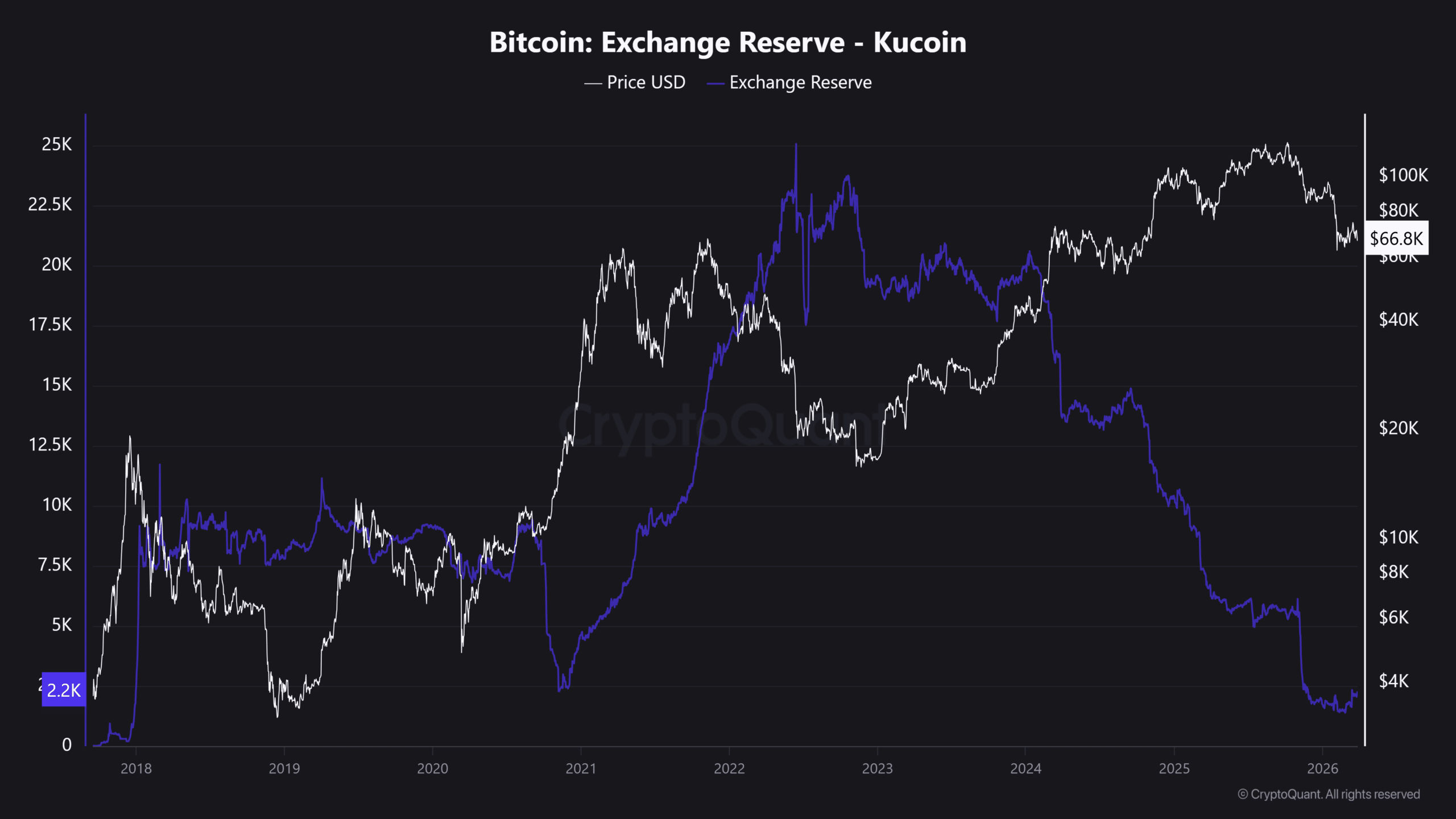
Unsurprisingly, the recurring patterns of regulatory hiccups have begun to affect user trust. This was illustrated by the Bitcoin and stablecoin reserves on the exchange. For Bitcoin, the exchange reserves dropped from 14K BTC in 2024 to 2100 BTC in early 2026.
Source: CryptoQuant

Here, it’s worth noting that the BTC exchange reserve decline was a broader trend across other platforms, likely due to transfers to self-custody wallets.

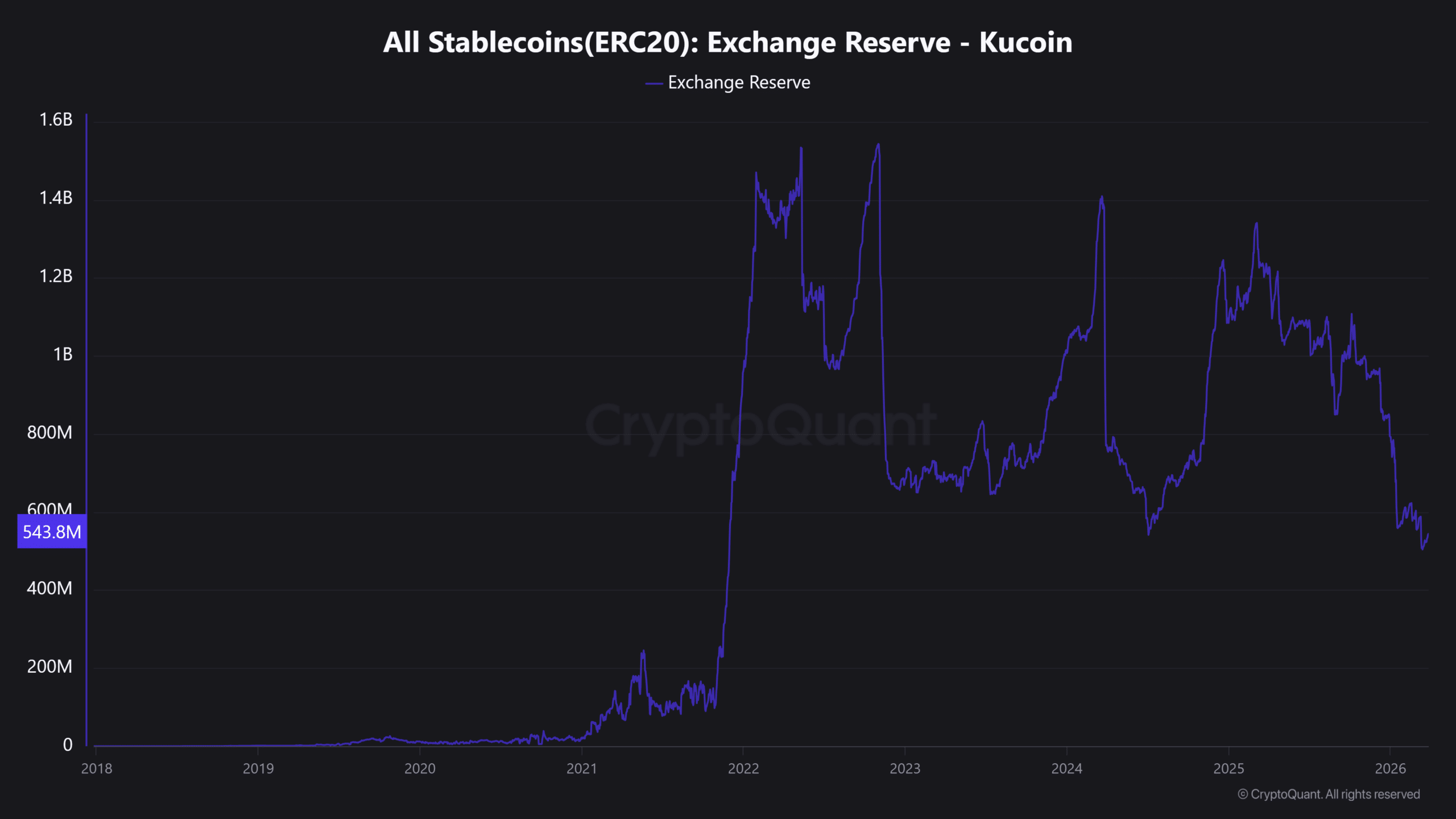
However, a deeper look at the liquidity or user funds held by the exchange, as painted by the stablecoin reserves, underscored a somewhat worried user base. The stablecoin exchange reserves fell from over $1.3 billion to $543M in just one year.

Even the mid-2025 rally and early 2026 recovery didn’t attract much flow into the exchange – Hinting at caution from users.
Source: CryptoQuant

Final Summary

  • Japan has sent a warning letter to KuCoin and other firms for operating unlicensed OTC derivatives trading.
  • Ongoing regulatory headwinds have eroded user trust, with user funds dropping from over $1.3B to $543M amid persistent outflows.


Пов'язані питання

QWhat regulatory action did Japan's FSA take against KuCoin in March 2026?

AJapan's Financial Services Agency (FSA) issued a warning letter to KuCoin for soliciting over-the-counter (OTC) derivative transactions without proper registration.

QWhich other regions has KuCoin faced regulatory challenges in besides Japan?

AKuCoin has faced regulatory challenges in Hong Kong (May 2024), Austria (February 2026), and Dubai (March 2026).

QHow did KuCoin's stablecoin reserves change between 2025 and early 2026?

AKuCoin's stablecoin reserves dropped from over $1.3 billion to $543 million in just one year, indicating significant user fund outflows.

QWhy did KuCoin wind down its operations in Hong Kong in 2024?

AKuCoin withdrew from Hong Kong after failing to meet new licensing requirements following a crackdown on platforms with ties to mainland China.

QWhat was the consequence of KuCoin's failure to comply with EU's MiCA guidelines in Austria?

AThe Austrian Financial Market Authority (FMA) partially banned KuCoin for failing to implement proper anti-money laundering procedures as required by MiCA, just three months after obtaining the license.

Пов'язані матеріали

The Waged Worker Driven to Poverty by AI Subscriptions

"AI Membership: The Hidden Cost Pushing Workers Toward 'Poverty'" The widespread corporate push for AI adoption is creating a hidden financial burden for employees. Companies, from giants like Alibaba to small firms, are mandating AI use, often tying token consumption to KPIs, but frequently refuse to cover the costs. Workers are forced to pay for subscriptions out of pocket to stay competitive and avoid being replaced. Front-end developer Long Shen spends up to 2000 RMB monthly on tools like Cursor and ChatGPT Plus, seeing it as a necessary 3% salary investment to handle 90% of his coding tasks. While it boosted his performance and led to promotions, he now faces idle time at work, pretending to be busy. Designer Peng Peng navigates strict company firewalls by using personal devices and accounts for AI image generation tools like Midjourney, spending hundreds monthly without reimbursement, while her boss demands faster, more numerous revisions. The pressure creates workplace anxiety and suspicion. Programmer Li Huahua, after a friend's experience of raised KPIs following AI success, fears being branded a "traitor" for using it yet worries about falling behind if she doesn't. The dynamic allows management to demand results without understanding the tools or covering expenses, treating employees like AI "agents." While some, like entrepreneur Jin Tu, find high value in paid AI, building entire systems and winning competitions, for most, it's a trap. Free tools like Kimi and Doubao are introducing fees, closing off alternatives. The initial efficiency gains individual advantage, but as AI becomes ubiquitous, the personal edge disappears, workloads increase, and a cycle of dependency begins. Workers like Long Shen realize they cannot maintain AI-generated code without AI, making stopping harder than continuing to pay. The tool promising liberation is instead becoming a compulsory, costly chain in the modern workplace.

marsbit36 хв тому

The Waged Worker Driven to Poverty by AI Subscriptions

marsbit36 хв тому

SK Hynix's Trillion-Won Empire: The Successors

"SK Hynix's Trillion-Won Empire and Its Heirs" explores the unconventional succession narrative within SK Group, South Korea's second-largest conglomerate, following SK Hynix's dramatic market rise. Unlike traditional chaebol scripts prioritizing the eldest son, ownership, and political marriages, Chairman Choi Tae-won's three children from his first marriage are charting distinct paths. The eldest daughter, Choi Yun-jeong, is considered the most visible candidate. With a background in biology, consulting, and a PhD, she holds executive roles at SK Bioscience and SK Inc.'s growth strategy unit, focusing on biopharma and new businesses. Her marriage is to an AI infrastructure entrepreneur, not a traditional chaebol heir. The second daughter, Choi Min-jeong, took a unique route by voluntarily serving as a South Korean naval officer, including a tour in the Gulf of Aden. She later worked on policy and strategy for SK Hynix in Washington D.C. before co-founding an AI-driven healthcare startup in San Francisco. She married a former U.S. Marine Corps officer, connecting the family to U.S. defense and policy networks. The son, Choi In-geun, who has Type 1 diabetes, followed a more classic preparatory path with a physics degree and a stint at SK E&S but left to join McKinsey's Seoul office. He remains publicly silent and holds no SK shares, defying the traditional "crown prince" archetype. Their paths unfold against the backdrop of their parents' high-profile, contentious divorce and a record-setting asset division lawsuit. The article argues that as SK Hynix becomes a geopolitical asset in the AI era, the conventional rules of chaebol inheritance are changing. The heirs are being groomed not simply to take over, but to navigate a complex global landscape defined by AI, biotech, geopolitics, and policy, forging legitimacy through their own expertise and networks rather than birth order alone.

marsbit45 хв тому

SK Hynix's Trillion-Won Empire: The Successors

marsbit45 хв тому

BitMart Research Institute Weekly Highlights: A Comprehensive Review of Macro Environment, Crude Oil, AI Tech Stocks, and Crypto Market

**Weekly Market Review: Macro, Oil, AI Tech Stocks & Crypto Market** **Macroeconomic & Traditional Finance** The April U.S. Non-Farm Payrolls report of 115K new jobs exceeded expectations, but the data's quality was questioned. Growth was heavily concentrated in healthcare, while other sectors contracted, and manufacturing employment turned negative. A statistical model accounted for a large portion of the gains, conflicting with household survey data showing a loss of 226K jobs. Meanwhile, AI's impact on jobs is emerging, with information sector roles declining, though overall unemployment remains at ~4.3%. Oil prices hovered near $100 per barrel. Global oil buffer inventories have drawn down significantly, supporting prices, but high costs are suppressing demand. China's recent reduction in crude imports acted as a market stabilizer. Geopolitically, the U.S. and Iran are likely to reach a tentative agreement to keep the Strait of Hormuz open and avoid price spikes. For AI tech stocks, short-term prospects are mixed. A potential SpaceX IPO in June could pressure current index heavyweights like Nvidia, while smaller components might benefit. The mid-term focus shifts to Q2 earnings, emphasizing AI's return on investment. Long-term risks include potential election policy shifts and massive IPOs from companies like OpenAI, which could test the sector's sustainability. **Crypto Market & Ecosystem** Crypto markets rose moderately, with BTC climbing from ~$77K to ~$82K, driven by improved risk sentiment. Spot trading volumes remain low, but buying pressure is evident. ETF inflows continued (~$791M last week). However, institutional purchases of BTC and ETH were more modest than expected. The derivatives market shows lingering bearish bets, particularly on alts and ETH. A key trend is the "dual-track" model where projects pursue public listings for traditional funding while also building their own blockchains/tokens to capture crypto liquidity, as seen with Circle's ARC chain. Stablecoins and institutional chains present significant future opportunities. *Disclaimer: This is market analysis, not investment advice.*

marsbit1 год тому

BitMart Research Institute Weekly Highlights: A Comprehensive Review of Macro Environment, Crude Oil, AI Tech Stocks, and Crypto Market

marsbit1 год тому

Торгівля

Спот
Ф'ючерси
活动图片




