Doubao and Qwen Will Discontinue Agent Functionality on July 15

marsbitОпубліковано о 2026-07-05Востаннє оновлено о 2026-07-05

Анотація

On July 4th, Doubao and Tongyi Qianwen announced the impending shutdown of their user-created "AI Agent" features. Doubao confirmed its agent feature will be taken offline on July 15, directing users to ByteDance's CatBox app for similar needs. On the same day, Tongyi Qianwen notified users, specifying that personalized interactive agents and user-built agent functions will cease on July 10, with all agent features and services completely deactivated by July 15. After this date, access to agent configurations and historical chat records will be lost. This adjustment impacts core user scenarios like role-playing, personal assistants, and vertical tool agents. The shutdown date coincides with the official implementation of China's "Interim Measures for the Administration of Artificial Intelligence Human-like Interactive Services" on July 15. The new regulations impose strict rules on "human-like emotional interaction services," requiring platforms to implement measures like anti-addiction systems, minor verification, and content moderation. This move is widely seen as a proactive step by the platforms to align with regulatory timelines and mitigate compliance risks. Additionally, commercial challenges are a key driver. Analysis suggests that casual, human-like chat agents generate high-frequency, low-value interactions, leading to high computational costs with poor monetization. As the AI application market shifts from user growth to proving value, sustaining such "high-cost...

On July 4, Doubao and Tongyi Qwen announced the upcoming discontinuation of their agent functionality.

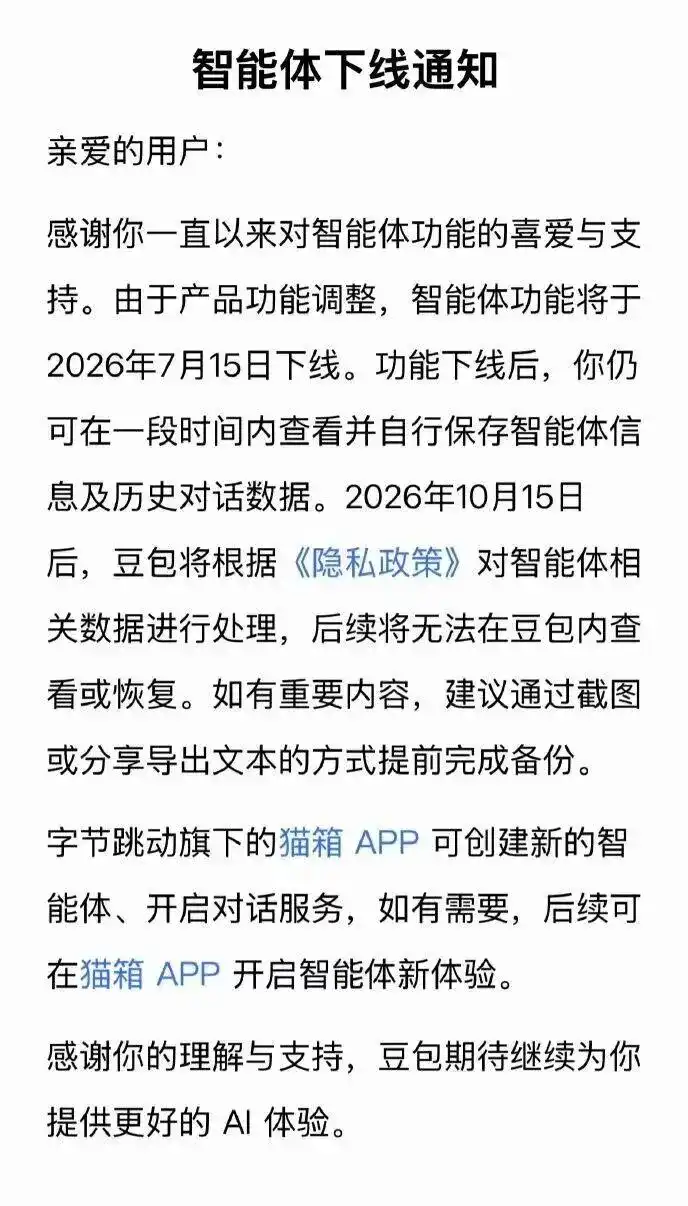
Doubao issued the "Notice on Discontinuation of Doubao Agent Functionality," confirming that the agent functionality will be discontinued on July 15, and will redirect users to ByteDance's Mao Xiang App to meet related needs.
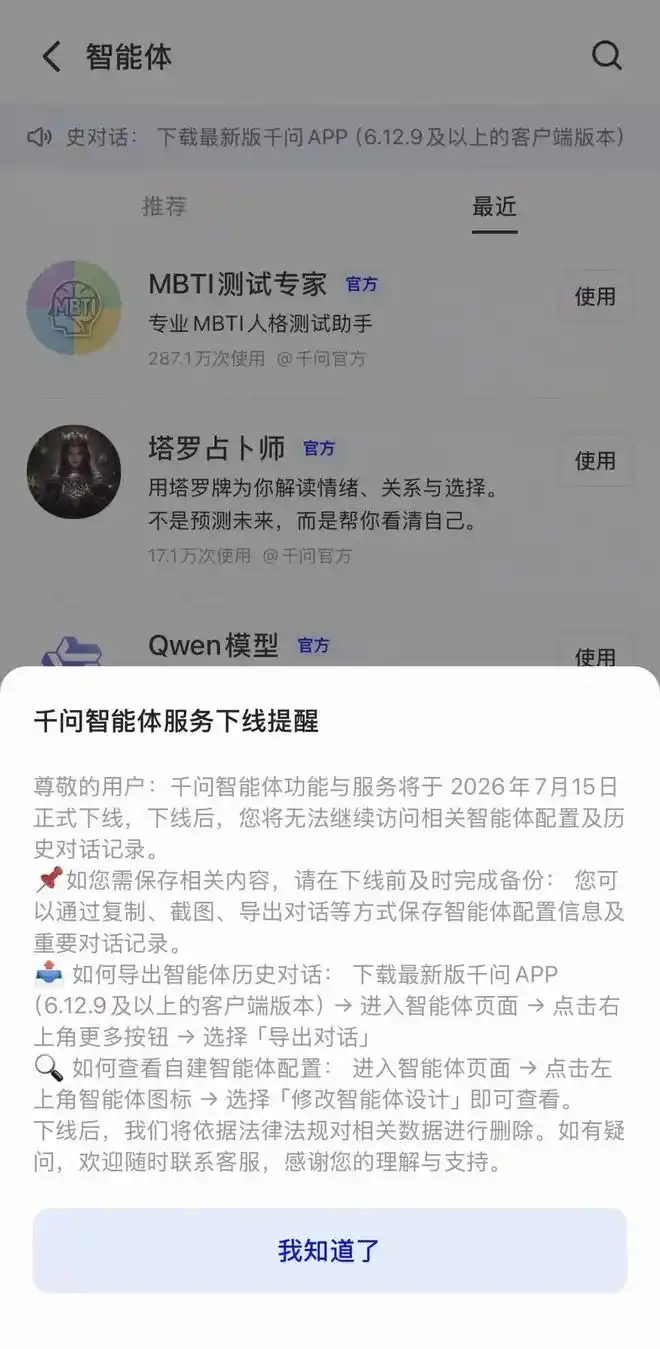
On the same day, Tongyi Qwen pushed a discontinuation reminder to users, stating that personified interaction agents and user-created agent functionality will be discontinued on July 10, and that after the complete discontinuation of Qwen agent functionality and services on July 15, users will no longer be able to access related agent configurations and historical conversation records.
This adjustment affects the most core personalized usage scenarios for C-end users of AI platforms — including role-playing, exclusive assistants, and vertical tool-type agents.

For Doubao and Qwen, user-created agents were previously a key means to gather C-end users and accumulate UGC content. The comprehensive discontinuation of this functionality signifies a directional shift in the platforms' traffic strategies.

New Regulations Force Action, Discontinuation Date Not a Coincidence

The discontinuation date chosen by Doubao and Qwen, July 15, coincides with the official implementation date of the "Interim Measures for the Administration of AI Personified Interaction Services."

These measures strictly regulate "personified emotional interaction services," requiring platforms to implement mechanisms to prevent addiction, verify the identities of minors, conduct content reviews, and fulfill other primary responsibilities.

Regulatory rectification actions have already begun. On June 26, the Cyberspace Administration of Shanghai Municipal Committee announced the results of the first phase of the "Clear and Bright: Rectifying Irregularities in AI Applications" special campaign, having removed over 14,000 non-compliant agents. Among them, agents from Xuanyu (MiniMax) involving functions like "one-click undressing" and soccer betting/gambling were key targets of the crackdown.

Currently, the Cyberspace Administration of Shanghai Municipal Committee has completed regulatory briefings for nearly a hundred key platforms, urging enterprises to fulfill their compliance obligations.

Against this backdrop, Doubao and Qwen proactively aligning with the regulatory timeline, choosing to complete the functionality discontinuation on the day the new regulations take effect, is widely interpreted by the industry as a proactive move to mitigate compliance risks in advance and fulfill platform responsibilities.

User Transition Arrangements and Data Processing Timeline

Both platforms have provided a transition window for existing users to save their data.

For Doubao, after the functionality is discontinued, users will still be able to view and manually save their agent information and historical conversation data for a period of time; after October 15, Doubao will process the relevant data according to its privacy policy, at which point the data will no longer be viewable or recoverable.

Doubao recommends users back up their data in advance by taking screenshots or exporting text, and migrate agent creation and conversation functionality to the Mao Xiang App.

Tongyi Qwen similarly advises users to save important content before the discontinuation by copying, taking screenshots, or exporting conversations. After discontinuation, access to related agent configuration information and historical conversation records will no longer be possible.

As leading platforms successively scale back their C-end agent layouts, the competitive logic of the AI application market is undergoing a fundamental shift.

Compliance capabilities and sustainable business models will replace user scale and feature richness as the core dimensions of platform competition in the next phase.

High Consumption, Low Efficiency, Business Logic Also Unsustainable

In addition to regulatory pressure, difficulties in commercial monetization are also an intrinsic motive driving this adjustment.

Analysis suggests that personified chit-chat and niche role-playing agents typically generate scattered, high-frequency, lightweight conversation calls, resulting in high computing power consumption and low per-unit commercial value, representing a typical "high consumption, low efficiency" business model.

In the phase where AI applications are shifting from "land grabbing" to "value verification," while such UGC agents may bring short-term traffic and user engagement metrics, they are difficult to convert into direct commercial revenue. Their economic rationale for continued existence is being questioned.

Tongyi Qwen's pivot to the B-end has already shown signs. On June 3, Qwen officially announced the comprehensive opening of Agent and Skill access permissions to third-party enterprises and developers across all industries. Leading brands like Luckin Coffee, KFC, Mixue Ice Cream & Tea, and China Eastern Airlines have already initiated service testing.

This strategic shift indicates that platforms are concentrating resources from low-value C-end UGC ecosystems towards high-value B-end enterprise service scenarios.


Трендові криптовалюти

Пов'язані питання

QAccording to the article, on what date are Doubao and Tongyi Qianwen scheduled to take their 'Intelligent Agent' functions offline?

ABoth platforms have scheduled the full shutdown of their Intelligent Agent functions for July 15.

QWhat is the main regulatory reason mentioned for the shutdown of the Intelligent Agent functions?

AThe shutdown coincides with the formal implementation on July 15 of the 'Interim Measures for the Management of Artificial Intelligence Anthropomorphic Interaction Services', which strictly regulates services involving simulated human emotional interaction.

QWhat alternative platform does Doubao recommend for users who wish to continue using Intelligent Agent features?

ADoubao is directing users to migrate their Intelligent Agent creation and conversation functions to the ByteDance-owned app, Cat Box (猫箱 App).

QBeyond regulatory pressure, what internal business challenge contributed to the decision to shut down these C-end Intelligent Agent functions?

AThe article cites commercialization difficulties, describing these UGC agents (especially for casual chat and niche roles) as 'high-consumption, low-efficiency'—they require significant computing power but generate little direct revenue, making them economically unsustainable.

QHow is Tongyi Qianwen's strategic focus shifting according to the article?

ATongyi Qianwen is shifting its resources from low-value C-end UGC ecosystems towards high-value B-end enterprise service scenarios, having opened its Agent and Skill access to third-party businesses and developers.

Пов'язані матеріали

Why Did Codex and ChatGPT Merge? What's Next for Codex? OpenAI Core Leader Answers Everything

In 2026, OpenAI's Codex saw explosive growth, with weekly active users surging over 5x to 5 million since January, driven largely by the February launch of its desktop app. Codex desktop lead Andrew Ambrosino explains key shifts behind its evolution. A core change is the inversion of development costs: implementation is now cheap, while curation and taste—judging which of many AI-generated prototypes is valuable—have become the new scarcities. Ambrosino defines taste as a blend of aesthetics, systems thinking, direction, and semantic coherence in interaction. He notes AI still struggles with design because evaluating it requires human cultural context and abstract reasoning about how components relate—capabilities beyond current models. Timing is critical: the same Codex app would have failed months earlier; success hinges on the model's capabilities at launch. Roles are blurring within his team, with engineers, designers, and PMs overlapping significantly. However, Ambrosino cautions against eliminating specialized roles entirely, as each field retains deep expertise. On AI-assisted development, the focus has shifted from measuring code written by AI to distinguishing between supervised and unsupervised generation. A current challenge is teaching models to simplify code, not just add complexity. The merger of Codex and ChatGPT stems from observed user behavior: non-developers adopted Codex for general knowledge work despite its developer-centric interface. This revealed a collapsing boundary between specialized tools and universal assistants. The vision is a "home base" that orchestrates tasks across external professional tools (like Excel or Premiere Pro) via connectors, rather than rebuilding everything internally. An internal example showed Codex helping edit video by interacting with Premiere Pro's files and even writing a plugin for it. The future direction is a unified, extensible platform that serves as a central hub for automating and managing work across any specialized tool the user employs.

marsbit1 год тому

Why Did Codex and ChatGPT Merge? What's Next for Codex? OpenAI Core Leader Answers Everything

marsbit1 год тому

CLARITY Act Countdown: How Will the Crypto Market Fare If It Doesn't Pass Before the August Recess?

The CLARITY Act, a major US crypto market structure bill, faces a tight deadline before the Senate's August 10 recess. It must overcome final hurdles—negotiations on ethics provisions and law enforcement concerns—to secure the 60 votes needed for passage. Analysts warn that missing this window significantly lowers its chances in 2026, with prediction markets giving only a 40% probability of success this year. If the act fails to pass by the recess, the market is expected to react not with a crash but with continued "slow bleeding," particularly in premium products like ETFs. June saw record net outflows from US Bitcoin spot ETFs, partly attributed to this legislative uncertainty. Assets like XRP, which would receive permanent commodity classification under the act, stand to lose a "regulatory premium" on further delays. Bitcoin and Ethereum, already classified as commodities by regulators, face less direct impact, but DeFi innovation and institutional capital inflows would remain stifled by regulatory ambiguity. The path forward includes passing before the recess (a major catalyst), postponement to 2027 (prolonging uncertainty), or failure, requiring the bill to be reintroduced in the next Congress. Despite the stalled negotiations, the bill's advancement this far signals the US is closer than ever to resolving crypto regulatory clarity.

marsbit4 год тому

CLARITY Act Countdown: How Will the Crypto Market Fare If It Doesn't Pass Before the August Recess?

marsbit4 год тому

Торгівля

Спот

Популярні статті

Як купити 4

Ласкаво просимо до HTX.com! Ми зробили покупку 4 (4) простою та зручною. Дотримуйтесь нашої покрокової інструкції, щоб розпочати свою криптовалютну подорож.Крок 1: Створіть обліковий запис на HTXВикористовуйте свою електронну пошту або номер телефону, щоб зареєструвати обліковий запис на HTX безплатно. Пройдіть безпроблемну реєстрацію й отримайте доступ до всіх функцій.ЗареєструватисьКрок 2: Перейдіть до розділу Купити крипту і виберіть спосіб оплатиКредитна/дебетова картка: використовуйте вашу картку Visa або Mastercard, щоб миттєво купити 4 (4).Баланс: використовуйте кошти з балансу вашого рахунку HTX для безперешкодної торгівлі.Треті особи: ми додали популярні способи оплати, такі як Google Pay та Apple Pay, щоб підвищити зручність.P2P: Торгуйте безпосередньо з іншими користувачами на HTX.Позабіржова торгівля (OTC): ми пропонуємо індивідуальні послуги та конкурентні обмінні курси для трейдерів.Крок 3: Зберігайте свої 4 (4)Після придбання 4 (4) збережіть його у своєму обліковому записі на HTX. Крім того, ви можете відправити його в інше місце за допомогою блокчейн-переказу або використовувати його для торгівлі іншими криптовалютами.Крок 4: Торгівля 4 (4)Легко торгуйте 4 (4) на спотовому ринку HTX. Просто увійдіть до свого облікового запису, виберіть торгову пару, укладайте угоди та спостерігайте за ними в режимі реального часу. Ми пропонуємо зручний досвід як для початківців, так і для досвідчених трейдерів.

462 переглядів усьогоОпубліковано 2025.10.20Оновлено 2026.06.02

Як купити 4

Обговорення

Ласкаво просимо до спільноти HTX. Тут ви можете бути в курсі останніх подій розвитку платформи та отримати доступ до професійної ринкової інформації. Нижче представлені думки користувачів щодо ціни 4 (4).

活动图片