Don't Just Focus on Yi Lihua, These Whales' Moves During the Crash Are More Worth Watching

Odaily星球日报Опубліковано о 2026-02-06Востаннє оновлено о 2026-02-06

Анотація

Amid a sharp crypto market downturn, Bitcoin fell over 15% in 24 hours, dropping below $60,000, while altcoins suffered even steeper losses. Market fear spiked, with the Crypto Fear & Greed Index hitting 9, indicating extreme fear. The article highlights key whale activities during the sell-off. Notable sellers included Aave founder Stani Kulechov, who sold 4,504 ETH, and Ethereum co-founder Vitalik Buterin, who sold 6,899.5 ETH from a planned donation. Prominent ETH bull Yi Lihua (Trend Research) sold approximately 250,000 ETH, citing risk management. Data also showed whales dumped 81,068 BTC in just eight days. On the buying side, despite the panic, some large players accumulated. "Machi Big Brother" aggressively opened leveraged long positions on ETH and other assets, though some were liquidated. MicroStrategy, a major corporate BTC holder, purchased an additional 855 BTC, reaffirming its long-term strategy and stating it would only face real threat if BTC stayed at $8,000 for years. Similarly, Bitmine, led by Tom Lee, continued buying ETH, adding over 60,000 ETH recently despite significant unrealized losses. On-chain whales were also active, with one entity withdrawing 55,483 ETH from an exchange, indicating strong accumulation during the dip. The contrast between panic selling and strategic buying underscores the divided sentiment among large holders during the market turmoil.

Original | Odaily Planet Daily (@OdailyChina)

Author | Golem (@web3_golem)

Blockchain is killing people again. Bitcoin has been falling for days, dropping over 15% in the past 24 hours at one point, quickly sliding to $60,000, down more than 40% from the October 2025 high, hitting a new low for the phase, and potentially recording its largest single-day drop since the FTX incident in 2022. Altcoins have been hit even harder, with a river of blood. (Related reading: Plunging nearly 20% in a single day, how long has it been since you saw Bitcoin at $60,000?)

Regarding the reasons behind this decline, the market mostly links it to macro-level factors, such as the "Warsh effect" triggered by the new Fed Chair Warsh taking office, the AI capital race sucking liquidity from other global assets, and the escalation of US-Iran tensions.

In addition, there have been many baseless speculations. Because this decline was so smooth, almost without pause, and lacked specific event drivers, many voices speculate whether a major institution has exploded, and a hidden black swan may surface soon. It's like watching a pile of explosives detonate without knowing who lit the fuse. According to Alternative.me data, today's crypto market Fear and Greed Index dropped to 9, in the "Extreme Fear" zone, further declining from the previous day's 12 and last week's 16. Last month, this index was still 42.

"The peak produces虚伪的拥护 (hypocritical supporters), the twilight witnesses the true believers".

The more it is this kind of moment where "analysis fails", the more one can see investors' true thoughts from their positions. While we fear the deep bear is coming, which whales in the market are selling, and who is truly buying the dip on a large scale?

Who is Selling Valuable Coins?

Vitalik and Aave Founder Sell ETH to Cash Out

During the market drop in the early hours of February 6th, Aave founder Stani Kulechov (0x803...c78d) sold 4,504 ETH on-chain at a price of $1,855, converting it into 8.36 million USDC. ETH fell to a low of $1,747 in the early hours of February 6th.
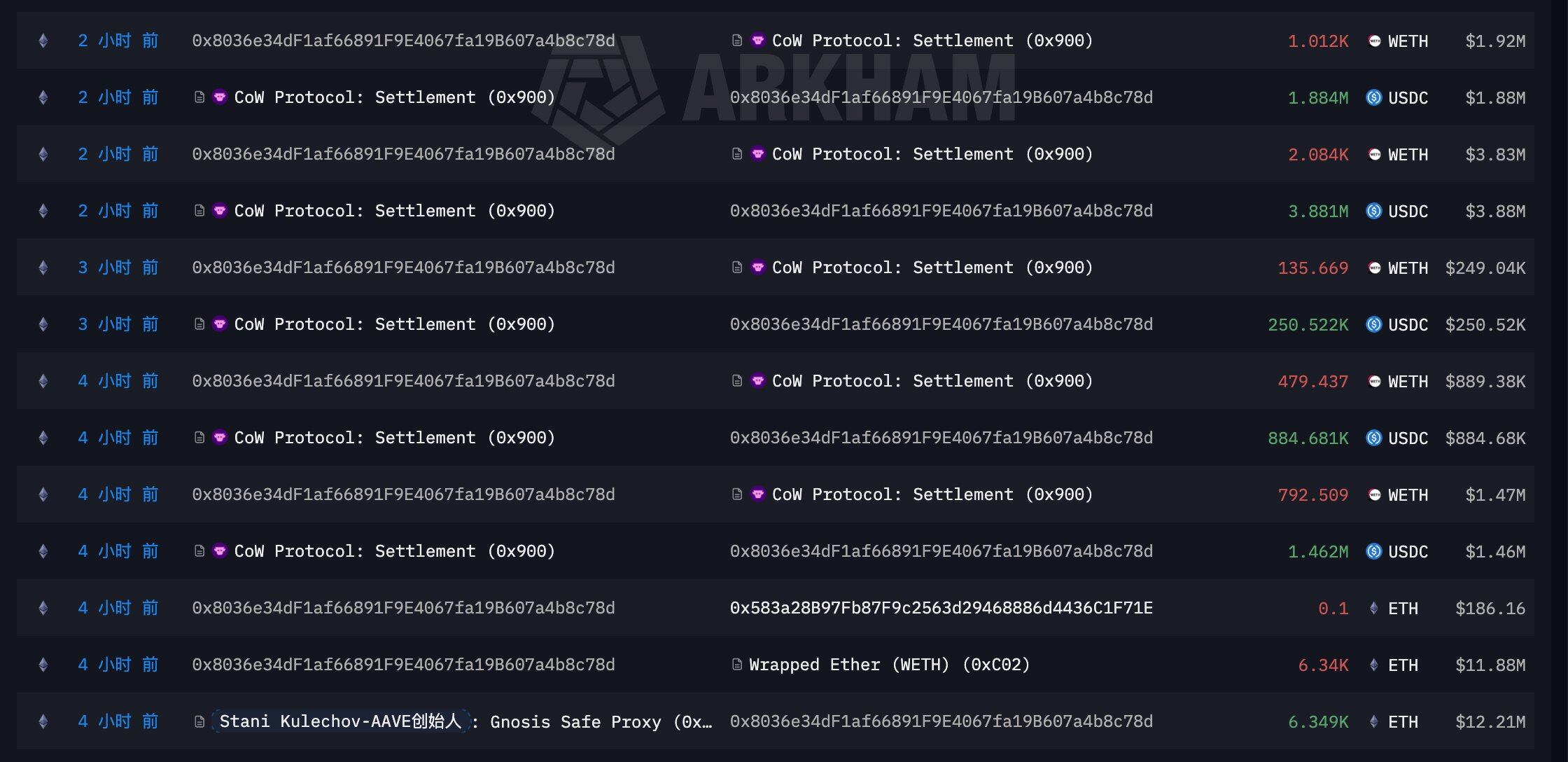
Aave Founder Sells ETH

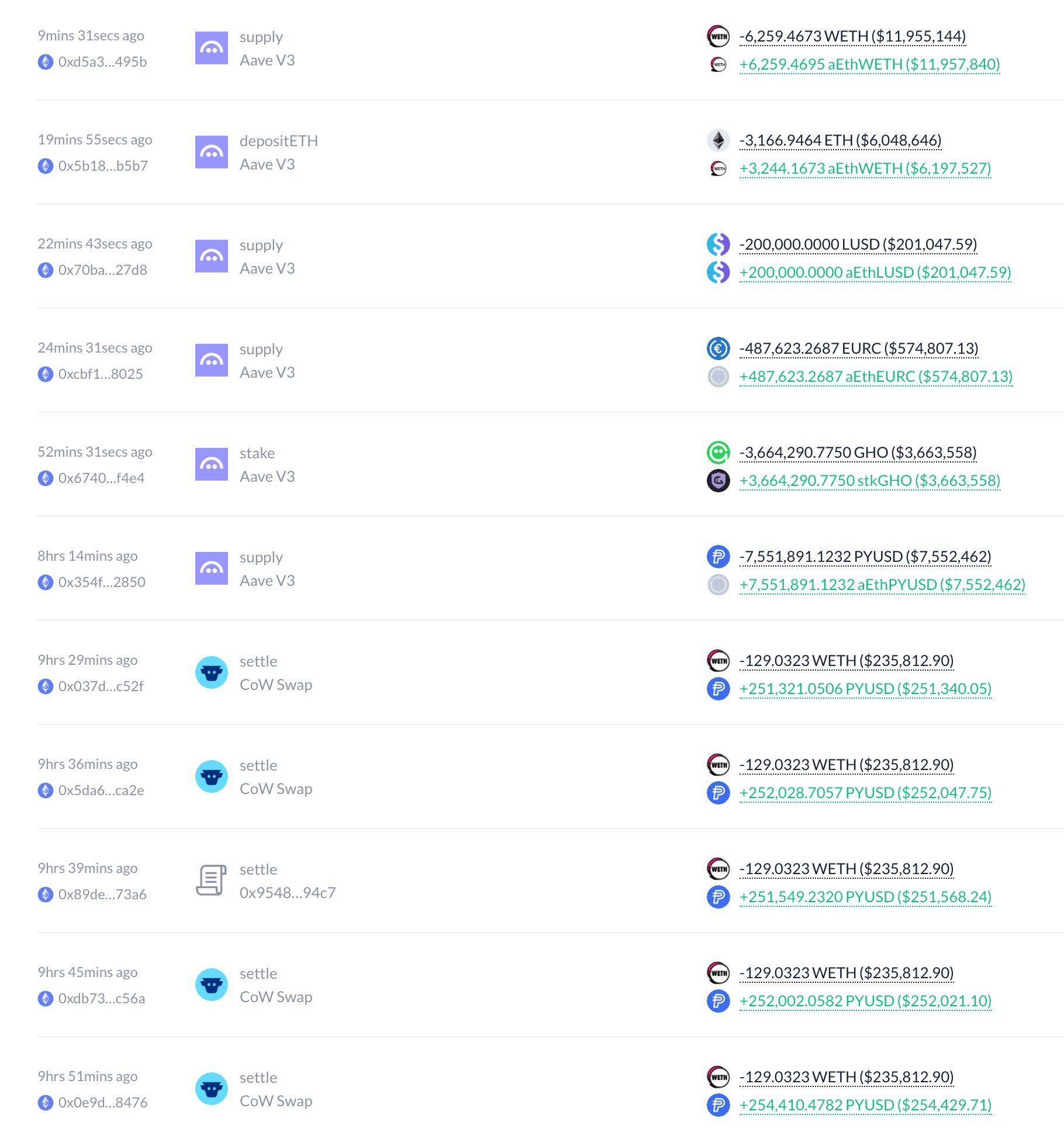
Besides the Aave founder, Ethereum founder Vitalik has also been frequently selling ETH recently. On January 30th, Vitalik posted that he had withdrawn 16,384 ETH for a multi-year donation plan, focusing on supporting an open, verifiable, end-to-end software and hardware technology stack to protect personal life and the public environment.

On February 3rd, Vitalik began selling these ETH, selling 493 ETH that day, worth about $1.16 million. As of February 6th, the sale progress of the 16,384 ETH planned for donation had reached 42.1%, with a cumulative sale of 6,899.5 ETH, totaling $14.15 million, at an average selling price of $2,052. However, Vitalik has deposited the remaining 9,484.5 ETH into Aave, which may mean he does not plan to sell in the short term.
"ETH Mega-Bull" Yi Lihua Falls, Sells About 250,000 ETH

Yi Lihua's Trend Research was one of the most watched ETH bulls in this cycle, and he himself often publicly sang the praises of the bull market on social media, with the community drawing the analogy "Tom Lee in the West, Yi Lihua in the East".

However, as ETH fell, Yi Lihua couldn't hold on either. On February 1st, according to monitoring, Yi Lihua's Trend Research began depositing over 10,000 ETH into Binance. On February 2nd, Yi Lihua posted on platform X admitting that he was indeed too early in being bullish on ETH, the profits from the previous top's sell-off had been wiped out, and he decided to continue waiting for the market to go up while controlling risks.

On February 3rd, he posted again, saying he still看好 (is optimistic about) the new bull market performance, expecting ETH to reach over $10,000 and BTC to exceed $200,000, but recently adjusted some positions to control risks.

This statement may have paved the way for subsequent ETH transfers. As of now, the six publicly known addresses of Trend Research hold only about 396,000 ETH. On February 1st, Trend Research publicly held 650,000 ETH, meaning they sold about 250,000 ETH, worth $554 million. Simultaneously, Yi Lihua's latest liquidation range is between $1,509 and $1,800.

But from firmly buying long to being forced to "cut losses", Yi Lihua's heart must be full of helplessness (无奈).

Whales Sold 81,068 BTC in the Past 8 Days

Besides these celebrities selling their公开 (public) positions, hidden on-chain are also纷纷 "fleeing". According to Santiment statistics, whales holding 10 to 10,000 BTC currently hold 68.04% of the total BTC supply, a new low in 9 months, having sold 81,068 BTC in just the past 8 days.

After the market fell, whales also began to stop losses and卸杠杠 (deleverage). According to monitoring, during yesterday's market drop, a certain whale deposited 10,128 ETH into Galaxy and FalconX, worth $20.44 million. A whale (0xfdd...6a92) holding an ETH lending position on Spark also began selling ETH to stop losses when the ETH price fell to $2,050. This whale累计 (cumulatively) sold 27,800 ETH, repaying $44.14 million in loans.

However, unlike the whales, retail investors are more inclined to buy the dip at this time. According to Santiment statistics, addresses holding less than 0.01 BTC, the "shrimp addresses," hold 0.249% of the total BTC supply, hitting a 20-month high, reflecting retail investors buying on the dip. But it is important to be cautious, as this combination of whale selling and retail buying has historically created bear market cycles.

Who is Silently Buying the Dip

Besides retail investors buying the dip, some faithful large holders/institutions are also buying the dip. According to statistics, after the market fell, Bitfinex margin long positions rose to about 77,100 BTC, hitting a nearly two-year high. This trend shows that there is still明显的 (obvious) leveraged funds buying the dip during the decline. Additionally, the scale of Bitfinex margin longs has grown by about 64% in the past six months,通常被视为 (often seen as) large holders or high-risk preference funds continuously adding positions during periods of market stress.

Well-known trader Eugene Ng Ah Sio also posted on his personal channel, "Buy when there's blood in the streets, even if it's your own."

"Machi" Going Long with Unlimited Bullets

The iron-headed" Machi" is a representative of large holders who go long on the dip. According to monitoring, in the early hours of February 6th, during the market decline, Brother Machi insisted on going long, depositing 250,000 USDC into Hyperliquid, opening a 25x leveraged ETH long, a 40x leveraged BTC long, a 10x leveraged HYPE long, and a 10x leveraged PUMP long. However, the BTC and PUMP long positions were quickly liquidated in the subsequent market drop. The HYPE and ETH long positions were partially liquidated before adding more.

As of now, "Machi" still holds a 25x leveraged Ethereum long position, with a position of 320 ETH, liquidation price $1,841; he also holds a 10x leveraged HYPE long position, with a position of 14,720 HYPE, liquidation price about $31.

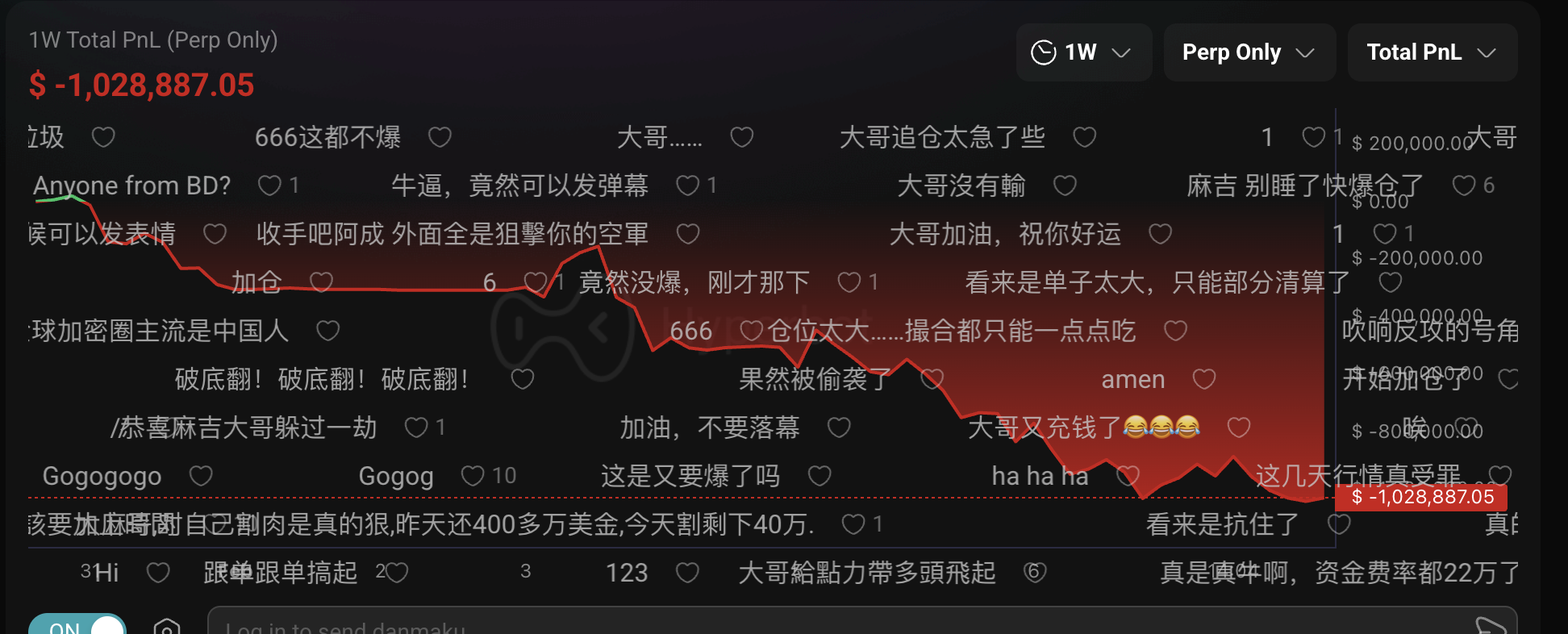
This week, Brother Machi had 11平仓 (position closures), of which 3 were profitable and 8 were losses, with a win rate of 27.27%, and a net loss of about $286,000 for the single week. In the hyperbot弹屏 (live screen) comments, there were all voices encouraging Machi.
BTC's Eternal "Backstop" MicroStrategy: Cost Basis $76,052

Fortunately, during the market crash, the largest BTC treasury, MicroStrategy, did not choose to sell. MicroStrategy CEO Phong Le said at the MicroStrategy Q4 financial results webinar that Bitcoin would need to fall to $8,000 and stay at that level for five to six years to pose a real threat to repaying its convertible debt. This means that only then might MicroStrategy sell BTC, which is somewhat reassuring for the market.

Meanwhile, during the market decline earlier this month, MicroStrategy bought another 855 BTC for approximately $75.3 million, at a unit price of about $87,974. As of now, MicroStrategy holds

713,502 BTC, with a total acquisition cost of approximately $54.26 billion, and an average acquisition price of about $76,052. Therefore, at the current Bitcoin price of $66,000, MicroStrategy has a floating loss of over $7.168 billion.

Besides MicroStrategy firmly holding and buying, Japan's largest BTC treasury company, Metaplanet, also expressed faith in BTC on February 6th. Its CEO Simon Gerovich posted on platform X, "Regarding the recent stock price movements and the severe situation faced by shareholders, Metaplanet's strategy remains unchanged. The company will continue to accumulate BTC." But data shows that Metaplanet has not purchased BTC for three consecutive weeks.

ETH's Staunch Supporter Tom Lee: $6.6 Billion Floating Loss is Just a "Small Problem"

Just from the perspective of holding ETH, Tom Lee is显然 (clearly) more resilient than Yi Lihua. His ETH treasury company, Bitmine, not only did not sell ETH but also continued to buy during the market decline.

In the last week of January, when ETH fell to a low of $2,200, Bitmine bought 41,788 ETH that week, worth $96.55 million. Subsequently, Tom Lee said on February 2nd, "The company currently has no debt. Given the strengthening fundamentals of Ethereum, the recent market pullback is极具吸引力 (extremely attractive)", which basically indicates Tom Lee's strategy of buying the dip. On February 3rd, Bitmine bought 20,000 ETH through FalconX, worth $46.04 million.

On February 4th, in response to外界称 (external claims that) Bitmine's ETH holdings had a floating loss of up to $6.6 billion, Tom Lee responded that this was normal. But as of now, Bitmine holds 4,285,125 ETH, with an average cost basis above $3,500. With ETH falling below $2,000, Bitmine's floating loss has exceeded $8 billion.

On-Chain Whales Still Bullish on ETH

For on-chain whales, the declining market is also a rare opportunity to buy the dip. According to monitoring, a whale dormant for 7 months (3M4p1i) began buying the dip after the sharp drop in BTC on February 6th. This whale bought 482 BTC, worth $32.5 million, and currently holds a total of 1,960 BTC, worth $128 million.

Compared to BTC, on-chain whales seem to prefer ETH more. A newly created wallet withdrew 55,483 ETH from WhiteBIT in the past 2 days, worth $115.16 million.

From the evening of February 5th to February 6th, several on-chain whales/institutions also continued to buy ETH. According to Lookonchain monitoring, a wallet associated with Longling Capital withdrew 8,500 ETH from Binance on the evening of February 5th, worth $17.51 million. The whale/institution "7 Siblings" added another 6,923.85 ETH in the early hours when ETH fell below $2,000, about $13.91 million, with an average cost of $2,009.8. The current ETH holding reached 318,508.07. Meanwhile, another whale account spent 28 million USDT to buy 13,837 ETH, with an average purchase price of $2,024, but this whale wallet is also believed to可能属于 (possibly belong to) "7 Siblings".


Пов'язані питання

QWhat are the main reasons mentioned in the article for the recent sharp decline in the cryptocurrency market?

AThe article attributes the decline to macro factors such as the 'Warsh effect' from the new Fed Chair Warsh, AI capital competition draining liquidity from other global assets, and escalating US-Iran tensions. It also mentions unverified speculation about potential institutional failures or hidden black swan events.

QWhich major Ethereum figures sold ETH during the market downturn, and what were their reasons?

AVitalik Buterin sold 6,899.5 ETH (out of 16,384 ETH earmarked for a multi-year donation plan) at an average price of $2,052, and Aave founder Stani Kulechov sold 4,504 ETH at $1,855 to obtain 8.36 million USDC. Vitalik's sale was for a charitable initiative, while Kulechov's was likely a response to market conditions.

QHow did Yi Lihua (Trend Research) respond to the ETH price drop, and what was the impact on his holdings?

AYi Lihua, a prominent ETH bull, admitted to being overly optimistic and sold approximately 250,000 ETH (worth $554 million) to control risk. His public ETH holdings dropped from 650,000 to about 396,000 ETH, with a liquidation range between $1,509 and $1,800.

QWhat actions did some large investors or 'whales' take during the market crash, according to the article?

AWhales sold 81,068 BTC in eight days, reducing their holdings to a nine-month low. However, some, like the entity 7 Siblings, bought significant amounts of ETH (e.g., 69,23.85 ETH at $2,009.8). Retail investors (small addresses) increased their BTC holdings, while Bitfinex margin long positions hit a two-year high, indicating leveraged buying.

QWhich companies maintained or increased their cryptocurrency holdings despite the downturn, and what were their stated strategies?

AMicroStrategy continued buying BTC, adding 855 BTC at $87,974 each, and stated it would only sell if BTC fell to $8,000 for 5-6 years. Bitmine (Tom Lee's firm) bought 61,788 ETH during the dip, despite an $8 billion unrealized loss, citing strong fundamentals. Metaplanet also reaffirmed its commitment to accumulating BTC.

Пов'язані матеріали

The "Impossible Triad" Is Fundamentally a Pseudo-Problem

The article argues that blockchain's fundamental limitation is not the scalability trilemma (decentralization, scalability, security), which has been largely solved, but the lack of **privacy** and, until recently, clear **legitimacy**. Blockchain is described as a slow, expensive, globally shared computer whose core value is censorship resistance and verifiability. While ideal for native digital assets like money (e.g., stablecoins), its default transparency acts as a **tax**, exposing all transactions and enabling MEV extraction, which deters serious institutional capital. Simultaneously, its permissionless nature created regulatory ambiguity. The piece contends that **privacy** is the missing critical feature. It rejects the false choice between total transparency and complete anonymity. Modern cryptography (like zero-knowledge proofs) enables **compliant privacy**: users can prove facts (solvency, KYC status, compliance) without revealing the underlying sensitive data (specific holdings, identities). This preserves auditability for regulators and eliminates the leak of financial information. With recent regulatory progress (e.g., the GENIUS Act) addressing legitimacy, adding default, provably compliant privacy becomes a pure upgrade. It transforms blockchain from a costly, public ledger into a confidential settlement layer, finally bridging the gap to mainstream institutional and individual adoption of on-chain finance.

链捕手4 год тому

The "Impossible Triad" Is Fundamentally a Pseudo-Problem

链捕手4 год тому

Optical Chips: Collective Capacity Expansion

The global optical chip industry is experiencing a massive wave of expansion driven by surging AI data center demand. Major players across the US, Japan, Europe, and China are aggressively investing to ramp up production capacity. In the US, Coherent is expanding its 6-inch Indium Phosphide (InP) semiconductor fab in Texas, supported by CHIPS Act funding and a $2 billion strategic investment from NVIDIA. Lumentum is building a new factory for InP optical devices, and Nokia is scaling its advanced photonic chip packaging and testing capabilities. NVIDIA's investments aim to secure future supply of critical lasers and optical interconnect products for AI infrastructure. Japan's JX Advanced Metals, a leading InP substrate supplier, plans a multi-billion yen investment to increase its capacity 7-10 times, strengthening its grip on the crucial upstream materials market. In Europe, IQE and Tower Semiconductor settled a patent dispute and signed a multi-year InP epitaxial wafer supply agreement, highlighting that next-generation silicon photonics platforms will integrate high-performance InP components. STMicroelectronics and Sivers Semiconductors are also expanding silicon photonics production and partnerships. China is rapidly building out its domestic supply chain. Dongshan Precision's subsidiary, Source Photonics, announced a $12 billion project to expand optical chip and module production. Companies like Sanan Optoelectronics and Yunnan Germanium are scaling up InP chip manufacturing and substrate production, moving towards vertical integration from materials to modules. While debate continues around the exact future architecture—whether CPO (Co-Packaged Optics), NPO, or pluggables will dominate—analysts like Morgan Stanley argue the underlying driver is unchangeable: the explosive growth in bandwidth demand. This will inevitably increase the volume of optical engines, lasers, and related content per GPU, regardless of the final technical path. The competition for "more light" in the AI era has intensified into a global, full-chain capacity race.

marsbit6 год тому

Optical Chips: Collective Capacity Expansion

marsbit6 год тому

Stablecoins Finally Find Real Yield: An In-Depth Look at On-Chain Reinsurance Re | A Conversation with Re Founder Karan Saroya

Stablecoin Real Yield Found: A Deep Dive into On-Chain Reinsurance with Re's Karan Saroya As stablecoin supply exceeds $170 billion, the search for sustainable, non-speculative yield intensifies. Re, an on-chain reinsurance platform, provides an answer: connecting stablecoin capital to the trillion-dollar traditional reinsurance market. Re operates as a regulated reinsurer, accepting stablecoin deposits as collateral to back US insurance companies. These insurers pay premiums, generating yield that flows back to on-chain depositors. Currently supporting 35 insurers and underwriting $500 million, Re projects scaling to over $1 billion soon. Key insights from a Bankless podcast with founder Karan Saroya and investor Avichal of Electric Capital: 1. **Uncorrelated, Real-World Yield:** Re offers stablecoin holders access to reinsurance returns (targeting 12-14%+), an asset class entirely separate from crypto or equity markets. 2. **Operational Efficiency via Smart Contracts:** Re replaces traditional, labor-intensive capital fundraising with smart contracts, allowing a ~12-person team to compete with industry giants. 3. **Regulatory Leverage:** For every $1 of collateral, regulations allow backing $5-7 in written premiums. This leverage amplifies returns from the underlying risk-free rate. 4. **DeFi Integration:** Depositors receive receipt tokens, which can be used in protocols like Morpho for "looping," potentially pushing yields to 18-20%+. 5. **The "DeFi Mullet" Model:** A compliant front-end (regulated reinsurer) paired with a decentralized back-end (smart contracts, DeFi capital markets). 6. **RE Governance Token:** Modeled on Lloyd's of London, the token governs the central capital pool's allocation, counterparty acceptance, and parameters. 7. **Real Economic Impact:** Capital funds real-world productivity (factories, clinics, businesses) via insurance, moving beyond crypto's internal loops. The discussion highlights a pivotal moment: DeFi's supply-side infrastructure is now met by real demand for productive yield, potentially kickstarting a flywheel where vast on-chain stablecoin capital seeks these real-world returns.

链捕手7 год тому

Stablecoins Finally Find Real Yield: An In-Depth Look at On-Chain Reinsurance Re | A Conversation with Re Founder Karan Saroya

链捕手7 год тому

1996 or 1999? Walsh's First Test is 'How to View AI'

"1996 or 1999? Wall's First Big Test Is 'How to View AI'" Federal Reserve Chairman Wall's initial challenge is not whether to raise or cut rates, but a more fundamental judgment: what kind of boom is the current AI boom? This will determine the Fed's policy path and define his legacy. Economics is split between two opposing views, according to reporter Nick Timiraos. One sees imminent productivity gains that will increase supply and cool inflation, allowing the Fed to hold steady. The other argues that while productivity benefits are distant, demand shocks are here now, and waiting for data confirmation risks missing the intervention window, forcing sharper rate hikes later. Wall has signaled a leaning toward the first view, echoing 1996-era Alan Greenspan, who embraced strong, productivity-driven growth without fear of inflation. However, Wall faces a different macro environment than Greenspan did, with tariff pressures, expanding fiscal deficits, and diminishing globalization benefits, which could force more significant inflation pressures even if AI benefits materialize. Wall's logic, expressed before taking office, is that AI-driven productivity gains won't show in official data for years. If the Fed waits for confirmation, it might mistakenly tighten policy and choke off the very growth that could suppress inflation. This argues for using forward-looking narratives over lagging data. Chicago Fed President Austan Goolsbee presents a key counter-argument. He distinguishes between expected and unexpected productivity booms. A widely anticipated boom, like the current AI wave, can cause people to spend future wealth gains in advance, overheating the economy before productivity actually rises, thus requiring preemptive rate hikes. He cites rising costs for AI data centers as evidence of such overheating. Fed Governor Christopher Waller offers a rebuttal to Goolsbee, noting the "expected spending" mechanism only works if people can borrow against future income, which many households cannot do due to borrowing constraints. Wall also faces a paradox related to his desire to reduce the Fed's use of "forward guidance" (pre-announcing policy moves). This practice was established in 1999 when Greenspan began signaling hikes to avoid market shocks. If the economy follows a less optimistic path, Wall may be forced to choose between using the guidance he wants to abolish or risking market volatility by staying silent. The ultimate question defining Wall's first major test remains: Is this 1996 or 1999?

marsbit8 год тому

1996 or 1999? Walsh's First Test is 'How to View AI'

marsbit8 год тому

Торгівля

Спот
Ф'ючерси
活动图片