Don't Just Focus on Trading Volume, Learn to Understand the 'True and False Prosperity' of Perpetual Contracts

marsbitОпубліковано о 2026-02-23Востаннє оновлено о 2026-02-23

Анотація

Title: Look Beyond Trading Volume: Understanding the Real Growth of Perpetual Contracts Perpetual contracts (perps) have become a dominant force in crypto trading, with their volume now accounting for about 75% of decentralized exchange activity, up from 44% in February 2025. This surge occurred even as the total crypto market cap fell nearly 40% between August 2025 and February 2026, indicating a shift towards derivatives for speculation and hedging during volatility. However, volume alone can be misleading. It may reflect high-frequency, incentive-driven activity rather than meaningful capital deployment. A more nuanced view comes from combining volume with Open Interest (OI)—the total value of outstanding contracts. While cumulative perps volume doubled in the past six months to $14 trillion (exceeding the previous four years' total), OI grew by about 50%, from $13B to ~$18B before settling at $13B. The OI/Volume ratio, a measure of capital efficiency, rose from 0.33x to 0.49x over the past year. This growth wasn’t linear: it peaked at ~0.72x from June to mid-October 2025, then dropped to ~0.38x after a major liquidation event in October wiped out $19B in leveraged positions. At the platform level, Hyperliquid leads in capital efficiency with an OI/7-day volume ratio over 45% and a take rate of 3.2 bps, effectively converting trading activity into sustained positions and fee revenue. Aster follows with a 34% ratio but a lower take rate of 1.6 bps, prioritizing capital ...

Original Title: Reading Perps Beyond Volume

Original Author: Prathik Desai, Token Dispatch

Original Compilation: Bitpush News

Just when you think finance is getting dull, it always has a way of surprising you. Lately, it seems like everyone is restructuring the financial system in ways few could have foreseen, even those from the entertainment and media industries.

Take Jimmy Donaldson (aka "MrBeast" on YouTube) as an example. Not only does he have a snack empire, but he recently also acquired a banking app aimed at promoting financial literacy and money management among teenagers and young adults. Why? Perhaps nothing is more straightforward than monetizing a subscriber base of 466 million users with financial products.

This summer, the world's largest derivatives exchange, the CME Group, will launch single-stock futures, allowing users to trade futures on over 50 top U.S. stocks, including Alphabet, NVIDIA, Tesla, and Meta.

These restructurings show us how the ways people engage with finance are changing. And nothing illustrates this better than the explosion of the Perpetual Markets over the past few years.

Perpetual futures (or Perps) are a type of financial derivative contract that allows market participants to speculate on the price of an asset without an expiration date. Perps also allow people to express views on assets quickly and cheaply. They are more captivating than traditional markets because they offer instant access and leverage. Unlike traditional markets, they don't require broker onboarding processes, jurisdictional paperwork, or adherence to "traditional" market hours.

Furthermore, on-chain perpetual markets allow any asset (whether traditional or crypto) to be traded in a permissionless, highly leveraged manner. This makes speculation fun, especially when humans can't resist gambling on the trajectory of volatile assets outside of traditional trading hours. This allows risk to be priced in real-time.

Think about what happened two weeks ago. When traditional and crypto markets crashed simultaneously, traders flocked to Hyperliquid, driving perpetual gold and silver trading into a frenzy. On January 31st, Hyperliquid alone accounted for 2% of the global daily trading volume in its Silver perpetual market, which had been live for less than a month.

This explains why dashboards of perpetual contract trading volume are increasingly dominating crypto communities and forums. Trading volume is an absolute value. It looks large, refreshes every few minutes, and is perfect for leaderboards. But it misses a key nuance: volume can reflect movement that lacks meaning. A market's high volume might be due to depth, but it could also be because rewards and incentives encourage higher-frequency activity. This activity is often recursive and largely meaningless.

This week, I delved into other metrics of the perpetual trading markets. When used in conjunction with trading volume, these metrics add more dimensions and tell a completely different story than volume alone.

Let's begin.

A Few Data Points

The user-friendly interface of perpetual markets makes them a low-barrier, default interface for expressing views across various markets and global assets. The wide selection of highly leveraged derivative trading on both traditional and crypto assets on a single platform has led to perpetual contract volume surpassing spot trading volume on decentralized exchanges. From 44% in February 2025, the share of perpetual contract volume has skyrocketed to around 75% today (relative to spot volume).

This growth has been particularly pronounced in the past few months:

· In the four years ending July 31, 2025, the cumulative total perpetual trading volume across all platforms was $6.91 trillion.

· In just the past six months, this volume has doubled, reaching $14 trillion.
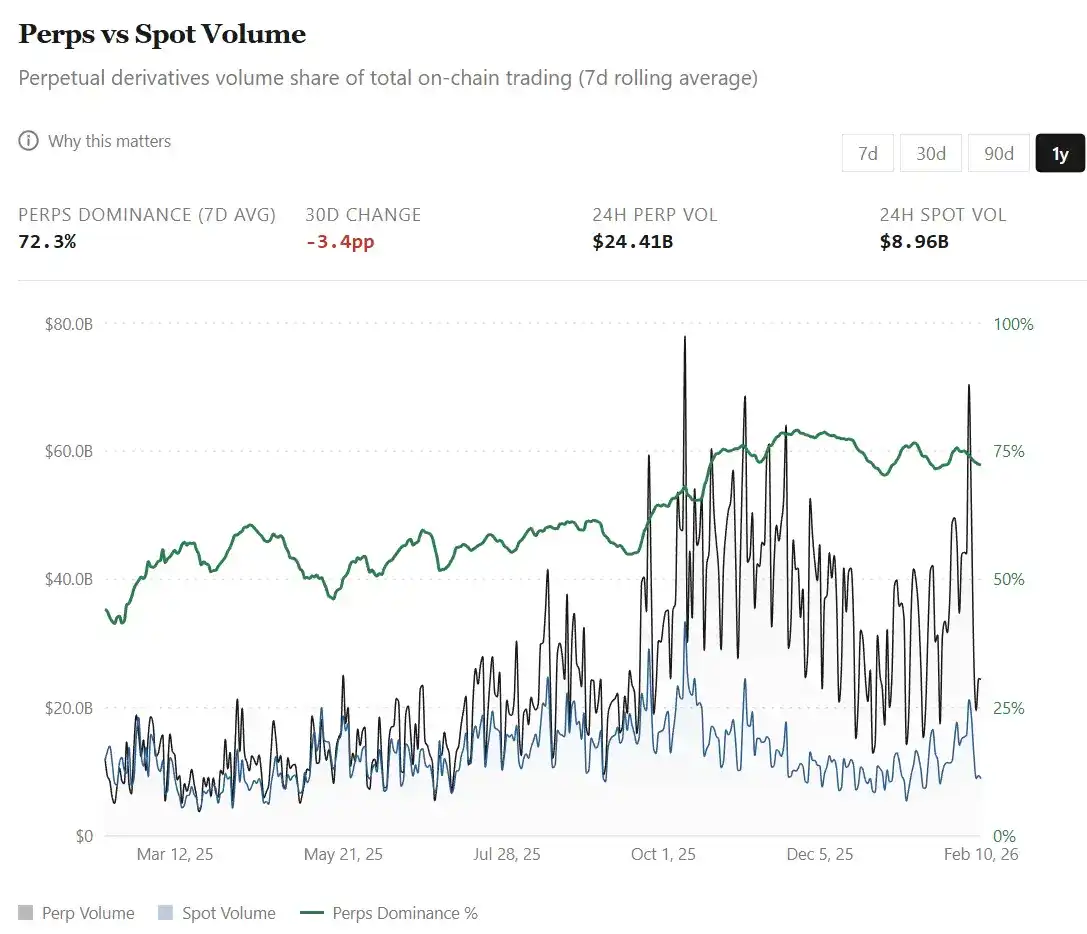
All this growth occurred against the backdrop of the total crypto market capitalization shrinking by nearly 40% between August 1, 2025, and February 9, 2026. This activity suggests traders are increasingly leaning towards derivative trading, hedging, and short-term positioning, especially when spot markets become highly volatile and bearish.

But there's a catch. With such massive activity, it's easy to misread the volume metric. Especially because perpetual trading isn't just about buying an asset and holding it long-term; it also involves repeatedly adjusting bet sizes using leverage over shorter time frames.

So, when market turnover speeds up, a question inevitably comes to mind: does record-breaking volume reflect more capital flowing in, or the same capital cycling faster?

This is where observing Open Interest (OI) becomes meaningful. If volume reflects capital flow, then OI measures outstanding risk exposure. On perpetual exchanges, OI refers to the total dollar value of active, unsettled long and short contracts held by traders.
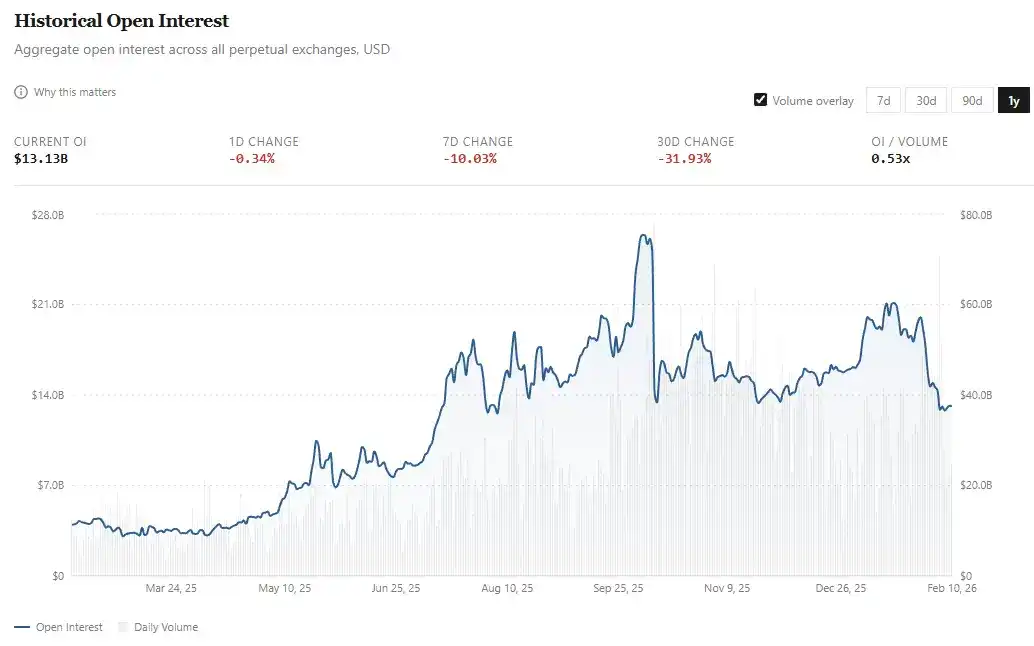
If perpetual trading is being adopted by the mass market, we would expect to see not only larger capital flows but also proportionally growing open interest exposure.

· Last February, OI averaged around $4 billion;

· Now that number has more than tripled, to approximately $13 billion. In fact, the average for the entire month of January reached about $18 billion before dropping by about 30% in the first week of February.

While perpetual trading volume has doubled in the past five months, OI has grown by about 50% (from $13 billion to ~$18 billion, then back to $13 billion). To understand this better, I looked at the capital efficiency (i.e., OI as a percentage of daily volume) over the past year.
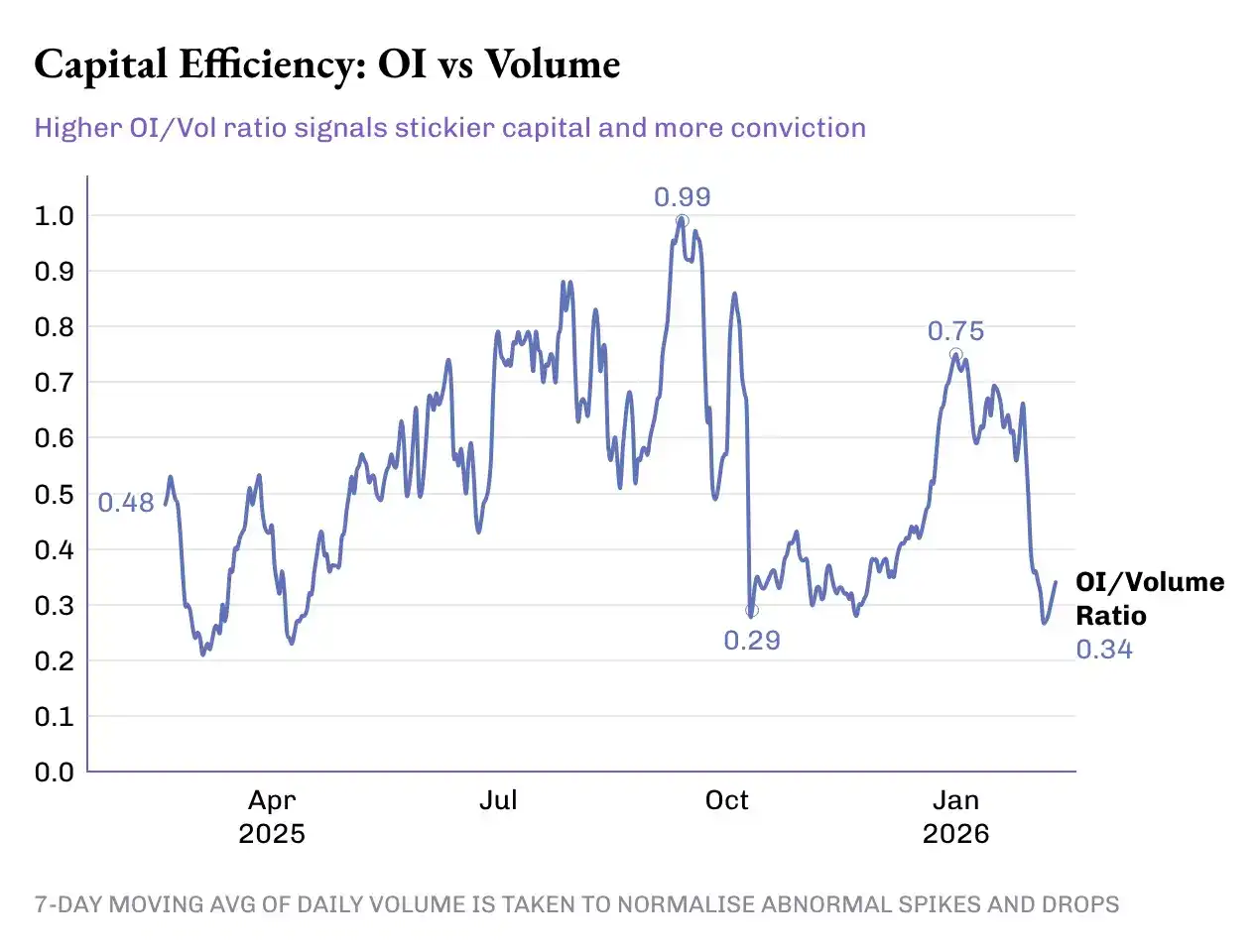
The OI/Volume ratio jumped 50% from last year's 0.33x to 0.49x today. But this progress wasn't smooth; the 50 basis point increase in this ratio went through multiple peaks and troughs:

· Phase 1 (Feb-May 2025): The Lull. The OI/Volume ratio averaged ~0.46x, with average OI of ~$4.8B and average daily volume of ~$11.5B.

· Phase 2 (June - Mid-Oct): The Jump. The ratio averaged ~0.72x. During this period, average OI rose to $14.8B, and average daily volume was $23B. This marked not only record-high volumes but also increased risk exposure and greater capital commitment to these derivatives.

· Phase 3: The Reversal. The start of this phase coincided with the massive liquidation on October 10th, which wiped out over $19B in leveraged positions within 24 hours. From mid-October to late December, the OI/Volume ratio dropped to ~0.38x, driven primarily by volume growth while open interest largely stagnated. October, November, and December saw the three highest monthly volumes of 2025, averaging over $1.2 trillion per month. During the same period, OI averaged around $15B, slightly below the average of the previous three months.

Protocol Level

Here, I want to add more dimensions at the protocol level for perpetual markets. This helps us understand how efficiently perpetual exchanges convert trading activity into "sticky capital" and revenue.
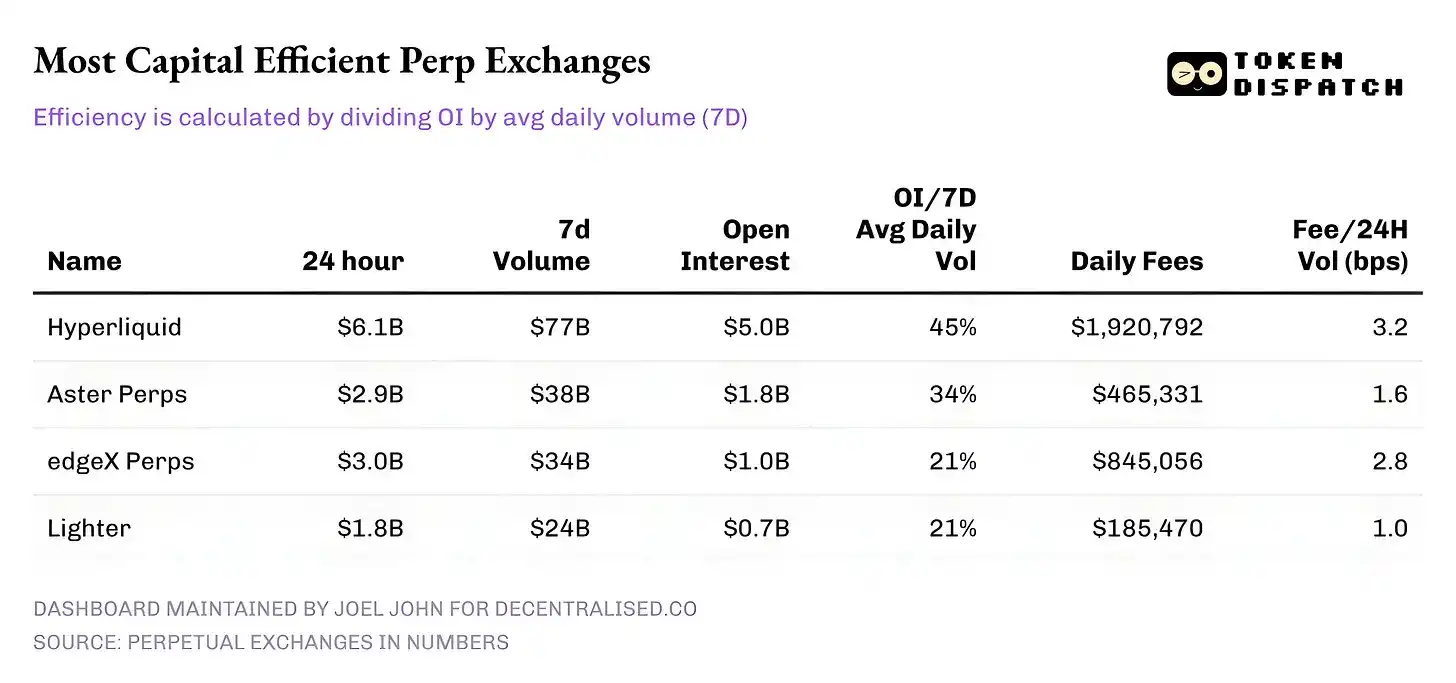
As of February 10th, here is how the top 5 perpetual exchanges by 24-hour volume performed:

· Hyperliquid: Its ratio of OI to 7-day average daily volume is over 45%, able to convert a large share of its volume into lasting positions. This suggests that for every $10 traded on the platform, $4.5 is投入 (invested) into active positions. This is important because high OI rates lead to tighter spreads, deeper liquidity, and confidence in scaling trades without slippage.

· Hyperliquid's fee revenue reinforces this story. Its Take Rate is ~3.2 basis points, converting the largest share of its 24-hour volume into fee income.

· Aster: Currently ranked second, it maintains a decent capital efficiency (OI/Vol) of 34%, even though its volume is almost half of Hyperliquid's. However, its monetization capability is notable—with a lower take rate (~1.6 bps), Aster clearly prioritizes capital retention on its platform over fee maximization.

· edgeX & Lighter: Both perform similarly on the capital efficiency ladder, with an OI/Vol of 21% each. However, edgeX's fee monetization is comparable to Hyperliquid's, at 2.8 bps.

Summary

It's remarkable that today's perpetual contract market is no longer a simple growth story; it requires a nuanced reading of multiple metrics. At the macro level, volume is exploding: the growth in cumulative perpetual trading volume in six months exceeded the total of the previous four years. But the picture only becomes clear when OI and volume are read together.

A clearer victory lies in the growth of the OI/Volume ratio. This is a direct signal that there is "patient capital" willing to trust and bet on the various products and markets emerging in perpetual trading exchanges.

What is even more值得关注 (worth watching) in the future is how individual players will evolve from here and what they choose to optimize. Over time, platforms that can optimize "trading conviction" and achieve sustainable monetization will be far more important than those that merely rely on rewards and incentives to dominate volume leaderboards.

Пов'язані питання

QWhat is the main limitation of using trading volume as the sole metric to evaluate the health of perpetual markets?

ATrading volume alone can be misleading because it may reflect high-frequency, recursive activity driven by incentives rather than meaningful capital inflow or deep market conviction. It doesn't distinguish between 'real' growth and activity that lacks significant economic substance.

QWhat key metric, when combined with trading volume, provides a more nuanced view of perpetual market activity?

AOpen Interest (OI) is the key metric. It measures the total dollar value of active, unsettled long and short contracts, representing the amount of 'patient capital' and real risk exposure in the market, not just the flow of capital.

QHow did the OI/Volume ratio for perpetual markets change from its average in early 2025 to February 2026?

AThe OI/Volume ratio increased by approximately 50%, rising from an average of around 0.33x in February 2025 to about 0.49x by February 2026, indicating an improvement in capital efficiency and the presence of more conviction-based trading.

QAccording to the article, which perpetual exchange demonstrated the highest capital efficiency (OI/Volume ratio) among the top five by volume?

AHyperliquid demonstrated the highest capital efficiency, with an OI to 7-day average daily volume ratio of over 45%, meaning that for every $10 traded, $4.50 was committed to an active position.

QWhat event in October 2025 marked a significant shift in the market, causing the OI/Volume ratio to drop to ~0.38x?

AThe shift began with a massive liquidation event on October 10th, 2025, which wiped out over $19 billion in leveraged positions within 24-hour period. This was followed by a phase where trading volume growth was driven largely by high-frequency activity while open interest stagnated.
Пов'язані матеріали

Has Hook Summer Really Arrived? sato, Lo0p, FLOOD Ignite the New Narrative of Uniswap v4

"Hook Summer" Arrives? Sato, Lo0p, FLOOD Ignite Uniswap v4 Narrative Amidst a slight market recovery, attention within the Ethereum ecosystem has shifted to Meme coins built on Uniswap v4's Hook protocol. Following ASTEROID, tokens like sato, sat1, Lo0p, and FLOOD have become market focal points, with market caps ranging from millions to tens of millions, bringing concentrated liquidity to a narrative-dry market. Uniswap v4 Hooks are "plugin smart contracts" that allow developers to inject custom logic at key points in a liquidity pool's lifecycle (initialization, adding/removing liquidity, swaps, etc.), making the AMM programmable. Recent representative projects include: * **sato**: Market cap peaked over $38M; uses a v4 curve mechanism for minting/burning, locking ETH as reserve. * **sat1**: Market cap briefly exceeded $10M, positioning as an "optimized sato," but later declined significantly. * **Lo0p**: Market cap neared $6.6M; a "lending AMM protocol" allowing users to borrow ETH against deposited LO0P tokens without immediate selling pressure. * **FLOOD**: Market cap approached $6M; channels trading reserves into Aave v3 to generate yield, which is retained in the pool. The emergence of these Hook-based tokens could drive long-term growth for the Uniswap ecosystem by attracting users and liquidity to v4 pools. Combined with Uniswap's activated fee switch (partially used to burn UNI), the long-term outlook for UNI appears positive. However, short-term UNI price appreciation is not directly guaranteed. Factors include the sustainability and lifecycle of these new tokens, their price volatility, overall market conditions, and regulatory pressures. Currently, Uniswap v4's TVL ($595M) lags behind v3 and v2, indicating Hook adoption still requires time to mature. In summary, the Hook ecosystem serves as "long-term nourishment" for UNI, but acts more as a "catalyst" than a direct "booster" in the short term. Note: These are early-stage experimental tokens and may carry unknown risks.

marsbit3 хв тому

Has Hook Summer Really Arrived? sato, Lo0p, FLOOD Ignite the New Narrative of Uniswap v4

marsbit3 хв тому

Has Hook Summer Truly Arrived? sato, Lo0p, FLOOD Ignite the New Uniswap v4 Narrative

With the broader market showing signs of recovery, a new wave of interest has emerged around Ethereum-based meme coins. Following ASTEROID, tokens like sato, sat1, Lo0p, and FLOOD, built upon the Uniswap v4 Hook protocol, are capturing market attention. Their market capitalizations range from millions to tens of millions of dollars, injecting much-needed focused liquidity into a market lacking narratives. This article explores whether this trend signifies an incoming "Hook Summer" and its potential impact on UNI's price. Hooks are essentially plug-in smart contracts for Uniswap v4 liquidity pools, allowing developers to inject custom logic at key points in a pool's lifecycle (like initialization, adding/removing liquidity, swaps). This transforms the AMM into programmable building blocks. Key highlighted projects include: * **sato**: Peaked over $38M market cap. It utilizes a v4 curve for minting/burning; buying locks ETH as reserve to mint new tokens, while selling redeems ETH from the reserve and burns tokens. * **sat1**: Market cap briefly exceeded $10M, promoted as an "optimized sato," but later declined significantly. * **Lo0p**: Reached nearly $6.6M. It's a lending AMM protocol where buying LO0P tokens locks them as collateral, allowing users to borrow ETH from the pool reserve at 40% LTV, aiming to improve capital efficiency for idle ETH in LPs. * **FLOOD**: Peaked near $6M. Its mechanism directs asset reserves from buys into Aave v3 to generate yield, with fees and interest retained in the pool to potentially influence the token's price long-term. In the long term, the development of the Hook ecosystem can attract users and liquidity to Uniswap v4, benefiting UNI's fundamentals—especially combined with the recent activation of the protocol fee switch, where a portion of fees is used to burn UNI. However, in the short term, these Hook-based tokens are unlikely to directly drive significant UNI price appreciation. Their impact is moderated by factors like token sustainability, price volatility, and broader market and regulatory conditions. Currently, Uniswap v4's TVL ($595M) still trails behind v2 and v3, indicating adoption and growth will take time. The article concludes that while the Hook ecosystem provides long-term "nourishment" for UNI, its short-term role is more of a "catalyst" than a "booster." Readers are cautioned that these are early-stage experimental tokens and may carry unknown risks.

Odaily星球日报16 хв тому

Has Hook Summer Truly Arrived? sato, Lo0p, FLOOD Ignite the New Uniswap v4 Narrative

Odaily星球日报16 хв тому

Interview with Michael Saylor: I Did Say I Would Sell Bitcoin, But Never a Net Sale

Interview with Michael Saylor: I Said We'd Sell Bitcoin, But Never Be a Net Seller In a recent podcast, MicroStrategy Executive Chairman Michael Saylor clarified the company's stance on potentially selling Bitcoin. Following MicroStrategy's earnings call statement about being prepared to sell BTC to fund dividends for its STRC (Strategic) credit product, Saylor emphasized the distinction between selling and being a "net seller." Saylor explained the core business model: MicroStrategy sells credit instruments like STRC and uses the proceeds to buy Bitcoin, which is viewed as "digital capital" expected to appreciate around 30-40% annually. A portion of these capital gains can then be used to pay the dividends on the credit products. He stressed that even if the company sells some Bitcoin for dividends, it simultaneously buys much more with new credit issuance. For example, after raising $3.2 billion from STRC sales in April, the dividend obligation was only $80-90 million, making the company a net buyer. The clarification aims to counter market narratives questioning the value of Bitcoin on MicroStrategy's balance sheet if it were never sold, and to dismiss claims of a "Ponzi scheme." Saylor reiterated his personal philosophy for investors: "Don't be a net seller of bitcoin" and ensure your Bitcoin holdings increase each year. Saylor also discussed Bitcoin's role as the foundation for "digital credit," noting that STRC has become the largest and most liquid preferred stock issue in the U.S., offering high risk-adjusted returns (Sharpe ratio). He highlighted Bitcoin's deep liquidity, stating that even large purchases by MicroStrategy do not move the market significantly, which is driven by macro factors, geopolitical tensions, and capital flows from ETFs and credit products. Finally, Saylor reflected on his early inspiration from sci-fi books, which motivated his path to MIT, and maintained his fundamental thesis on Bitcoin remains unchanged: it is superior digital capital enabling superior digital credit.

链捕手20 хв тому

Interview with Michael Saylor: I Did Say I Would Sell Bitcoin, But Never a Net Sale

链捕手20 хв тому

Beaten SK Hynix Employees in China: Year-end Bonus Less Than 5% of Korean Staff's

"SK Hynix Chinese Staff Hit Hard: Bonuses Less Than 5% of Korean Counterparts" Driven by the AI boom, South Korea's SK Hynix is experiencing record performance, with media reports predicting massive year-end bonuses for its employees, making them highly desirable in the matchmaking market. However, this prosperity starkly contrasts with the situation for the company's Chinese employees. According to reports, SK Hynix operates under a rule allocating 10% of operating profit for employee bonuses. While projections suggest Korean employees could receive bonuses reaching millions of RMB, a Chinese employee with over a decade of technical experience revealed the disparity: "If they get 3 million, Chinese staff get less than 5% of that." After adjustments based on KPI ratings, this employee's highest bonus was slightly over 100,000 RMB. Bonuses are paid annually in Korea but semi-annually in China. During the industry downturn in 2023-2024, Chinese employees received no bonus at all. The gap extends beyond bonuses. Recruitment posts for SK Hynix's Chinese factories (in Wuxi, Dalian, Chongqing) show engineer monthly salaries ranging from 10,000 to 35,000 RMB, with a 13th-month salary promised. Chinese employees also receive standard benefits like annual leave but lack stock incentives, which are reportedly unavailable to them. Furthermore, management positions in China are predominantly held by Korean personnel, though industry observers note a gradual increase in local middle managers over time. SK Hynix has confirmed the 10% bonus rule but cautioned that specific future bonus amounts remain unpredictable. The company forecasts strong demand for HBM and other high-value enterprise products for the next 2-3 years, driven by AI infrastructure investment. This focus on business-to-business markets may continue to constrain supply for consumer products, potentially prolonging price increases for components like memory.

链捕手34 хв тому

Beaten SK Hynix Employees in China: Year-end Bonus Less Than 5% of Korean Staff's

链捕手34 хв тому

Торгівля

Спот
Ф'ючерси
活动图片