Don't Hand Over Your Right to Think: A Psychological Defense Guide for Web3 People

比推Опубліковано о 2026-03-24Востаннє оновлено о 2026-03-24

Анотація

"Don't Outsource Your Thinking: A Psychological Defense Guide for the Web3 Generation" explores the anxiety and FOMO (Fear Of Missing Out) driven by the rapid emergence of AI tools like OpenClaw in Web3 communities. The author argues that many adopt these technologies not for practical utility, but to avoid decision-making fatigue and gain social validation, leading to loss of autonomy and increased anxiety. Key psychological factors include decision fatigue, herd mentality, and the fear of being left behind. The article suggests strategies to counter this: imposing a 24–48 hour cooling-off period before adopting new tools, seeking out critical perspectives to break echo chambers, using AI as a collaborative partner rather than a replacement, and focusing on human skills like empathy and trust-building that AI cannot replicate. The core message is to maintain independent judgment, prioritize mental well-being over trends, and reaffirm one’s core identity amid technological hype.

Author: Max.S

Original Title: Don't Let OpenClaw Steal Your Independent Thinking: A Psychological Disaster Prevention Manual for Web3 People


Recently, most circles, including Web3, have been taken over by the "Red Lobster." Opening Twitter or diving into various communities, various AI Agents similar to Claw have exploded, promoting "letting AI autonomously take over the computer to work," which has truly impressed many and made even more people feel a sense of unease.

In a world where industries are extremely competitive, faced with overwhelming AI information and tools, many practitioners do not feel the relief brought by tool upgrades. Instead, it's like "drinking seawater"—the more they consume vast amounts of AI information and tools, the more lost, suffocated, and anxious they feel.

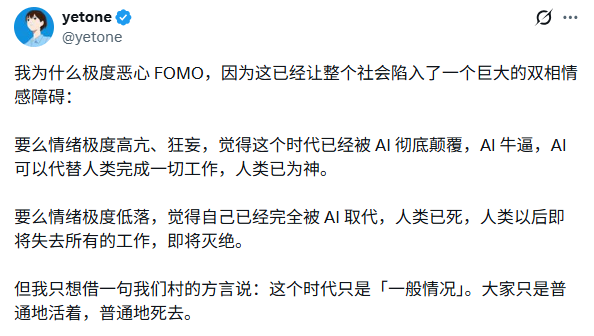
As AI developer @yetone bluntly stated on social media: "I am extremely disgusted by FOMO, which has already plunged the entire society into a massive bipolar disorder: either extremely euphoric, believing humans have become gods; or extremely depressed, feeling that humanity is dead."
We are now at the center of this "manic episode" storm. AI anxiety is no longer exclusive to programmers or tech giants; it has become a widespread psychological issue in the digital society. I will attempt to delve into the psychological roots behind the狂热 phenomenon of "the entire internet raising lobsters" and propose a set of "counter-consensus" coping strategies.

Decision Fatigue: "Copying Homework" to Avoid Thinking

Why do people so easily hand over sensitive permissions of many software to an unknown AI Agent? This is not merely technical enthusiasm but更像 a collapse of collective psychological defense mechanisms.

The modern human brain is already overloaded. Globalization and 24/7 digital life keep us under high-pressure, fast-paced information bombardment every day, causing severe "ego depletion" in the brain. Faced with endless new technologies, concepts, and workplace demands, our decision-making abilities are already exhausted.

Decision fatigue in psychology perfectly explains this. When a tool like OpenClaw, which claims to "handle everything," appears, it is like the last straw for a drowning person. Many people follow the trend to deploy it not to solve actual work problems but to avoid thinking.

"If others install it, I'll install it too"—isn't this just "copying homework"? It's worry-free and requires no brainpower. But this behavior, using "tactical diligence" to掩盖 "strategic laziness,"反而加剧es deep-seated anxiety—watching the computer run, the tools operate, but the brain completely "crashes" due to information overload.

Group Identity and Pathological FOMO: The Backlash of Tribal Genes

Humans are social animals. The ancient gene of "following the tribe for safety" is infinitely amplified in Web3 community culture. When your朋友圈, WeChat groups, and even various communities are all posting screenshots of deploying AI Agents, FOMO is no longer just a desire for wealth but a fear of "social death."

What you are truly anxious about may not be "will AI take my job?" but "if I don't follow the trend, I will be labeled as outdated and excluded from the current circle." This herd mentality, sacrificing rationality for "group security," turns the entire society into a massive echo chamber, infinitely amplifying the panic brought by uncertainty.

Additionally, AI Agents (like OpenClaw) are essentially huge "black boxes." What is their decision-making basis? We根本无法完全理解其内部逻辑.

When you try to use a highly centralized, unexplainable AI black box to handle your most sensitive personal assets, private data, and career decisions, a strong cognitive dissonance arises.

This psychological撕裂, caused by the冲击 of our底层信仰 in life control, directly打击s our self-efficacy.随之而来的是真实的安全噩梦: privacy leaks, sky-high bills,甚至系统被黑客控制. These real threats make anxiety彻底具象化.

AI anxiety is a physiological discomfort brought by technological development. We cannot eliminate it completely but can learn to驾驭 it. We need to establish a scientific defense and counterattack mechanism from three aspects: cognition, behavior, and self-positioning.

Faced with狂热, the most effective psychological intervention is to force yourself to calm down.

24–48 Hour Cooling-Off Period: When the next "Lobster"-level application floods your screen, don't immediately open the terminal to type code. Force yourself to stop and cool off for 24 to 48 hours. Ask yourself a soul-searching question: If no one on social media posted about this, would I still use it?

Break the Information Cocoon, Actively Seek FUD: Algorithms always push content that makes you FOMO. You need to actively search for "vulnerabilities," "complaints," and "security risks" of this AI product. Use rational FUD (Fear, Uncertainty, Doubt) to对抗 blind group excitement and regain control of independent thinking.

Instead of mutually infecting anxiety in group chats, it's better to directly seek answers from the source of anxiety.

Treat AI as a Psychological疏导 and Collaboration Partner: In this technological transformation, a Web3 community builder set a great example. While group members were疯狂 deploying AI, he directly asked AI: "What should I do about AI anxiety?" AI's response was very objective: "Maintain your own pace, trust your own judgment." This interaction of "using magic to defeat magic" not only breaks the mysterious and lofty filter of AI but also subconsciously establishes the psychological positioning of "I am the leader, AI is the assistant."

Small Steps, Fast Iterations, Reject Grand Narratives: Don't try to understand the underlying logic of all large models. Break down your workflow and find the smallest pain points. For example, only let AI help you summarize long reports or write a simple smart contract test case. Through small but certain successes, gradually rebuild your self-efficacy in the AI era.

Redefining Personal Moat: From "Knowing Prompt" to "Knowing How to Build Trust"

This is the core strategy to alleviate the threat of job replacement. Shift your focus from "what AI can do" to "what AI cannot do."

Deepen "Human Soft Skills" That AI Cannot Calculate: AI can instantly write tens of thousands of words of project analysis, but it cannot安抚 team emotions in a crisis; it cannot build trust through a glance at an offline gathering; it更无法 make judgments based on human morality and intuition for highly controversial business decisions. Emotional intelligence, empathy, complex interpersonal coordination, and political博弈 will be the ultimate, unassailable advantages of modern practitioners.

In terms of cognitive flexibility, we need to lengthen the historical cycle and jump out of the immediate 15-minute视野. Use a broader historical perspective to dilute the current cognitive overload. History tells us that looking back at the era when steam engines or electricity were first普及, it was also accompanied by extreme panic and bubbles. Technology is indeed reshaping productivity, but extreme二元论 like "humanity is dead" or "humanity has become gods" is just the noise of the times. Only when the bubble bursts will the killer applications truly land.

The Best Trend Is to Be Yourself

At this historical turning point where "software moves from scarcity to surplus," cognitive overload and近乎狂躁的社会情绪 are the growing pains of the era. But remember, blindly following the trend to deploy a red lobster will not make you a pioneer of the times; it will only make you a "肉鸡" (bot) providing computing power and data.

AI is the lever of the era, but the fulcrum is always your own independent judgment and core mentality. Next time anxiety surges in like seawater, try turning off the screen, take a deep breath, and tell yourself: More important than not falling behind the times is not losing yourself.

As an author from the Web3 industry, I have experienced more deeply than anyone this extreme insecurity torn between FUD and FOMO. In a world where "code is law," we understand better than anyone the cost of "Don't Trust, Verify." The cognitive dissonance brought by AI appears格外尖锐 under Web3's "trustless"信仰.

Therefore, I want to say to my peers even more: Surviving in a competitive market and maintaining a healthy psychological state is more important than catching every fleeting AI wave. Shift your focus from "AI will replace me" to "what trust crises does AI bring?" Solving these crises is our moat in the Web3 world.


Twitter:https://twitter.com/BitpushNewsCN

Bitpush TG Discussion Group:https://t.me/BitPushCommunity

Bitpush TG Subscription: https://t.me/bitpush

Original Link:https://www.bitpush.news/articles/7622806

Трендові криптовалюти

Пов'язані питання

QWhat is the main psychological reason people easily give sensitive permissions to AI Agents like OpenClaw according to the article?

AThe main psychological reason is decision fatigue, where people's brains are overloaded from high-pressure, fast-paced information bombardment, leading them to surrender permissions to avoid thinking and 'copy homework' from others.

QHow does the article suggest combating the fear of missing out (FOMO) in the context of AI trends?

AThe article suggests implementing a 24-48 hour cooling-off period when a new trend emerges, asking oneself if they would still use it without social media hype, and actively seeking out FUD (fear, uncertainty, doubt) to break information bubbles and regain independent thinking.

QWhat does the article identify as the ultimate advantage for humans that AI cannot replace?

AThe article identifies human soft skills such as emotional intelligence, empathy, complex interpersonal coordination, and moral judgment in crises as the ultimate advantages that AI cannot calculate or replicate.

QWhat historical perspective does the article recommend to alleviate cognitive overload from AI anxiety?

AThe article recommends looking at longer historical cycles, such as the initial panic and bubbles during the adoption of steam engines or electricity, to dilute current cognitive overload and recognize that extreme binary narratives are just noise of the era.

QWhat core advice does the article give to Web3 practitioners regarding AI and trust?

AThe article advises Web3 practitioners to shift focus from 'AI will replace me' to 'what trust crises does AI bring,' and to solve these crises, emphasizing that maintaining mental health and leveraging human trust-building skills are more important than chasing every AI trend.

Пов'язані матеріали

Will MicroStrategy Fall into a Death Spiral? What Will the Macro Trend Be in the Second Half of the Year?

The podcast features investor Didier discussing the recent Bitcoin downturn and the evolving strategy of MicroStrategy (MSTR). He argues the core pressure is not macro factors or ETF outflows, but the market pricing in an expectation that MSTR will engage in continuous, small-scale Bitcoin sales to fund its increasing preferred stock and debt obligations under its "bitcoin-per-share neutrality" principle. This creates a structural headwind. However, he is cautiously optimistic a "death spiral" is avoidable without new major shocks, as market support is likely to emerge at a certain price point. Didier then posits that the AI-driven bull market in US stocks (semiconductors, data centers) is fundamentally driven by AI agents and tokens becoming the "new labor force," displacing human roles and boosting corporate margins. This shift toward a machine economy is still in its early stages. He comments on crypto exchanges adding US stock trading, viewing it as a natural move toward valuable real-world assets as truly valuable crypto-native assets remain scarce. For crypto-native traders, he suggests existing strategies (e.g., meme-chasing or value investing) can translate to similar assets in US markets. The discussion notes the severe liquidity damage from the "1011 event" (likely referring to a major market crash) has essentially ended the altcoin cycle, with speculative momentum shifting to the more liquid US stock market. Regarding the macroeconomic outlook for H2 2024, Didier expresses increased caution due to potential market pressure from upcoming mega-IPOs (e.g., SpaceX) and US midterm election risks. Long-term, he remains bullish on AI's productivity gains and its convergence with blockchain/Web3, which he sees maturing into a more institutional, real-asset-focused phase.

链捕手4 хв тому

Will MicroStrategy Fall into a Death Spiral? What Will the Macro Trend Be in the Second Half of the Year?

链捕手4 хв тому

Dylan Patel: Founder of SemiAnalysis, Praised by Jensen Huang, is a 'Beekeeper' and 'Forum Enthusiast'

Dylan Patel, founder of the independent research firm SemiAnalysis, has an unconventional background. A former beekeeper from rural Georgia, he entered the semiconductor world as a self-taught "forum warrior," discussing chip technology anonymously online from a young age. He launched the SemiAnalysis blog in May 2020, which later transitioned to a paid subscription model. The firm has grown from a one-person operation to a global team of around 60, with a dedicated teardown lab. Its detailed, technically-focused analysis on semiconductor supply chains, AI infrastructure, and products has earned significant industry recognition. Notably, NVIDIA founder Jensen Huang has publicly cited their reports. In a landmark case, a critical 2024 report on AMD's MI300X GPU software stack led to a 90-minute call with AMD CEO Lisa Su, who thanked him for the constructive feedback. SemiAnalysis later acknowledged AMD's improvements. The firm's influence on markets was seen when a report on NVIDIA's Rubin memory configuration was partially shared, affecting memory stock prices. Dylan Patel emphasized the importance of context, contrasting the shared excerpt with the report's actual title. SemiAnalysis, now a multi-faceted consultancy with revenue projected to reach $100 million, is known for its deep technical insights that influence major industry players and investment decisions.

marsbit55 хв тому

Dylan Patel: Founder of SemiAnalysis, Praised by Jensen Huang, is a 'Beekeeper' and 'Forum Enthusiast'

marsbit55 хв тому

Dylan Patel: SemiAnalysis, Praised by Jensen Huang, is Founded by a 'Beekeeper and Forum Warrior'

Dylan Patel, founder of the independent research firm SemiAnalysis, has an unconventional background. Growing up in rural Georgia, he later worked as a beekeeper in Minnesota. His entry into semiconductors began as a self-taught "forum warrior," engaging anonymously in online tech communities from a young age. In May 2020, he started the SemiAnalysis blog on WordPress, later moving it to Substack as a paid subscription service. The firm has since evolved from a one-person operation into a global company with around 60 employees, featuring a dedicated chip teardown lab. Its revenue, reaching $20 million last year, is projected to surpass $100 million this year. SemiAnalysis is highly regarded in the AI and semiconductor industry for its deep technical analysis. NVIDIA founder Jensen Huang has publicly praised its reports. In a notable instance, a critical report on AMD's MI300X GPU software shortcomings prompted a 90-minute call with CEO Lisa Su, who thanked Patel for the "constructive feedback." A later report acknowledged AMD's subsequent improvements. The firm's analyses have significant market impact. For example, a June report discussing potential memory configuration changes in NVIDIA's next-generation servers was cited as a factor in pressure on memory-related stocks. Patel plans to establish a venture capital firm, having already made personal investments in about 20 startups. SemiAnalysis combines roles as a consultancy, model platform, and tech lab, focusing on the practical bottlenecks in AI infrastructure.

Odaily星球日报59 хв тому

Dylan Patel: SemiAnalysis, Praised by Jensen Huang, is Founded by a 'Beekeeper and Forum Warrior'

Odaily星球日报59 хв тому

Ethereum Q1 Report: On-chain Activity Hits Record High, Tokenized Assets Lead the Industry

Ethereum Q1 2026 Report: On-chain activity hits record high, tokenized assets lead the industry. In Q1 2026, Ethereum's network experienced a unique divergence: on-chain activity soared while USD-denominated metrics declined. Monthly active users reached 13.2 million, transactions hit 200.4 million, and TPS averaged 25.78, all setting new highs. However, total value locked (TVL) fell 11.0% to $316.2B, DEX volume dropped 24.0% to $134.5B, and ETH's fully diluted market cap fell 30.3% to $290B. A key driver was the Blob Parameter Fork (BPO#2) in January, which increased data capacity and caused a sharp 47.9% drop in layer-1 transaction fees despite higher usage. Etherean's tokenized asset market cap reached $203.4B, up 42.9% year-over-year. While stablecoins ($178.9B) saw a slight dip, tokenized funds ($19.4B, +73.1% YoY), commodities ($4.7B, +325.9% YoY), and stocks ($365.1M) grew strongly. Ethereum dominates cross-chain comparisons, holding 71% of TVL, 79.2% of active loans, 61.8% of stablecoins, and 73% of tokenized funds among top chains. The report highlights a "Jevons Paradox" scenario: network expansion reduces per-transaction costs but unleashes latent demand, driving long-term growth. Ethereum's strategy mirrors Amazon's early focus on scale over profit. Its open, neutral foundation is seen as critical for institutional adoption, as evidenced by growing activity from firms like BlackRock and JPMorgan. The roadmap targets further scalability, aiming for thousands of TPS by 2029 to solidify its role as a global financial settlement layer.

marsbit1 год тому

Ethereum Q1 Report: On-chain Activity Hits Record High, Tokenized Assets Lead the Industry

marsbit1 год тому

Торгівля

Спот
Ф'ючерси

Популярні статті

Як купити PEOPLE

Ласкаво просимо до HTX.com! Ми зробили покупку ConstitutionDAO (PEOPLE) простою та зручною. Дотримуйтесь нашої покрокової інструкції, щоб розпочати свою криптовалютну подорож.Крок 1: Створіть обліковий запис на HTXВикористовуйте свою електронну пошту або номер телефону, щоб зареєструвати обліковий запис на HTX безплатно. Пройдіть безпроблемну реєстрацію й отримайте доступ до всіх функцій.ЗареєструватисьКрок 2: Перейдіть до розділу Купити крипту і виберіть спосіб оплатиКредитна/дебетова картка: використовуйте вашу картку Visa або Mastercard, щоб миттєво купити ConstitutionDAO (PEOPLE).Баланс: використовуйте кошти з балансу вашого рахунку HTX для безперешкодної торгівлі.Треті особи: ми додали популярні способи оплати, такі як Google Pay та Apple Pay, щоб підвищити зручність.P2P: Торгуйте безпосередньо з іншими користувачами на HTX.Позабіржова торгівля (OTC): ми пропонуємо індивідуальні послуги та конкурентні обмінні курси для трейдерів.Крок 3: Зберігайте свої ConstitutionDAO (PEOPLE)Після придбання ConstitutionDAO (PEOPLE) збережіть його у своєму обліковому записі на HTX. Крім того, ви можете відправити його в інше місце за допомогою блокчейн-переказу або використовувати його для торгівлі іншими криптовалютами.Крок 4: Торгівля ConstitutionDAO (PEOPLE)Легко торгуйте ConstitutionDAO (PEOPLE) на спотовому ринку HTX. Просто увійдіть до свого облікового запису, виберіть торгову пару, укладайте угоди та спостерігайте за ними в режимі реального часу. Ми пропонуємо зручний досвід як для початківців, так і для досвідчених трейдерів.

490 переглядів усьогоОпубліковано 2024.12.12Оновлено 2026.06.02

Як купити PEOPLE

Обговорення

Ласкаво просимо до спільноти HTX. Тут ви можете бути в курсі останніх подій розвитку платформи та отримати доступ до професійної ринкової інформації. Нижче представлені думки користувачів щодо ціни PEOPLE (PEOPLE).

活动图片