Don't Be Misled by the $1.25 Billion Cap: MicroStrategy's Three-Pronged Bitcoin Sale Pools Hide Massive Selling Pressure

Foresight NewsОпубліковано о 2026-07-08Востаннє оновлено о 2026-07-08

Анотація

Don't Be Misled by the $1.25B Cap: Strategy's Three-Tier Bitcoin Sales Plan Hides Massive Potential Selling Pressure Strategy recently sold 3,588 BTC (~$216M) to fund a dividend and replenish its dollar reserve, while claiming its $1.25B "reserve build" capacity remains fully available. This highlights a key nuance: the widely cited $1.25B limit applies only to sales for "Building" the reserve. Strategy's broader capital framework, however, allows Bitcoin sales for three primary purposes, each with different scales: 1. **Building the Reserve:** Selling BTC to raise up to $1.25B for the reserve. 2. **Covering Priority Share Expenses:** Selling BTC to pay dividends/interest or to replenish the reserve after such payments are made from it (no specified limit). 3. **Share Repurchase Funding:** Selling BTC to fund up to $1B each in convertible note and common stock repurchases (totaling $2B potential). Combined, just the capped "Build" and "Repurchase" channels could facilitate over $3B in Bitcoin sales, excluding the uncapped "Cover Expenses" channel. The accounting distinction between "Building" (adding cash before a payout) and "Replenishing" (adding cash after a payout) is operationally blurry but allows sales like the recent $216M transaction without touching the $1.25B "Build" quota. This gives Strategy significant flexibility. The move signifies a strategic shift: Strategy is transforming from a simple Bitcoin accumulator into an active capital manager, akin to a he...


Author: David Christopher

Compiler: Saoirse, Foresight News


Recently, MicroStrategy disclosed that between June 29 and July 5, the company sold 3,588 bitcoins for a total value of approximately $216 million. The proceeds from this sale were used to distribute STRC dividends and to replenish the U.S. dollar reserves that had been depleted by previous dividend payments. Even after completing this sale, MicroStrategy publicly stated that its $1.25 billion reserve construction capacity remains fully available.


In other words, this $216 million bitcoin sale, intended to replenish reserves, does not consume the $1.25 billion quota allocated for building reserves. Financially, there is a distinction between "replenishing reserves" and "building reserves." However, both operations essentially serve the same purpose: injecting funds into the same pool of dollar reserves, differing only in their accounting classification.


Put differently, this bitcoin monetization plan never locks the total potential bitcoin sale volume at $1.25 billion. That cap only limits one type of operation: raising new funds through bitcoin sales to build up the dollar reserve. Beyond that, the plan allows MicroStrategy to sell bitcoin for other purposes, with the recent sale being a prime example.


Three Major Funding Pools


On June 29, after several weeks of sustained pressure on MSTR and STRC stock prices, MicroStrategy launched a bitcoin monetization plan as part of its overall Digital Credit Capital framework. This plan permits the company to sell bitcoin for three core purposes:


  1. Build Reserve: Sell bitcoin to raise up to $1.25 billion to bolster the dollar reserve;
  2. Cover Preferred Stock-Related Expenses: Sell bitcoin to pay fixed dividends on preferred stock and debt interest; or, after using reserve funds to make payments, sell bitcoin to refill the reserve — a method management may choose when selling bitcoin is deemed more advantageous than issuing common stock;
  3. Fund Share Repurchases: Sell bitcoin to repurchase preferred stock or MSTR common stock, with each repurchase channel capped at $1 billion, totaling $2 billion. Sale proceeds can also cover taxes, fees, and related expenses from the repurchases.


Only the first funding pool has the widely reported $1.25 billion limit; the third repurchase channel alone could monetize up to $2 billion worth of bitcoin. Just these two channels with explicit caps could lead to the sale of over $3 billion in bitcoin, not even counting the unlimited funding pool for dividend payments and reserve replenishment.
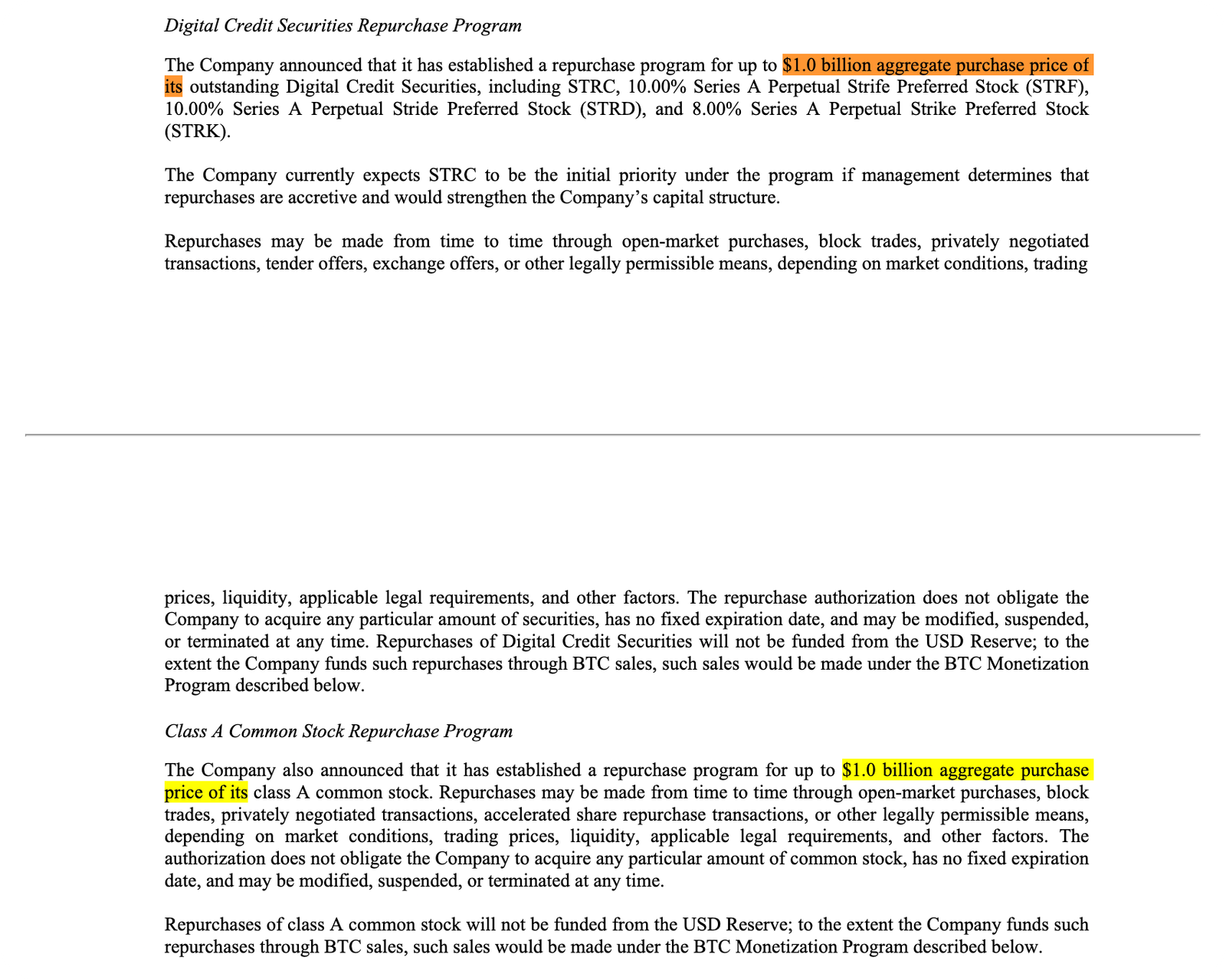


Distinguishing 'Building' from 'Replenishing': Blurry-Lined Accounting Operations


The sole purpose of the dollar reserve is to fund preferred stock dividends and debt interest payments. Under current rules, this money cannot be used for stock buybacks. As of June 28, the dollar reserve balance was $2.55 billion, sufficient to cover the company's annual $1.76 billion in mandatory payments for approximately 17 months. The board has set a floor: the reserve must cover at least 12 months of payments, unless the board approves a lower threshold.


This is why the distinction between "building reserve" and "replenishing reserve" deserves close scrutiny:


  • Selling bitcoin *before* a dividend payment and depositing the new cash into the reserve: defined as building reserve;
  • First using the reserve to pay a dividend, then later selling bitcoin to make up the shortfall: defined as replenishing reserve.


The plan categorizes them as two distinct operations, but their ultimate purpose is identical: selling bitcoin for cash to fund preferred stock dividends and interest payments. The relevant details were publicly disclosed, but this recent sale event vividly demonstrates how convenient this classification system is for the company. MicroStrategy sold $216 million worth of bitcoin, used the funds for dividends and to refill the reserve, yet publicly maintains that the $1.25 billion reserve-building quota remains untouched.


The market must now learn to read this "MicroStrategy-specific vernacular." "Building" and "replenishing" are merely nuanced accounting terms, yet they directly determine whether a bitcoin sale counts against the publicly stated cap.


From Simple Accumulation to Active Capital Management


In the June 29 announcement, Michael Saylor stated that this capital framework was designed to meet the company's needs for liquidity, standardized operations, and active capital management. CEO Phong Le was more direct: MicroStrategy is transitioning from a one-way street of issuing stock to buy bitcoin to a comprehensive, active capital operation.


As Matt Walsh and Jeff Dorman of Castle Island Ventures analyzed on a podcast last week, MicroStrategy has effectively become an actively managed hedge fund.


The market's narrative for MicroStrategy used to be simple: issue MSTR common stock, buy bitcoin, providing investors with leveraged bitcoin exposure. The new framework fundamentally alters this logic: the company will now actively buy and sell its own various capital instruments to balance the multiple pressures between common stock, preferred stock, dollar reserves, and bitcoin assets.


Walsh and Dorman pointed out that this operating model is internally contradictory: issuing common stock can secure preferred stock dividends but suppresses MSTR's valuation premium relative to its bitcoin holdings; selling bitcoin can extend the cash runway but fundamentally undermines the core "never sell" narrative; fully funding preferred dividends can stabilize market confidence but continuously depletes cash reserves; cutting preferred dividends preserves liquidity but could trigger a sharp drop in preferred stock prices.


The accounting loophole in the reserve quota is a microcosm of this strategic shift. Bitcoin is no longer the core asset held for the long term but a financial lever to adjust the balance sheet and maintain the functioning of the preferred stock payment system.


Conclusion


Investors must now anticipate the risks in Michael Saylor's capital management model: every action benefits one part of the capital structure while harming another.


This is also the key signal from the July 6 announcement: MicroStrategy is not short on room to sell bitcoin; its potential sale volume far exceeds the number the market superficially sees. The $1.25 billion figure only represents the company prioritizing the preservation of its bitcoin holdings if investors mistakenly believe it's the total sales cap; don't fall into this cognitive trap.


Today's MicroStrategy is a financial institution whose rules the market must parse word by word. Every professional term is critical: build, replenish, issue, repurchase, stabilize. Investors must dissect every term, like Fed watchers parsing policy statements, to gauge the potential scale of its future bitcoin sales.


This monetization plan gives MicroStrategy operational flexibility, but the underlying internal contradictions remain. It is no longer a simple, clear leveraged bitcoin investment vehicle; betting on this company is essentially a wager on its active capital management capabilities — betting it can continuously sell, refill, issue, repurchase, and stabilize its various capital tools without one link breaking and causing a systemic collapse.


Personally, I wouldn't take that bet.

Трендові криптовалюти

Пов'язані питання

QWhat are the three main purposes for which MicroStrategy can sell Bitcoin under its capital framework?

AThe three main purposes are: 1) To build a reserve, with an upper limit of $1.25 billion in funds raised; 2) To cover preferred share-related expenses, such as paying fixed dividends and debt interest; 3) To fund share repurchases, with a combined upper limit of $2 billion for repurchasing preferred shares and MSTR common stock.

QHow does MicroStrategy's recent sale of 3,588 bitcoins not deplete the widely reported $1.25 billion 'reserve building' limit?

AThe recent sale was categorized as 'reserve replenishment,' not 'reserve building.' According to MicroStrategy's accounting rules, only sales that add new cash to the reserve before dividends are paid count against the $1.25 billion 'building' limit. Sales that refill the reserve after it has been used for payouts are classified as 'replenishment' and do not count against that limit.

QWhat is the fundamental shift in MicroStrategy's corporate strategy as highlighted in the article?

AMicroStrategy has shifted from being a simple 'Bitcoin accumulator' that primarily issued shares to buy Bitcoin, to a company engaged in active capital management. It now strategically buys and sells various capital instruments (Bitcoin, preferred shares, common stock) to balance pressures across its balance sheet and maintain its payout systems.

QWhat is the 'intrinsic contradiction' within MicroStrategy's new operational model, according to the analysts cited?

AThe model is internally contradictory: issuing common stock ensures preferred share dividends but lowers MSTR's valuation premium over its Bitcoin holdings; selling Bitcoin extends cash runway but breaks the 'never sell' narrative; fully paying preferred dividends maintains market confidence but depletes cash reserves; cutting preferred dividends preserves liquidity but could cause the preferred stock price to crash.

QWhat key signal does the author suggest was released in MicroStrategy's July 6th announcement?

AThe announcement signaled that MicroStrategy has far more room to sell Bitcoin than the market's superficial focus on the $1.25 billion 'reserve building' limit suggests. The total potential selling capacity is much higher, and the $1.25 billion figure only represents a limit on one specific purpose, not the company's total Bitcoin sales capacity.

Пов'язані матеріали

The Danger of Old Bookmarks: How an Expired Tornado Cash Domain Cost a User 1,000 ETH

A user lost over 1,010 ETH (worth millions) due to a phishing attack via an expired official domain of the Tornado Cash protocol. As reported on August 20, 2026, the domain `tornado.cash` was not renewed by the original developers amid U.S. OFAC sanctions and was subsequently registered by malicious actors. They deployed a fake frontend mimicking the legitimate Tornado Cash interface. Through this site, the attackers gained access to the user's deposit notes—the data required to withdraw funds from the protocol's pools—and drained the ETH within 12 hours. On-chain data shows the stolen funds (e.g., wallet 0xd8B356...) were withdrawn from Tornado Cash pools. However, on-chain analyst Specter cast doubt on the victim's story. He suggested the individual might be involved in illicit activity, noting that a large sum of BTC was received from a coin-mixing service (Whirlpool) and converted to ETH before being sent to the fake Tornado Cash site. The victim's explanation of urgently moving funds due to a compromised hardware wallet was questioned, as the fund trail indicated deliberate obfuscation. Specter speculated this might be a conflict between malicious actors rather than a simple phishing case. The incident highlights the danger of expired domains for major protocols, where old bookmarks can lead to compromised sites. WHOIS records show the domain was registered in March 2025. Broader analysis notes that in 2025, over $1.8 billion was lost to scams and exploits, largely through social engineering like phishing via familiar but hijacked links. This case underscores the persistent risk when a domain's legal status changes but user trust and search engine reputation remain.

cryptonews.ru42 хв тому

The Danger of Old Bookmarks: How an Expired Tornado Cash Domain Cost a User 1,000 ETH

cryptonews.ru42 хв тому

You'll Be Surprised How Much WeChat's Architecture Differs from Telegram's

An article compares the core architectural philosophies of WeChat and Telegram, highlighting fundamental differences in data storage, monetization, and developer ecosystems. **Data Storage:** Telegram offers unlimited, synchronized cloud storage for seamless access across all devices. In contrast, WeChat stores chat history locally on each device, requiring a manual migration process for transfer and tethering desktop sessions to an active smartphone. **Features & Ecosystem:** Telegram's open Bot API allows for easy, free bot creation, while WeChat's massive ecosystem of over 4.8 million "mini-programs" operates within a closed, curated, and more regulated platform. Commenting also differs: Telegram uses integrated discussion threads for channels, whereas WeChat relies on pre-moderated comments for official accounts and separate chats for interaction. **File Sharing & Payments:** Telegram supports large file transfers (up to 4GB for Premium), while WeChat limits most files to 200MB. A key divergence is in payments: WeChat Pay is deeply integrated into daily life and commerce in China, whereas Telegram lacks a comparable built-in fiat payment system, focusing instead on third-party bots and crypto. **Analysis:** The comparison reveals two distinct models: WeChat is a tightly integrated, closed ecosystem deeply embedded in the real economy, while Telegram prioritizes open protocols, flexible data handling, and low barriers for developers. An added perspective notes that WeChat's fusion of messaging and payments in a single interface without end-to-end encryption for chats potentially broadens the attack surface, raising security questions as more functions converge.

cryptonews.ru6 год тому

You'll Be Surprised How Much WeChat's Architecture Differs from Telegram's

cryptonews.ru6 год тому

Торгівля

Спот

Популярні статті

Як купити CAP

Ласкаво просимо до HTX.com! Ми зробили покупку Cap (CAP) простою та зручною. Дотримуйтесь нашої покрокової інструкції, щоб розпочати свою криптовалютну подорож.Крок 1: Створіть обліковий запис на HTXВикористовуйте свою електронну пошту або номер телефону, щоб зареєструвати обліковий запис на HTX безплатно. Пройдіть безпроблемну реєстрацію й отримайте доступ до всіх функцій.ЗареєструватисьКрок 2: Перейдіть до розділу Купити крипту і виберіть спосіб оплатиКредитна/дебетова картка: використовуйте вашу картку Visa або Mastercard, щоб миттєво купити Cap (CAP).Баланс: використовуйте кошти з балансу вашого рахунку HTX для безперешкодної торгівлі.Треті особи: ми додали популярні способи оплати, такі як Google Pay та Apple Pay, щоб підвищити зручність.P2P: Торгуйте безпосередньо з іншими користувачами на HTX.Позабіржова торгівля (OTC): ми пропонуємо індивідуальні послуги та конкурентні обмінні курси для трейдерів.Крок 3: Зберігайте свої Cap (CAP)Після придбання Cap (CAP) збережіть його у своєму обліковому записі на HTX. Крім того, ви можете відправити його в інше місце за допомогою блокчейн-переказу або використовувати його для торгівлі іншими криптовалютами.Крок 4: Торгівля Cap (CAP)Легко торгуйте Cap (CAP) на спотовому ринку HTX. Просто увійдіть до свого облікового запису, виберіть торгову пару, укладайте угоди та спостерігайте за ними в режимі реального часу. Ми пропонуємо зручний досвід як для початківців, так і для досвідчених трейдерів.

558 переглядів усьогоОпубліковано 2026.06.26Оновлено 2026.06.26

Як купити CAP

Обговорення

Ласкаво просимо до спільноти HTX. Тут ви можете бути в курсі останніх подій розвитку платформи та отримати доступ до професійної ринкової інформації. Нижче представлені думки користувачів щодо ціни CAP (CAP).

活动图片