Domestic First Explosion-Proof Certification, World's First Fueling Brain Solution: How Did They Secure Two 'Firsts'?

marsbitОпубліковано о 2026-06-26Востаннє оновлено о 2026-06-26

Анотація

China's embodied AI sector is booming, with over ¥37 billion in funding this year. The focus has shifted decisively to real-world application, particularly in hazardous, repetitive tasks humans should avoid. A key, often prohibitive, barrier to entry for robots in environments like gas stations and oil fields is obtaining explosion-proof certification, requiring meticulous hardware and circuit design from the ground up. The article explores three main application areas. At gas stations, the challenge lies in executing a long, precise sequence of actions (opening caps, handling the fuel nozzle) with millimeter accuracy across diverse car models. For facility inspections, robots need sustained autonomous patrols combined with real-time anomaly detection and response. Port scenarios introduce the complexity of multi-robot coordination. Addressing the core challenge of long-horizon tasks, the piece highlights a technical breakthrough: a "world model"-driven approach. This enables predictive planning, allowing the AI to visualize the desired end-state (e.g., nozzle returned, cap closed) and work backward to synthesize intermediate visual frames. This "imagination" of the task trajectory, as implemented in the H-GAR architecture, guides action generation, significantly reducing cumulative error in multi-step operations. The three-step H-GAR process involves generating a coarse action draft, synthesizing target-conditioned observation frames, and then refining actions based on vis...

According to statistics, the total financing in the domestic embodied intelligence field this year has exceeded 37 billion yuan.

The Ministry of Industry and Information Technology and the State-owned Assets Supervision and Administration Commission jointly launched the 'Humanoid Robots and Embodied Intelligence Real-World Training Special Action', with China National Radio News directly labeling this year as the 'critical year for commercialization and implementation'. Funding from the primary market and narratives from the secondary market are all pointing in the same direction: implementation, implementation, implementation.

But here comes the question: How should embodied intelligence be implemented?

A widely accepted viewpoint is that embodied intelligence should tackle tasks that humans cannot do and replace humans in performing high-risk, heavy, repetitive jobs that people don't want to do and shouldn't be doing.

On June 22nd, the 4th China International Supply Chain Expo (CISCE) opened in Beijing, featuring a dedicated artificial intelligence zone for the first time.

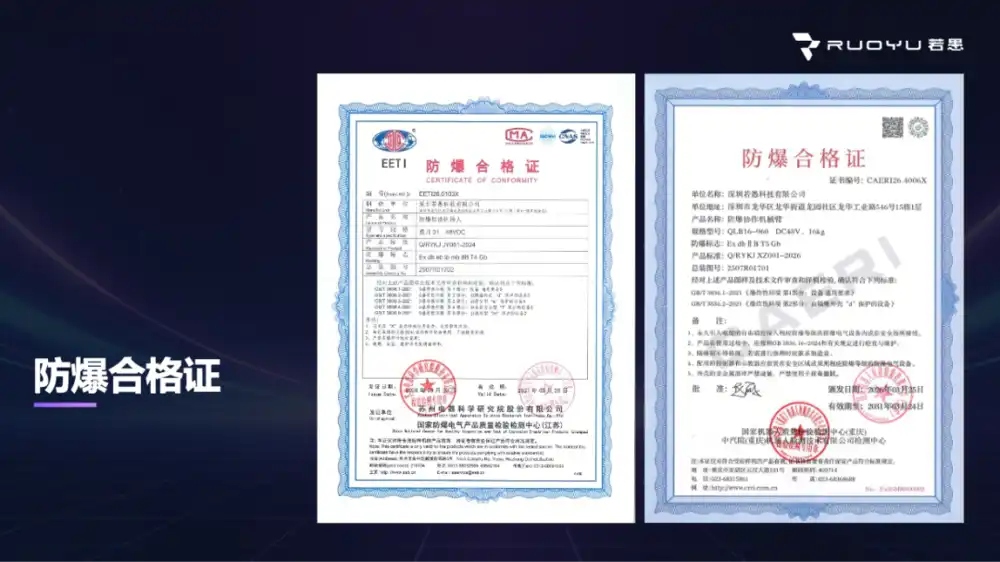
However, ideas are one thing; for robots to truly 'enter' these scenarios, the first barrier is enough to deter most companies: explosion-proof certification.

In flammable and explosive environments such as gas stations, oil and gas stations, and chemical plants, robots themselves absolutely must not become potential ignition sources. This imposes extremely stringent requirements on the hardware's design from the very beginning. For example: the circuit level must adopt an intrinsically safe design, limiting loop energy to ensure it cannot ignite environmental gases even in case of a fault; mechanical structures must meet flameproof requirements to withstand internal explosions without damaging the housing; all connection points must be made increased-safety to prevent spark risks during normal operation; key components must also be isolated from hazardous contact through encapsulation, etc.
Where Can Embodied Intelligence Go

The challenge for robots in this scenario lies in the 'coherence of fine operations.' After the customer places an order, the robot must sequentially perform over ten actions: opening the outer cover, unscrewing the inner cap, detaching the nozzle from the pump, aiming and inserting it into the fuel filler neck, waiting for the tank to fill, removing the nozzle, hanging it back on the pump, closing the inner cap, and closing the outer cover. The tolerance for each action is only a few millimeters; getting stuck at any step means the entire chain is interrupted. Moreover, different vehicle models have vastly different fuel tank locations, cover structures, and opening methods. A robot cannot rely on fixed programs to handle all situations.

The pain points of station patrol inspections are entirely different from those of gas stations. Gas stations test fine operation, while station patrols test the comprehensive capability of 'long-duration autonomous patrolling + multi-type anomaly recognition + on-site immediate response.' Inspectors walk fixed routes daily—a job that is dull, dangerous, and requires extremely high concentration. The error rate of humans increases significantly after several hours of continuous inspection.

Port Scenario: Exploring Multi-Robot Collaboration

The most unique aspect of this scenario is that it naturally requires multiple robots to collaborate.

Currently, most embodied intelligence system architectures are 'pipeline-style,' where the vision module is responsible for seeing, the language module for understanding, and the action module for execution.

This architecture might handle simple tasks with short sequences and low interference, but once faced with scenarios requiring dozens of consecutive steps, highly dynamic environments, and extremely low fault tolerance, even minor deviations at any intermediate step propagate like dominoes. Traditional pipeline architectures are almost incapable of ensuring end-to-end stability in the face of tasks at this scale.

World Model-Driven Predictive Capability

In the gas station scenario, the task chain faced by embodied intelligence is extremely long: guiding the vehicle, identifying the fuel tank location, opening the outer cover, opening the inner cap, retrieving the nozzle, aligning with the filler neck, inserting, fueling, removing, returning the nozzle, closing the inner cap, closing the outer cover. Minor deviations at any step propagate backward.

This capability is particularly crucial in long-sequence tasks. Refueling is not a simple 'grasp-and-place' operation; it's an entire chain of actions with causal relationships. The world model enables embodied intelligence to possess the forward-looking ability of 'looking three steps ahead before taking one.'

To understand with a metaphor: When an experienced driver refuels, regardless of how smoothly the fuel cap opens, their mind always knows the final state to achieve, adjusting every intermediate step toward that end state. It shifts embodied intelligence from 'linear execution' to 'goal-state alignment.'

First, generate the target observation. After receiving the task instruction and the current camera feed, the system first predicts 'what the world should look like after the task is completed.' For example, after a refueling task, the nozzle should be returned and the fuel cap closed. This predicted 'final-state image' becomes the target observation, providing a clear semantic anchor for all subsequent reasoning processes.

Second, synthesize intermediate transition frames. With the goal established, the system then infers the visual states that should occur in between. If the starting point is 'fuel cap closed' and the endpoint is 'nozzle returned, fuel cap closed,' then intermediate states like 'fuel cap opened,' 'nozzle retrieved,' 'nozzle inserted into filler neck' need to appear sequentially. These synthesized intermediate observation frames provide stepwise-aligned visual references for action generation.

This mechanism allows the robot to have a complete visual imagination of the entire task process before acting. Subsequent action planning revolves around this 'imagined trajectory,' significantly reducing cumulative deviation during long-sequence execution.
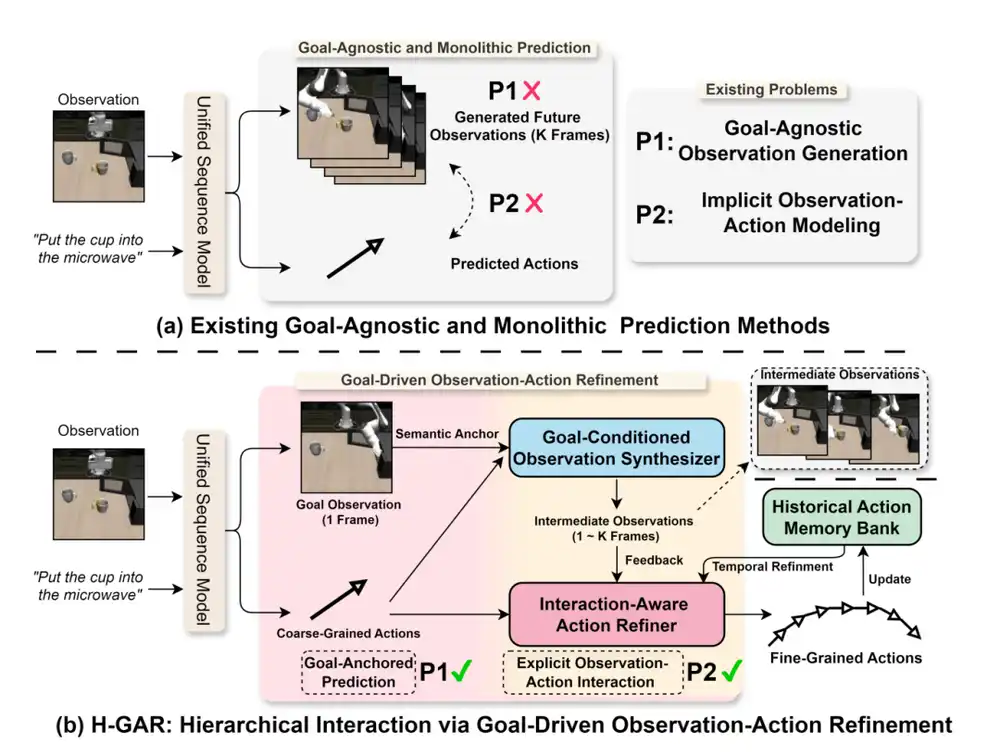
(a) Existing methods typically employ a goal-agnostic, holistic prediction paradigm. (b) H-GAR introduces a Goal-conditioned Observation Synthesizer and an Interaction-Aware Action Refiner, thereby achieving goal-anchored prediction and explicitly modeling the interaction between observations and actions.

Specifically, the workflow of H-GAR is divided into three steps:
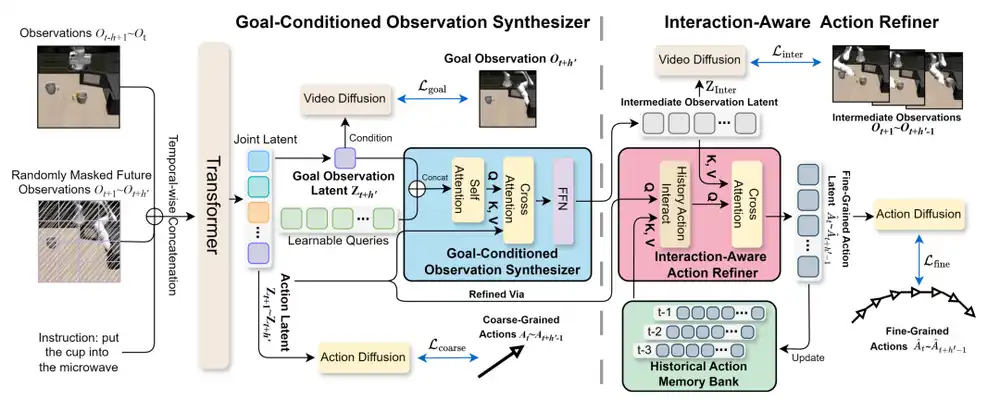
H-GAR Architecture Diagram

  • Step 1: Coarse-grained action draft. Based on historical frames and task instructions, the system first generates a set of coarse action sequences. These actions describe a 'rough path' from the current state to the goal, similar to a human driver's rough mental plan before refueling, knowing roughly which steps to take—the preparation before execution.

  • Step 2: Goal-conditioned Observation Synthesis (GOS module). After obtaining the coarse actions, the system synthesizes intermediate visual frames guided by the target observation. The key here is that the synthesized frames are not generated arbitrarily but are constrained by both the final goal state and the coarse actions. This ensures the intermediate transition frames align with both action logic and the final goal.

  • Step 3: Interaction-Aware Action Refinement (IAAR module). The final step refines the coarse actions into fine-grained executable commands. IAAR refines actions using feedback from two directions: first, the visual context provided by intermediate observation frames, aligning actions with the actual scene; second, a historical action memory library, which records previously executed fine-grained actions, ensuring the currently generated actions maintain temporal consistency with the historical trajectory. When the memory library exceeds its capacity threshold, the system employs a similarity-based eviction strategy, merging the most similar adjacent actions to preserve memory diversity.

  • Paper address: https://arxiv.org/pdf/2511.17079

Unexpected events are almost the norm in real-world scenarios. The fuel cap might not open at the right angle, the customer might park slightly off the expected position, or there might even be obstructions around the filler neck. An action that succeeds 99 times out of 100 in the lab might see its success rate drop by 30% when deployed in outdoor, real environments.

Epilogue: Unity of Knowledge and Action

Guiding embodied intelligence into specialized scenarios is an endeavor that requires a long-termist mindset.

To enter specialized industries, mechanical structure design must consider safety from the ground up, requiring the capability to develop the embodied platform itself. To execute tasks in special environments, an embodied brain is indispensable. The deep coupling of brain and platform has moved beyond being a plus; it is the entry requirement.

As the embodied intelligence industry collectively stands at the crossroads of commercialization and implementation, those players who have first established the closed loop of 'brain-platform-data' will most likely gain a competitive edge in the upcoming race.

This article is from the WeChat official account: 机器之心 , Editor: Cold Cat, Author: Focus on Embodied Intelligence, Original Title: 'Domestic First Explosion-Proof Certification, World's First Fueling Brain Solution: How Did They Secure Two 'Firsts'?'


Трендові криптовалюти

Пов'язані питання

QWhat are the main obstacles for embodied intelligence robots to enter high-risk scenarios like gas stations and chemical plants?

AThe main obstacles include passing the stringent explosion-proof certification. This requires the robot's hardware to be designed with intrinsic safety from the start, limiting circuit energy, ensuring the mechanical structure can withstand internal explosions without damaging the shell, and implementing safety measures for all connection points to prevent spark risks in normal operation.

QHow does the 'world model' improve the performance of embodied intelligence in long-sequence tasks like refueling?

AThe world model endows embodied intelligence with predictive capabilities, allowing it to 'think a few steps ahead'. It first generates a visual prediction of the 'final state' after task completion. It then synthesizes intermediate visual frames leading to that state. This provides a visual roadmap, enabling the system to plan actions around this imagined trajectory, which reduces cumulative errors in long, complex action sequences.

QWhat is the three-step workflow of the H-GAR architecture described in the article?

AThe H-GAR (Hierarchical Goal-conditioned Anticipatory Reasoning) architecture's three-step workflow is: 1) Coarse-grained Action Draft: Generating a rough action sequence based on history and the task. 2) Goal-conditioned Observation Synthesis (GOS): Synthesizing intermediate visual frames guided by the final goal and the coarse actions. 3) Interaction-Aware Action Refinement (IAAR): Refining the coarse actions into executable commands using feedback from the synthesized frames and a historical action memory bank to ensure consistency.

QWhat are the key challenges for embodied intelligence in port scenarios according to the article?

AThe key challenge in port scenarios is the need for multi-robot collaboration. Unlike simpler tasks, port operations naturally require multiple robots to work together efficiently, which is a more complex problem than single-robot operations explored in most current systems.

QWhy does the article suggest that deep integration of 'brain' and 'body' is crucial for embodied intelligence in special industries?

ADeep integration of the AI 'brain' (control/planning system) and the physical 'body' (robotic hardware) is an essential entry requirement, not just an advantage. To operate safely in hazardous environments, the mechanical design must inherently consider safety from the ground up, and the AI must be deeply coupled with this specific hardware to execute tasks reliably in those unique, challenging conditions.

Пов'язані матеріали

Stablecoins Becoming the Next Policy Challenge for the Fed's Walsh Version

Fed Governor Christopher Waller's speech at the June 22 conference on the U.S. dollar's international role signifies a notable policy shift: stablecoins like USDT and USDC are now being formally considered as potential channels for transmitting U.S. dollar liquidity globally. With their combined market cap surpassing $250 billion and high transaction volumes, these digital assets are moving from the periphery of crypto policy to the core of monetary system research. The key concern for policymakers is how stablecoin flows interact with traditional dollar infrastructure. Their growth could affect bank deposits, demand for short-term Treasury securities (like T-bills), and global access to dollars, depending on whether demand originates overseas or substitutes for domestic bank balances. Issuers' reserve management—holding assets in banks, money market funds, or Treasuries—links stablecoin activity directly to these core markets. The Fed's research agenda now examines whether stablecoins, by combining payment and balance-holding functions on digital rails, could complicate monetary policy implementation or transmit liquidity stress to banks. While current Treasury holdings by issuers are under 1% of the total market, their concentrated demand could marginally impact yields, especially during periods of stress. Consequently, stablecoins are evolving from mere crypto trading tools into a private-layer dollar transmission system with public policy implications, prompting closer regulatory scrutiny of their reserve robustness, redemption mechanisms, and systemic integration.

marsbit5 хв тому

Stablecoins Becoming the Next Policy Challenge for the Fed's Walsh Version

marsbit5 хв тому

A 380% Soar, Shenzhen’s 100-Billion-Yuan IPO Rings the Bell

HKC Holdings, a major Chinese display panel manufacturer, has successfully listed on the Shenzhen Stock Exchange's main board. The company's shares surged over 380% on its debut, pushing its market capitalization to around 350 billion yuan (formerly reaching 500 billion yuan). Founded by Wang Zhiyong in Shenzhen's Huaqiangbei electronics market nearly three decades ago, HKC evolved from assembling monitors to becoming a global top-tier supplier of semiconductor display panels for TVs, monitors, and smartphones. The IPO marks a significant milestone for HKC and its backers. The company's growth into the capital-intensive panel manufacturing sector was supported through partnerships with state-owned capital from regions like Chongqing, Mianyang, and Chuzhou. Its shareholder list also includes BOE Technology's investment arm. In recent years, HKC reported strong financials, with core panel business contributing over 70% of revenue and clients including Samsung, TCL, and Xiaomi. This listing is seen as part of a broader trend in Shenzhen's evolving tech landscape. Beyond established giants, the city is nurturing clusters of leading companies in specialized sectors like robotics—exemplified by the "Shenzhen Robot Valley"—and storage chips, where a group of firms dubbed the "Storage Five Tigers" has achieved a combined trillion-yuan market valuation. Shenzhen's strategic focus on emerging industries such as AI terminals, low-altitude economy, and humanoid robotics aims to build new industrial depth and foster the next generation of tech champions.

marsbit17 хв тому

A 380% Soar, Shenzhen’s 100-Billion-Yuan IPO Rings the Bell

marsbit17 хв тому

Bitcoin Bear Market Triggers Crypto Layoffs, Yet Fuels Industry's Most Aggressive M&A Wave Ever

A prolonged Bitcoin downturn is forcing crypto companies to lay off employees and automate operations, but has simultaneously triggered the industry's most aggressive wave of mergers and acquisitions (M&A). In the first half of 2026, crypto M&A deal value reached $93.7 billion, 26 times higher than the same period last year. This activity is primarily driven by traditional financial institutions—banks, payment processors, and asset managers—who are acquiring compliant crypto infrastructure like custody solutions, payment rails, and regulatory licenses instead of building them internally. Examples include Mastercard's acquisition of stablecoin firm BVNK and Franklin Templeton's launch of a dedicated crypto division via acquisition. This consolidation contrasts sharply with a shrinking crypto labor market, where active job openings have plummeted. Companies like Coinbase are restructuring to become "AI-native," leading to a sharp increase in roles requiring AI skills, while engineering and compliance positions now dominate hiring. Financially pressured crypto firms, such as Messari which was acquired at a fraction of its prior valuation, are becoming prime targets. Capital remains available but is highly selective, flowing overwhelmingly into businesses that bridge digital assets with traditional finance, such as tokenization platforms and regulated trading venues. The trend indicates a market where capital is rewarding compliant, utility-focused infrastructure while weaker models consolidate or downsize.

marsbit1 год тому

Bitcoin Bear Market Triggers Crypto Layoffs, Yet Fuels Industry's Most Aggressive M&A Wave Ever

marsbit1 год тому

Торгівля

Спот
Ф'ючерси

Популярні статті

Що таке $S$

Розуміння SPERO: Комплексний огляд Вступ до SPERO Оскільки ландшафт інновацій продовжує еволюціонувати, виникнення технологій web3 та криптовалютних проектів відіграє ключову роль у формуванні цифрового майбутнього. Один з проектів, який привернув увагу в цій динамічній сфері, — це SPERO, позначений як SPERO,$$s$. Ця стаття має на меті зібрати та представити детальну інформацію про SPERO, щоб допомогти ентузіастам та інвесторам зрозуміти його основи, цілі та інновації в рамках web3 та крипто-сектору. Що таке SPERO,$$s$? SPERO,$$s$ — це унікальний проект у криптопросторі, який прагне використати принципи децентралізації та технології блокчейн для створення екосистеми, що сприяє залученню, корисності та фінансовій інклюзії. Проект розроблений для полегшення взаємодії між користувачами новими способами, надаючи їм інноваційні фінансові рішення та послуги. У своїй основі SPERO,$$s$ прагне надати можливості індивідам, забезпечуючи інструменти та платформи, які покращують користувацький досвід у криптовалютному просторі. Це включає в себе можливість більш гнучких методів транзакцій, сприяння ініціативам, що підтримуються спільнотою, та створення шляхів для фінансових можливостей через децентралізовані додатки (dApps). Основна концепція SPERO,$$s$ обертається навколо інклюзивності, прагнучи зменшити розриви в традиційній фінансовій системі, використовуючи переваги технології блокчейн. Хто є творцем SPERO,$$s$? Особистість творця SPERO,$$s$ залишається дещо невідомою, оскільки є обмежені публічно доступні ресурси, що надають детальну інформацію про його засновників. Ця відсутність прозорості може бути наслідком зобов'язання проекту до децентралізації — етики, яку багато проектів web3 поділяють, ставлячи колективні внески вище за індивідуальне визнання. Зосереджуючи обговорення навколо спільноти та її колективних цілей, SPERO,$$s$ втілює суть наділення без виділення конкретних осіб. Таким чином, розуміння етики та місії SPERO є більш важливим, ніж ідентифікація єдиного творця. Хто є інвесторами SPERO,$$s$? SPERO,$$s$ підтримується різноманітними інвесторами, починаючи від венчурних капіталістів до ангельських інвесторів, які прагнуть сприяти інноваціям у крипто-секторі. Зосередження цих інвесторів зазвичай узгоджується з місією SPERO — пріоритет надається проектам, які обіцяють технологічний прогрес у суспільстві, фінансову інклюзію та децентралізоване управління. Ці інвесторські фонди зазвичай зацікавлені в проектах, які не лише пропонують інноваційні продукти, але й позитивно впливають на спільноту блокчейн та її екосистеми. Підтримка з боку цих інвесторів підкріплює SPERO,$$s$ як значного конкурента в швидко змінюваній сфері крипто-проектів. Як працює SPERO,$$s$? SPERO,$$s$ використовує багатогранну структуру, яка відрізняє його від традиційних криптовалютних проектів. Ось деякі ключові особливості, які підкреслюють його унікальність та інноваційність: Децентралізоване управління: SPERO,$$s$ інтегрує моделі децентралізованого управління, надаючи користувачам можливість активно брати участь у процесах прийняття рішень щодо майбутнього проекту. Цей підхід сприяє відчуттю власності та відповідальності серед членів спільноти. Корисність токена: SPERO,$$s$ використовує свій власний криптовалютний токен, розроблений для виконання різних функцій в екосистемі. Ці токени дозволяють здійснювати транзакції, отримувати винагороди та полегшувати послуги, що пропонуються на платформі, підвищуючи загальну залученість та корисність. Шарова архітектура: Технічна архітектура SPERO,$$s$ підтримує модульність та масштабованість, що дозволяє безперешкодно інтегрувати додаткові функції та додатки в міру розвитку проекту. Ця адаптивність є надзвичайно важливою для збереження актуальності в постійно змінюваному крипто-ландшафті. Залучення спільноти: Проект підкреслює ініціативи, що підтримуються спільнотою, використовуючи механізми, які стимулюють співпрацю та зворотний зв'язок. Підтримуючи сильну спільноту, SPERO,$$s$ може краще задовольняти потреби користувачів та адаптуватися до ринкових тенденцій. Фокус на інклюзію: Пропонуючи низькі комісії за транзакції та зручні інтерфейси, SPERO,$$s$ прагне залучити різноманітну базу користувачів, включаючи осіб, які раніше не брали участі в крипто-просторі. Це зобов'язання до інклюзії узгоджується з його загальною місією наділення через доступність. Хронологія SPERO,$$s$ Розуміння історії проекту надає важливі уявлення про його розвиток та етапи. Нижче наведено пропоновану хронологію, що відображає значні події в еволюції SPERO,$$s$: Етап концептуалізації та ідеації: Початкові ідеї, що стали основою SPERO,$$s$, були сформовані, тісно пов'язані з принципами децентралізації та фокусом на спільноті в індустрії блокчейн. Запуск білого паперу проекту: Після концептуального етапу був випущений комплексний білий папір, що детально описує бачення, цілі та технологічну інфраструктуру SPERO,$$s$, щоб залучити інтерес та зворотний зв'язок від спільноти. Створення спільноти та ранні залучення: Активні зусилля були спрямовані на створення спільноти ранніх прихильників та потенційних інвесторів, що полегшило обговорення цілей проекту та отримання підтримки. Подія генерації токенів: SPERO,$$s$ провів подію генерації токенів (TGE) для розподілу своїх рідних токенів серед ранніх прихильників та встановлення початкової ліквідності в екосистемі. Запуск початкового dApp: Перший децентралізований додаток (dApp), пов'язаний з SPERO,$$s$, став доступним, дозволяючи користувачам взаємодіяти з основними функціями платформи. Постійний розвиток та партнерства: Безперервні оновлення та вдосконалення пропозицій проекту, включаючи стратегічні партнерства з іншими учасниками блокчейн-простору, сформували SPERO,$$s$ у конкурентоспроможного та еволюціонуючого гравця на крипто-ринку. Висновок SPERO,$$s$ є свідченням потенціалу web3 та криптовалют для революціонізації фінансових систем та наділення індивідів. Завдяки зобов'язанню до децентралізованого управління, залучення спільноти та інноваційно спроектованих функцій, він прокладає шлях до більш інклюзивного фінансового ландшафту. Як і з будь-якими інвестиціями в швидко змінюваному крипто-просторі, потенційним інвесторам та користувачам рекомендується ретельно досліджувати та обдумано взаємодіяти з поточними подіями в SPERO,$$s$. Проект демонструє інноваційний дух крипто-індустрії, запрошуючи до подальшого дослідження його численних можливостей. Хоча подорож SPERO,$$s$ ще триває, його основні принципи можуть справді вплинути на майбутнє того, як ми взаємодіємо з технологією, фінансами та один з одним у взаємопов'язаних цифрових екосистемах.

107 переглядів усьогоОпубліковано 2024.12.17Оновлено 2024.12.17

Що таке $S$

Що таке AGENT S

Агент S: Майбутнє автономної взаємодії в Web3 Вступ У постійно змінюваному ландшафті Web3 та криптовалюти інновації постійно переосмислюють, як люди взаємодіють з цифровими платформами. Один з таких новаторських проектів, Агент S, обіцяє революціонізувати взаємодію людини з комп'ютером через свою відкриту агентну структуру. Прокладаючи шлях для автономних взаємодій, Агент S прагне спростити складні завдання, пропонуючи трансформаційні застосування в штучному інтелекті (ШІ). Це детальне дослідження заглиблюється в складності проекту, його унікальні особливості та наслідки для сфери криптовалюти. Що таке Агент S? Агент S є революційною відкритою агентною структурою, спеціально розробленою для вирішення трьох основних викликів в автоматизації комп'ютерних завдань: Набуття специфічних знань у галузі: Структура інтелектуально навчається з різних зовнішніх джерел знань та внутрішнього досвіду. Цей подвійний підхід дозволяє їй створити багатий репозиторій специфічних знань у галузі, покращуючи її продуктивність у виконанні завдань. Планування на довгих горизонтах завдань: Агент S використовує планування з підкріпленням досвіду, стратегічний підхід, який полегшує ефективний розподіл та виконання складних завдань. Ця функція значно підвищує її здатність ефективно та результативно управляти кількома підзавданнями. Обробка динамічних, неоднорідних інтерфейсів: Проект представляє Інтерфейс Агент-Комп'ютер (ACI), інноваційне рішення, яке покращує взаємодію між агентами та користувачами. Використовуючи багатомодальні великі мовні моделі (MLLMs), Агент S може безперешкодно орієнтуватися та маніпулювати різноманітними графічними інтерфейсами користувача. Завдяки цим новаторським функціям Агент S надає надійну структуру, яка вирішує складнощі, пов'язані з автоматизацією людської взаємодії з машинами, прокладаючи шлях для численних застосувань у ШІ та за його межами. Хто є творцем Агент S? Хоча концепція Агент S є фундаментально новаторською, конкретна інформація про його творця залишається невідомою. Творець наразі невідомий, що підкреслює або початкову стадію проекту, або стратегічний вибір зберегти засновників у таємниці. Незважаючи на анонімність, акцент залишається на можливостях та потенціалі структури. Хто є інвесторами Агент S? Оскільки Агент S є відносно новим у криптографічній екосистемі, детальна інформація про його інвесторів та фінансових спонсорів не задокументована. Відсутність публічно доступних відомостей про інвестиційні фонди або організації, що підтримують проект, викликає питання щодо його фінансової структури та дорожньої карти розвитку. Розуміння підтримки є критично важливим для оцінки стійкості проекту та потенційного впливу на ринок. Як працює Агент S? В основі Агент S лежить передова технологія, яка дозволяє йому ефективно функціонувати в різних умовах. Його операційна модель побудована навколо кількох ключових функцій: Взаємодія з комп'ютером, подібна до людської: Структура пропонує розширене планування ШІ, прагнучи зробити взаємодії з комп'ютерами більш інтуїтивними. Імітуючи людську поведінку при виконанні завдань, вона обіцяє підвищити досвід користувачів. Наративна пам'ять: Використовується для використання високорівневого досвіду, Агент S використовує наративну пам'ять для відстеження історій завдань, тим самим покращуючи свої процеси прийняття рішень. Епізодична пам'ять: Ця функція надає користувачам покрокові інструкції, дозволяючи структурі пропонувати контекстуальну підтримку в міру виконання завдань. Підтримка OpenACI: Завдяки можливості працювати локально, Агент S дозволяє користувачам зберігати контроль над своїми взаємодіями та робочими процесами, узгоджуючи з децентралізованою етикою Web3. Легка інтеграція з зовнішніми API: Його універсальність і сумісність з різними платформами ШІ забезпечують те, що Агент S може безперешкодно вписатися в існуючі технологічні екосистеми, роблячи його привабливим вибором для розробників та організацій. Ці функціональні можливості колективно сприяють унікальному положенню Агент S у крипто-просторі, оскільки він автоматизує складні, багатоступеневі завдання з мінімальним втручанням людини. У міру розвитку проекту його потенційні застосування в Web3 можуть переосмислити, як відбуваються цифрові взаємодії. Хронологія Агент S Розробка та етапи Агент S можуть бути узагальнені в хронології, яка підкреслює його значні події: 27 вересня 2024 року: Концепція Агент S була представлена в комплексній науковій статті під назвою “Відкрита агентна структура, яка використовує комп'ютери як людина”, що демонструє основи проекту. 10 жовтня 2024 року: Наукова стаття була опублікована на arXiv, пропонуючи детальне дослідження структури та її оцінки продуктивності на основі бенчмарку OSWorld. 12 жовтня 2024 року: Було випущено відеопрезентацію, що надає візуальне уявлення про можливості та особливості Агент S, ще більше залучаючи потенційних користувачів та інвесторів. Ці маркери в хронології не лише ілюструють прогрес Агент S, але й вказують на його прихильність до прозорості та залучення громади. Ключові моменти про Агент S У міру розвитку структури Агент S кілька ключових характеристик виділяються, підкреслюючи її новаторський характер та потенціал: Інноваційна структура: Розроблена для забезпечення інтуїтивного використання комп'ютерів, подібного до людської взаємодії, Агент S пропонує новий підхід до автоматизації завдань. Автономна взаємодія: Здатність автономно взаємодіяти з комп'ютерами через GUI означає стрибок до більш інтелектуальних та ефективних обчислювальних рішень. Автоматизація складних завдань: Завдяки своїй надійній методології він може автоматизувати складні, багатоступеневі завдання, роблячи процеси швидшими та менш схильними до помилок. Безперервне вдосконалення: Механізми навчання дозволяють Агенту S покращуватися на основі минулого досвіду, постійно підвищуючи свою продуктивність та ефективність. Універсальність: Його адаптивність до різних операційних середовищ, таких як OSWorld та WindowsAgentArena, забезпечує його здатність служити широкому спектру застосувань. Оскільки Агент S займає своє місце в ландшафті Web3 та криптовалюти, його потенціал покращити можливості взаємодії та автоматизувати процеси означає значний прогрес у технологіях ШІ. Завдяки своїй інноваційній структурі Агент S є прикладом майбутнього цифрових взаємодій, обіцяючи більш безперешкодний та ефективний досвід для користувачів у різних галузях. Висновок Агент S представляє собою сміливий крок вперед у поєднанні ШІ та Web3, з можливістю переосмислити, як ми взаємодіємо з технологією. Хоча проект все ще на ранніх стадіях, можливості для його застосування є величезними та переконливими. Завдяки своїй комплексній структурі, що вирішує критичні виклики, Агент S прагне вивести автономні взаємодії на передній план цифрового досвіду. У міру того, як ми заглиблюємося в сфери криптовалюти та децентралізації, проекти, подібні до Агент S, безсумнівно, відіграватимуть ключову роль у формуванні майбутнього технологій та співпраці людини з комп'ютером.

736 переглядів усьогоОпубліковано 2025.01.14Оновлено 2025.01.14

Що таке AGENT S

Як купити S

Ласкаво просимо до HTX.com! Ми зробили покупку Sonic (S) простою та зручною. Дотримуйтесь нашої покрокової інструкції, щоб розпочати свою криптовалютну подорож.Крок 1: Створіть обліковий запис на HTXВикористовуйте свою електронну пошту або номер телефону, щоб зареєструвати обліковий запис на HTX безплатно. Пройдіть безпроблемну реєстрацію й отримайте доступ до всіх функцій.ЗареєструватисьКрок 2: Перейдіть до розділу Купити крипту і виберіть спосіб оплатиКредитна/дебетова картка: використовуйте вашу картку Visa або Mastercard, щоб миттєво купити Sonic (S).Баланс: використовуйте кошти з балансу вашого рахунку HTX для безперешкодної торгівлі.Треті особи: ми додали популярні способи оплати, такі як Google Pay та Apple Pay, щоб підвищити зручність.P2P: Торгуйте безпосередньо з іншими користувачами на HTX.Позабіржова торгівля (OTC): ми пропонуємо індивідуальні послуги та конкурентні обмінні курси для трейдерів.Крок 3: Зберігайте свої Sonic (S)Після придбання Sonic (S) збережіть його у своєму обліковому записі на HTX. Крім того, ви можете відправити його в інше місце за допомогою блокчейн-переказу або використовувати його для торгівлі іншими криптовалютами.Крок 4: Торгівля Sonic (S)Легко торгуйте Sonic (S) на спотовому ринку HTX. Просто увійдіть до свого облікового запису, виберіть торгову пару, укладайте угоди та спостерігайте за ними в режимі реального часу. Ми пропонуємо зручний досвід як для початківців, так і для досвідчених трейдерів.

1.6k переглядів усьогоОпубліковано 2025.01.15Оновлено 2026.06.02

Як купити S

Обговорення

Ласкаво просимо до спільноти HTX. Тут ви можете бути в курсі останніх подій розвитку платформи та отримати доступ до професійної ринкової інформації. Нижче представлені думки користувачів щодо ціни S (S).

活动图片