Dogecoin Targets Japan In New RWA And Adoption Push

bitcoinistОпубліковано о 2026-01-09Востаннє оновлено о 2026-01-09

Анотація

Dogecoin's corporate arm, House of Doge, has partnered with two Japan-focused firms, abc Co., Ltd. and ReYuu Japan Inc., to drive localized adoption and real-world asset (RWA) initiatives in Japan. The collaboration aims to explore gold-backed stablecoins, regulatory-compliant RWA tokenization under Japan's "green list" framework, and the establishment of a joint fund. This move signals a strategic shift for Dogecoin towards practical utility, including payments and financial products, beyond its meme-centric origins. The partnership emphasizes responsible innovation and ecosystem growth, though specific details on assets, timelines, or merchants were not disclosed. At the time of writing, DOGE was trading at $0.14276.

House of Doge, the corporate arm of the Dogecoin Foundation, says it has struck a partnership framework with two Japan-focused firms to explore localized Dogecoin adoption and real-world asset (RWA) initiatives, putting Japan at the center of its next ecosystem expansion effort.

Dogecoin Plots Japan Expansion

In a Thursday press release dated Jan. 8, House of Doge said it has agreed a tripartite cooperation framework with abc Co., Ltd. and ReYuu Japan Inc. The arrangement is framed as a roadmap for “future collaboration,” rather than a single product launch, but it spells out several lines of work that point toward regulated tokenization and payments-style integrations tailored to the Japanese market.

“This partnership reflects our continued focus on supporting thoughtful, real-world expansion of the Dogecoin ecosystem,” Marco Margiotta, CEO of House of Doge, said in the release. “Japan represents a natural and culturally aligned market for DOGE given its strong embrace of digital innovation and we are pleased to explore opportunities alongside abc and ReYuu Japan that support responsible innovation, real-world utility, and long-term ecosystem growth.”

House of Doge said the agreement outlines potential cooperation areas designed to “leverage the strengths of each party” in support of ecosystem growth. The framework highlights efforts around promoting and adopting gold asset-backed stablecoins, as well as regulatory-oriented work connected to listing RWA tokens under Japan’s “green list” framework. It also references establishing a joint fund within the Dogecoin ecosystem and pushing “next-generation Web3” through real-world use cases.

The inclusion of a “green list” pathway is notable because it foregrounds compliance and market-structure considerations rather than the meme-driven branding that has historically defined DOGE in the public imagination. At the same time, the release does not specify which assets would be tokenized, what a gold-backed stablecoin would look like in practice, or whether any on-chain issuance would be directly tied to Dogecoin versus adjacent infrastructure.

The partners are positioned as complementary: ReYuu Japan is described as supporting business development and localization in Japan, while abc is presented as bringing “token-economy design, smart-contract development, and regulatory alignment,” with a focus on RWA and compliant Web3 integration. House of Doge’s role is framed as ecosystem coordination and infrastructure investment, with the press release casting the partnership as part of a broader international strategy.

Together, the companies say they intend to support “localized and responsible” expansion of Dogecoin-related initiatives in Japan, though the release stops short of naming specific merchants, financial institutions, pilot programs, or timelines.

House of Doge used the announcement to reinforce its broader narrative: that Dogecoin’s next phase is about practical utility; payments, financial products, and tokenization rather than purely cultural relevance. “House of Doge is the official corporate arm of the Dogecoin Foundation, committed to advancing Dogecoin as a widely accepted and decentralized global currency. By investing in the necessary infrastructure to integrate Dogecoin into everyday commerce, House of Doge is building secure, scalable, and efficient systems for real-world use.”

It adds that its scope spans “payments and financial products to real-world asset tokenization and cultural partnerships,” arguing this is “the next era of crypto utility, where Dogecoin goes beyond the meme.”

At press time, DOGE traded at $0.14276.
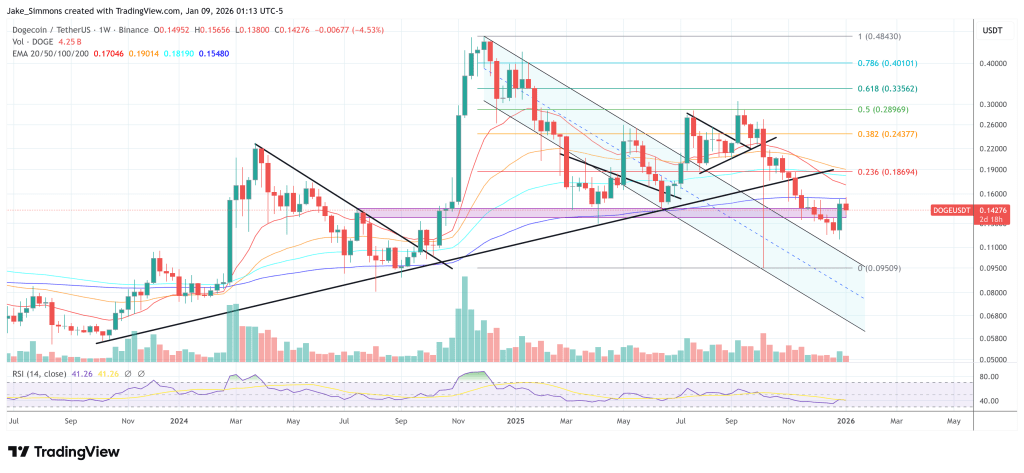
DOGE remains below the 200-week EMA, 1-week chart | Source: DOGEUSDT on TradingView.com

Пов'язані питання

QWhat is the main focus of the partnership between House of Doge, abc Co., Ltd., and ReYuu Japan Inc. in Japan?

AThe partnership focuses on exploring localized Dogecoin adoption and real-world asset (RWA) initiatives, including promoting gold asset-backed stablecoins, regulatory work for RWA token listings, establishing a joint fund, and pushing next-generation Web3 through real-world use cases in the Japanese market.

QWhich two Japan-focused companies did House of Doge partner with for its expansion efforts?

AHouse of Doge partnered with abc Co., Ltd. and ReYuu Japan Inc. for its expansion efforts in Japan.

QWhat role does ReYuu Japan play in this partnership framework?

AReYuu Japan supports business development and localization efforts in Japan for the partnership.

QHow does House of Doge describe the next phase of Dogecoin's development in this announcement?

AHouse of Doge describes Dogecoin's next phase as being about practical utility, including payments, financial products, and tokenization, moving beyond purely cultural relevance and meme-driven branding.

QWhat specific regulatory framework in Japan is mentioned in relation to listing RWA tokens?

AThe partnership framework highlights regulatory-oriented work connected to listing RWA tokens under Japan's 'green list' framework.

Пов'язані матеріали

Understanding CPO (Co-Packaged Optics) in One Article: Why Nvidia Is Willing to Spend $3.2 Billion on a Fiber?

NVIDIA and Corning announced a multi-year strategic partnership on May 6, 2026, with NVIDIA committing up to $3.2 billion to support Corning's U.S. expansion. This investment will triple Corning's manufacturing plants and significantly boost its optical fiber and communications production capacity. The core driver behind this massive investment is the fundamental shift from copper to optical interconnect technology within AI data centers. As GPU clusters scale, copper wires face critical limitations: severe signal attenuation over distance, high energy consumption for signal integrity, and excessive heat generation. Optical fiber, transmitting light instead of electrical signals, solves these issues with minimal loss, near-light speed, and lower power needs. The article outlines a three-stage evolution of data center interconnect: 1. **Traditional Copper Interconnects:** The mainstream solution of the 2010s, now being phased out due to scaling bottlenecks. 2. **Pluggable Optical Modules:** The current mainstream, where modules convert electrical signals to light externally. This process still introduces energy loss and latency. 3. **CPO (Co-Packaged Optics):** The next-generation technology where the optical engine is integrated directly with the GPU chip package. This drastically reduces the electrical signal travel distance to mere millimeters, slashing power consumption and latency while boosting data density. NVIDIA CEO Jensen Huang has identified CPO as an essential core technology for AI infrastructure. NVIDIA's investment signifies a strategic shift from being a buyer to actively controlling its supply chain for critical components. With demand for specialized optical fiber far outstripping supply—evidenced by soaring prices—securing long-term manufacturing capacity has become a competitive necessity. While Corning's expansion may pressure some suppliers, a projected global fiber supply gap of 5-15% over the next few years creates a significant opportunity window, particularly for Chinese manufacturers competitive in optical preforms, chips, and modules. Ultimately, NVIDIA's move is not about chasing a trend but an engineering imperative. The transition to light-based interconnects like CPO is driven by the physical limits of copper, marking a definitive step in the ongoing AI computing revolution.

marsbitЩойно

Understanding CPO (Co-Packaged Optics) in One Article: Why Nvidia Is Willing to Spend $3.2 Billion on a Fiber?

marsbitЩойно

KOL's Perspective: Why Is SOL Set to Rise from This Point?

**Summary: Why SOL is Positioned for Growth at This Level** The article argues that SOL is poised for an upward move from its current price point, citing several key factors. Primarily, SOL has just broken out of a 4-month consolidation phase. This breakout signals a return of risk appetite to the broader crypto market, as SOL is seen as a key indicator of overall crypto health. The token's ownership has reportedly shifted from short-term traders and tourists to long-term accumulators, leading to low volume. Any meaningful increase in trading activity could thus trigger significant upward momentum. Fundamental strengths include strong institutional adoption, integration with DeFi and RWAs (Real-World Assets), and the potential benefits from the Clarity Act. Despite its high volatility—having dropped 70% from its all-time high but still up 12x from its bear market low—SOL is highlighted as one of the few tokens from the last cycle to reach new highs. It boasts a robust ecosystem of applications, users, and protocols. Future catalysts include the expected influx of AI developers following the Miami Accelerate conference, which focused on AI on Solana. Furthermore, Solana is positioned as the premier chain for memecoin activity, a trend expected to continue and drive network usage and fees. The article concludes that recent price action reflects a healthy transfer to long-term holders, setting the stage for growth.

marsbit50 хв тому

KOL's Perspective: Why Is SOL Set to Rise from This Point?

marsbit50 хв тому

Those Pre-Bitcoin PoW Protocols Have Recently Been Reimplemented

This article details a recent surge in replicating pre-Bitcoin Proof-of-Work (PoW) protocols, specifically focusing on Hal Finney's 2004 RPOW (Reusable Proofs of Work). Within five days in May 2026, multiple independent builders in the Bitcoin/cypherpunk community launched projects inspired by this early electronic cash proposal. The initiative began with Fred Krueger's `rpow2.com`, a centralized but auditable system that replaced RPOW's original IBM 4758 hardware with Ed25519 signatures. Initially a faithful replica, it later adopted Bitcoin-like features (21M supply cap, difficulty adjustment) and a controversial 5.24% founder allocation. This sparked rapid forks, including `rpow4.com` which incorporated full Bitcoin parameters, a prediction market (`rpowmarket.com`), and a DEX (`rpow2swap.com`). Concurrently, Mike In Space created a prototype of Wei Dai's 1998 b-money proposal (`b-money.replit.app`), pushing the historical exploration even further back. The article contrasts these centralized, server-dependent experiments with Bitcoin's core innovation of decentralized, trustless consensus. It also highlights a parallel development: the `HASH` project on Ethereum, which uses smart contract hooks to enable a purely fair-launch, browser-mineable PoW token with 0% allocations to team or VCs. The collective activity is framed as a meme-driven, educational exploration of cypherpunk history rather than a serious financial movement, with all projects heavily disclaiming any investment value.

marsbit55 хв тому

Those Pre-Bitcoin PoW Protocols Have Recently Been Reimplemented

marsbit55 хв тому

South Korean Exchanges 'Battle' Regulators, Challenging the Boundaries of Enforcement and Legislation

South Korea's cryptocurrency industry is engaged in a rare, direct confrontation with regulators. The Financial Intelligence Unit (FIU), the primary anti-money laundering (AML) watchdog, has recently imposed heavy penalties on major exchanges like Upbit and Bithumb for alleged violations involving unregistered overseas VASPs and AML procedures. However, exchanges are now actively challenging these actions in court and through industry associations. In a significant shift, the Seoul Administrative Court ruled in favor of Upbit's operator, Dunamu, overturning part of an FIU-ordered business suspension. The court found the FIU's penalty criteria and justification insufficiently clear. Similarly, the court suspended the enforcement of a six-month business suspension against Bithumb pending a final ruling, citing potential irreversible harm to the exchange. Beyond legal battles, the industry is contesting proposed legislative amendments. The Digital Asset eXchange Alliance (DAXA) strongly opposes a draft rule that would mandate Suspicious Transaction Reports (STRs) for all crypto transfers over 10 million KRW (~$6,800). DAXA argues this "poison pill" clause violates legal principles and would overwhelm the STR system, increasing reports from 63,000 to an estimated 5.45 million annually for major exchanges, thereby crippling effective AML monitoring. This conflict highlights a structural tension in South Korea's crypto governance: comprehensive digital asset laws are still developing, while regulators rely heavily on AML enforcement. The industry's move from passive compliance to active legal and legislative challenges signifies a new phase, pressing for clearer rules and more proportionate enforcement. While short-term disputes may intensify, this clash could ultimately lead to a more mature and sustainable regulatory framework for South Korea's vibrant crypto market.

marsbit1 год тому

South Korean Exchanges 'Battle' Regulators, Challenging the Boundaries of Enforcement and Legislation

marsbit1 год тому

Торгівля

Спот
Ф'ючерси

Популярні статті

Як купити PUSH

Ласкаво просимо до HTX.com! Ми зробили покупку Push Protocol (PUSH) простою та зручною. Дотримуйтесь нашої покрокової інструкції, щоб розпочати свою криптовалютну подорож.Крок 1: Створіть обліковий запис на HTXВикористовуйте свою електронну пошту або номер телефону, щоб зареєструвати обліковий запис на HTX безплатно. Пройдіть безпроблемну реєстрацію й отримайте доступ до всіх функцій.ЗареєструватисьКрок 2: Перейдіть до розділу Купити крипту і виберіть спосіб оплатиКредитна/дебетова картка: використовуйте вашу картку Visa або Mastercard, щоб миттєво купити Push Protocol (PUSH).Баланс: використовуйте кошти з балансу вашого рахунку HTX для безперешкодної торгівлі.Треті особи: ми додали популярні способи оплати, такі як Google Pay та Apple Pay, щоб підвищити зручність.P2P: Торгуйте безпосередньо з іншими користувачами на HTX.Позабіржова торгівля (OTC): ми пропонуємо індивідуальні послуги та конкурентні обмінні курси для трейдерів.Крок 3: Зберігайте свої Push Protocol (PUSH)Після придбання Push Protocol (PUSH) збережіть його у своєму обліковому записі на HTX. Крім того, ви можете відправити його в інше місце за допомогою блокчейн-переказу або використовувати його для торгівлі іншими криптовалютами.Крок 4: Торгівля Push Protocol (PUSH)Легко торгуйте Push Protocol (PUSH) на спотовому ринку HTX. Просто увійдіть до свого облікового запису, виберіть торгову пару, укладайте угоди та спостерігайте за ними в режимі реального часу. Ми пропонуємо зручний досвід як для початківців, так і для досвідчених трейдерів.

520 переглядів усьогоОпубліковано 2024.12.13Оновлено 2025.03.21

Як купити PUSH

Обговорення

Ласкаво просимо до спільноти HTX. Тут ви можете бути в курсі останніх подій розвитку платформи та отримати доступ до професійної ринкової інформації. Нижче представлені думки користувачів щодо ціни PUSH (PUSH).

活动图片