Dogecoin Targets Japan In New RWA And Adoption Push

bitcoinistОпубліковано о 2026-01-09Востаннє оновлено о 2026-01-09

Анотація

Dogecoin's corporate arm, House of Doge, has partnered with two Japan-focused firms, abc Co., Ltd. and ReYuu Japan Inc., to drive localized adoption and real-world asset (RWA) initiatives in Japan. The collaboration aims to explore gold-backed stablecoins, regulatory-compliant RWA tokenization under Japan's "green list" framework, and the establishment of a joint fund. This move signals a strategic shift for Dogecoin towards practical utility, including payments and financial products, beyond its meme-centric origins. The partnership emphasizes responsible innovation and ecosystem growth, though specific details on assets, timelines, or merchants were not disclosed. At the time of writing, DOGE was trading at $0.14276.

House of Doge, the corporate arm of the Dogecoin Foundation, says it has struck a partnership framework with two Japan-focused firms to explore localized Dogecoin adoption and real-world asset (RWA) initiatives, putting Japan at the center of its next ecosystem expansion effort.

Dogecoin Plots Japan Expansion

In a Thursday press release dated Jan. 8, House of Doge said it has agreed a tripartite cooperation framework with abc Co., Ltd. and ReYuu Japan Inc. The arrangement is framed as a roadmap for “future collaboration,” rather than a single product launch, but it spells out several lines of work that point toward regulated tokenization and payments-style integrations tailored to the Japanese market.

“This partnership reflects our continued focus on supporting thoughtful, real-world expansion of the Dogecoin ecosystem,” Marco Margiotta, CEO of House of Doge, said in the release. “Japan represents a natural and culturally aligned market for DOGE given its strong embrace of digital innovation and we are pleased to explore opportunities alongside abc and ReYuu Japan that support responsible innovation, real-world utility, and long-term ecosystem growth.”

House of Doge said the agreement outlines potential cooperation areas designed to “leverage the strengths of each party” in support of ecosystem growth. The framework highlights efforts around promoting and adopting gold asset-backed stablecoins, as well as regulatory-oriented work connected to listing RWA tokens under Japan’s “green list” framework. It also references establishing a joint fund within the Dogecoin ecosystem and pushing “next-generation Web3” through real-world use cases.

The inclusion of a “green list” pathway is notable because it foregrounds compliance and market-structure considerations rather than the meme-driven branding that has historically defined DOGE in the public imagination. At the same time, the release does not specify which assets would be tokenized, what a gold-backed stablecoin would look like in practice, or whether any on-chain issuance would be directly tied to Dogecoin versus adjacent infrastructure.

The partners are positioned as complementary: ReYuu Japan is described as supporting business development and localization in Japan, while abc is presented as bringing “token-economy design, smart-contract development, and regulatory alignment,” with a focus on RWA and compliant Web3 integration. House of Doge’s role is framed as ecosystem coordination and infrastructure investment, with the press release casting the partnership as part of a broader international strategy.

Together, the companies say they intend to support “localized and responsible” expansion of Dogecoin-related initiatives in Japan, though the release stops short of naming specific merchants, financial institutions, pilot programs, or timelines.

House of Doge used the announcement to reinforce its broader narrative: that Dogecoin’s next phase is about practical utility; payments, financial products, and tokenization rather than purely cultural relevance. “House of Doge is the official corporate arm of the Dogecoin Foundation, committed to advancing Dogecoin as a widely accepted and decentralized global currency. By investing in the necessary infrastructure to integrate Dogecoin into everyday commerce, House of Doge is building secure, scalable, and efficient systems for real-world use.”

It adds that its scope spans “payments and financial products to real-world asset tokenization and cultural partnerships,” arguing this is “the next era of crypto utility, where Dogecoin goes beyond the meme.”

At press time, DOGE traded at $0.14276.
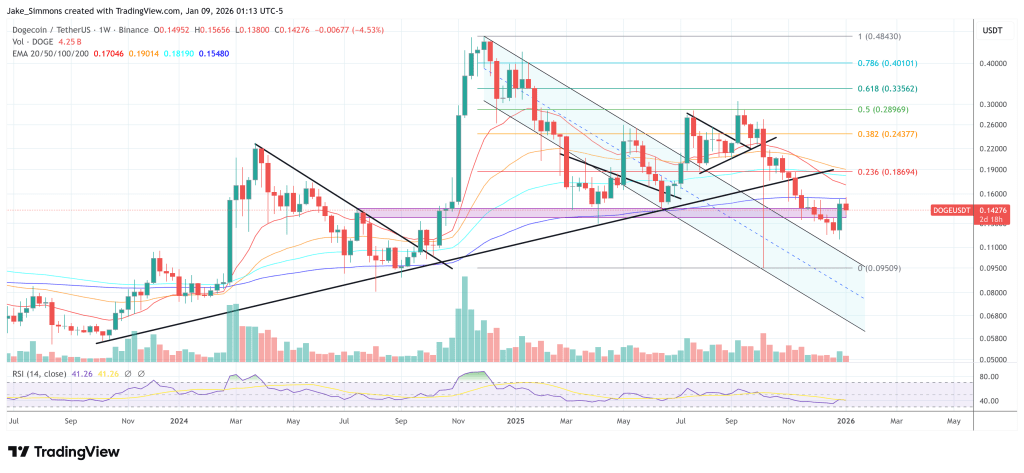
DOGE remains below the 200-week EMA, 1-week chart | Source: DOGEUSDT on TradingView.com

Пов'язані питання

QWhat is the main focus of the partnership between House of Doge, abc Co., Ltd., and ReYuu Japan Inc. in Japan?

AThe partnership focuses on exploring localized Dogecoin adoption and real-world asset (RWA) initiatives, including promoting gold asset-backed stablecoins, regulatory work for RWA token listings, establishing a joint fund, and pushing next-generation Web3 through real-world use cases in the Japanese market.

QWhich two Japan-focused companies did House of Doge partner with for its expansion efforts?

AHouse of Doge partnered with abc Co., Ltd. and ReYuu Japan Inc. for its expansion efforts in Japan.

QWhat role does ReYuu Japan play in this partnership framework?

AReYuu Japan supports business development and localization efforts in Japan for the partnership.

QHow does House of Doge describe the next phase of Dogecoin's development in this announcement?

AHouse of Doge describes Dogecoin's next phase as being about practical utility, including payments, financial products, and tokenization, moving beyond purely cultural relevance and meme-driven branding.

QWhat specific regulatory framework in Japan is mentioned in relation to listing RWA tokens?

AThe partnership framework highlights regulatory-oriented work connected to listing RWA tokens under Japan's 'green list' framework.

Пов'язані матеріали

The Value Distribution of Stablecoins

**Summary: The Value Distribution of Stablecoins** The article argues that stablecoins are evolving from mere trading tools into broader channels for dollar access. It divides the stablecoin ecosystem into four layers to analyze how value is distributed: 1. **Issuance Layer:** Mints stablecoins, holds reserve assets, and captures the spread between reserve yield and user costs (e.g., Tether, Circle). This layer currently earns the largest profit margin. 2. **Infrastructure Layer:** Connects stablecoins to the traditional financial system, handling fiat on/off-ramps, banking integration, compliance (KYC/AML), and asset management (e.g., Bridge, BVNK). This is the "unglamorous" but critical work, building the essential bridges between crypto and real-world finance. 3. **Acquiring/Distribution Layer:** Integrates stablecoins into merchant systems, manages payment flows, and provides enterprise financial software (e.g., Stripe, Coinbase). They act as the access point for businesses. 4. **Application Layer:** The end-users and businesses that ultimately use stablecoins for payments, settlements, or as a store of value. They benefit from convenience but have little pricing power. The core thesis is that while the issuance layer currently dominates profits, the often-overlooked **infrastructure layer holds significant long-term potential**. The real challenge and barrier to mass adoption is not the on-chain transfer of stablecoins (which is simple), but the complex "last mile" integration into existing business workflows, banking systems, and regulatory frameworks across different countries. Companies in this layer are currently in a "land grab" phase, investing heavily to build networks, secure bank partnerships, and establish compliance pathways. While their position is currently pressured by the profitable issuers above and distribution platforms below, the article suggests that if stablecoins become a default financial rail for businesses, the infrastructure providers who have done the hard work of integration will ultimately gain strong pricing power and become entrenched, essential players.

marsbit6 год тому

The Value Distribution of Stablecoins

marsbit6 год тому

The Value Distribution of Stablecoins

The Value Distribution of Stablecoins The article argues that stablecoins are evolving from a mere trading tool into a broad "dollar channel." It analyzes the industry's value chain through four layers: 1. **Issuance Layer (e.g., Tether, Circle):** The top layer that mints stablecoins, holds reserve assets, and captures the thickest interest rate spread. 2. **Infrastructure Layer (e.g., Bridge, BVNK):** Connects stablecoins to the traditional financial system, handling critical but complex "dirty work" like fiat on/off-ramps, banking integration, compliance (KYC/AML), and cross-border settlement. 3. **Acquiring/Distribution Layer (e.g., Stripe, Coinbase):** Embeds stablecoins into merchant systems, manages payment flows, and integrates with enterprise software. 4. **Application Layer:** End-users and businesses that ultimately use stablecoins for payments, settlement, or storing value. The author posits that while the issuance layer currently captures the most profit, the most overlooked and potentially critical layer is infrastructure. The core challenge for stablecoin adoption isn't the on-chain transfer (which is simple), but bridging the gap between blockchain and the real-world financial system. This involves solving practical problems for businesses: fiat conversion, reconciliation, tax handling, and user onboarding. Infrastructure companies are currently in a difficult "land-grab" phase—building networks, securing banking relationships, and achieving compliance country-by-country. They face pressure from both the profitable issuance layer above and distribution platforms below. However, the author suggests this layer is building a crucial moat. Once stablecoins become a default business rail, the infrastructure players who have done the hard work of integration may gain significant, durable value and pricing power.

链捕手6 год тому

The Value Distribution of Stablecoins

链捕手6 год тому

Торгівля

Спот
Ф'ючерси

Популярні статті

Як купити PUSH

Ласкаво просимо до HTX.com! Ми зробили покупку Push Protocol (PUSH) простою та зручною. Дотримуйтесь нашої покрокової інструкції, щоб розпочати свою криптовалютну подорож.Крок 1: Створіть обліковий запис на HTXВикористовуйте свою електронну пошту або номер телефону, щоб зареєструвати обліковий запис на HTX безплатно. Пройдіть безпроблемну реєстрацію й отримайте доступ до всіх функцій.ЗареєструватисьКрок 2: Перейдіть до розділу Купити крипту і виберіть спосіб оплатиКредитна/дебетова картка: використовуйте вашу картку Visa або Mastercard, щоб миттєво купити Push Protocol (PUSH).Баланс: використовуйте кошти з балансу вашого рахунку HTX для безперешкодної торгівлі.Треті особи: ми додали популярні способи оплати, такі як Google Pay та Apple Pay, щоб підвищити зручність.P2P: Торгуйте безпосередньо з іншими користувачами на HTX.Позабіржова торгівля (OTC): ми пропонуємо індивідуальні послуги та конкурентні обмінні курси для трейдерів.Крок 3: Зберігайте свої Push Protocol (PUSH)Після придбання Push Protocol (PUSH) збережіть його у своєму обліковому записі на HTX. Крім того, ви можете відправити його в інше місце за допомогою блокчейн-переказу або використовувати його для торгівлі іншими криптовалютами.Крок 4: Торгівля Push Protocol (PUSH)Легко торгуйте Push Protocol (PUSH) на спотовому ринку HTX. Просто увійдіть до свого облікового запису, виберіть торгову пару, укладайте угоди та спостерігайте за ними в режимі реального часу. Ми пропонуємо зручний досвід як для початківців, так і для досвідчених трейдерів.

578 переглядів усьогоОпубліковано 2024.12.13Оновлено 2026.06.02

Як купити PUSH

Обговорення

Ласкаво просимо до спільноти HTX. Тут ви можете бути в курсі останніх подій розвитку платформи та отримати доступ до професійної ринкової інформації. Нижче представлені думки користувачів щодо ціни PUSH (PUSH).

活动图片













