Dogecoin Bullish Divergence Says A 500% Price Rally Is Coming, But The Real Target Is Much Higher

bitcoinistОпубліковано о 2026-05-14Востаннє оновлено о 2026-05-14

Анотація

A crypto analyst identifies a bullish divergence on Dogecoin's three-day chart, signaling a potential massive breakout. This pattern suggests DOGE could rally approximately 500% from current levels, targeting $0.6533, which is near its all-time high. The analyst further projects an even higher target of $1.25 upon reaching the first milestone. Another analyst notes DOGE has broken out of a descending channel, with bulls taking control and setting nearer-term price targets at $0.135, $0.153, $0.182, and $0.206, advising profit-taking around the latter level. Despite recent declines, the overall bullish structure for the meme coin is considered intact.

A crypto analyst has identified a Bullish Divergence on a three-day Dogecoin (DOGE) price chart that is pointing toward a fresh breakout to new highs. He believes that the emergence of this formation suggests that Dogecoin could be gearing up for a massive 500% price rally. However, his optimistic forecast does not stop there, as the analyst projects an even higher price target above $1 once that first target is reached.

Dogecoin Bullish Divergence Signals Move To $1.25

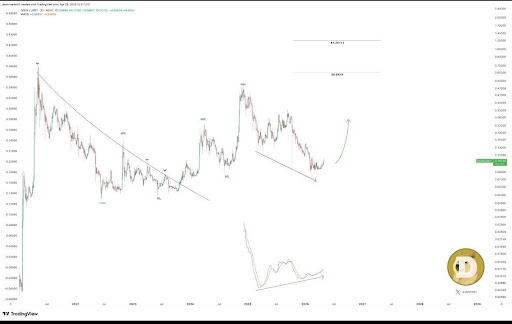
Javon Marks, a well-known crypto analyst on X, has shared a new analysis for Dogecoin, predicting two bullish targets that are drawing attention from investors and traders. According to the analyst, Dogecoin is now responding even more positively to a key Bullish Divergence that has been holding up well on the Moving Average Convergence Divergence (MACD).

Marks’ accompanying chart shows that this divergence has been forming since 2025, taking enough time and strength to develop. Usually, when the MACD indicator signals a Bullish Divergence, it suggests that a cryptocurrency that has spent a long time declining or trading sideways has quietly been building significant momentum beneath the surface.
Source: X

Given that strong foundation, Marks predicts that DOGE’s recent recovery near $0.10 could be the early signal of a much greater move to the upside. He suggests the breakout is pointing toward a staggering price rally of about 500%, which, from current prices, could catapult DOGE straight toward $0.6533. This bullish level puts the meme going just 11.4% below its all-time high of roughly $0.73 set in May 2021.

Once Dogecoin reaches $0.6533, Marks projects an even bigger and stronger price surge toward $1.25. He noted that $0.6533 will likely be the resistance that opens up the path for Dogecoin to hit that historical milestone. According to the analyst, DOGE’s current Bullish Divergence has been laying the groundwork for a huge “running season” that could soon completely transform the meme coin’s price.

Analyst Says DOGE Bulls Are Finally Taking Control

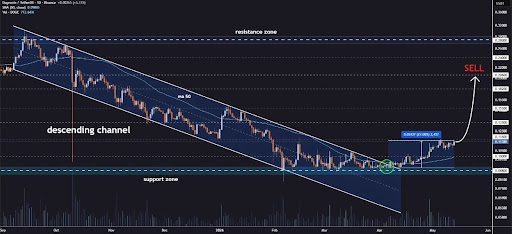
Meanwhile, in a separate analysis, market expert Jonathan Carter stated that the Dogecoin bulls are now taking control of the market as the price shows signs of a potential rally. The analyst revealed that DOGE recently broke out of a descending channel on the daily timeframe, reinforcing his optimistic outlook on the meme coin.

Carter believes that once this breakout is confirmed with momentum, the meme coin could attract strong buying pressure as investors head back into the market. Despite its recent price declines and bearish sentiment, the analyst maintains that Dogecoin’s bullish structure remains intact.
Source: X

He has outlined four potential upside targets for the meme coin this year, starting with a run to $0.135, then $0.153, $0.182, and ultimately $0.206. While his chart suggests that DOGE still has more room to rally to $0.28, he urges investors to sell and take profits around the $0.206 area.

DOGE continues sideways movement | Source: DOGEUSDT on Tradingview.com

Пов'язані питання

QWhat key technical indicator does analyst Javon Marks identify in the Dogecoin (DOGE) price chart, and what does it signal?

AJavon Marks identifies a Bullish Divergence on the Moving Average Convergence Divergence (MACD) indicator on a three-day Dogecoin price chart. This signals that DOGE, after a period of decline or sideways movement, has been building significant momentum beneath the surface, potentially indicating an upcoming major price rally.

QAccording to Javon Marks, what is the first major price target for Dogecoin following the anticipated breakout?

AJavon Marks's first major price target following the anticipated breakout is approximately $0.6533, which would represent a rally of about 500% from the price level mentioned in the analysis near $0.10.

QWhat is Javon Marks's even higher price target for Dogecoin after it reaches his initial target of $0.6533?

AAfter Dogecoin reaches the initial target of $0.6533, Javon Marks projects an even bigger price surge toward $1.25, suggesting that the first target will act as a resistance level that opens the path to this historical milestone.

QWhat market structure does analyst Jonathan Carter say Dogecoin recently broke out of, reinforcing his bullish outlook?

AAnalyst Jonathan Carter stated that Dogecoin recently broke out of a descending channel on the daily timeframe, which reinforces his optimistic outlook on the meme coin.

QWhat are the four potential upside price targets for Dogecoin outlined by analyst Jonathan Carter for this year?

AJonathan Carter outlined four potential upside targets for Dogecoin this year: $0.135, $0.153, $0.182, and ultimately $0.206. His analysis suggests taking profits around the $0.206 area, even though the chart indicates room to rally further to $0.28.

Пов'язані матеріали

GitHub, Transfixed by AI

On the night of February 9th, GitHub suffered a major outage caused by a simple configuration change—reducing a cache refresh interval from 12 to 2 hours—that triggered a cascade of failures. This was not an isolated event, but part of a broader pattern. In early 2026, GitHub experienced at least 8 major incidents, failing to meet its promised 99.9% availability. These outages stemmed from structural issues: explosive growth in load, tight service coupling, and insufficient protection against abnormal traffic. This unprecedented load is driven by AI Agents. In 2025, GitHub handled ~1 billion commits. By 2026, weekly commits reached 275 million, projecting to ~14 billion for the year—a 14x increase. AI tools like Claude Code now contribute 4.5% of all public repository commits, with weekly submissions surging 25x in just three months. AI-generated pull requests jumped from 4 million to 17 million per month in half a year. Unlike human developers, AI Agents work continuously, generating commits at a scale that overwhelms infrastructure designed for human rhythms. The surge also shattered GitHub's business model. Copilot's flat-rate pricing, based on assisting human developers, became unsustainable as Agentic AI sessions consumed resources worth hundreds of dollars for a few dollars in fees. In response, GitHub imposed usage limits and, by June 1st, shifted to a pay-per-use "AI Credits" system. Facing this new reality, GitHub realized a 10x scaling plan was insufficient. It announced a need to *redesign* its architecture for 30x current scale—decoupling services, adding fault isolation, and improving change management to prevent cascading failures. Other platforms like Stripe and AWS are facing similar challenges with AI Agents. Fundamentally, GitHub is transitioning from a human collaboration platform to an "exhaust pipe" for automated AI workflows. Its detailed post-mortem reports aim to maintain trust during this turbulent rebuild. The February outage was not just a technical glitch, but a signal of the software industry's entry into a new, AI-driven era.

marsbit20 хв тому

GitHub, Transfixed by AI

marsbit20 хв тому

Both Suffer Massive Losses Exceeding $90 Billion, Which Is in Greater Peril: Strategy or Bitmine?

Facing massive paper losses exceeding $90 billion each amidst a sharp market downturn, "Digital Asset Treasury" (DAT) giants Strategy and Bitmine find themselves in a precarious position, but with different underlying risks. Strategy, heavily invested in Bitcoin (BTC), faces significant financial strain. Its strategy relies heavily on debt, including convertible notes and preferred stock (STRC) requiring substantial dividend payments. With its cash reserves dwindling and BTC offering no staking yield for cash flow, Strategy's high leverage makes it vulnerable. A continued price decline could force asset sales to meet obligations, potentially creating a negative feedback loop. Its market value has already fallen sharply. In contrast, Bitmine, an Ethereum (ETH) holder, appears on firmer financial ground. It primarily funds its purchases through equity offerings (like ATM programs), avoiding debt pressure. It also generates income by staking a large portion of its ETH holdings. While not immune to market drops and shareholder dilution concerns, Bitmine maintains more flexibility, recently announcing a new preferred share offering to raise further capital. The core divergence lies in their financing: Bitmine uses equity (investor money), while Strategy uses debt (borrowed money). Consequently, Bitmine currently faces less immediate liquidity pressure than Strategy, which must navigate the dual challenge of servicing debt/dividends and a declining core asset (BTC) price.

marsbit27 хв тому

Both Suffer Massive Losses Exceeding $90 Billion, Which Is in Greater Peril: Strategy or Bitmine?

marsbit27 хв тому

Where the AI Bubble Really Is: Which Layer of Players Are Naked

AI Bubble: Where It Really Is and Who's Swimming Naked This analysis dissects the AI industry not as a single entity but as a five-layer pyramid, arguing that bubbles are concentrated in specific tiers, not uniformly distributed. **Key Distinction from the 2000 Dot-com Bubble:** Unlike 2000, where companies had stock prices before revenue, today's leading AI players have massive, contract-backed revenue driving their valuations. Core infrastructure demand is real, with every GPU running at full capacity for paying customers. **The Five-Layer Pyramid & Bubble Assessment:** * **L0 (Fab/Manufacturing) & Top L4 (Leading AI Apps): NO BUBBLE.** Companies like TSMC, NVIDIA, major cloud providers (Microsoft, Google, Meta, Amazon), and top AI labs have real revenues and orders. Supply is tightly constrained by TSMC's disciplined capacity control and physical limits like power/land for data centers, preventing a supply glut. * **L1 (Memory): BATTLEGROUND.** Sky-high HBM margins could signal a new structural cycle or a classic "boom before bust." The oligopoly of three major players may enforce supply discipline, making this a high-stakes bet. * **L2 (Interconnect/Optical Modules): BUBBLE TERRITORY.** Companies like Lumentum and AAOI have seen stock surges (4-10x) far outpacing revenue growth. This hardware segment has lower physical barriers to expansion than fabs, allowing speculation. It mirrors the 2000 bubble's epicenter—optics. * **L3 (Infrastructure/"GPU Landlords"): VULNERABLE.** GPU leasing companies profit from the current compute shortage but own no long-term moat. Their business model relies on a temporary bottleneck that will ease as big tech expands and new tech (e.g., potential space-based data centers) emerges. * **L4 Long Tail (VC-backed Startups): STRONG BUBBLE SIGNALS.** VC funding concentration in AI is twice that of the 1999 peak. Many startups with little revenue use the valuation logic of successful giants to justify their own, creating high risk of a "valuation crunch" when funding dries up. **Critical Risks to Monitor:** 1. **GPU Depreciation & Accounting:** Companies extending the assumed useful life of GPUs artificially boost profits. The true economic life depends on future generational leaps from NVIDIA. 2. **"GPU Credit" & Off-Balance-Sheet Leverage:** Emerging structures where shell companies borrow to buy GPUs and lease them out (with chipmakers sometimes investing) move debt off major balance sheets. This echoes the "vendor financing" of 2000 and the securitization risks of 2008, though currently small-scale. 3. **TSMC Abandoning Caution:** If the primary supply bottleneck (TSMC's conservative capacity planning) breaks, runaway supply could trigger a bust. 4. **Algorithmic Efficiency Breakthrough:** A major leap in software efficiency could drastically reduce the need for raw compute hardware, undermining the investment thesis. **Conclusion:** The AI boom is expensive and has frothy areas, but its core is underpinned by real demand and physical supply constraints. The bubble risk is layered: most present in optical components, GPU leasing, and the long-tail startup ecosystem, while the foundational chip manufacturing and leading application layers remain relatively solid—for now.

marsbit40 хв тому

Where the AI Bubble Really Is: Which Layer of Players Are Naked

marsbit40 хв тому

Торгівля

Спот
Ф'ючерси
活动图片





