Do Not Apply Blindly: A Comprehensive Evaluation of the Eight Main Pathways to Hong Kong Residency by 2026

marsbitОпубліковано о 2026-06-24Востаннє оновлено о 2026-06-24

Анотація

Hong Kong has recently updated its talent attraction policies, offering eight mainstream pathways to residency. These include programs like the Top Talent Pass Scheme (TTPS), Quality Migrant Admission Scheme (QMAS), the newly introduced Technology Professionals Admission Scheme (TP Stream), and Vocational Professionals Admission Scheme (VPAS). Navigating these options involves understanding key details such as core eligibility criteria, employer sponsorship requirements, and the respective advantages and drawbacks of each scheme. A comprehensive comparison chart is provided to help applicants evaluate their choices and potentially save on consultancy fees. Applicants are reminded to always verify information with the official announcements from the Hong Kong Immigration Department.

Author: Biteye

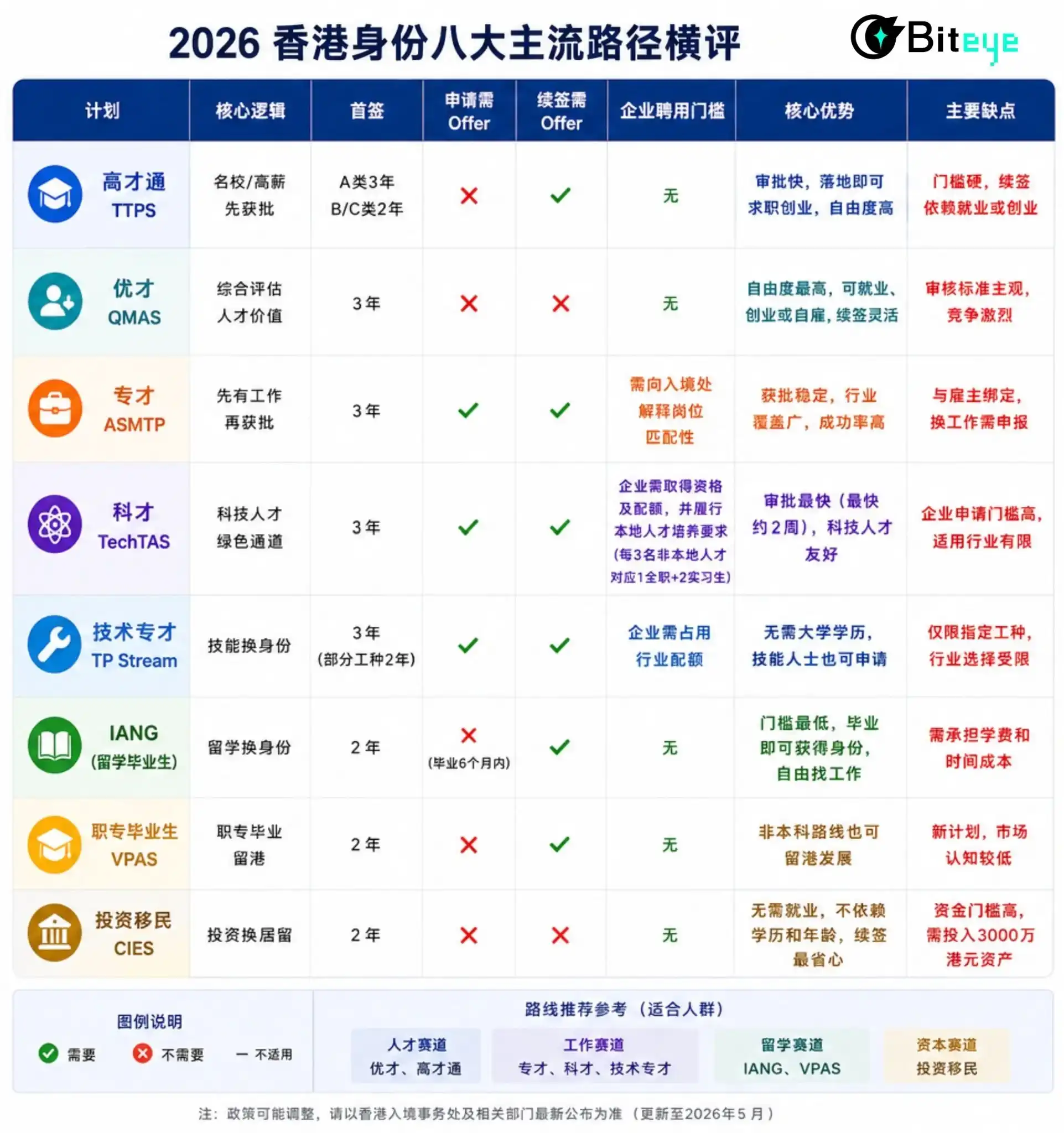
Recently, Hong Kong's talent policies have undergone intensive adjustments. From the Top Talent Pass Scheme (TTPS) and Quality Migrant Admission Scheme (QMAS) to the latest Technical Professionals Stream (TP Stream) and Vocational Professionals Admission Scheme (VPAS), there are now a total of eight mainstream pathways to obtaining residency.

There are many underlying unspoken rules regarding Hong Kong residency. Biteye has distilled the core logic, corporate sponsorship requirements, as well as the advantages and disadvantages of these eight schemes into the comprehensive comparison chart below.

This one chart can save you tens of thousands in agency fees.

(All interested individuals must remember: all information should be verified against the official announcements from the Hong Kong Immigration Department.)

Пов'язані питання

QAccording to the article, how many main pathways are there to obtain Hong Kong residency status in 2026?

AAccording to the article, there are eight main pathways to obtain Hong Kong residency status in 2026.

QWhat does the article claim its comprehensive comparison chart can help readers save money on?

AThe article claims its comprehensive comparison chart can help readers save tens of thousands of dollars on agency or intermediary fees.

QWhich Hong Kong government department's official announcements does the article advise readers to refer to for the final authoritative information?

AThe article advises readers to refer to the official announcements of the Hong Kong Immigration Department for the final authoritative information on all policies.

QWhat are two examples of the eight Hong Kong talent schemes mentioned in the article?

ATwo examples of the eight Hong Kong talent schemes mentioned in the article are the Top Talent Pass Scheme (TTPS) and the Quality Migrant Admission Scheme (QMAS).

QWhat does the article say are the key aspects condensed into its comparison chart regarding the eight residency pathways?

AThe article states that its comparison chart condenses the core logic, employer hiring thresholds, as well as the advantages and disadvantages of each of the eight residency pathways.

Пов'язані матеріали

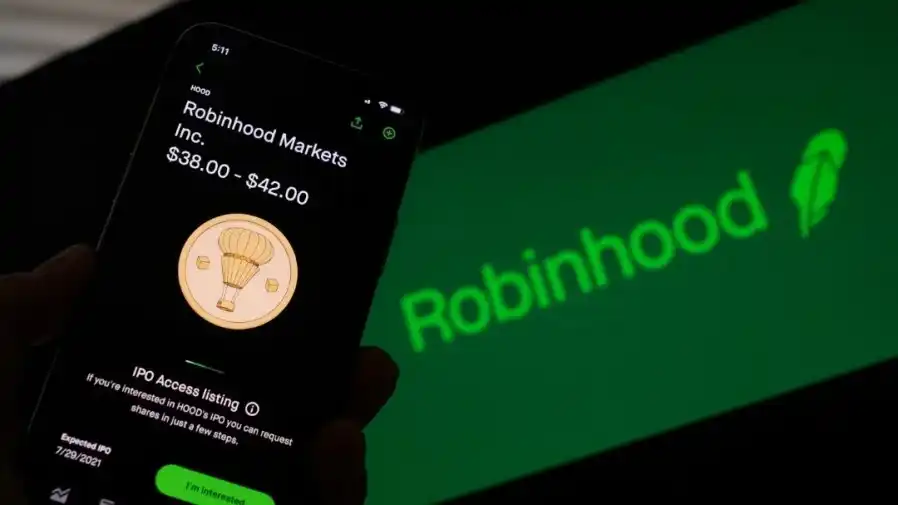
Behind Robinhood's Chain Launch and Tokenized Stocks: No Equity Rights, How Far Can This Packaging Game Go?

Robinhood is launching its own Layer 2 blockchain (Robinhood Chain) and "tokenized stocks," but these are not actual equity shares. The tokens are legally structured as debt securities or derivatives, offering economic exposure to a reference stock without granting voting rights or direct ownership. This move represents Robinhood's strategy to expand from a traditional brokerage into a "financial super app," building a user-friendly, programmable financial interface on top of complex, legally compliant, and jurisdiction-specific backend structures. The company's existing business remains strong, driven by options, event contracts, and stock trading. The new blockchain and tokenization efforts are an ambitious layer of infrastructure built atop this core, aiming to make financial products more portable and globally accessible via crypto rails. Key components include the Robinhood Wallet, Bitstamp acquisition (for institutional reach), the Lighter perpetual contracts platform, and Robinhood Earn (DeFi yield). The central challenge is the "brokerage chain paradox": maintaining a simple, intuitive user experience while the underlying assets are highly structured, regulated, and legally distinct from direct ownership. The success of this strategy depends on users, developers, and regulators accepting this model. If the complexity is misunderstood or deemed misleading, it could create product liability issues and stall expansion. The initiative is a significant infrastructure play, but its long-term viability hinges on navigating this fundamental tension between simplicity and legal reality.

marsbit15 хв тому

Behind Robinhood's Chain Launch and Tokenized Stocks: No Equity Rights, How Far Can This Packaging Game Go?

marsbit15 хв тому

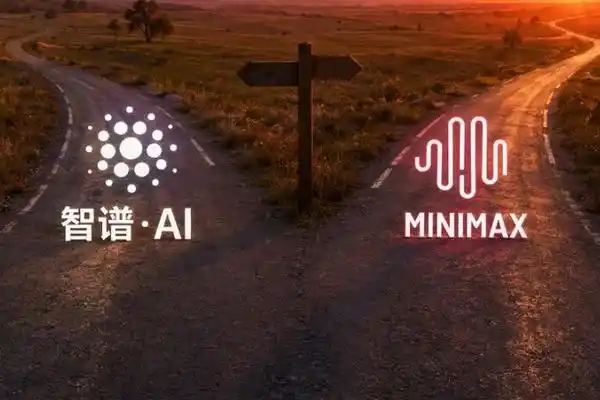
Zhipu, Afraid of Becoming the Next MiniMax

Title: Zhipu, Fearing to Become the Next MiniMax In July 2026, amid the success of its coding-focused AI, Zhipu's founder, Tang Jie, issued an internal letter titled "The Giant Wave Has Come." It notably avoided celebrating recent triumphs, such as Zhipu's trillion-HKD market cap and booming MaaS revenue driven by its GLM-5.2 model in coding applications. Instead, the letter pivoted the narrative to future-oriented concepts like Long Horizon Task, Autonomous Agents, Self-Evolving systems, and AGI. This strategic shift in messaging followed the sharp devaluation of its competitor, MiniMax. After its lock-up period expired, MiniMax's stock plummeted as the market began evaluating it with traditional SaaS metrics like ARR and user growth, rather than as a frontier AI pioneer. Seeing this, Tang Jie aimed to preempt a similar revaluation of Zhipu. He fears that if the market starts viewing Zhipu primarily as a profitable "AI coding company," its valuation would become anchored to conventional financial metrics, losing the premium associated with AGI potential. Therefore, the letter reframed Zhipu's mission. While acknowledging that coding was the current commercial driver, Tang positioned Zhipu on the "infrastructure path," akin to OpenAI and Anthropic. The new focus is on developing agents capable of complex, long-term planning and autonomous operation—moving from assisting individuals (OPC: One Person Company) to automating entire organizations (NPC: No People Company). This "Touch High" plan explicitly prioritizes long-term AGI research over short-term monetization. The article frames this as a critical divergence in China's AI landscape: the "commercialization path" (exemplified by MiniMax) versus the "infrastructure path" (chosen by Zhipu). The former risks being judged harshly by internet-era metrics once growth slows, while the latter risks failing if technological breakthroughs stall. Tang Jie's letter is thus a calculated move to secure Zhipu's identity as an AGI contender, buying time before the inevitable market demand for commercial proof. The core question remains: can Zhipu's "mo gao" (reach high) plan achieve genuine technological leaps fast enough to outpace the market's diminishing patience for stories over substance?

marsbit16 хв тому
Zhipu, Afraid of Becoming the Next MiniMax

marsbit16 хв тому

Торгівля

Спот
活动图片