Dissecting Circle's Q1 Earnings Report: After the Interest Rate Dividend Ebbs, USDC Prepares for a Big Chess Game

marsbitОпубліковано о 2026-05-11Востаннє оновлено о 2026-05-11

Анотація

Title: Circle Q1 2026 Earnings: Shifting Strategy as Interest Rate Windfall Subsides Circle reported its Q1 2026 financial results. While total revenue and reserve income of $694M slightly missed expectations, adjusted EBITDA grew 24% to $151M. A key trend is the decline in reserve income due to lower Federal Reserve interest rates, which Circle is countering by diversifying its revenue streams. Notably, non-interest "Other Revenue" hit a record $42M. USDC's circulation reached 77 billion, up 28% year-over-year, but its on-chain transaction volume surged 263% to $21.5 trillion, indicating significantly higher utilization in payments and DeFi. Financially, the core RLDC Margin improved to 41%, showing better cost control. However, operating expenses nearly doubled, partly due to post-IPO stock compensation costs. Looking ahead, Circle is expanding beyond being a simple stablecoin issuer. It highlighted the $222M presale for its Arc Network (valued at $3B) and launched new services like Managed Payments and the "Agent Stack" for AI-driven commerce. The company's strategy is evolving to position USDC as the foundational dollar network for the internet, targeting broader payment, enterprise, and AI agent economies.

Original | Odaily Planet Daily(@OdailyChina)

Author | Azuma(@azuma_eth)
Before the US stock market opened on May 11th, stablecoin issuer Circle officially announced its Q1 2026 earnings report.

The financial report data shows, Circle's total revenue and reserve income for Q1 was $694 million, slightly below market expectations of $715 million; EPS was $0.21, higher than market expectations of $0.18; adjusted EBITDA was $151 million, a year-on-year increase of 24%; net profit was $55 million, a year-on-year decrease of 15%.

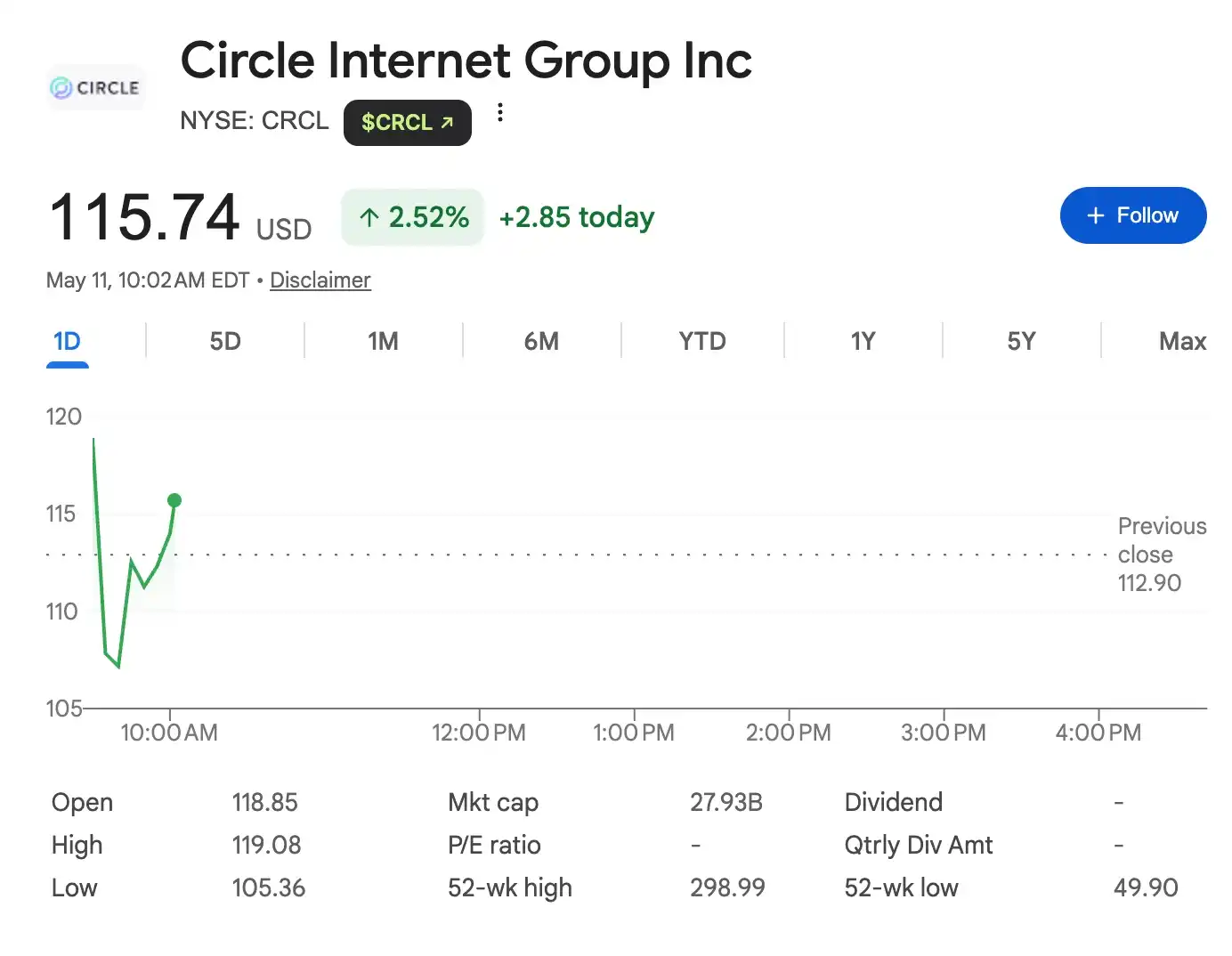
Affected by the earnings release, CRCL experienced significant pre-market volatility, with nearly a 6% pre-market gain gradually being erased amid fluctuations. As of 22:00, after the opening of US stocks, CRCL once continued to plummet but then quickly turned from loss to gain, temporarily quoted at $115.74, with an intraday increase of 2.52%.
Interpretation of Core Data

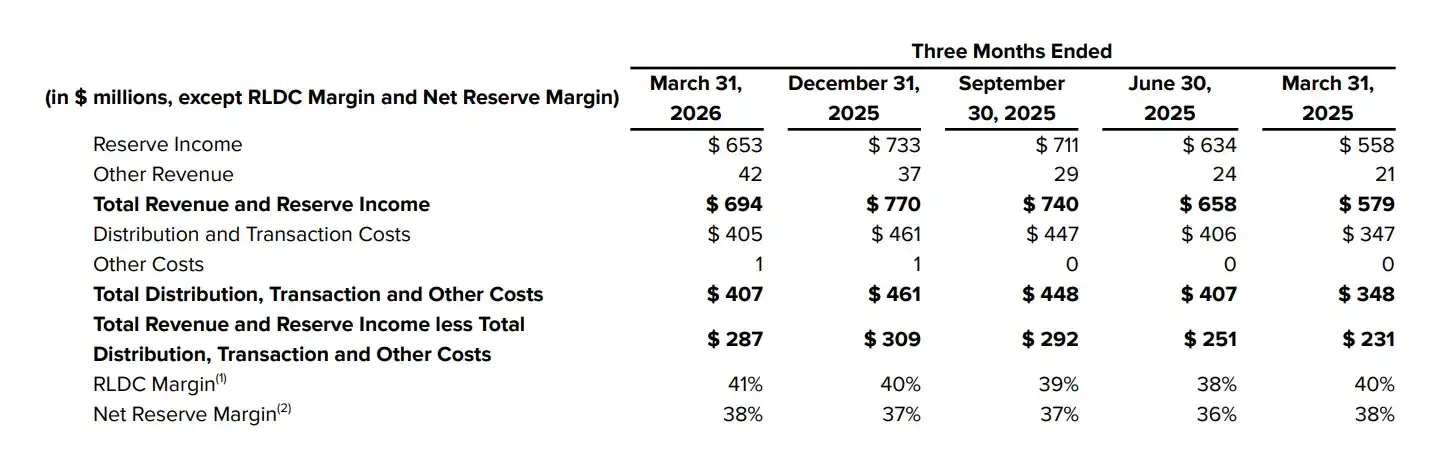
As shown in the report, Circle's total revenue and reserve income for this quarter was $694 million. Although it increased by 20% year-on-year, it broke the growth trend of previous consecutive quarters ($579M → $658M → $740M → $770M → $694M) and also fell short of market expectations.

Circle attributed the slowdown in revenue growth to a decline in the Reserve Return Rate. On December 10, 2025, the Federal Reserve lowered the federal funds rate target range by 25 basis points to 3.5%-3.75%, thereby compressing the yield of Circle's primarily US Treasury-backed reserve assets.
However, despite the relatively weak revenue, this earnings report from Circle still reveals some locally optimistic data.

First, Circle's Other Revenue, excluding Reserve Income, reached a new high of $42 million, showing a growth trend over multiple consecutive quarters ($21M → $24M → $29M → $37M → $42M).

As we mentioned in this afternoon's article "Earnings Report, Bill, Federal Reserve... Circle Faces Three Major Tests This Week", this means Circle's revenue sources are becoming more diversified. Its platform services, API tools, and payment products are generating tangible commercial returns, and reliance on interest income is decreasing.

Another noteworthy data point is RLDC Margin, the profit margin after revenue minus distribution costs. This reflects the core business profitability after deducting distribution expenses and is widely regarded as Circle's most crucial profit metric. This quarter, Circle's RLDC Margin reached 41%, achieving growth for four consecutive quarters (36% → 39% → 40% → 41%). This means Circle's control over distribution costs is becoming more efficient.
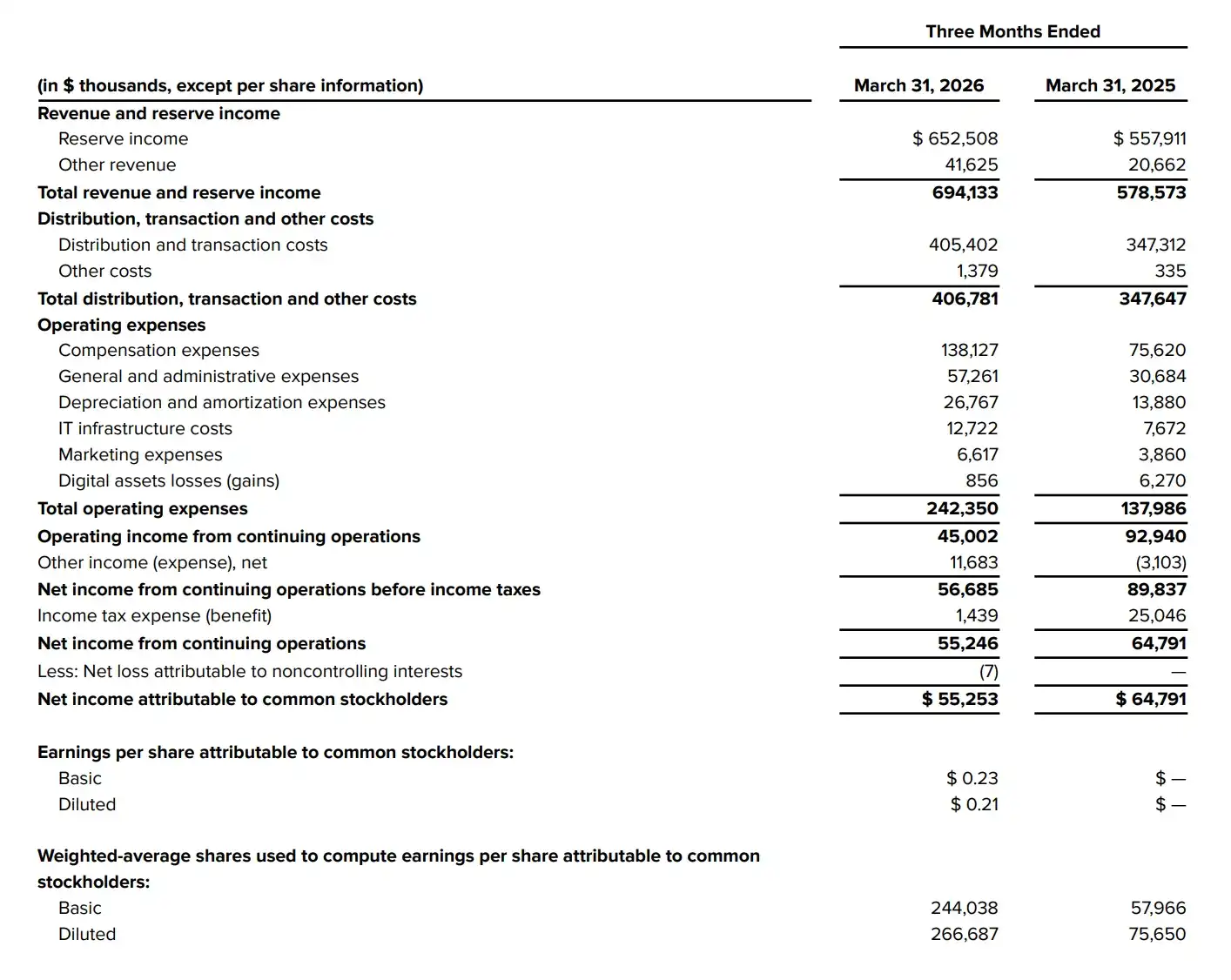
Now let's look at the expense situation. Distribution and Transaction Costs remain Circle's largest expense item, reaching a high of $405 million this quarter, a 17% year-on-year increase. This expense is mainly tied to the USDC distribution contract with Coinbase. This contract is set to expire in August this year. How it is renewed (primarily looking at whether the revenue-sharing ratio will be adjusted) will greatly impact Circle's subsequent expenses and profit status.

Apart from distribution costs, Total Operating Expenses also surged from $138 million last year to $242 million, a year-on-year increase of 76%. The primary increase came from Compensation expenses, which nearly doubled from $75.62 million to $138 million—Circle explained this was mainly due to IPO-related stock-based compensation expenses and related taxes.

Affected by the surge in expenses, Circle's operating profit for this quarter dropped to $45 million from $92.94 million in the same period last year; net profit attributable to common shareholders decreased from $64.79 million to $55.25 million; earnings per share (EPS) were $0.23, diluted to $0.21.

Other Operational Highlights

In addition to core financial data, Circle disclosed several operational highlights in its Q1 earnings report.

The most crucial data point is that USDC's circulation at the end of Q1 reached 77 billion tokens, a year-on-year increase of 28%. However, at the same time, USDC's on-chain transaction volume in Q1 reached a staggering $21.5 trillion, a year-on-year increase of 263%. Visa Onchain Analytics data also shows that USDC accounted for 63% of the total stablecoin transaction volume in Q1.
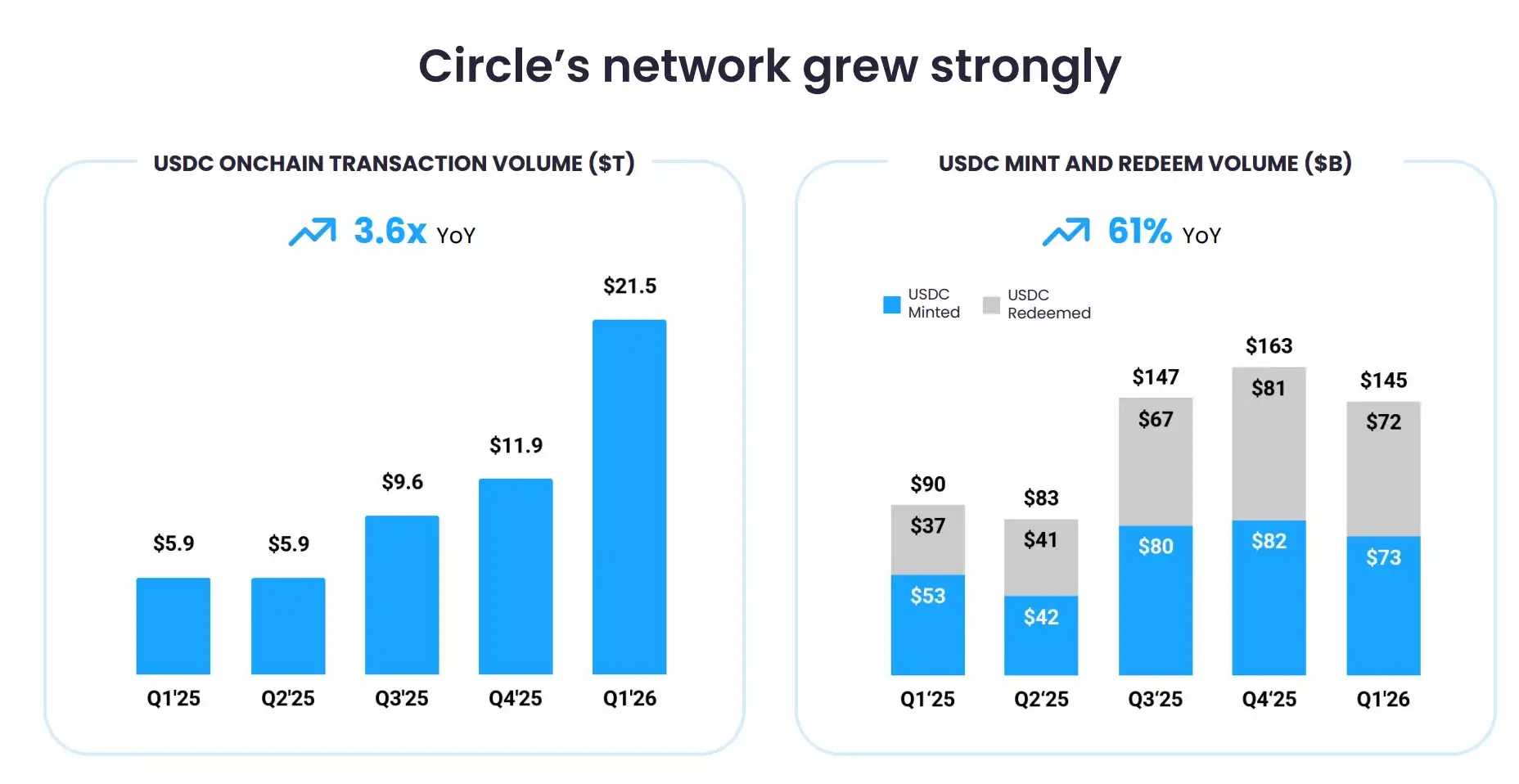
The transaction volume growth rate far exceeding the circulation growth rate means that the turnover and application frequency of each USDC token on-chain has significantly increased — USDC is not lying statically in wallets but is being genuinely and frequently used in scenarios like payments, DeFi, and cross-border settlements.

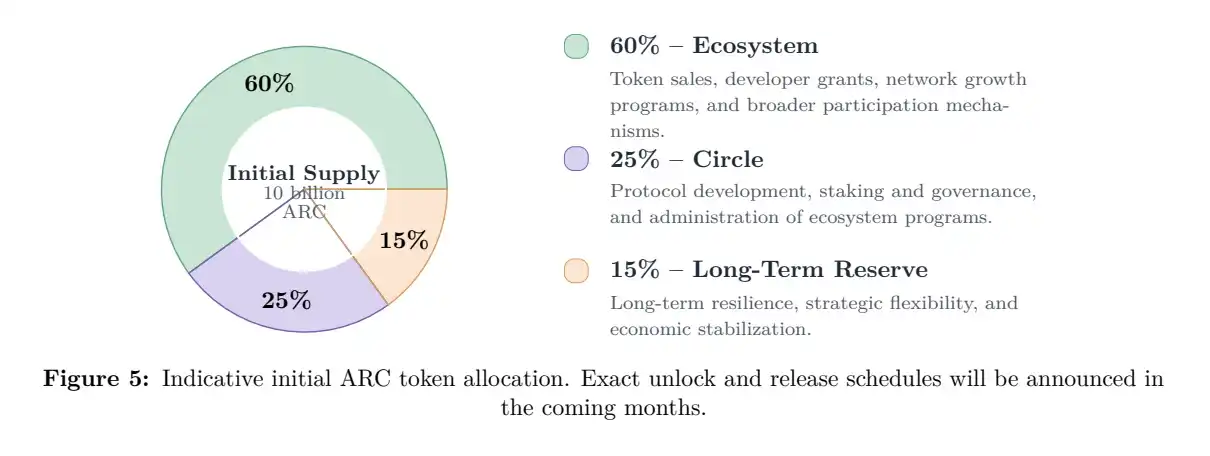
Another important point is that Circle also disclosed that its payment network, Arc Network, has completed a $222 million ARC token pre-sale with a valuation as high as $3 billion. Investors include renowned institutions such as a16z, BlackRock, Intercontinental Exchange, Standard Chartered, and SBI. The ARC token whitepaper disclosed today shows that 60% of the tokens will be allocated to the ecosystem (token sales, developer grants, network growth); 25% will be allocated to Circle (protocol development, staking & governance); 15% will be allocated to a long-term reserve (strategic flexibility & economic stability).
In the subsequent earnings call, when asked how the ARC tokens belonging to Circle would be accounted for, Circle Co-founder and CEO Jeremy Allaire stated: "When ARC tokens are created, they will be recorded on Circle's balance sheet at cost, and their cost is zero. Subsequently, after Circle fulfills its obligations under the token pre-sale agreement, we will recognize the value of these tokens as 'Other Revenue', and this value will then be directly reflected in RLDC and Adjusted EBITDA."

This also means that in a future quarter, Circle's reported revenue data will look "exceptionally good" due to the inclusion of ARC token value.

Furthermore, the estimated annual transaction volume for Circle's institutional payment service, Circle Payments Network (CPN) (extrapolated based on 30-day data as of March 31st), has also reached $8.3 billion; In April, Circle launched the "Managed Payments" product to expand its payment offerings. This product allows financial institutions to launch stablecoin payment services without having to manage digital assets themselves.

To prepare for the AI Agent-driven commercial future, Circle also announced the launch of Agent Stack, a set of infrastructure services and toolkits for the AI Agent economy, designed to provide high-speed, low-cost financial service capabilities for autonomously operating AI Agents. Jeremy Allaire's vision for this is: "With the ARC token pre-sale, the momentum building for Arc Network, and the launch of Agent Stack, we are building trusted infrastructure for AI-native economic activity and a more programmable internet financial system."

Circle's New Chess Game

Against the macroeconomic backdrop of receding high-interest dividends (Warsh is expected to promote a "rate cut + balance sheet reduction" strategy upon succeeding as Fed Chair), Circle clearly does not want to be entirely at the mercy of the Federal Reserve's interest rate policy. Its strategic focus has quietly shifted towards diversified expansion of non-interest revenue.

Judging from the details disclosed in this quarterly report, after successively launching services like CPN, Managed Payments, Agent Stack, and Arc Network, Circle's goal is no longer just to be a "stablecoin issuer." It is attempting to build USDC into the underlying dollar network for the internet era. Under this new vision, Circle's service targets are no longer limited to exchanges or crypto-native users but are extending comprehensively into cross-border payments, corporate settlements, and even the AI Agent economy.

Circle's ambition is now abundantly clear: to transform USDC from a "static reserve asset" into "flowing economic blood." This is perhaps the big chess game Circle truly wants to play.


Пов'язані питання

QWhat were Circle's total revenue and reserve income for Q1 2026, and how did it compare to market expectations?

ACircle's total revenue and reserve income for Q1 2026 was $6.94 billion, which was slightly below the market expectation of $7.15 billion.

QAccording to the article, what are the two key positive data points from Circle's Q1 report despite slowing revenue growth?

ATwo key positive data points are: 1) Other Revenue (excluding Reserve Income) reached a new high of $42 million, showing a consecutive growth trend. 2) The RLDC Margin, a core profitability indicator, reached 41%, marking four consecutive quarters of growth.

QWhat major operational highlight regarding USDC usage is mentioned in the Q1 report?

AA major operational highlight is that the on-chain transaction volume of USDC reached $21.5 trillion in Q1, a 263% year-over-year increase, significantly outpacing its circulation growth of 28%. This indicates much higher frequency of real-world use.

QWhat is the significance of the Arc Network and its ARC token for Circle's future financials, as explained by CEO Jeremy Allaire?

AThe ARC tokens allocated to Circle will be recorded on its balance sheet at cost (which is zero). Once Circle fulfills its obligations under the token presale agreement, the value of these tokens will be recognized as 'other revenue,' which will directly boost the RLDC and Adjusted EBITDA figures in a future quarter.

QHow does the article describe Circle's strategic shift and ultimate ambition in the context of declining interest rate benefits?

ACircle's strategy is shifting from relying on interest income to diversifying into non-interest revenue streams. Its ultimate ambition is to transform USDC from a 'static reserve asset' into 'circulating economic blood,' aiming to build it as the foundational dollar network for the internet era, extending into cross-border payments, corporate settlement, and the AI Agent economy.

Пов'язані матеріали

The Jacobian Conjecture that plagued Yitang Zhang for 7 years was overturned and disproven by Fable 5 overnight

**Summary:** The mathematical community was shocked when the longstanding **Jacobi Conjecture**—a core problem in polynomial mapping that had remained open for 87 years—was reportedly **disproven** by **Fable 5** (an AI model from Anthropic). The conjecture, first posed in 1939, asks whether a polynomial map with a constant, non-zero Jacobian determinant must have a polynomial inverse. Despite seeming intuitive, it had resisted numerous proof attempts by leading mathematicians. The breakthrough came when a researcher, Levent Alpoge, shared a succinct counterexample generated by Fable 5: a specific polynomial map from ℂ³ to ℂ³ whose Jacobian is the constant -2, yet which is not injective (mapping three distinct points to the same image). This elegantly falsifies the conjecture in its general form for dimensions ≥3. The counterexample is simple enough to be verified by hand or with tools like Wolfram Alpha. The event sparked intense discussion, with other AI models like GPT-5.6 quickly analyzing the result and even proposing a refined conjecture. It demonstrated AI's emerging capacity for genuine mathematical creativity, not just pattern matching. The story carries a poignant human dimension: renowned mathematician **Yitang Zhang** had devoted seven years of his early career to this problem under his PhD advisor, using a flawed lemma provided by the advisor. This setback contributed to Zhang leaving academia for years, including a period working at Subway, before his later breakthrough on the Twin Prime Conjecture. The AI's swift resolution underscores the tragic waste of his early effort on a conjecture now shown to be false in higher dimensions. It's important to note the disproof specifically targets the generalized (n-dimensional, n≥3) conjecture. The 2-dimensional case, which Zhang worked on, remains open and is considered mathematically distinct and even more challenging. Nonetheless, the event marks a significant moment, prompting reflections on AI's future role in mathematical discovery.

marsbit3 хв тому

The Jacobian Conjecture that plagued Yitang Zhang for 7 years was overturned and disproven by Fable 5 overnight

marsbit3 хв тому

Bought Bitcoin at $117,000, Sold at $62,000 in Tears: This Company’s Faith Only Lasted a Year

Wall Street's once-hot trend of corporate "Bitcoin hoarding" has hit a painful reality check. Empery Digital, formerly an electric motorcycle company, pivoted to Bitcoin in July 2025, accumulating over 4,000 BTC at an average cost of approximately $117,600 each. As Bitcoin's price plummeted, the company faced massive paper losses exceeding its total market value by early 2026, triggering internal conflict with a major shareholder demanding a sale. In a stark reversal from its earlier refusal to sell, Empery Digital recently sold 1,400 BTC at an average price of $62,000, locking in a significant loss of roughly $77 million on just those coins. The proceeds were used to pay down $10 million in debt, prepare for legal fees related to shareholder lawsuits, and, most notably, fund a new strategic shift: a $65 million investment for a 25% stake in an AI data center facility. This move completes a cycle of chasing market trends—from electric vehicles to Bitcoin treasury and now to AI infrastructure. Empery's case exposes the leveraged nature of the corporate "treasury model," where buying Bitcoin with borrowed money works only while prices rise. Once the asset fell below its cost basis, the company was forced to sell at a loss to service debt and pivot to the next opportunity. The company's remaining assets are 1,514 BTC and its ambitions in AI, demonstrating that its stated "long-term belief" in Bitcoin had a clear price tag: a 50% discount.

marsbit13 хв тому

Bought Bitcoin at $117,000, Sold at $62,000 in Tears: This Company’s Faith Only Lasted a Year

marsbit13 хв тому

Visa Joins the Stablecoin Arena: Not to Eliminate Stablecoins, but to 'Collect Rent' from Them

Visa is entering the stablecoin arena by launching a stablecoin platform, aiming not to eliminate existing stablecoins but to facilitate and profit from their broader adoption. The platform will enable banks, financial institutions, and fintech companies to more easily issue, manage, and integrate stablecoins into Visa's existing global payment network, which spans over 200 million merchants and 15,000 financial institutions. This move is expected to expand the overall stablecoin market by creating more use cases. For USDC (Circle), it presents a short-term benefit due to likely direct integration and its compliance advantages, though long-term competition may increase from bank-issued or consortium stablecoins. For USDT (Tether), the impact could be more significant in traditional payment and settlement areas, as Visa's platform may favor more transparent, compliant options, though USDT is expected to remain strong in pure crypto trading contexts. Regarding Ethereum, Visa's initiative is seen as neutral to slightly positive. It could drive more traditional capital into the Ethereum ecosystem in the form of stablecoins, increasing network activity and demand for Ethereum as a settlement layer, especially with Layer-2 scaling solutions. While the platform will support multiple blockchains, Ethereum's maturity and decentralization make it a likely primary choice for compliant stablecoins. In essence, Visa's strategy is to embrace stablecoins, collect fees from increased transaction volume on its network, and grow the overall market, rather than displace major incumbents like USDC and USDT directly.

marsbit44 хв тому

Visa Joins the Stablecoin Arena: Not to Eliminate Stablecoins, but to 'Collect Rent' from Them

marsbit44 хв тому

Торгівля

Спот
活动图片