Digital asset ETPs post third straight week of net inflows, led by US demand

cointelegraphОпубліковано о 2025-12-15Востаннє оновлено о 2025-12-15

Анотація

Digital asset exchange-traded products (ETPs) recorded $864 million in net inflows for the third consecutive week, driven primarily by U.S. demand, according to CoinShares. Bitcoin products led with $522 million in inflows, while Ether saw $338 million. Solana and XRP also attracted significant inflows of $65 million and $46.9 million, respectively. The U.S., Germany, and Canada accounted for the majority of regional inflows, while Switzerland posted outflows. Year-to-date, Bitcoin has attracted $27.7 billion, though still below 2024 levels. Multi-asset crypto ETPs and blockchain equity funds saw mixed flows during the period.

Crypto exchange-traded products (ETPs) recorded about $864 million in inflows last week, according to a report on Monday by European digital asset manager CoinShares.

The United States led regional inflows with about $796 million, followed by Germany with roughly $68.6 million and Canada with about $26.8 million. Together, the three countries account for approximately 98.6% of year-to-date (YTD) inflows into digital asset investment products.

Switzerland-listed crypto ETPs recorded about $41.4 million in weekly outflows, while YTD net flows were about $622.4 million, according to the data.
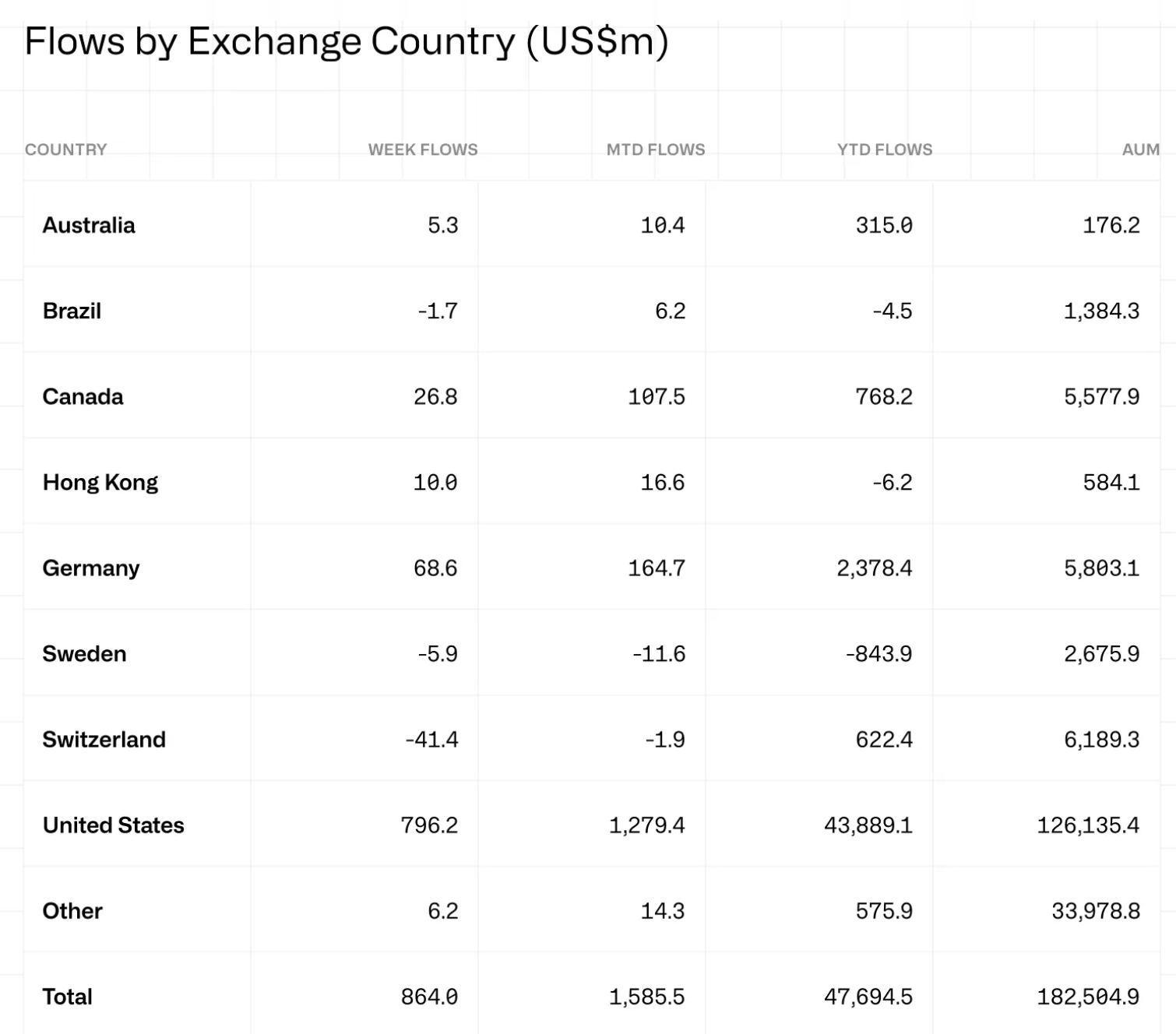
Flows by Exchange Country (US$m). Source: CoinShares’ Report

Bitcoin and Ether dominate inflows, followed by Solana and XRP

Bitcoin (BTC) investment products recorded about $522 million in weekly inflows, while short-Bitcoin products posted roughly $1.8 million in net outflows, “signalling a recovery in sentiment,” according to the report.

Ether (ETH) saw approximately $338 million in inflows during the week, lifting YTD to about $13.3 billion, up 148% from 2024.

Beyond Bitcoin and Ether, Solana (SOL) investment products recorded about $65 million in weekly inflows, bringing YTD inflows to roughly $3.46 billion, a tenfold increase from last year.

XRP (XRP) products also attracted fresh capital, with approximately $46.9 million added during the week and about $3.18 billion in inflows accumulated YTD, according to the data.

Smaller-cap products saw more mixed results, with Aave (AAVE)-linked products recording about $5.9 million in weekly inflows and Chainlink (LINK) adding roughly $4.1 million. Hyperliquid (HYPE) products posted net outflows of around $14.1 million during the period.

This is the third consecutive week of inflows for crypto ETPs, following about $716 million in inflows last week and roughly $1 billion the week before.

Bitcoin has attracted around $27.7 billion YTD, still below the $41 billion it recorded in 2024.

Related: XRP sinks below $2 despite $1B in ETF inflows: How low can price go?

Assets under management and equity ETP flows

By assets under management, Bitcoin investment products hold about $141.8 billion, while Ether-linked products account for roughly $26 billion.

Outside of single-asset products, multi-asset crypto ETPs recorded about $104.9 million in weekly outflows, extending net redemptions to roughly $69.5 million YTD, despite holding approximately $6.8 billion in assets under management, according to the data.
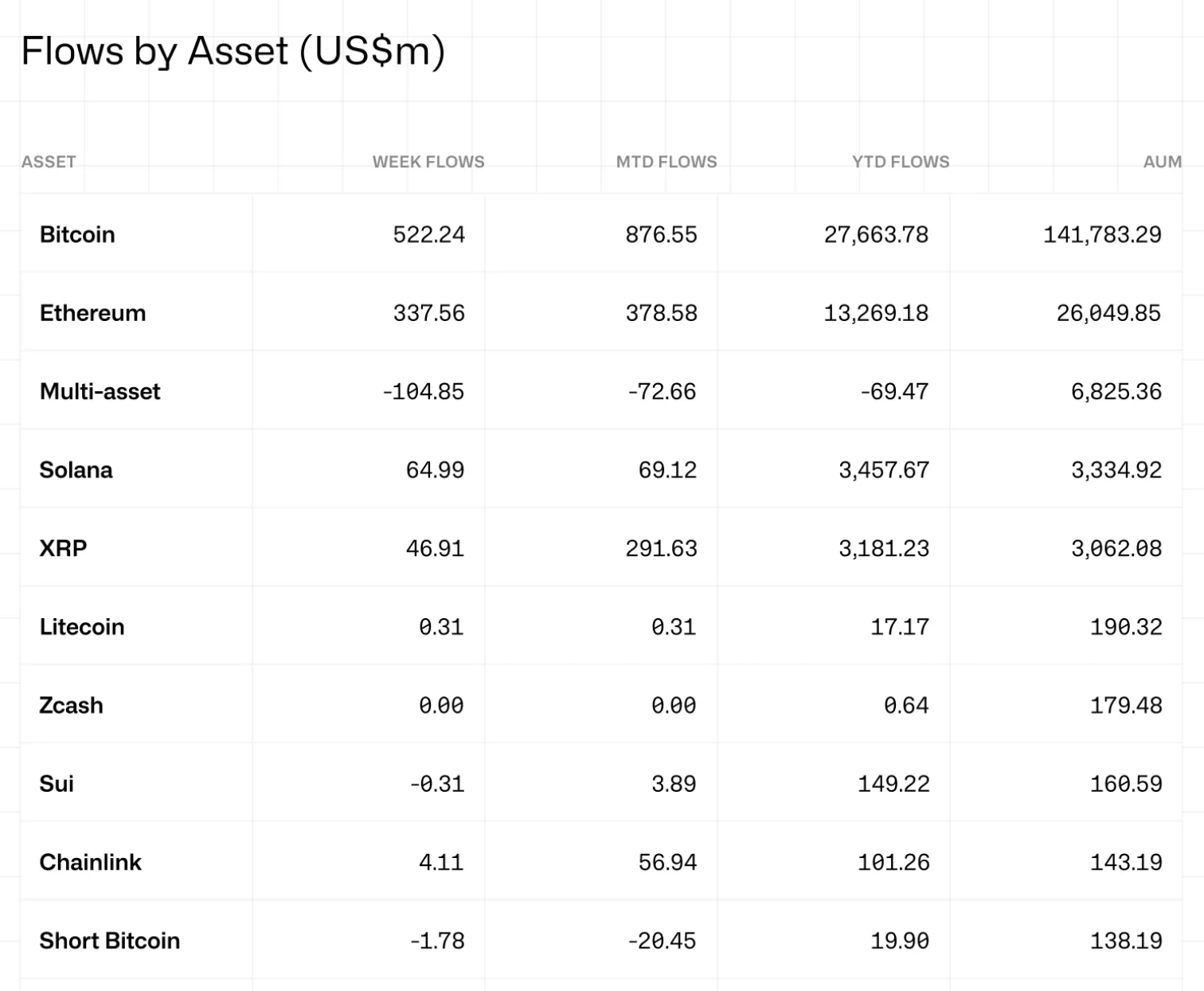
Crypto ETP USD flows by asset. Source: CoinShares

Funds that invest in publicly traded blockchain-related companies saw mixed investor flows during the week. VanEck’s Digital Transformation fund posted the largest weekly inflow at about $45.8 million, followed by VanEck Crypto and Blockchain at roughly $20.5 million and Schwab’s Crypto Thematic ETF at about $7.2 million.

Invesco CoinShares’ Global Blockchain and Bitwise Crypto Industry Innovators ETPs recorded modest net outflows during the week.
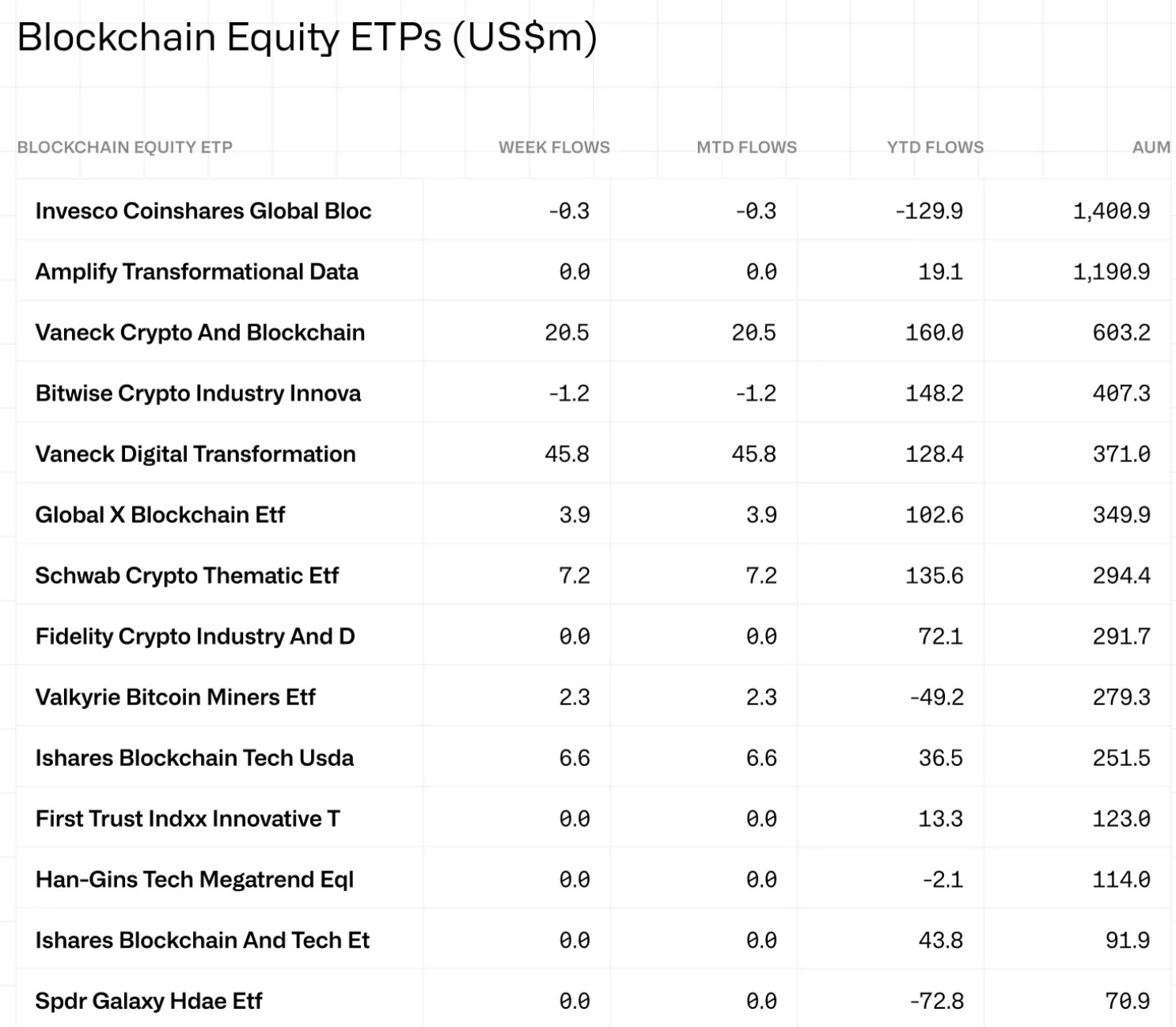
Blockchain Equity ETPs. Source: CoinShares’

Magazine: Big questions: Would Bitcoin survive a 10-year power outage?

Пов'язані матеріали

Huang Renxun Dramatically 'Saves' South Korean Stock Market

In early June, South Korea's stock market experienced a sharp decline, with the KOSPI index dropping over 5% and triggering a trading halt. Amid this volatility, NVIDIA CEO Jensen Huang's visit to Seoul provided a dramatic boost to market sentiment. During his trip, Huang held a dinner meeting with SK Group Chairman Chey Tae-won and SK Hynix CEO Kwak Noh-Jung. He announced that NVIDIA's new Vera CPU would utilize SK Hynix DRAM and confirmed a multi-year technical collaboration between the two companies. This partnership aims to co-develop next-generation memory for NVIDIA's AI infrastructure roadmap, covering products from data center supercomputers to personal AI devices. Huang also publicly commented that AI company stocks were attractively priced. A key announcement was that NVIDIA's upcoming Vera Rubin AI supercomputer systems will use HBM4 memory, with supply qualifications granted to all three major suppliers: SK Hynix, Samsung Electronics, and Micron Technology. Despite this multi-sourcing strategy, Huang warned that the industry-wide chip shortage, affecting everything from wafers to packaging, is expected to persist for several years due to relentless demand from global AI factory construction. The collaboration extends beyond memory supply. SK Hynix will employ NVIDIA's AI platforms and Omniverse digital twin technology to enhance its own semiconductor design, simulation, and manufacturing processes, aiming for more autonomous factory operations. This visit builds upon a prior October 2025 agreement for SK Group to build a large-scale AI data center using over 50,000 NVIDIA GPUs. Huang's itinerary also included meetings with other Korean giants like Hyundai, LG, and Samsung, indicating NVIDIA's broader strategy to deepen ties with South Korea's tech industry.

链捕手3 год тому

Huang Renxun Dramatically 'Saves' South Korean Stock Market

链捕手3 год тому

When Inference Becomes a Scarce Resource, Who Captures the Value?

When Inference Becomes the Scarce Resource, Who Captures the Value? The core AI bottleneck has shifted from model training to inference (runtime execution). While concerns persisted about an "AI compute gap"—initially a $200B, now a $600B problem—the market is now recognizing that the solution and value lie in the inference layer. Nvidia's financial restructuring around "serving tokens" and Cerebras's successful IPO highlight this shift. Inference is a recurring, usage-based cost, estimated to be 10-50x larger than the one-time training market, especially with the rise of agentic AI. The inference stack spans six layers: silicon (e.g., Nvidia), bare metal (e.g., CoreWeave), GPU rental/aggregation, deployment/optimization, model APIs, and end applications. Most companies operate in one layer. However, Hyperbolic uniquely spans three layers (GPU rental, deployment, and model APIs) without owning any hardware. It aggregates fragmented GPU supply from multiple cloud providers into a standardized pool, offering developers the cheapest available compute through intelligent routing. Its multi-cloud aggregation creates a data moat and a flywheel: more supply leads to better pricing data and liquidity, attracting more developers and providers. In contrast, applications like Venice operate at the top of the stack, reselling privacy-wrapped inference but remaining dependent on and constrained by the underlying compute costs they purchase. As inference demand explodes, value accrues not just to consumer applications but increasingly to the aggregation and routing layer that captures their cost of revenue. The coming potential GPU oversupply reinforces this dynamic. While hardware owners may suffer from depreciation, asset-light aggregators like Hyperbolic benefit from price arbitrage, routing workloads to the cheapest available capacity. The ultimate winner in the inference economy may not be the entity with the most GPUs, but the one that can most efficiently discover, aggregate, and route the world's fragmented compute.

链捕手3 год тому

When Inference Becomes a Scarce Resource, Who Captures the Value?

链捕手3 год тому

Торгівля

Спот
Ф'ючерси

Популярні статті

Як купити US

Ласкаво просимо до HTX.com! Ми зробили покупку Talus Network (US) простою та зручною. Дотримуйтесь нашої покрокової інструкції, щоб розпочати свою криптовалютну подорож.Крок 1: Створіть обліковий запис на HTXВикористовуйте свою електронну пошту або номер телефону, щоб зареєструвати обліковий запис на HTX безплатно. Пройдіть безпроблемну реєстрацію й отримайте доступ до всіх функцій.ЗареєструватисьКрок 2: Перейдіть до розділу Купити крипту і виберіть спосіб оплатиКредитна/дебетова картка: використовуйте вашу картку Visa або Mastercard, щоб миттєво купити Talus Network (US).Баланс: використовуйте кошти з балансу вашого рахунку HTX для безперешкодної торгівлі.Треті особи: ми додали популярні способи оплати, такі як Google Pay та Apple Pay, щоб підвищити зручність.P2P: Торгуйте безпосередньо з іншими користувачами на HTX.Позабіржова торгівля (OTC): ми пропонуємо індивідуальні послуги та конкурентні обмінні курси для трейдерів.Крок 3: Зберігайте свої Talus Network (US)Після придбання Talus Network (US) збережіть його у своєму обліковому записі на HTX. Крім того, ви можете відправити його в інше місце за допомогою блокчейн-переказу або використовувати його для торгівлі іншими криптовалютами.Крок 4: Торгівля Talus Network (US)Легко торгуйте Talus Network (US) на спотовому ринку HTX. Просто увійдіть до свого облікового запису, виберіть торгову пару, укладайте угоди та спостерігайте за ними в режимі реального часу. Ми пропонуємо зручний досвід як для початківців, так і для досвідчених трейдерів.

1.2k переглядів усьогоОпубліковано 2025.12.11Оновлено 2026.06.02

Як купити US

Обговорення

Ласкаво просимо до спільноти HTX. Тут ви можете бути в курсі останніх подій розвитку платформи та отримати доступ до професійної ринкової інформації. Нижче представлені думки користувачів щодо ціни US (US).

活动图片













