Did Vitalik Buterin Just Kill Ethereum Layer-2s? Here’s What He Said

bitcoinistОпубліковано о 2026-02-05Востаннє оновлено о 2026-02-05

Анотація

Vitalik Buterin is reframing the narrative around Ethereum's layer-2s, arguing that the original vision of L2s as "branded shards" primarily for scaling no longer fits current realities. With low L1 fees and an expected gas limit increase in 2026, he states Ethereum is scaling on its own, reducing the need for L2s solely for capacity. Buterin highlights that many L2s are slow to reach "stage 2" decentralization and some may never intend to, due to technical challenges or regulatory requirements that demand ultimate control. He proposes a spectrum model where L2s offer varying levels of security and trust, rather than uniformly claiming to "scale Ethereum." Buterin advises L2 teams to differentiate through features like specialized execution, privacy, or ultra-low latency, rather than scaling alone. He emphasizes the importance of "stage 1" security for handling ETH or Ethereum-based assets and advocates for a native ZK-EVM precompile to simplify trustless interoperability and synchronous composability. Buterin concludes that while some chains will remain trust-dependent, the focus should be on clear user guarantees and base-layer strength, shifting competition from scaling to proving credible offerings.

Vitalik Buterin is signaling a major reframing of Ethereum’s layer-2 narrative: not the death of rollups, but the end of the idea that L2s are shards whose primary job is scaling the network. With L1 fees now low and gas limit projected to rise sharply in 2026, he argues the rollup-centric roadmap’s original premise no longer fits the reality on the ground.

Buterin opened his X post on Feb. 3 by pointing to two pressures that have been building in parallel: L2s have moved to “stage 2” far more slowly than expected, and Ethereum mainnet is scaling in its own right. In his telling, those trends break the old mental model in both directions.

“Ethereum needs to scale,” he wrote, recapping what he framed as the original thesis. “The definition of ‘Ethereum scaling’ is the existence of large quantities of block space that is backed by the full faith and credit of Ethereum... block space where, if you do things (including with ETH) inside that block space, your activities are guaranteed to be valid, uncensored, unreverted, untouched, as long as Ethereum itself functions. If you create a 10000 TPS EVM where its connection to L1 is mediated by a multisig bridge, then you are not scaling Ethereum.”

The punchline is blunt: “This vision no longer makes sense.” Buterin says L1 doesn’t need L2s to serve as “branded shards” if base-layer capacity is expanding, and he’s increasingly skeptical that many L2s either can or want to meet the security and control expectations that label implies. He pointed to at least one L2 that, in his words, “may never want to go beyond stage 1,” citing not only technical concerns around ZK-EVM safety but also customer-driven regulatory requirements that “require them to have ultimate control.”

Ethereum Layer-2’s Need To Change

That’s not presented as an indictment so much as a categorization shift. If an L2 retains ultimate control, it may still be a valid product for its users, Buterin suggested, but it shouldn’t be marketed as “scaling Ethereum” in the strict sense envisioned by the rollup-centric roadmap. In that context, he argues, “we should stop thinking about L2s as literally being ‘branded shards’, with the social status and responsibilities that this entails.”

Instead, he sketches a spectrum model: some L2s can be tightly backed by ETH’s security guarantees, while others can be looser and more optional depending on user needs. That spectrum framing implicitly makes room for app-specific chains, different trust models, and non-EVM environments—without forcing them into a single “rollup as shard” storyline.

For L2 teams, Buterin’s guidance is straightforward: stop anchoring your identity on scaling alone. If you’re handling ETH or Ethereum-issued assets, he argues “stage 1 at the minimum” matters; otherwise, you’re effectively operating as “just a separate L1 with a bridge.” The real differentiator, in his view, should be features and properties that a larger L1 still won’t provide—whether that’s specialized execution environments, privacy, sequencing characteristics like ultra-low latency, or non-financial use cases.

Buterin says he’s become “more convinced of the value of the native rollup precompile,” especially once Ethereum has enshrined the ZK-EVM proof verification it “need[s] anyway to scale L1.” The idea is a protocol-level precompile that verifies ZK-EVM proofs and is treated as part of Ethereum itself, meaning it would “auto-upgrade along with Ethereum,” and if it shipped with a bug, “Ethereum will hard-fork to fix the bug.”

That last point is the subtext: he wants a path where trustless verification and interoperability are easier to achieve without a “security council,” and where rollups can add custom features while still anchoring their EVM correctness directly to Ethereum. He also tied this direction to the prospect of synchronous composability: transactions that can safely span L1 and L2 liquidity with tight coupling, referencing ongoing research on combining preconfirmations with based rollups and real-time proving.

Buterin’s conclusion leaves room for uncomfortable outcomes. A permissionless ecosystem will produce chains with “trust-dependent, or backdoored, or otherwise insecure” elements, he wrote, calling that “unavoidable.” The job, as he frames it, is to make guarantees legible to users while strengthening Ethereum’s base layer, suggesting that the next phase of L2 competition may be less about who “scales Ethereum,” and more about who can credibly define, and prove, what they’re actually offering.

At press time, ETH traded at $2,256.
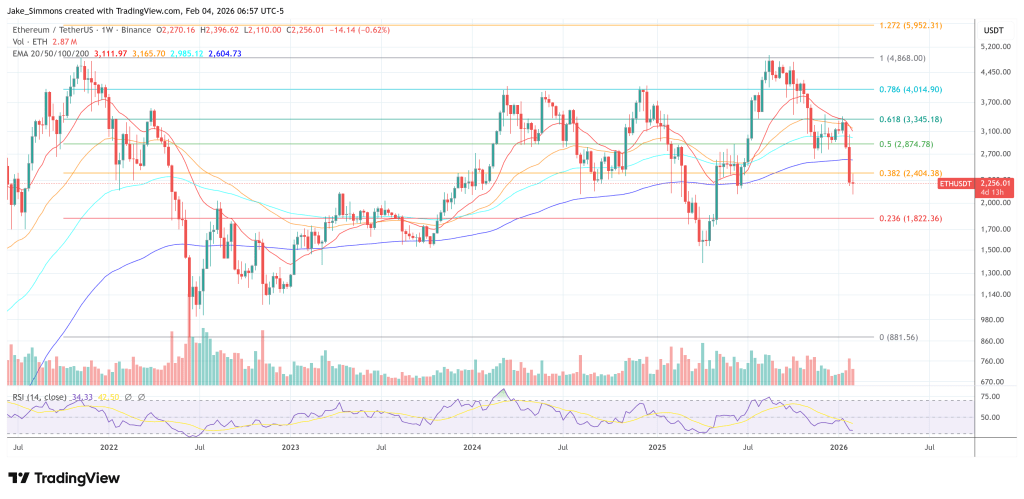
ETH remains below between the 0.382 Fib, 1-week chart | Source: ETHUSDT on TradingView.com

Трендові криптовалюти

Пов'язані питання

QWhat is the main shift in Ethereum's layer-2 narrative that Vitalik Buterin is signaling?

AHe is reframing the narrative away from viewing L2s as 'shards' whose primary purpose is scaling, arguing that this vision no longer makes sense given low L1 fees and Ethereum's own scaling progress.

QAccording to Buterin, what is the original definition of 'Ethereum scaling' that he now says is outdated?

AThe original definition was the existence of large quantities of block space backed by the full faith and credit of Ethereum, guaranteeing activities are valid, uncensored, and unreverted as long as Ethereum functions.

QWhat new model does Buterin propose for categorizing Layer-2 solutions?

AHe proposes a spectrum model where some L2s are tightly backed by Ethereum's security, while others can be looser and more optional, making room for different trust models and use cases without forcing them into a single 'rollup as shard' storyline.

QWhat technical solution does Buterin express increased conviction in for the future of rollups?

AHe is more convinced of the value of a 'native rollup precompile,' a protocol-level feature that would verify ZK-EVM proofs and be treated as part of Ethereum itself, auto-upgrading with the main chain.

QWhat does Buterin suggest should be the real differentiator for L2 teams instead of just scaling?

AHe suggests the real differentiator should be features and properties that a larger L1 won't provide, such as specialized execution environments, privacy, ultra-low latency sequencing, or non-financial use cases.

Пов'язані матеріали

The Verdict in Choi Tae-won's Divorce Case: Revealing the Inheritance Undercurrent Behind SK Hynix's Trillion-Won Empire

SK Group Chairman Chey Tae-won's high-profile divorce case, involving a record 1.38 trillion won settlement, has drawn attention to the succession plans for Korea's second-largest conglomerate, especially its crown jewel, SK hynix. Unlike traditional chaebol scripts centered on the eldest son, Chey's three children from his marriage to former President Roh Tae-woo's daughter, Roh Soh-yeong, are carving distinct, non-traditional paths. Eldest daughter Chey Yun-jung (b. 1989) is seen as the most evident successor. With a scientific and consulting background, she holds executive roles at SK bioscience and SK Inc.'s growth support department, focusing on future strategy and biopharma. Her marriage is to an AI infrastructure entrepreneur, not a traditional business alliance. Second daughter Chey Min-jung (b. 1991) took a unique route, voluntarily serving as a South Korean naval officer, including an anti-piracy deployment. She later worked on policy and strategy for SK hynix in Washington D.C. before co-founding an AI-driven healthcare startup. She married a former U.S. Marine Corps officer, connecting her to U.S. defense and policy circles—networks crucial for a global semiconductor giant. The only son, Chey In-geun (b. 1995), who studied physics like his father, worked briefly at SK E&S before joining McKinsey. Despite fitting the traditional "heir" profile as the eldest son, he remains silent and holds no public position or shares in SK, suggesting the old succession playbook is obsolete. As SK hynix's valuation soars, becoming a geopolitical asset in the AI era, the heirs' legitimacy is no longer automatic. They must prove themselves in fields like AI biotech, global policy, and strategic consulting. Their marriages also reflect new elite networks in tech and defense, not old political alliances. Their inheritance is the complex challenge of navigating a globalized, tech-driven world, not just a corporate throne.

marsbitВчора 09:06

The Verdict in Choi Tae-won's Divorce Case: Revealing the Inheritance Undercurrent Behind SK Hynix's Trillion-Won Empire

marsbitВчора 09:06

From OpenSea to OpenRouter: Is Alex Atallah Repeating His 'Exit at the Peak' Playbook?

From OpenSea to OpenRouter: Is Alex Atallah Repeating His "Exit at the Peak" Playbook? According to the Wall Street Journal, payments giant Stripe is in talks to acquire the AI model aggregation platform OpenRouter in a potential deal valuing the company near $100 billion. This would mark founder Alex Atallah's second creation of a company reaching a $100 billion valuation, following his co-founding of NFT marketplace OpenSea. OpenRouter, founded just over three years ago, has grown rapidly by acting as a unified gateway for developers to access over 400 AI models. It currently has about 10 million users and processes over 200 trillion tokens monthly. While the platform's annualized revenue is around $50 million, its valuation has skyrocketed from $1.3 billion in March 2026. The potential acquisition by Stripe, a company OpenRouter's founder once likened it to, represents a major expansion into AI infrastructure for the payments leader. This move echoes Atallah's previous timing with OpenSea, where he departed before the NFT market's significant downturn. For OpenRouter, selling now may be strategic. Despite its scale, its business model—charging a 5-5.5% fee on AI inference calls—faces pressure from competition, open-source models, and potential price wars among model providers, limiting its profitability narrative for an IPO. A key asset for potential acquirers like Stripe is OpenRouter's vast repository of real-world AI usage data, which offers unique insights into model performance and developer preferences that are difficult to replicate. Whether this potential deal signifies a new valuation benchmark for AI infrastructure or another market peak signal remains to be seen.

链捕手Вчора 08:42

From OpenSea to OpenRouter: Is Alex Atallah Repeating His 'Exit at the Peak' Playbook?

链捕手Вчора 08:42

Торгівля

Спот

Популярні статті

Як купити LAYER

Ласкаво просимо до HTX.com! Ми зробили покупку Solayer (LAYER) простою та зручною. Дотримуйтесь нашої покрокової інструкції, щоб розпочати свою криптовалютну подорож.Крок 1: Створіть обліковий запис на HTXВикористовуйте свою електронну пошту або номер телефону, щоб зареєструвати обліковий запис на HTX безплатно. Пройдіть безпроблемну реєстрацію й отримайте доступ до всіх функцій.ЗареєструватисьКрок 2: Перейдіть до розділу Купити крипту і виберіть спосіб оплатиКредитна/дебетова картка: використовуйте вашу картку Visa або Mastercard, щоб миттєво купити Solayer (LAYER).Баланс: використовуйте кошти з балансу вашого рахунку HTX для безперешкодної торгівлі.Треті особи: ми додали популярні способи оплати, такі як Google Pay та Apple Pay, щоб підвищити зручність.P2P: Торгуйте безпосередньо з іншими користувачами на HTX.Позабіржова торгівля (OTC): ми пропонуємо індивідуальні послуги та конкурентні обмінні курси для трейдерів.Крок 3: Зберігайте свої Solayer (LAYER)Після придбання Solayer (LAYER) збережіть його у своєму обліковому записі на HTX. Крім того, ви можете відправити його в інше місце за допомогою блокчейн-переказу або використовувати його для торгівлі іншими криптовалютами.Крок 4: Торгівля Solayer (LAYER)Легко торгуйте Solayer (LAYER) на спотовому ринку HTX. Просто увійдіть до свого облікового запису, виберіть торгову пару, укладайте угоди та спостерігайте за ними в режимі реального часу. Ми пропонуємо зручний досвід як для початківців, так і для досвідчених трейдерів.

399 переглядів усьогоОпубліковано 2025.02.11Оновлено 2026.06.02

Як купити LAYER

Обговорення

Ласкаво просимо до спільноти HTX. Тут ви можете бути в курсі останніх подій розвитку платформи та отримати доступ до професійної ринкової інформації. Нижче представлені думки користувачів щодо ціни LAYER (LAYER).

活动图片













