Design, Development, Legal, Sports... Polymarket Launches 'Full-Stack' Talent Grab

Odaily星球日报Опубліковано о 2026-04-15Востаннє оновлено о 2026-04-15

Анотація

Polymarket, a leading prediction market platform, is aggressively expanding its team across multiple domains following competitor Kalshi's recent $22 billion valuation funding round. Key hires and strategic acquisitions are central to its growth strategy. Design remains a priority, with the design lead actively recruiting to strengthen the platform's distinctive blue-and-white branding. Engineering recruitment is also intensive, highlighted by the acquisition of API platform Dome, whose co-founders joined Polymarket, and the hiring of a former Aave engineering VP. Multiple senior engineering roles are currently open. For its US platform, Polymarket is bolstering legal and compliance expertise, adding a former RBC Capital Markets veteran as Legal Counsel. In a significant move, it hired a former Fanatics CBO to lead sports business development, which sparked a non-compete lawsuit from Fanatics, revealing complex industry entanglements. Further hires include a former Coinbase institutional product lead to handle institutional liquidity sales, a marketing head from MrBeast's team, and a Citadel veteran for exchange upgrades. Polymarket is also recruiting for HR and a Head of Markets, indicating the talent competition in the prediction market space is far from over.

Original|Odaily Planet Daily(@OdailyChina)

Author|Wenser(@wenser 2010 )

After Kalshi completed a new funding round in March with a valuation of $22 billion, Polymarket, one of the two giants in the prediction market, couldn't sit still.

Apart from the news that it was previously seeking funding with a $20 billion valuation, Polymarket has also been busy recruiting new team members recently for platform development and business expansion. From the list of new team members joining Polymarket, we might get a glimpse of the focus and突围 directions of this former prediction market霸主, now the "perennial runner-up".

Odaily Planet Daily will provide a梳理 and analysis based on Polymarket's recruitment information in this article.

Design Remains a Top Priority: Design Lead Posted Recruitment Plan in January

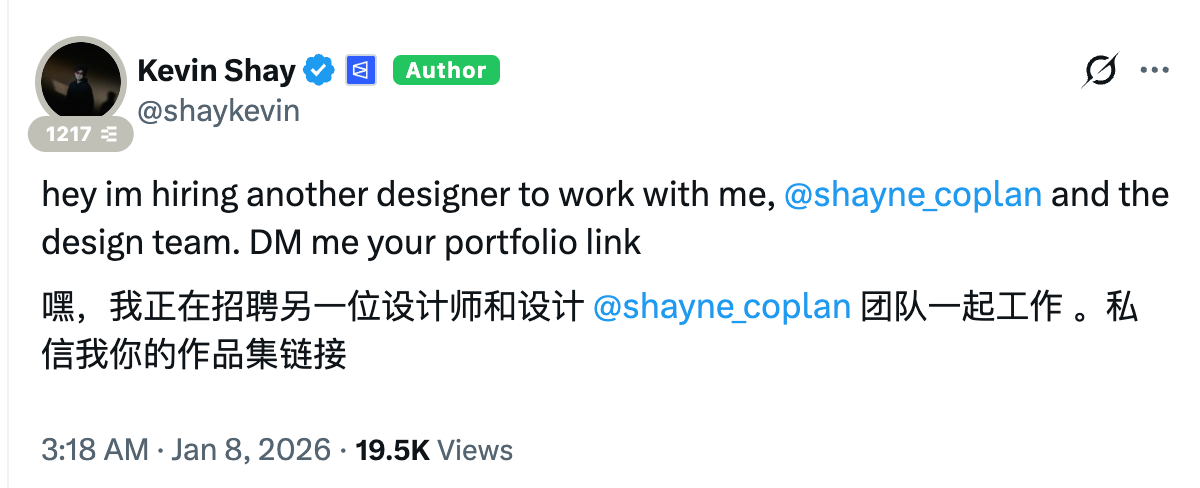
In January of this year, Polymarket's Head of Design, Kevin Shay, posted a tweet stating that he was recruiting designers. Apart from distinguishing itself from Kalshi's green and white UI, Polymarket's blue and white UI remains an important design language and iconic symbol. Its previously opened pop-up grocery store in New York also used corresponding blue and white elements in its design. In the crucial battle for brand突围, design is still a top priority for Polymarket's development.

Additionally, according to the official recruitment page, there are currently 2 design-related positions still open.
Development Engineers Continuously Recruited: Emphasizing Both Talent Acquisition and External Recruitment

As the business cornerstone of platform development, developers are also a key driving force behind Polymarket's recent business expansion. The strategy adopted by Polymarket's talent recruitment team is to emphasize both talent acquisition and external recruitment.

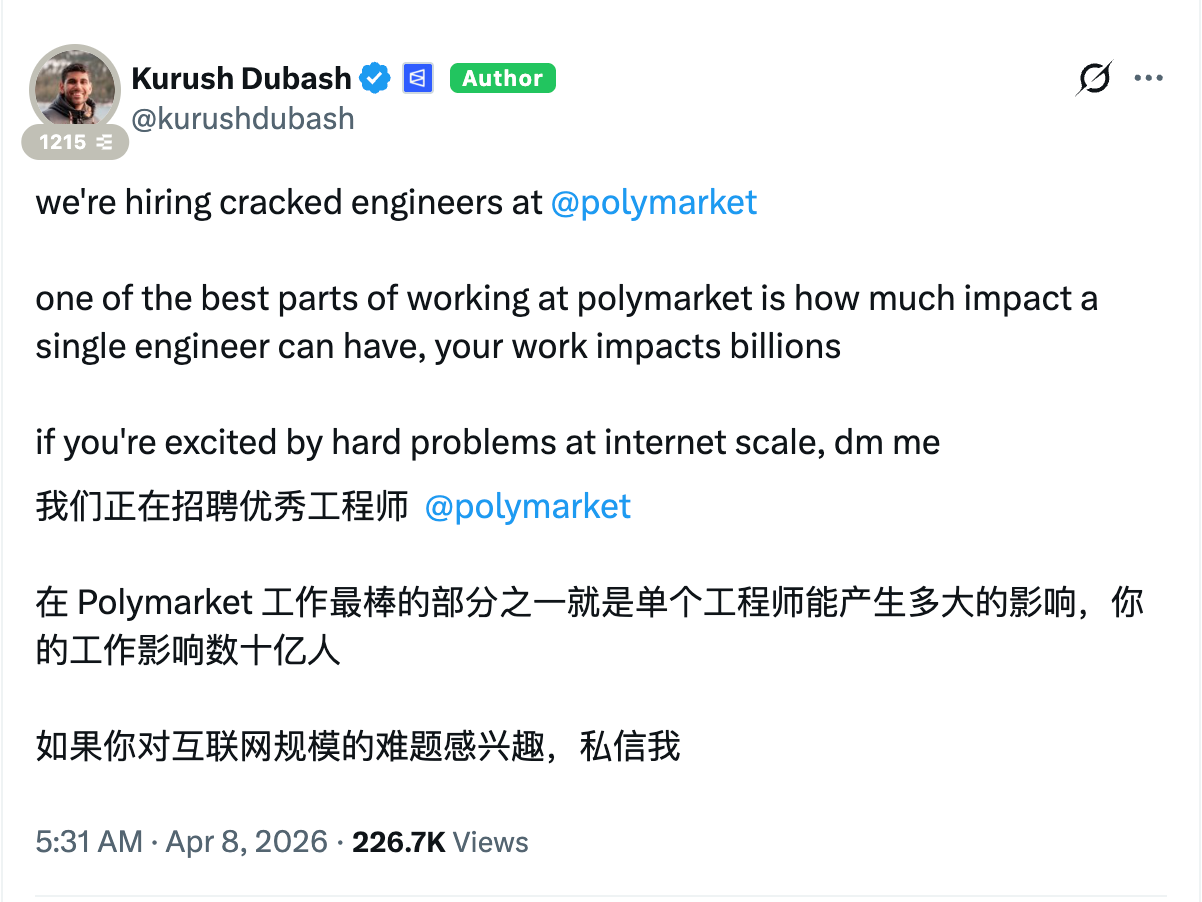
Kurush Dubash & Kunal Roy, Two Co-founders of Dome

In February, the prediction market API platform Dome was officially acquired by Polymarket. Subsequently, Dome's two co-founders, Kurush Dubash and Kunal Roy, also joined Polymarket. In April, they posted tweets recruiting top engineers, beginning to show a "person-to-person"火热 recruitment phenomenon.

It is worth mentioning that Polymarket also acquired the executive search firm Lunch in the same month; many of the executives and team members mentioned later were contacted and recruited by the leaders of this company; in March, Polymarket also acquired the DeFi infrastructure startup Brahma, and most of its team members have also been integrated into the Polymarket team.
Josh Stevens, Vice President of Engineering

On March 24th, former Aave engineer and senior vice president Josh announced that he had joined Polymarket. And just half a month later, he was already posting again on his personal account to recruit engineers. It seems that the developer gap at the rapidly developing Polymarket is much larger than outsiders might imagine.
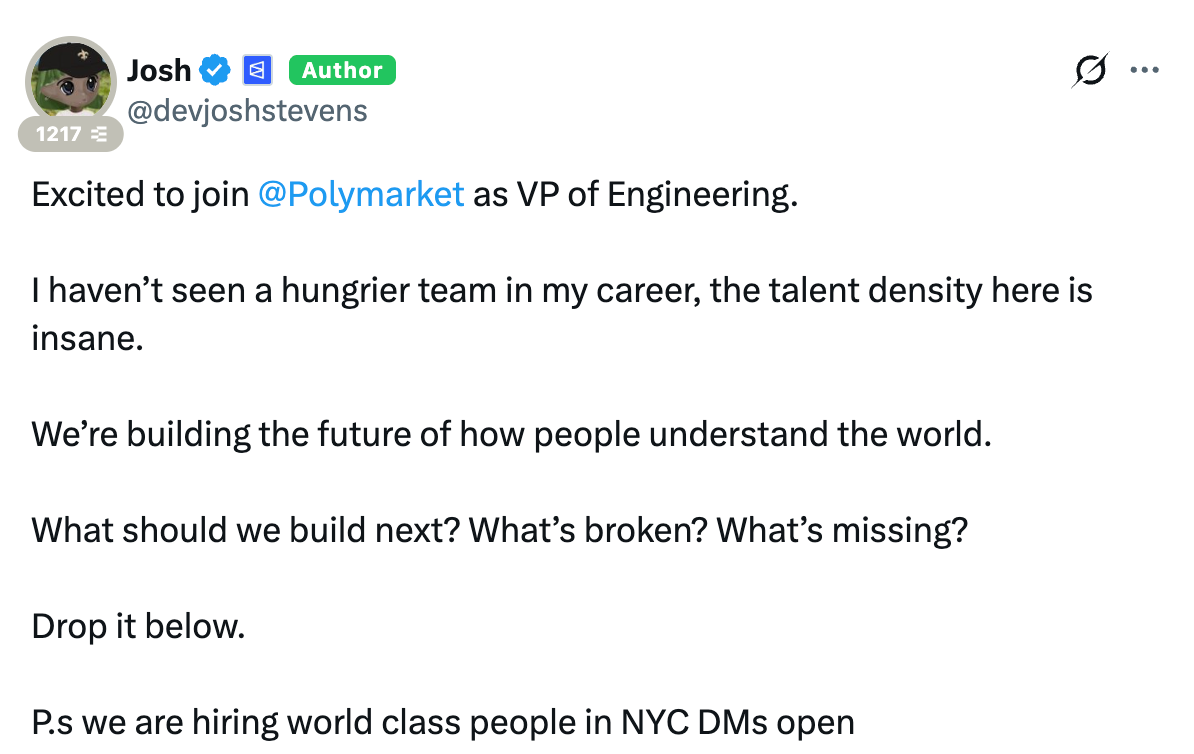
Joining announcement tweet in March
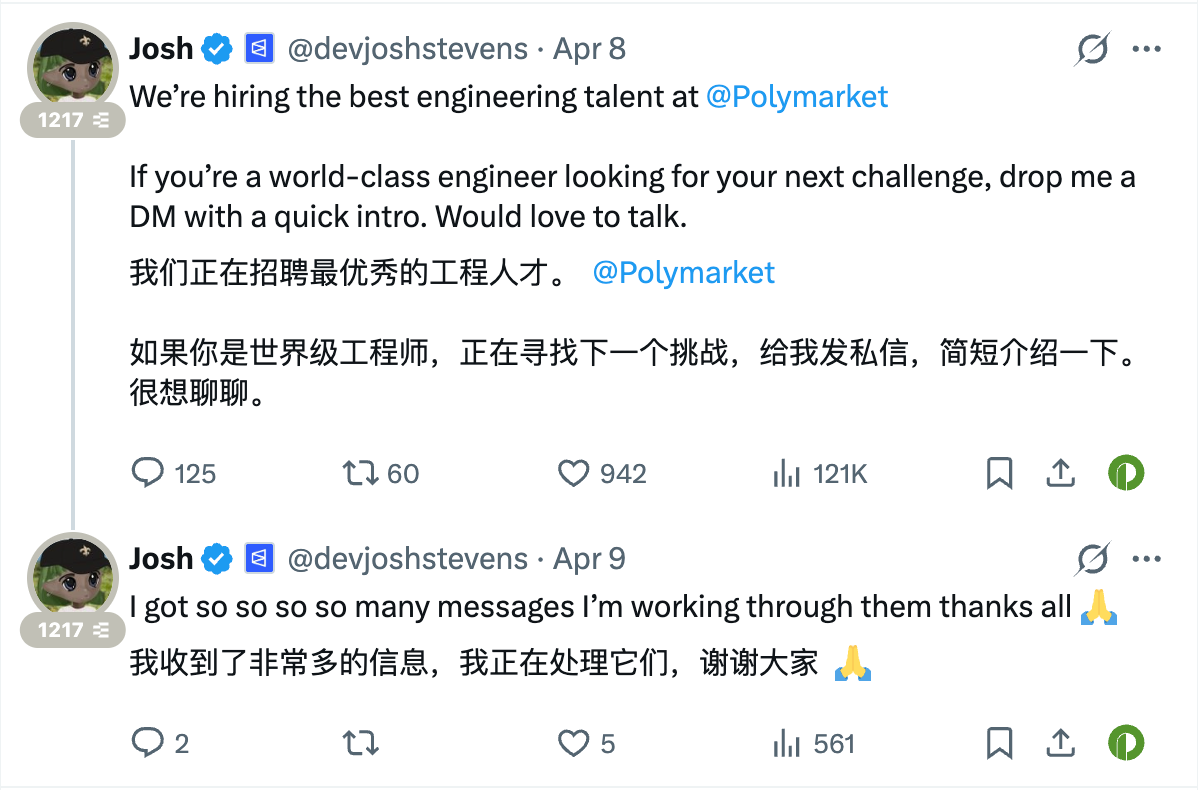
Posting recruitment information again in early April

Additionally, according to the official recruitment page information, the developer positions currently being recruited by Polymarket include Senior Backend Engineer (US Platform), C/C++ Senior Engineer (US Platform), Smart Contract Developer, Mobile AI Engineer, and Senior Platform Infrastructure Engineer. Interested friends can try applying.

Compliance, Legal, and Sports Betting Talent: Personnel Reserves for Polymarket's US Platform

Last November, by acquiring the US-compliant trading platform QCX, Polymarket finally managed to return to the US market. Facing the increasingly stringent regulatory environment in the US market and the regulatory contradictions between federal agencies and state/local courts, Polymarket has had to once again strengthen its talent reserves in legal and compliance aspects.

Matthew Lischin, Legal Counsel for Polymarket US Platform

In February 2026, after ending his 13-year tenure at RBC Capital Markets (the investment banking division of Royal Bank of Canada), Matthew Lischin finally joined Polymarket as the Head of North America Global Markets Legal Team. Public information shows that he will focus on the legal compliance of complex financial products such as equity derivatives and margin loans.

It is worth mentioning that when he posted on LinkedIn announcing his departure from RBC, Polymarket's Chief Legal Officer, Neal Kumar, left a comment to communicate. Perhaps due to this opportunity, Lischin later posted确认 joining the Polymarket US platform as Legal Counsel,直言: "The wish has finally come true!"

Ari Borod, Former Fanatics Executive Becomes President of Sports Business Development

In February 2026, after ending his 4-year tenure as Chief Commercial Officer (CBO) and other positions at the well-known sports betting platform Fanatics, Ari Borod subsequently plunged into Polymarket, the prediction market霸主 and rising star in sports betting.

Unexpectedly, due to his sensitive career experience, it also triggered a non-compete lawsuit from his former employer Fanatics. Although the lawsuit was eventually settled out of court, it must be said that in the process of the prediction market's growth, friction with traditional industries like sports betting may not only exist at the regulatory level but also at the talent争夺 level.

Public information shows that Ari Borod led the strategic transformation of Fanatics from fan merchandise to sports betting business. Earlier, he served as Chief Commercial Officer and Chief Operating Officer at The Action Network and worked at FanDuel for six years, rising from Assistant General Counsel to Vice President of Sports at Fanatics.

However, in the non-compete lawsuit filed by Fanatics in a Florida court, court documents revealed another shocking thing - Fanatics founder Michael Rubin and Fanatics Betting and Gaming CEO Matt King personally hold shares in Kalshi. It just goes to show that real business warfare is everywhere. Furthermore, even more laughably, Fanatics had previously been involved in a non-compete lawsuit for hiring Mike Hermalyn, former Senior Vice President of Growth at DraftKings. It seems因果循环,报应不爽 (karma is a cycle, retribution is not pleasant).

Institutional Liquidity Awaits Introduction: Former Coinbase Institutional Product Lead

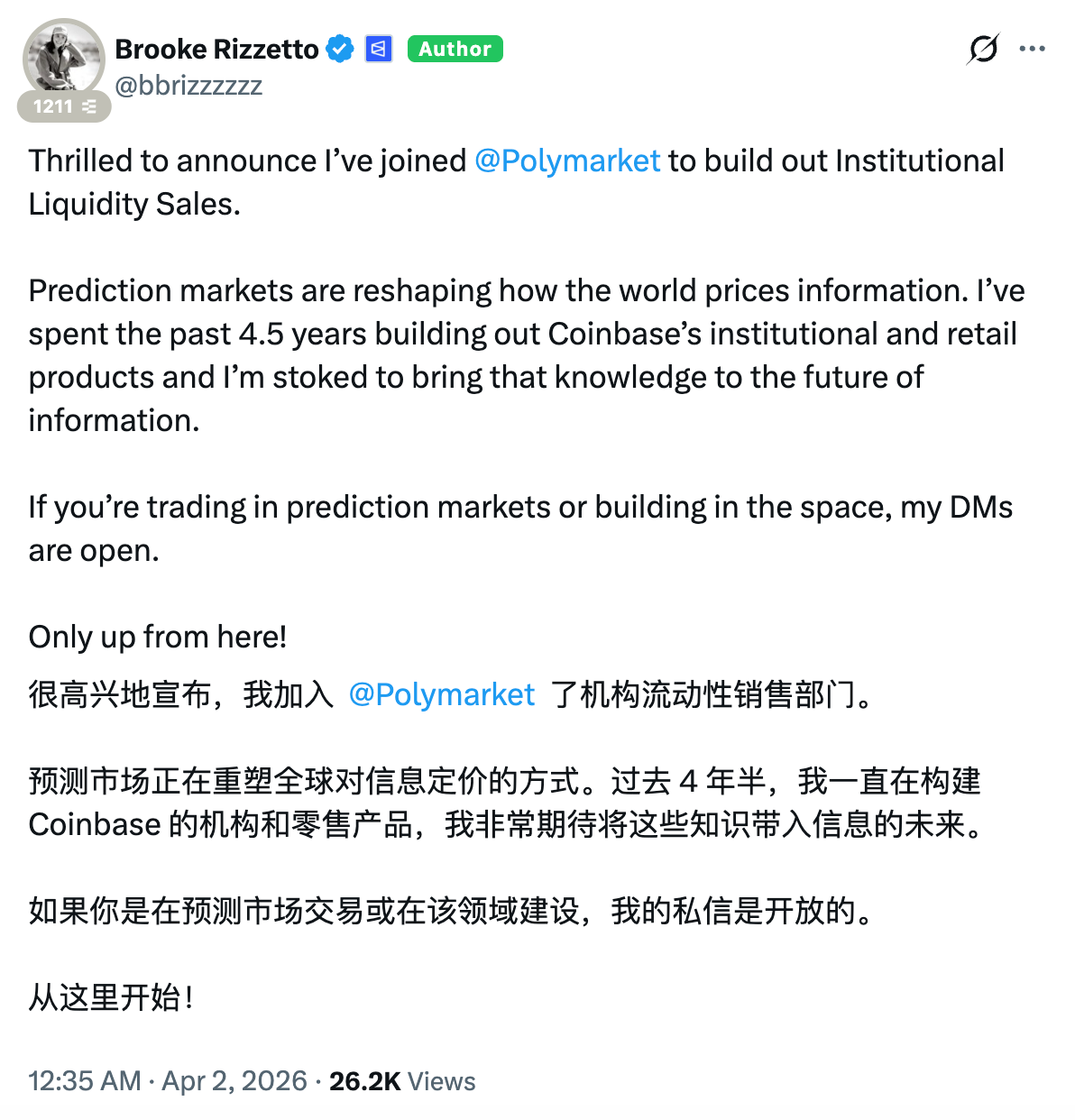
On April 2nd, former Coinbase Head of Institutional & Retail Products, Brooke Rizzetto, officially announced joining Polymarket, stating that she would later be responsible for "institutional liquidity sales." After working at Coinbase for over 4 years, Brooke Rizzetto began seeking new ways of information pricing and liquidity introduction from the prediction market赛道.
In addition to the above personnel, other team members recently joining Polymarket include former "MrBeast (YouTube's top influencer Beast Mr.)" viral marketing lead Josh Tucker, and Citadel hedge fund veteran of 8 years Mukilan Ashok,主要负责 marketing, exchange platform upgrades and other business.

Furthermore, Polymarket's Head of People Recruitment, Matthew Kendall Clark, recently pointed out in a post that they are currently recruiting Personnel Recruitment Staff and Polymarket Head of Markets. This "talent arms race" among prediction market platforms is clearly still in the land-grabbing stage, far from over.

For more information about Polymarket's recruitment, please check its official recruitment page.

Пов'язані питання

QWhat is the valuation of Kalshi after its latest funding round in March, as mentioned in the article?

AKalshi was valued at $22 billion after its latest funding round in March.

QWhich two key strategies is Polymarket using to recruit developers for its platform expansion?

APolymarket is using talent acquisition and external recruitment as its key strategies to recruit developers.

QWho was hired as the President of Sports Business Development at Polymarket, and what controversy was associated with this hire?

AAri Borod was hired as the President of Sports Business Development, and his hiring led to a non-compete lawsuit from his former employer, Fanatics, which was eventually settled out of court.

QWhat specific role will Brooke Rizzetto, formerly of Coinbase, take on at Polymarket?

ABrooke Rizzetto will be responsible for institutional liquidity sales at Polymarket.

QWhich two companies did Polymarket acquire to support its talent recruitment and platform development efforts?

APolymarket acquired Dome, a prediction market API platform, and Brahma, a DeFi infrastructure startup, to support its talent recruitment and platform development.

Пов'язані матеріали

It Took Me a Year to See the Bitter Truth About Agent Payments

After a year building infrastructure for the Agent economy, engaging with major players like Stripe, Visa, and Coinbase, the author shares a sobering analysis of the current state of Agent payments. The core finding is a stark lack of genuine, immediate demand across most envisioned use cases. The article breaks down four key market segments: 1. **Agent-to-Merchant (Consumer Shopping):** For most product categories (e.g., clothing, electronics), conversational AI shopping is a step backwards from visual e-commerce interfaces. While agents excel at understanding needs, they can't replace side-by-side product comparison. Real merchant interest is defensive "Agent Engine Optimization," not driven by current customer demand. Potential exists for high-frequency, low-decision purchases (like food delivery) or navigating complex store UIs, but these require massive B2C distribution channels dominated by giants like Amazon. 2. **Agent-to-API (Developer Services):** Developers already have subscriptions and billing relationships for APIs (compute, data). Prepaid balances solve micro-payment issues for low transaction volumes. A deeper structural problem is that major SaaS vendors' business models rely on enterprise contracts, resisting granular pay-per-call pricing. While protocols like MPP and x402 serve the long tail of niche services, this market is small and developers are historically low-willingness-to-pay. 3. **Agent-to-Agent:** This remains largely theoretical with minimal transaction volume. While it represents a long-term bet on a fundamentally new transaction infrastructure (sub-second, micro-penny to million-dollar, multi-party settlements), it does not constitute a present market. 4. **Agent-to-Finance:** This is the only category with existing, paying demand. Integrating AI into financial workflows (trading, portfolio management) is a natural evolution and enables new capabilities like autonomous rebalancing. However, competition favors established, regulated institutions. The "real problem" is not moving money between agents, but the broader challenge of **coordination**—orchestrating work between agents and humans, verifying outcomes, and settling results. Payment is just one component of settlement, which is itself part of coordination. Companies that solve the coordination layer will subsume payment, not the other way around. While well-funded incumbents build defensively for a long-term future, startups must find where the market is today—which, for the author's team, lies outside these four categories in an area of real, growing, and underserved activity.

marsbit2 хв тому

It Took Me a Year to See the Bitter Truth About Agent Payments

marsbit2 хв тому

It Took Me a Year to See the Hard Truth About Agent Payments

**Title: It Took Me a Year to See the Hard Truth About Agent Payments** Over the past year, I've worked on infrastructure for the Agent economy, engaging with major players like Stripe, Visa, Coinbase, and numerous startups. The findings reveal a stark reality: genuine, widespread demand for Agent-based payments does not yet exist. **Key Observations:** * **Agent-to-Merchant (Shopping):** The user experience for AI shopping often falls short, especially for visual product discovery. While AI excels at understanding needs, conversational interfaces can't yet replace browsing and comparing multiple products visually. Current merchant interest is largely defensive ("Agent Engine Optimization") for a future that hasn't arrived. High-frequency, low-friction purchases (like food delivery) are potential fits, but lack open APIs and face high AI inference costs. Simpler, more affordable, or cross-language interactions for complex UIs are a niche opportunity but require massive consumer distribution to scale. * **Agent-to-API (Developer Tools):** Developer payment needs for APIs (computing, data, models) are already met through subscriptions and prepaid credits. The core challenge is not payment friction but supplier economics: most large SaaS providers prefer enterprise contracts over micropayments for API calls. Protocols like MPP and x402 suit the long-tail of smaller services but cater to a developer market historically reluctant to pay for these tools. Major infrastructure needs at the top of the stack are already being addressed. * **Agent-to-Agent (Machine Commerce):** This is a long-term vision with almost no current transaction volume. While a future with high-speed, high-frequency, multi-party machine-to-machine transactions would require novel infrastructure, it remains theoretical. The market is not here yet. * **Agent-to-Finance:** This is the only category with clear, present demand. Financial professionals and DeFi users already pay for tools, and AI augmentation is a natural evolution. Autonomous AI agents can enable entirely new financial strategies. However, competition is fierce from established, regulated incumbents who can more easily layer AI onto their existing products. **The Core Insight:** Companies, especially giants with long time horizons, are building defensively for a potential future of mass machine commerce. For them, early investment is a low-cost hedge. For startups, the current market reality is different. The primary challenge isn't just moving money between agents (payments). The larger, unsolved problem is **orchestration** – coordinating work between agents and humans, verifying outcomes, and then settling. Payment is just a part of settlement, which is just a part of orchestration. Companies that solve the orchestration problem will subsume payments, not the other way around. After a year of building, we see the real, growing, and underserved market opportunity lies in this broader domain of orchestration.

链捕手26 хв тому

It Took Me a Year to See the Hard Truth About Agent Payments

链捕手26 хв тому

Claude Opus 4.8 Finds a $4.5 Billion Bug: The AI Era is Mass-Producing Hackers

A researcher discovered a critical "infinite mint" vulnerability in the Zcash cryptocurrency's Orchard protocol using Claude Opus 4.8, leading to a swift fix but also a 50% market drop, erasing billions in value. This incident highlights a new era where powerful, accessible AI models are dramatically lowering the barrier to finding software vulnerabilities. Previously, the security community feared specialized models like Claude Mythos Preview, capable of finding decades-old zero-day exploits. The Zcash case, however, involved a publicly available, general-purpose model. This shift makes advanced security auditing—and attack capabilities—accessible to far more people, not just experts. The mass democratization of vulnerability discovery brings a dual challenge: a flood of low-quality, AI-generated false reports that overwhelm maintainers, and the real, rapid uncovering of deep, dangerous bugs. Open-source projects, often understaffed and unfunded, are particularly vulnerable to this "attention DDoS." The article cites examples like curl shutting down its bug bounty program due to the unsustainable workload. Our perceived digital safety has often been luck, relying on the high cost and effort required to find deeply hidden flaws in complex systems, as seen with historical vulnerabilities like Heartbleed or Baron Samedit. AI changes this cost structure, effectively "mass-producing flashlights" to illuminate every corner of our codebase. While large companies operate extensive security chains involving external white-hat hackers and massive defensive operations, the global cybersecurity workforce faces a severe shortage, especially of experienced personnel capable of analyzing complex threats and coordinating fixes. The core dilemma emerges: AI makes *finding* bugs cheap and scalable, but *fixing* them remains a slow, expensive, and human-intensive process. The article concludes that AI won't destroy the internet but acts as a bright light, revealing that our digital existence is not inherently secure but is precariously maintained by ongoing human effort. The true cost in the AI era may not be discovery, but whether there will be enough people left willing and able to do the hard work of repair.

marsbit59 хв тому

Claude Opus 4.8 Finds a $4.5 Billion Bug: The AI Era is Mass-Producing Hackers

marsbit59 хв тому

Codex Goal Mode Usage Guide: How to Make AI Continuously Pursue a Specific Objective

"Codex Goal Mode: How to Make AI Work Continuously Toward a Specific Goal" OpenAI's Codex "goal mode" (/goal) transforms the AI from a reactive code assistant into a proactive execution agent capable of working autonomously for hours or even days to achieve a defined objective. To maximize its effectiveness, follow these key principles: 1. **Define Clear, Verifiable Exit Criteria:** The goal prompt should be a concise, measurable success condition, not a lengthy specification. Use quantifiable metrics like "reduce build time by 30%" or "achieve 100% test parity." 2. **Provide Initial Guidance and Tools:** Direct Codex toward likely problem areas and specify available tools (e.g., browsers, testing environments) to prevent it from exploring unproductive paths. 3. **Enable Progress Measurement:** Equip Codex with ways to track advancement, such as creating comparison tools for visual tasks or evaluation sets, ensuring it can gauge its own progress. 4. **Use a Realistic Execution Environment:** For tasks like performance optimization, provide access to environments that closely mimic production (e.g., similar configs, databases) to yield valid results. 5. **Be Cautious with Visual Goals:** Avoid vague "pixel-perfect" instructions. Instead, supplement visual references with functional checklists or design system specifications to prevent Codex from obsessing over minor details. 6. **Implement Progress Tracking:** For long-running tasks, have Codex commit code to draft PRs, update progress documents, or send Slack updates to maintain visibility into its work. 7. **Review and Consolidate Results:** Once the goal is met, instruct Codex to review its work, clean up ineffective experimental code, and reflect on what strategies succeeded or failed. Ultimately, using goal mode shifts the developer's role from writing prompts to managing a persistent engineering agent—defining objectives, establishing metrics, configuring environments, and conducting final reviews.

marsbit2 год тому

Codex Goal Mode Usage Guide: How to Make AI Continuously Pursue a Specific Objective

marsbit2 год тому

Торгівля

Спот
Ф'ючерси
活动图片





