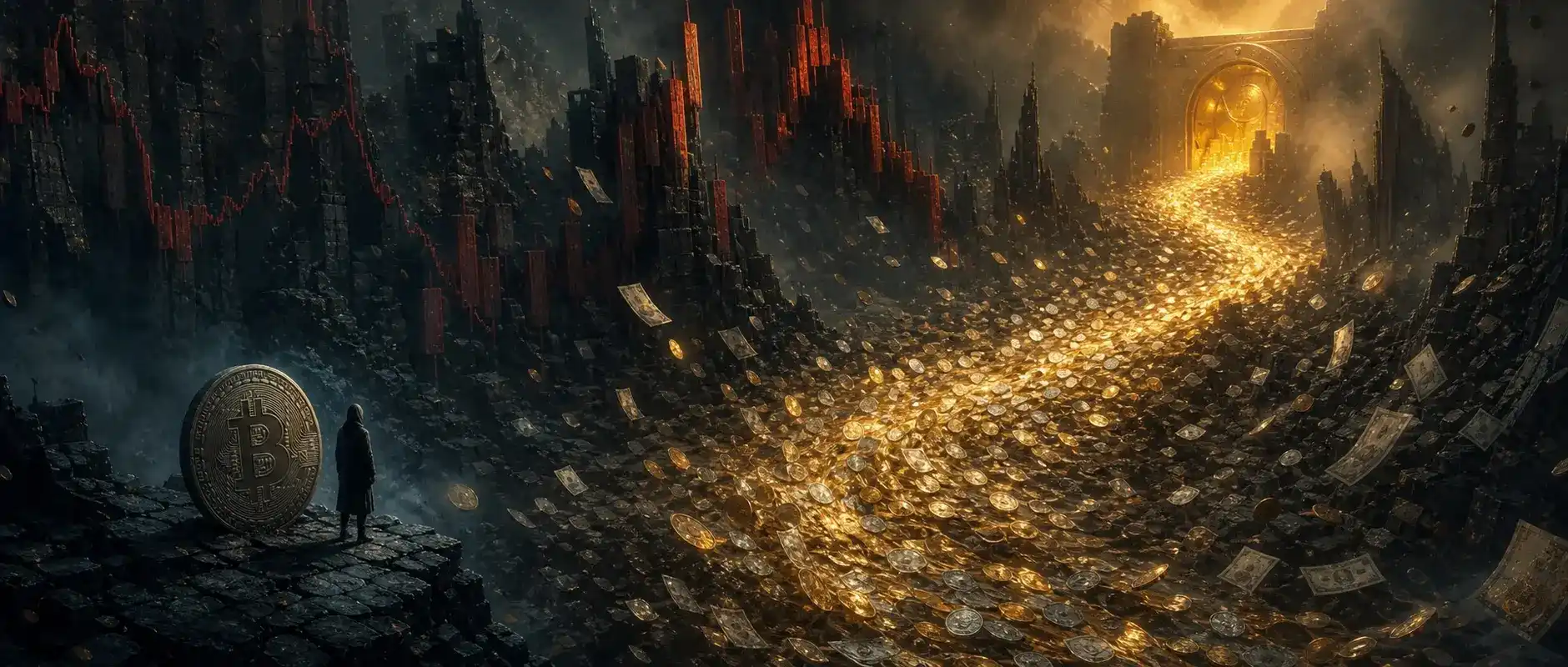
February 6th, dollar asset investors found it hard to sleep.
Opening the trading software, the screen was filled with red. Bitcoin once fell to $60,000, evaporating 16% in 24 hours, and had fallen 50% from its previous high.
Silver plummeted 17% in a single day, like a kite with a broken string. The Nasdaq fell 1.5%, with tech stocks suffering heavy losses.
In the crypto market, 580,000 people were liquidated, with $2.6 billion vanishing into thin air.
But the most bizarre thing was: no one knew exactly what happened?
There was no Lehman Brothers collapse, no black swan event, not even a decent piece of bad news. U.S. stocks, silver, and cryptocurrencies—three types of assets—collectively plunged at the same time.
When "safe-haven assets" (silver), "tech faith" (U.S. stocks), and the "speculative casino" (cryptocurrencies) all crash simultaneously, the message the market might be sending is only one: liquidity is gone.
U.S. Stocks: The Bubble Bursts During Earnings Season
On February 4th after market close, AMD delivered a beautiful report: revenue and profits all exceeded expectations. CEO Lisa Su said on the earnings call: We are entering 2026 with strong momentum.
Then the stock price plummeted 17%.
What was the problem? Q1 revenue guidance was $9.5-$10.1 billion, with a midpoint of $9.8 billion. This number exceeded the Wall Street consensus expectation ($9.37 billion), so it should have been cheered.
But the market didn't approve.
The most aggressive analysts, those shouting "AI revolution" and giving AMD sky-high price targets, were expecting "$10 billion+". A 2% shortfall, in their eyes, was a signal of "slowing growth".
The result was a full-scale stampede. AMD plunged 17%, losing tens of billions in market cap overnight; the Philadelphia Semiconductor Index plummeted over 6%; Micron Technology fell over 9%, SanDisk plunged 16%, Western Digital dropped 7%.
The entire chip sector was dragged down by one company, AMD.
Before AMD's wounds could heal, Alphabet added another blow.
On February 6th after market close, Google's parent company's earnings were released. Revenue and profits again comprehensively beat expectations, cloud business grew 48%, CEO Sundar Pichai was brimming with confidence: AI is driving growth across all our businesses. Then, CFO Anat Ashkenazi dropped a number: "In 2026, we plan capital expenditures of $175 to $185 billion."
Wall Street collectively froze.
This number is double Alphabet's last year ($91.4B), and 1.5 times the Wall Street expectation ($119.5B). It's equivalent to burning $5 billion every day, for a full year.
Alphabet's stock plummeted 6% after hours, then convulsed, rebounding and falling again, finally barely flat, but panic and worry had already spread through the market.
This is the real AI arms race of 2026: Google burning $1.8 trillion, Meta burning $1.15-$1.35 trillion, Microsoft and Amazon are also frantically spending money. The four tech giants are set to burn over $5 trillion combined this year.
But no one knows where the finish line for this arms race is. It's like two people pushing each other on the edge of a cliff; whoever stops first gets pushed off.
The gains of the Magnificent Seven in 2025 came almost entirely from "AI expectations." Everyone was betting: expensive now, but AI will make these companies immensely profitable, so buying now isn't a loss.
But when the market realizes that "AI is not a money printer, but a money burner," the sky-high capital expenditures under high valuations become a sword of Damocles hanging overhead.
AMD was just the beginning. Next, every less-than-perfect earnings report could trigger a new round of stampede.
Silver: From "Poor Man's Gold" to Liquidity Sacrifice
Up 68% in a month, down 50% in three days.
From January to now, silver has drawn a curve that left everyone stunned.
It was hovering around $70 at the beginning of the month, and surged to $121 by the end of the month.
Social media once erupted in a "silver frenzy." Reddit's silver subreddit was flooded with "Diamond Hands," Twitter was full of posts like "silver to the moon," "industrial demand explosion," "solar panels can't do without silver."
Many really believed "this time is different." Solar demand, AI data centers, electric vehicles—these tangible industrial demands, plus five consecutive years of supply deficit, all seemed to point to a golden age for silver.
Then on January 30th, silver fell 30% in one day.
It crashed directly from $121 to around $78. This was silver's most brutal single-day crash since the "Hunt Brothers incident" in 1980. That year, two Texas tycoons tried to corner the silver market, were finally forced to liquidate by the exchange, causing a market collapse.
45 years later, history repeated itself.
On February 6th, silver fell another 17%. Those who "bought the dip" at $90 watched their money evaporate again.
Silver is special; it is both "poor man's gold" (a safe-haven asset) and an "industrial necessity" (used in solar panels, phones, cars).
In a bull market, this is a double positive: good economy, strong industrial demand; bad economy, rising safe-haven demand. It rises either way.
But once in a bear market, this becomes a double curse.
The source of the crash goes back to January 30th, when Trump announced the nomination of Kevin Warsh as the new Fed Chair. Silver plummeted 31.4% that day, its largest single-day drop since 1980.
Warsh is a famous hawk, advocating maintaining high interest rates to control inflation. His nomination meant market concerns about "the Fed losing independence," "chaotic monetary policy," and "runaway inflation" instantly cooled—concerns that were precisely the core drivers behind gold and silver's surge in 2025. The day Warsh was nominated, the dollar index rose 0.8%, and all safe-haven assets (gold, silver, yen) were sold off simultaneously.
Looking back at this crash, three things happened within 48 hours.
January 30th, the Chicago Mercantile Exchange (CME) suddenly announced: Silver margin requirements increased from 11% to 15%, gold from 6% to 8%.
At the same time, market makers began retreating.
Saxo Bank commodity strategist Ole Hansen stated bluntly: "When volatility is too high, banks and brokers exit the market to manage their own risk, and this retreat反而加剧价格波动, triggering stop-loss orders, margin calls, and forced selling."
Most bizarrely, just as silver volatility was most intense, the London Metal Exchange (LME) trading system suddenly 'experienced technical issues,' delaying opening by an hour.
Several events叠加 on almost the same day, silver fell from $120 to $78, a single-day drop of 35%, countless people were liquidated.
Coincidence? Or a carefully designed "liquidity trap"? No one knows the answer. But the silver market was left with another deep scar.
Cryptocurrency: The Delayed Funeral Finally Held
To summarize the recent continuous暴跌行情 in cryptocurrency in one sentence: This is a delayed funeral.
In early February, Bitwise CIO Matt Hougan published an article with a blunt title: 'The Depths of Crypto Winter'. His analysis concluded: The bull market ended as early as January 2025.
In October 2025, BTC hit a new all-time high of $126,000, everyone was cheering "$100k is just the beginning". Hougan believes this short-lived bull market was artificially maintained.
Throughout 2025, Bitcoin ETFs and DATs (Digital Asset Treasuries) collectively bought 744,000 Bitcoin, worth approximately $75 billion.
Compare this to a data point: In 2025全年, new Bitcoin mining output was about 160,000 (post-halving). This means institutions bought 4.6 times the new supply.
In Hougan's view, without this $75 billion buying pressure, Bitcoin might have fallen 60% by mid-2025.
The funeral was delayed by 9 months, but it ultimately had to be held.
But why, comparatively, did crypto fall the hardest?
On institutions' "asset list," there is an implicit ranking:
Core assets: U.S. Treasuries, gold, blue-chip stocks, sold last in a crisis.
Semi-core assets: Corporate bonds, large-cap stocks, real estate, start selling when liquidity is tight.
Peripheral assets: Small-cap stocks, commodity futures, cryptocurrencies, the first to be sacrificed.
In the face of a liquidity crisis, cryptocurrency is always the first to be sacrificed.
This also stems from the inherent characteristics of cryptocurrency. Best liquidity, 7x24 trading, can be cashed out anytime, and carries the lightest moral burden and regulatory pressure.
Thus, whenever institutions need cash, whether to cover margins, stop losses, or the boss suddenly orders "reduce risk exposure," the first thing sold is always cryptocurrency.
When U.S. stocks and gold/silver reversed trend and entered a decline, cryptocurrency was also innocently sold off,沦为 fuel for margin calls.
However, Hougan also believes the crypto winter has lasted long enough; spring is definitely not far away.
The Real Epicenter: Japan's Overlooked Time Bomb?
Everyone is looking for the culprit: Was it AMD's earnings? Alphabet's spending? Trump's Fed Chair nomination?
The real epicenter might have been埋下 as early as January 20th.
That day, the yield on Japan's 40-year government bond broke through 4%, the first time since that maturity was introduced in 2007, and the first time for any Japanese government bond maturity in over 30 years.
For decades, Japanese government bonds (JGBs) have been the "safety cushion" of the global financial system. Interest rates near zero, even negative, stable as a rock.
Hedge funds, pension funds, insurance companies worldwide have been playing a game called the "yen carry trade":
Borrow ultra-low-interest yen in Japan, convert to dollars, buy U.S. Treasuries, tech stocks, or cryptocurrencies, and profit from the interest rate differential.
As long as JGB yields didn't move, this game could continue indefinitely. How big is the market? No one knows for sure, but conservative estimates are at least several trillion dollars.
As the yen entered a rate hike cycle, the yen carry trade规模 gradually contracted, but after January 20th, this carry trade directly entered hell mode, even liquidation mode.
Japanese Prime Minister Sanae Takaichi announced an early election, promising tax cuts and increased fiscal spending. The problem is, the Japanese government's debt-to-GDP ratio is already 240%, the highest in the world. More tax cuts, how will they repay the debt?
The market exploded, JGBs were疯狂抛售, yields soared. The 40-year bond yield rose 25 basis points in one day, volatility unseen in Japan for 30 years.
When JGBs crash, the chain reaction begins:
The yen appreciates, funds that borrowed yen to buy U.S. Treasuries, stocks, Bitcoin suddenly find their repayment costs soaring. Either liquidate positions to stop losses immediately, or wait to be margin called.
U.S. Treasuries, European bonds, all "long-duration assets" are sold off连带, because investors need cash.
Stocks, precious metals, cryptocurrencies all suffer. When even "risk-free assets" are being sold, naturally no other asset is spared.
This is why "safe-haven assets" (silver), "tech faith" (U.S. stocks), and the "speculative casino" (cryptocurrencies) collectively plunged at the same time.
A pure "liquidity black hole."