Delphi Digital: The Era of Tokenization Has Arrived

比推Опубліковано о 2026-02-18Востаннє оновлено о 2026-02-18

Анотація

Tokenized U.S. Treasuries surpassed $10 billion in January 2024, led by institutions like BlackRock and Franklin Templeton. While government bonds are relatively straightforward to tokenize due to their standardized nature, equities present greater complexity because they involve shareholder rights such as voting and legal ownership. Two primary models exist: custodian-backed tokens (e.g., xStocks, Backed) offer price exposure but not direct ownership, while transfer agent-registered tokens (e.g., Superstate, Securitize) record holders directly on the shareholder registry, granting full rights. The latter enables functionalities like 24/7 trading, use as collateral in DeFi, cross-margin capabilities with crypto assets, and direct capital raises without traditional underwriters. However, challenges remain, including fragmented liquidity across blockchains, KYC/AML compliance friction, varying international regulations, and limited integration with traditional exchanges. While Nasdaq has applied to trade tokenized securities, broader market adoption depends on regulatory clarity and improved liquidity. The market is betting that the transfer agent model—which offers real ownership—will outperform custodian-based structures. Equities can now be settled instantly, traded around the clock, and used as collateral, but whether this becomes standard depends on regulatory and liquidity developments.

Source: Delphi Digital

Compiled and Edited: BitpushNews


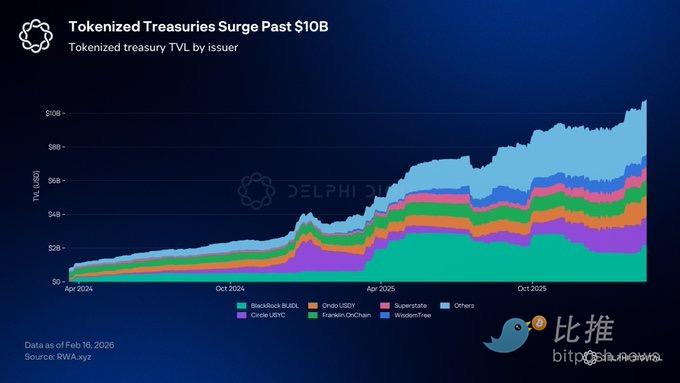
In January, the scale of tokenized treasury bonds exceeded $10 billion, with BlackRock, Franklin Templeton, Ondo, and Circle leading the market. Government bonds were the first to be tokenized because they have standardized instruments and liquid markets, making the process relatively straightforward.

But the real challenge lies with stocks.

Stocks represent shareholders, who possess voting rights and legal rights that must be enforced. Tokenization projects have all hit the same wall: you can mint a token representing a stock, but you do not actually own the share.
Not all tokenized stocks operate in the same way. Tokens issued by platforms like xStocks, Backed, and similar are backed 1:1 by shares held by a custodian. Investors gain price exposure and can trade 24/7, but ownership remains with the custodian.

Custodian vs. Transfer Agent

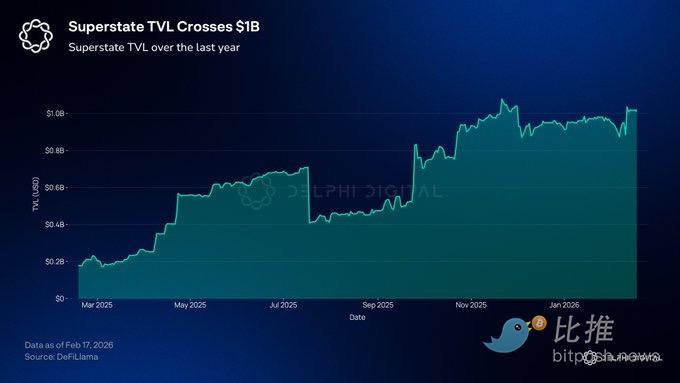
Superstate and Securitize are registered as transfer agents with the U.S. Securities and Exchange Commission (SEC), directly recording token holders on the company's shareholder registry. In September 2025, when Galaxy Digital was tokenized via Superstate's Opening Bell platform, GLXY token holders became genuine shareholders with voting rights and dividend entitlements. The blockchain was integrated with the shareholder registry.

Securitize has adopted a similar approach on the fund side. As the transfer agent behind BlackRock's BUIDL, they manage one of the largest tokenized treasury funds. They are also bringing institutional-grade private funds on-chain, lowering investment barriers and expanding access to alternative assets that were previously out of reach for most investors.

Recent guidance from SEC staff clarifies this distinction. Issuer-led tokenization through registered transfer agents creates ownership with full shareholder rights. Custodian-backed tokens may face different regulatory treatment and limitations compared to direct shareholder registration.
Genuine shareholder status enables functionalities that custodian-backed token structures cannot achieve.

Shareholders can trade 24/7 on supported trading platforms without waiting for the Toronto Stock Exchange to open. Shareholders of Forward Industries can pledge their equity as collateral on Kamino. Even if shares are deposited in lending pools, Superstate tracks beneficial ownership, ensuring dividends are distributed to the correct holders regardless of where the tokens are stored.

Backpack Exchange and Superstate have announced plans to enable cross-margining between tokenized stocks and crypto assets. Once live, traders can hold both tokenized stocks and SOL in the same account and use both as margin. Traditional brokers typically cannot offer this service because stocks and cryptocurrencies exist in completely separate custody and clearing systems.

This is unprecedented capital efficiency. Shareholders can obtain liquidity without selling, hedge across asset classes in a single account, and trade globally without settlement delays.

Raising Capital Without Underwriters

Superstate's direct issuance program allows publicly traded companies to reduce reliance on traditional underwriters for on-chain fundraising. Investors pay with stablecoins, shares are minted directly into their wallets, and companies receive funds instantly, with no cash settlement delays.

Traditional equity fundraising involves underwriters, roadshows, and settlement delays that can last weeks. Direct issuance compresses this into a single transaction, with the shareholder registry updated in real time.

The first issuances are expected later this year, likely from small-cap public companies that find traditional capital market infrastructure too costly relative to their trading size.

Missing Pieces

Liquidity remains fragmented. Tokenized stocks exist on multiple chains with no unified order book connecting them. Trading volumes are small compared to traditional markets, limiting the scale investors can move without impacting prices.

KYC requirements create friction with DeFi's permissionless architecture. Only whitelisted addresses can hold tokenized stocks, meaning they cannot be integrated into every lending protocol or liquidity pool. Issuers need to verify investors before they receive shares, and this verification must persist as tokens move between wallets.

Outside the U.S., regulatory frameworks vary significantly. SEC guidance applies to matters involving U.S. federal securities laws, but Europe, Asia, and other markets have their own rules, which may not align.

Traditional exchanges are watching closely. Nasdaq has filed an application with the SEC to trade tokenized securities. But until regulators and existing participants figure out how this fits into the existing market structure, actual exchange support for on-chain stocks remains pending.

Conclusion

Tokenized treasury bonds have proven that this mechanism can work at scale. Now, the stock space is catching up, achieving genuine compliance and true DeFi integration.

The market is betting that the transfer agent model, which records token holders as actual shareholders, will outperform indirect ownership structures that only provide price exposure.

Stocks can now be settled instantly, traded 24/7, and used as collateral in markets that never close. Whether this becomes the standard for how stocks operate or remains a niche play for crypto-native companies depends on whether liquidity and regulatory clarity can keep up with the infrastructure already in place.


Twitter:https://twitter.com/BitpushNewsCN

Bitpush TG Discussion:https://t.me/BitPushCommunity

Bitpush TG Subscription: https://t.me/bitpush

Original link:https://www.bitpush.news/articles/7612882

Трендові криптовалюти

Пов'язані питання

QWhat is the key difference between tokenized stocks issued by platforms like xStocks/Backed and those registered with the SEC as transfer agents like Superstate/Securitize?

APlatforms like xStocks and Backed issue tokens that are 1:1 backed by stocks held by a custodian, providing price exposure but not actual ownership. In contrast, SEC-registered transfer agents like Superstate and Securitize record token holders directly on the company's shareholder registry, granting them full shareholder rights including voting and dividends.

QWhat major milestone did tokenized treasury products achieve in January, and which companies are leading this market?

AIn January, the size of tokenized treasury products surpassed $10 billion. Companies such as BlackRock, Franklin Templeton, Ondo, and Circle are leading this market.

QWhat are some of the unique functionalities enabled by true shareholder status in tokenized stocks, according to the article?

ATrue shareholder status enables functionalities like 24/7 trading on supported platforms, the ability to use equity as collateral (e.g., on Kamino), receiving dividends regardless of where the token is held, and cross-margining between tokenized stocks and crypto assets in a single account for unprecedented capital efficiency.

QHow does Superstate's direct issuance plan aim to change the traditional capital raising process for public companies?

ASuperstate's direct issuance plan allows public companies to raise capital on-chain with reduced reliance on traditional underwriters. Investors pay with stablecoins, shares are minted directly to their wallets, the company receives funds instantly, and the shareholder registry is updated in real-time, compressing a process that traditionally takes weeks into a single transaction.

QWhat are the main challenges or missing pieces currently hindering the wider adoption of tokenized stocks?

AThe main challenges include fragmented liquidity across different blockchains without a central order book, smaller trading volumes limiting large-scale moves, friction between KYC requirements and DeFi's permissionless architecture, and varying regulatory frameworks outside the U.S. that are not necessarily aligned with the SEC's guidance.

Пов'язані матеріали

Once-Popular Web3 Enters Wave of Layoffs

The once-hot Web3 industry is experiencing a severe wave of layoffs. While many companies attribute job cuts to AI-driven restructuring, the primary reason is often financial pressure. The Web3 sector, at the intersection of tech and finance, has been hit particularly hard. Employees at major cryptocurrency exchanges report sudden, impersonal layoffs—often with system access revoked overnight—and minimal or no severance. Common tactics include setting impossible performance targets or terminating employees for minor policy violations. The working atmosphere has become toxic, marked by intense monitoring, excessive meetings, and management obsessed with control and internal politics rather than product innovation. The industry's core business model is collapsing. Exchange revenue from trading fees and listing charges has plummeted due to a decline in quality projects and retail investor exodus. Events like the massive forced liquidation on October 10th further shattered confidence. Competition from on-chain derivatives platforms and prediction markets is intensifying the downturn. As layoffs continue, displaced workers struggle to find new opportunities. Many transition to the AI sector, but face significant bias from traditional finance and even some AI firms, which view crypto industry experience with suspicion. The current downturn appears more structural than cyclical, driven by unsustainable practices, internal strife, and a failure to innovate, raising questions about the industry's future trajectory.

marsbit10 хв тому

Once-Popular Web3 Enters Wave of Layoffs

marsbit10 хв тому

Sales Drop 26% But Prices Rise? Xiaomi's Dilemma

Xiaomi, facing a significant 26.3% year-on-year decline in global smartphone shipments in Q2 2026, has implemented its third price hike of the year. On August 2nd, prices were raised for nine models, including the flagship Mi 17 series (up 400-500 yuan) and Redmi K90/Turbo 5 series (up 300 yuan). This move completes a pattern where cost pressure, originating from surging memory chip prices, has climbed from entry-level to mid-range and now flagship products. The primary driver is a severe supply squeeze on consumer-grade DRAM and NAND flash memory, as major manufacturers like Samsung shift advanced capacity to more profitable HBM for AI applications. According to Xiaomi President Lu Weibing, memory prices for the same configuration have skyrocketed nearly fourfold since Q1 2025, adding roughly 1500 yuan to the cost of a mainstream 12GB+512GB phone. IDC estimates consumer memory costs have risen nearly 300% year-on-year. While the price increases hurt demand and contributed to the sales slump, Xiaomi's strategy of reducing entry-level models and upgrading its product mix also played a role. Domestically, its market share in China fell to 12% (5th place), while leaders Huawei and Apple saw shipments grow over 24%. To mitigate future risks, Xiaomi is accelerating its in-house "Surge" chip development and optimizing memory configurations across its lineup. Xiaomi is not alone; major brands like OPPO, vivo, and Apple have already raised prices in 2026, with industry insiders predicting another round of increases (200-800 yuan) in the second half. A full-scale industry-wide涨价 cycle is underway, forcing both manufacturers and consumers to recalibrate their strategies and purchasing decisions amid sustained cost pressures.

marsbit21 хв тому

Sales Drop 26% But Prices Rise? Xiaomi's Dilemma

marsbit21 хв тому

Three Consecutive Quarters of Decline: The Crypto Market is Experiencing Its Longest Ebb Since 2022

The cryptocurrency market experienced its third consecutive quarterly decline in Q2 2026, marking its longest downturn since 2022, according to a CoinGecko report. The total market capitalization fell 12.6% to $2.1 trillion, a retreat of roughly 52% from its October 2025 peak. Multiple indicators signal an orderly capital exit from the sector. For the first time since Q3 2023, the total stablecoin market cap shrank (-1.6% to $305.1B), indicating funds are leaving the ecosystem entirely, not just rotating to safer crypto assets. Trading volumes on centralized exchanges dropped 27.9%, while DeFi's Total Value Locked (TVL) plummeted 23.4%. Both Bitcoin (-14.2%) and Ethereum (-25.4%) underperformed traditional risk assets like equities in Q2, breaking from previous correlative narratives. Ethereum saw its first-ever three-quarter losing streak, with its market share falling to around 10%. A few areas saw growth. Prediction market volumes surged 48.7%, largely driven by sports betting. Hyperliquid's HYPE token entered the top 10 by market cap, and tokenized collectibles platforms grew, though primarily via gamified mechanics. Despite a ~9.8% Bitcoin rebound in July, historical trends suggest caution for August. The market, now ~49% below its 2025 high, is undergoing a measured retreat. Its recovery hinges on future Federal Reserve policy and the industry's ability to develop sustainable revenue streams beyond speculation.

marsbit35 хв тому

Three Consecutive Quarters of Decline: The Crypto Market is Experiencing Its Longest Ebb Since 2022

marsbit35 хв тому

Торгівля

Спот

Популярні статті

Як купити ERA

Ласкаво просимо до HTX.com! Ми зробили покупку Caldera (ERA) простою та зручною. Дотримуйтесь нашої покрокової інструкції, щоб розпочати свою криптовалютну подорож.Крок 1: Створіть обліковий запис на HTXВикористовуйте свою електронну пошту або номер телефону, щоб зареєструвати обліковий запис на HTX безплатно. Пройдіть безпроблемну реєстрацію й отримайте доступ до всіх функцій.ЗареєструватисьКрок 2: Перейдіть до розділу Купити крипту і виберіть спосіб оплатиКредитна/дебетова картка: використовуйте вашу картку Visa або Mastercard, щоб миттєво купити Caldera (ERA).Баланс: використовуйте кошти з балансу вашого рахунку HTX для безперешкодної торгівлі.Треті особи: ми додали популярні способи оплати, такі як Google Pay та Apple Pay, щоб підвищити зручність.P2P: Торгуйте безпосередньо з іншими користувачами на HTX.Позабіржова торгівля (OTC): ми пропонуємо індивідуальні послуги та конкурентні обмінні курси для трейдерів.Крок 3: Зберігайте свої Caldera (ERA)Після придбання Caldera (ERA) збережіть його у своєму обліковому записі на HTX. Крім того, ви можете відправити його в інше місце за допомогою блокчейн-переказу або використовувати його для торгівлі іншими криптовалютами.Крок 4: Торгівля Caldera (ERA)Легко торгуйте Caldera (ERA) на спотовому ринку HTX. Просто увійдіть до свого облікового запису, виберіть торгову пару, укладайте угоди та спостерігайте за ними в режимі реального часу. Ми пропонуємо зручний досвід як для початківців, так і для досвідчених трейдерів.

600 переглядів усьогоОпубліковано 2025.07.17Оновлено 2026.06.02

Як купити ERA

Обговорення

Ласкаво просимо до спільноти HTX. Тут ви можете бути в курсі останніх подій розвитку платформи та отримати доступ до професійної ринкової інформації. Нижче представлені думки користувачів щодо ціни ERA (ERA).

活动图片