DeFi stops the liquidation leak: Protocols reclaim billions lost to MEV bots

ambcryptoОпубліковано о 2026-03-30Востаннє оновлено о 2026-03-30

Анотація

DeFi protocols are addressing a major inefficiency by reclaiming billions in value that was previously extracted by MEV bots during liquidations. For years, these bots profited from liquidation events, draining value from users and weakening protocol sustainability. With over $2 billion in liquidatable positions on Ethereum alone, protocols like Aave are now implementing new mechanisms such as Smoothing Varying Rate (SVR) to internalize this value. Aave has already recaptured $16.7 million in MEV on Ethereum and is expanding SVR to Arbitrum and Base. This shift turns liquidations into controlled revenue channels, strengthening protocol economics and sustainability. While Aave’s revenue has increased—reaching a $76 million annual run rate—long-term growth remains dependent on sustained market activity and volatility.

DeFi is addressing a key inefficiency as protocols move to reclaim value once captured by external Maximal Extractable Value (MEV) bots during liquidations.

For years, bots exploited liquidation windows, extracting profits while value leaked from users and weakened protocol sustainability over time.

As this leakage grew too large to ignore, Ethereum’s [ETH] lending markets started holding about $2.16 billion in liquidatable positions.

Within this, Compound accounted for $1.23 billion, while Sky held around $801 million, highlighting persistent extraction opportunities during volatility.
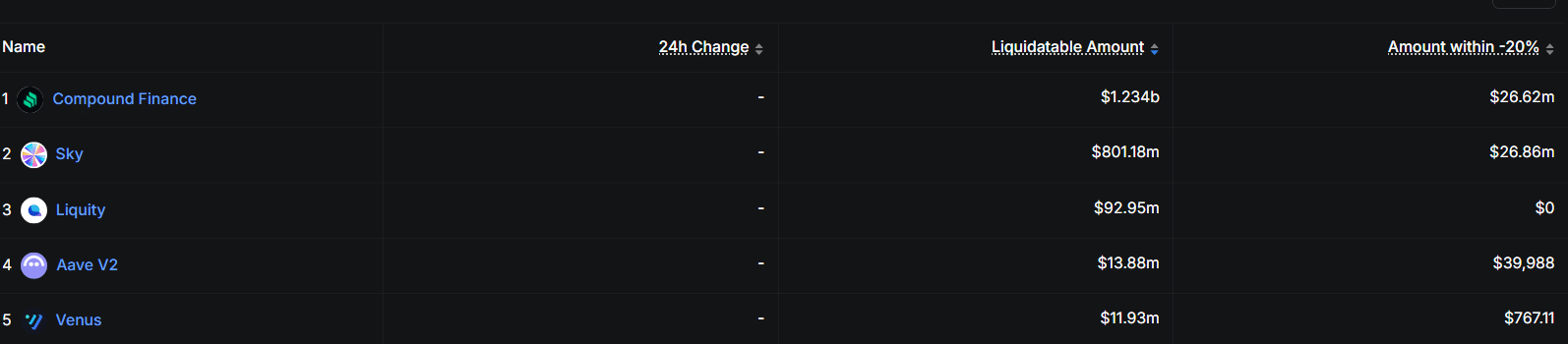
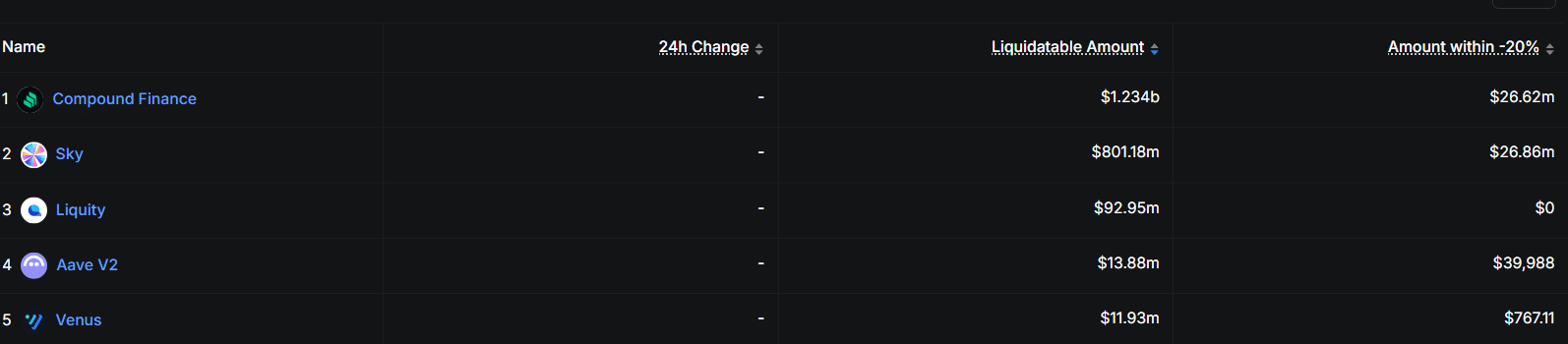
Source: DeFiLlama

However, protocols are redesigning mechanisms through auctions and controlled liquidations to retain value internally rather than letting it escape. This shift changes who benefits from market stress, allowing protocols to capture and recycle value instead of losing it.

As a result, DeFi strengthens its economic structure, improving sustainability and reinforcing long-term resilience

Aave reclaims MEV as SVR reshapes liquidation flows

Aave [AAVE] is not just refining its system; it is expanding a model that is already changing how value moves during liquidations. After proving effective on Ethereum, where Aave recaptured over $16.7 million in MEV, the protocol now extends SVR to Arbitrum and Base.
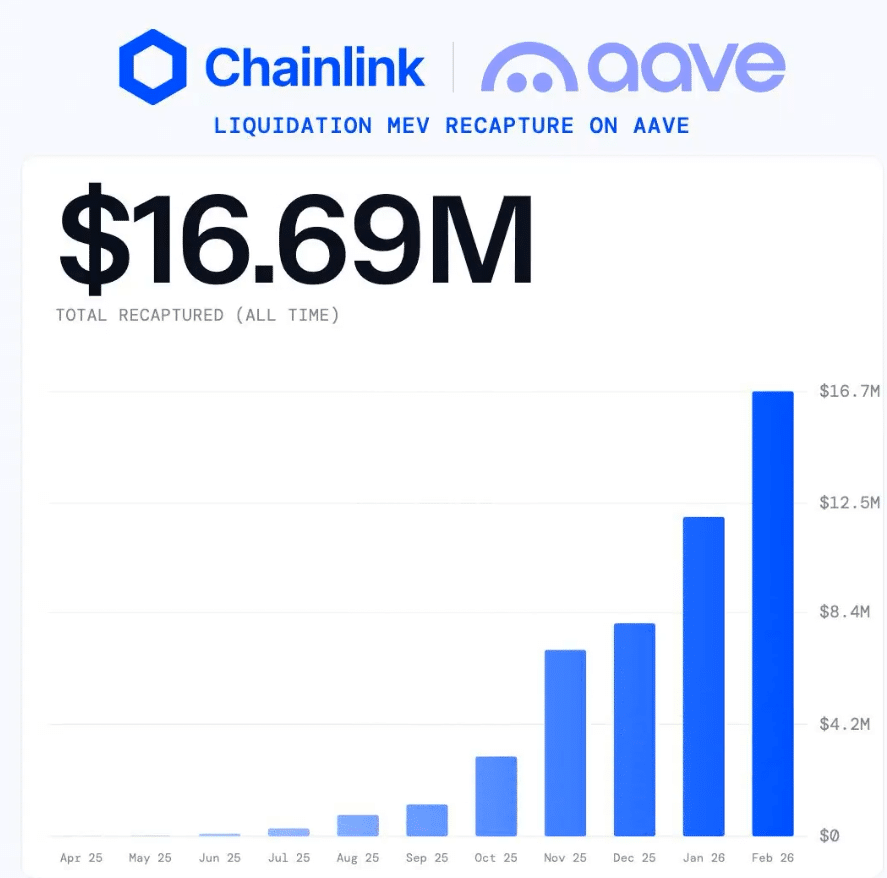
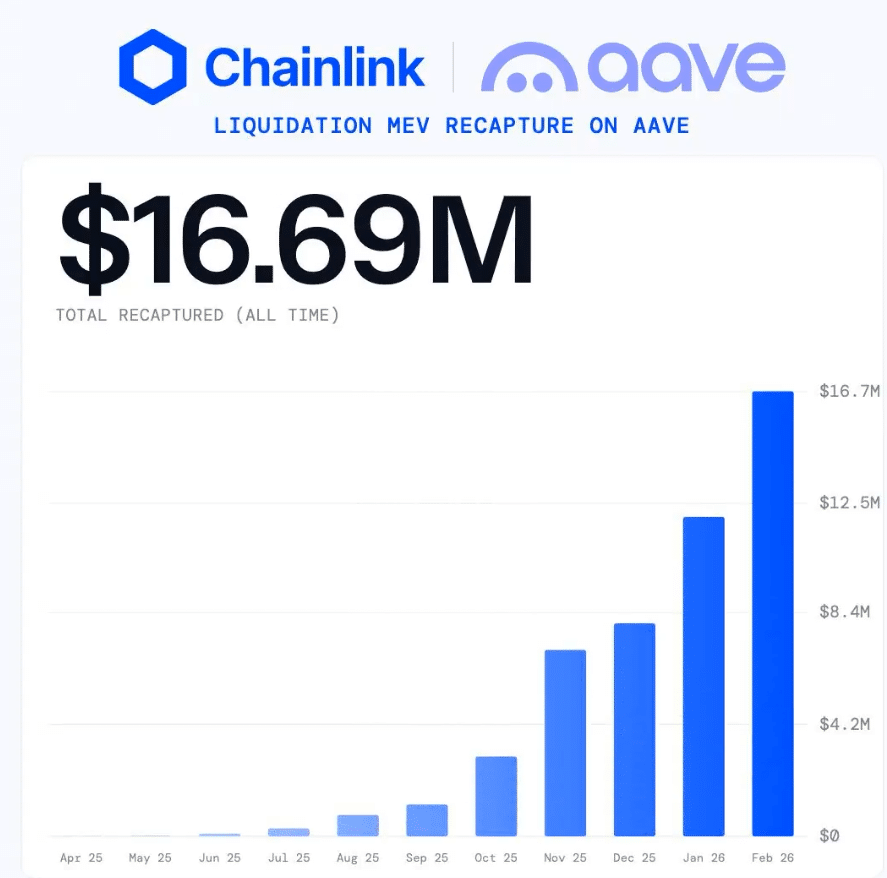
Source: ChainLink/X

This expansion is happening because the previous model left too much value on the table. Bots consistently captured liquidation profits, especially during volatility, while protocols saw little benefit. SVR changes this by redirecting that flow back into Aave’s ecosystem.

As this rollout scales across chains, liquidation events no longer act as pure extraction points. Instead, they become controlled revenue channels that strengthen the protocol.

The implication of these changes is clear. Aave is turning volatility into income, which improves sustainability and sets a precedent for how DeFi protocols capture value going forward.

SVR boosts revenue, but sustainability remains uncertain

As SVR begins to scale across networks, the focus shifts from early success to whether these gains can actually hold over time. The initial results look strong, yet they raise a deeper question about durability.

Aave now sits near $23.87 billion in TVL, while revenue reaches $6.24 million over 30 days, pointing to a $76 million annual run rate. This growth is not accidental, since liquidation activity is now feeding directly into protocol income.

This shift happens because value no longer escapes to bots and instead flows back into the ecosystem, strengthening internal cash flow. However, this strength is conditional. Revenue rises with volatility and lending demand, yet fades when activity slows.

All in all, this approach leaves a clear outcome. SVR improves Aave’s economics, but only sustained market activity can turn these gains into durable value growth.


Final Summary

  • The Aave protocol internalizes MEV through SVR, strengthening DeFi’s shift toward sustainable value capture.
  • AAVE shows rising revenue and improved efficiency, yet long-term growth remains dependent on volatility.


Пов'язані питання

QWhat is the main problem that DeFi protocols are addressing with their new liquidation mechanisms?

ADeFi protocols are addressing the problem of value leakage during liquidations, where external Maximal Extractable Value (MEV) bots were extracting profits, weakening protocol sustainability and causing billions in losses to users.

QHow much MEV value has Aave recaptured on Ethereum after implementing its new system?

AAave has recaptured over $16.7 million in MEV on Ethereum after implementing its SVR (Smart Vault Recovery) system.

QWhat are the two major Ethereum lending markets mentioned, and what were their respective liquidatable positions?

AThe two major Ethereum lending markets mentioned are Compound, with about $1.23 billion in liquidatable positions, and Aave (referred to as 'Sky' in the context, likely a typo for Aave), with around $801 million.

QWhat is the key change that protocols like Aave are making to their liquidation process?

AProtocols like Aave are redesigning their liquidation mechanisms through auctions and controlled processes (like SVR) to retain value internally, turning liquidation events into controlled revenue channels for the protocol instead of allowing value to be extracted by external bots.

QWhat is the primary condition for Aave's SVR model to generate sustainable revenue growth, according to the article?

AThe primary condition for sustainable revenue growth from Aave's SVR model is sustained market activity and volatility, as the revenue gains are dependent on lending demand and market stress, and can fade when activity slows down.

Пов'язані матеріали

From Theft to Re-entry: How Was $292 Million "Laundered"?

A sophisticated crypto laundering operation was executed following the $292 million hack of Kelp DAO on April 18. The attack, attributed to the North Korean Lazarus group, began with anonymous infrastructure preparation using Tornado Cash to fund wallets untraceably. The hacker exploited a vulnerability in Kelp’s cross-chain bridge, stealing 116,500 rsETH. To avoid crashing the market, the attacker used Aave and Compound as laundering tools—depositing the stolen rsETH as collateral to borrow $190 million in clean, liquid ETH. This move triggered a bank run on Aave, causing an $8 billion drop in TVL. After consolidating funds, the attacker fragmented them across hundreds of wallets to evade detection. A major breakpoint was THORChain, where over $460 million in volume—30 times its usual activity—was processed in 24 hours, converting ETH into Bitcoin. This shift to Bitcoin’s UTXO model exponentially increased tracing complexity by shattering funds into countless untraceable fragments. The final destination was Tron-based USDT, the primary channel for illicit crypto flows. From there, funds were cashed out via OTC brokers in China and Southeast Asia, using unlicensed underground banks and UnionPay networks outside Western sanctions scope. Ultimately, the laundered money supports North Korea’s weapons programs, which rely heavily on crypto hacking for foreign currency. The incident underscores structural challenges in DeFi: its openness, composability, and lack of central control make such laundering not just possible, but inherently difficult to prevent.

marsbit1 год тому

From Theft to Re-entry: How Was $292 Million "Laundered"?

marsbit1 год тому

Google and Amazon Simultaneously Invest Heavily in a Competitor: The Most Absurd Business Logic of the AI Era Is Becoming Reality

In a span of four days, Amazon announced an additional $25 billion investment, and Google pledged up to $40 billion—both direct competitors pouring over $65 billion into the same AI startup, Anthropic. Rather than a typical venture capital move, this signals the latest escalation in the cloud wars. The core of the deal is not equity but compute pre-orders: Anthropic must spend the majority of these funds on AWS and Google Cloud services and chips, effectively locking in massive future compute consumption. This reflects a shift in cloud market dynamics—enterprises now choose cloud providers based on which hosts the best AI models, not just price or stability. With OpenAI deeply tied to Microsoft, Anthropic’s Claude has become the only viable strategic asset for Google and Amazon to remain competitive. Anthropic’s annualized revenue has surged to $30 billion, and it is expanding into verticals like biotech, positioning itself as a cross-industry AI infrastructure layer. However, this funding comes with constraints: Anthropic’s independence is challenged as it balances two rival investors, its safety-first narrative faces pressure from regulatory scrutiny, and its path to IPO introduces new financial pressures. Globally, this accelerates a "tri-polar" closed-loop structure in AI infrastructure, with Microsoft-OpenAI, Google-Anthropic, and Amazon-Anthropic forming exclusive model-cloud alliances. In contrast, China’s landscape differs—investments like Alibaba and Tencent backing open-source model firm DeepSeek reflect a more decoupled approach, though closed-source models from major cloud providers still dominate. The $65 billion bet is ultimately about securing a seat at the table in an AI-defined future—where missing the model layer means losing the cloud war.

marsbit7 год тому

Google and Amazon Simultaneously Invest Heavily in a Competitor: The Most Absurd Business Logic of the AI Era Is Becoming Reality

marsbit7 год тому

Торгівля

Спот
Ф'ючерси
活动图片