DeFi stops the liquidation leak: Protocols reclaim billions lost to MEV bots

ambcryptoОпубліковано о 2026-03-30Востаннє оновлено о 2026-03-30

Анотація

DeFi protocols are addressing a major inefficiency by reclaiming billions in value that was previously extracted by MEV bots during liquidations. For years, these bots profited from liquidation events, draining value from users and weakening protocol sustainability. With over $2 billion in liquidatable positions on Ethereum alone, protocols like Aave are now implementing new mechanisms such as Smoothing Varying Rate (SVR) to internalize this value. Aave has already recaptured $16.7 million in MEV on Ethereum and is expanding SVR to Arbitrum and Base. This shift turns liquidations into controlled revenue channels, strengthening protocol economics and sustainability. While Aave’s revenue has increased—reaching a $76 million annual run rate—long-term growth remains dependent on sustained market activity and volatility.

DeFi is addressing a key inefficiency as protocols move to reclaim value once captured by external Maximal Extractable Value (MEV) bots during liquidations.

For years, bots exploited liquidation windows, extracting profits while value leaked from users and weakened protocol sustainability over time.

As this leakage grew too large to ignore, Ethereum’s [ETH] lending markets started holding about $2.16 billion in liquidatable positions.

Within this, Compound accounted for $1.23 billion, while Sky held around $801 million, highlighting persistent extraction opportunities during volatility.
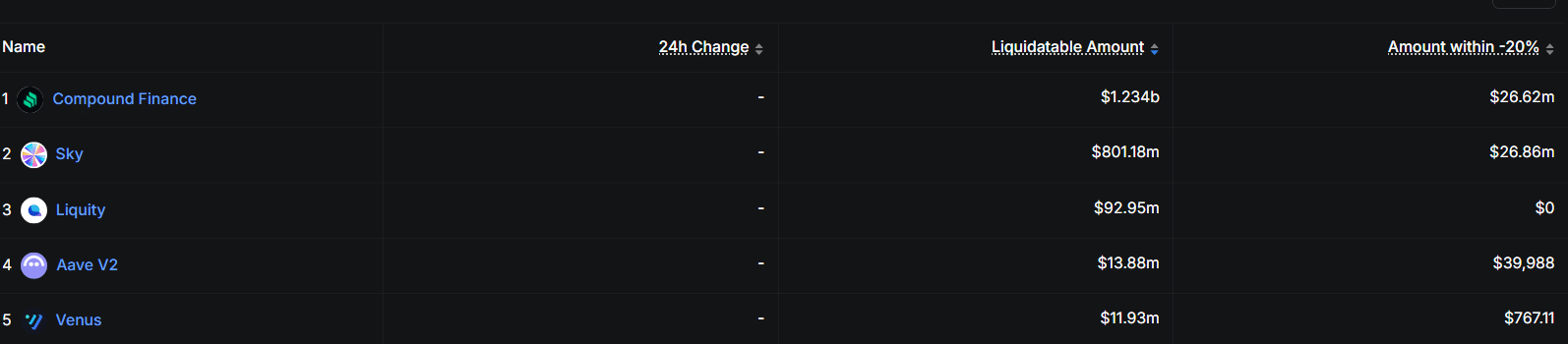
Source: DeFiLlama

However, protocols are redesigning mechanisms through auctions and controlled liquidations to retain value internally rather than letting it escape. This shift changes who benefits from market stress, allowing protocols to capture and recycle value instead of losing it.

As a result, DeFi strengthens its economic structure, improving sustainability and reinforcing long-term resilience

Aave reclaims MEV as SVR reshapes liquidation flows

Aave [AAVE] is not just refining its system; it is expanding a model that is already changing how value moves during liquidations. After proving effective on Ethereum, where Aave recaptured over $16.7 million in MEV, the protocol now extends SVR to Arbitrum and Base.
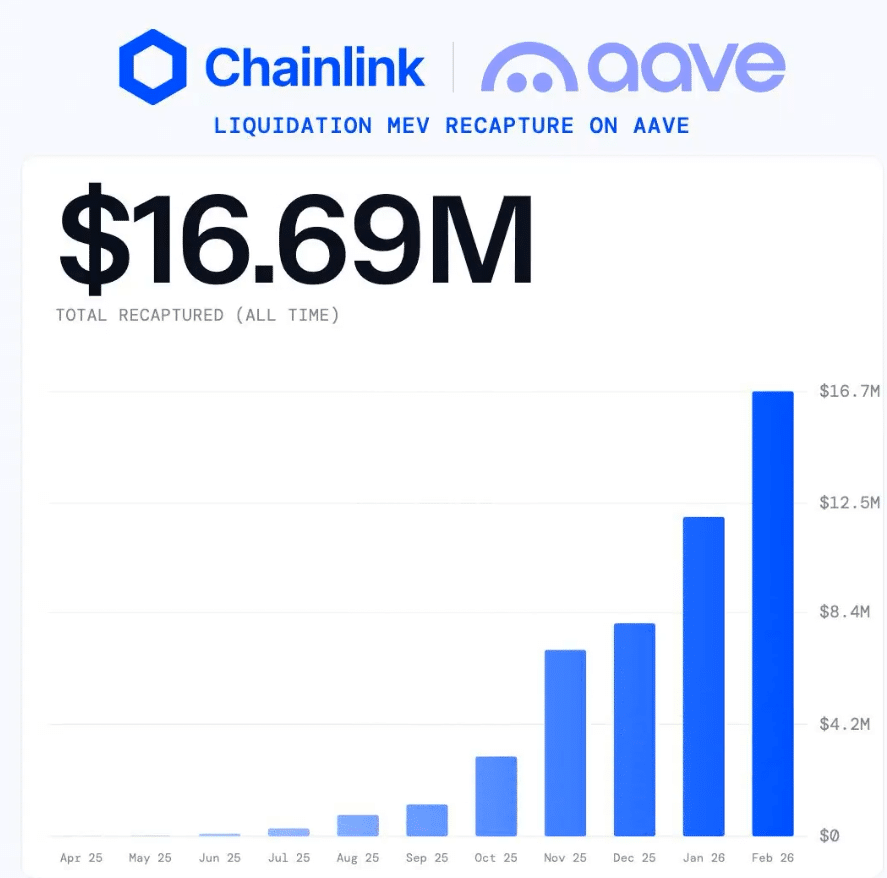
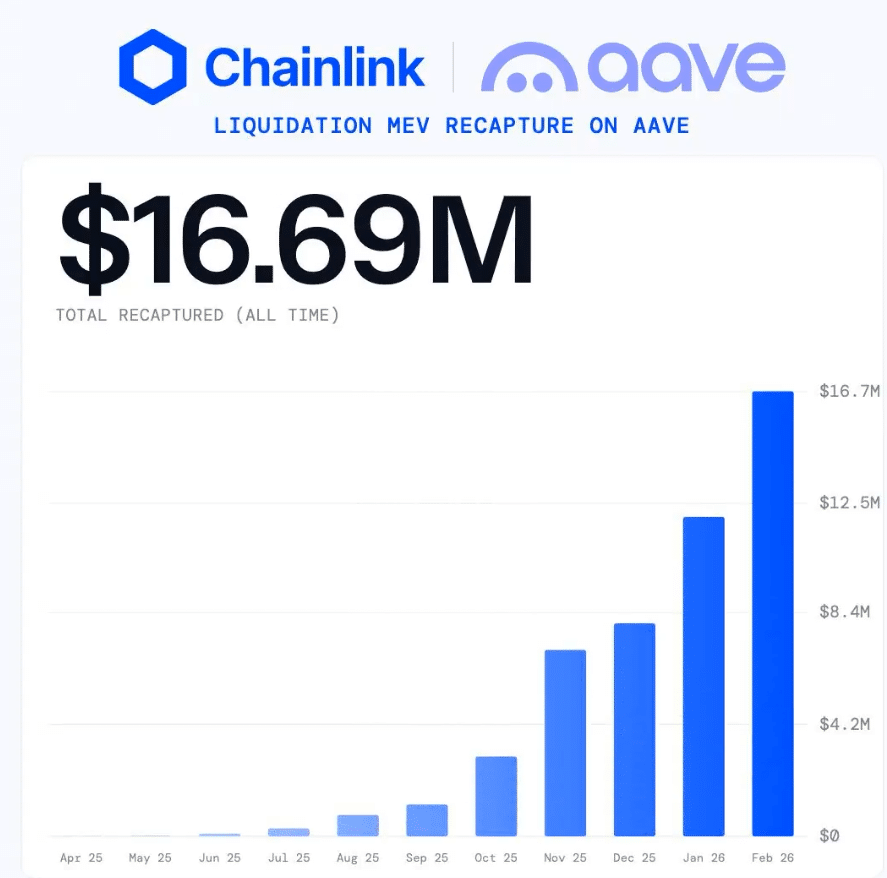
Source: ChainLink/X

This expansion is happening because the previous model left too much value on the table. Bots consistently captured liquidation profits, especially during volatility, while protocols saw little benefit. SVR changes this by redirecting that flow back into Aave’s ecosystem.

As this rollout scales across chains, liquidation events no longer act as pure extraction points. Instead, they become controlled revenue channels that strengthen the protocol.

The implication of these changes is clear. Aave is turning volatility into income, which improves sustainability and sets a precedent for how DeFi protocols capture value going forward.

SVR boosts revenue, but sustainability remains uncertain

As SVR begins to scale across networks, the focus shifts from early success to whether these gains can actually hold over time. The initial results look strong, yet they raise a deeper question about durability.

Aave now sits near $23.87 billion in TVL, while revenue reaches $6.24 million over 30 days, pointing to a $76 million annual run rate. This growth is not accidental, since liquidation activity is now feeding directly into protocol income.

This shift happens because value no longer escapes to bots and instead flows back into the ecosystem, strengthening internal cash flow. However, this strength is conditional. Revenue rises with volatility and lending demand, yet fades when activity slows.

All in all, this approach leaves a clear outcome. SVR improves Aave’s economics, but only sustained market activity can turn these gains into durable value growth.


Final Summary

  • The Aave protocol internalizes MEV through SVR, strengthening DeFi’s shift toward sustainable value capture.
  • AAVE shows rising revenue and improved efficiency, yet long-term growth remains dependent on volatility.

Пов'язані питання

QWhat is the main problem that DeFi protocols are addressing with their new liquidation mechanisms?

ADeFi protocols are addressing the problem of value leakage during liquidations, where external Maximal Extractable Value (MEV) bots were extracting profits, weakening protocol sustainability and causing billions in losses to users.

QHow much MEV value has Aave recaptured on Ethereum after implementing its new system?

AAave has recaptured over $16.7 million in MEV on Ethereum after implementing its SVR (Smart Vault Recovery) system.

QWhat are the two major Ethereum lending markets mentioned, and what were their respective liquidatable positions?

AThe two major Ethereum lending markets mentioned are Compound, with about $1.23 billion in liquidatable positions, and Aave (referred to as 'Sky' in the context, likely a typo for Aave), with around $801 million.

QWhat is the key change that protocols like Aave are making to their liquidation process?

AProtocols like Aave are redesigning their liquidation mechanisms through auctions and controlled processes (like SVR) to retain value internally, turning liquidation events into controlled revenue channels for the protocol instead of allowing value to be extracted by external bots.

QWhat is the primary condition for Aave's SVR model to generate sustainable revenue growth, according to the article?

AThe primary condition for sustainable revenue growth from Aave's SVR model is sustained market activity and volatility, as the revenue gains are dependent on lending demand and market stress, and can fade when activity slows down.

Пов'язані матеріали

Saylor: Strategy Now Focuses on Bitcoin's 200-Week Moving Average

Strategy now focuses on Bitcoin's 200-week moving average. The company's executive chairman, Saylor, announced they are now tracking Bitcoin's price relative to this key metric on a public dashboard. He noted Bitcoin has traded above this line 92% of the time since its inception and is currently trading almost exactly at it. This move is part of Strategy's efforts to reframe market perception of its massive $64 billion Bitcoin bet. The 200-week average is seen by bulls as a major support level, often signaling the end of bear markets. Bitcoin dipped below it earlier this year but has since recovered to around $62,500. Saylor has characterized tests of this level as buying opportunities. This comes as Strategy's Bitcoin position, totaling 843,775 BTC acquired at an average cost of $75,476 per coin, remains underwater. The company also reported a shift from profit to loss in Q2 and executed its first Bitcoin sales since 2022, selling 3,588 BTC to fund dividends. Saylor insists this does not change the long-term buy-and-hold strategy. Despite the unrealized loss, Saylor continues to signal further purchases. He recently posted a cryptic "Bitcoin Drive engaged" message, fueling speculation of a new buy. He also denied rumors of a new $5 billion sale authorization, calling it old news. Analysts remain cautious on Bitcoin's near-term momentum from this level, citing factors like weaker institutional inflows and macroeconomic uncertainty. However, Saylor maintains the long-term trend is still favorable for buyers at this support.

cryptonews.ru2 хв тому

Saylor: Strategy Now Focuses on Bitcoin's 200-Week Moving Average

cryptonews.ru2 хв тому

SEC to Review Approval of Nasdaq's Bitcoin Options Following CME's Challenge

The U.S. Securities and Exchange Commission (SEC) has suspended its approval of Nasdaq PHLX's cash-settled bitcoin index options (QBTC) and will review the decision following a legal challenge from CME Group, according to a July 31 order. The SEC had granted conditional approval for the product in May, pending an exemption from the Commodity Futures Trading Commission (CFTC). CME Group petitioned against the SEC's approval in June, arguing that bitcoin is a commodity. Consequently, options directly linked to its price should fall under the exclusive jurisdiction of the CFTC, not the SEC. CME contends that if it is correct, the SEC lacks the authority to approve QBTC. This would require Nasdaq to register as a CFTC-regulated futures or swaps exchange or redesign the contracts to track bitcoin-related securities like a spot ETF. The petition also warns that the SEC's approval could set a precedent allowing securities exchanges to list derivatives on other commodities. Notably, Nasdaq's proposed contracts would utilize CME CF benchmarks. The SEC's order suspends the May approval and invites public comments until August 24. The stay took effect on June 11. The SEC's initial approval was contingent on CFTC exemptions, which CME argues agencies cannot use to transfer a product between regulators. QBTC will remain on hold pending a full commission review.

cryptonews.ru5 хв тому

SEC to Review Approval of Nasdaq's Bitcoin Options Following CME's Challenge

cryptonews.ru5 хв тому

Торгівля

Спот
活动图片