DeFi Soars, Meme Breaks Through! Huobi HTX New Assets Weekly Review (1.19—1.25): RIVER Surges 393%, Multi-Sector Heat Resonates

marsbitОпубліковано о 2026-01-30Востаннє оновлено о 2026-01-30

Анотація

The cryptocurrency market showed signs of recovery and increased risk appetite from January 19 to 25, with capital inflow into high-potential sectors. Huobi HTX’s newly listed assets demonstrated significant gains, led by RIVER (River), a chain-abstracted stablecoin system, which surged by 393%. The Chinese meme token "我踏马来了" (based on a viral tweet) also rose 192%. Multiple sectors saw notable activity: - In DeFi, established projects like AUCTION grew by 34%. - Layer-1 project HANA increased by 157%, while Taiko (an Ethereum-equivalent ZK-Rollup) rose 47% in the Layer-2 segment. B2 Network, a Bitcoin Layer-2 solution, gained 19%. - Privacy and AI narratives remained strong, with Oasis Network (ROSE) up 44% and Kite AI (KITE) rising 40%. Huobi HTX emphasized its role in identifying high-quality assets early across diverse sectors—including DeFi, memes, public chains, privacy, AI, and BitcoinFi—enabling users to capture opportunities as market sentiment continues to improve.

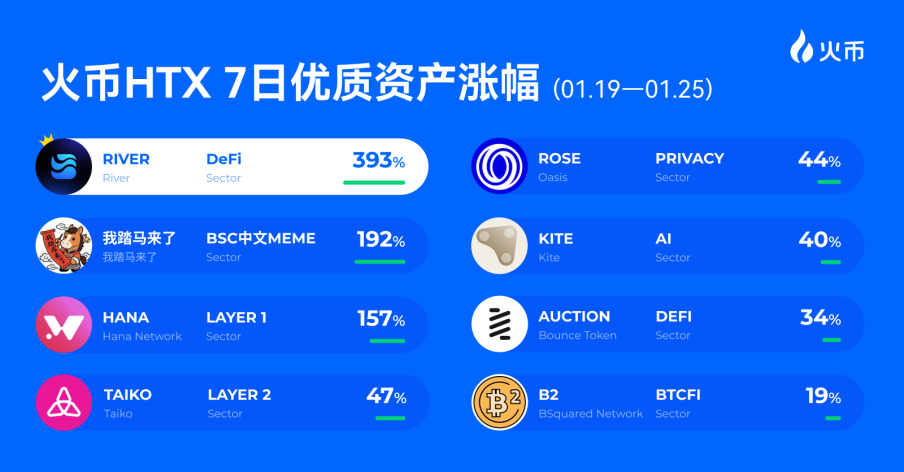
Over the past week (January 19th to January 25th), the crypto market gradually warmed up amidst fluctuations, with a partial recovery in risk appetite. Funds began to re-concentrate on niche sectors with strong narratives and practical application prospects. Data shows that the new assets recently launched on Huobi HTX have released significant wealth effects. As a newly listed project, RIVER surged up to 393% after its listing on Huobi HTX, while the Chinese Meme project "我踏马来了" (I'm F*cking Coming) also saw a substantial increase of 192% post-listing.

As the market gradually recovers, Huobi HTX, through strict project screening and a forward-looking listing pace, continues to provide users with potential asset choices for "earlier discovery and faster participation." Opportunities across multiple sectors are also being realized more quickly on the platform.

DeFi and Meme Sectors: Sentiment Returns, Leading Assets Surge Strongly

RIVER (River): Topped the platform with a weekly peak increase of 393%. River is building a chain-abstract stablecoin system that connects assets, liquidity, and yields across multiple blockchains. Notably, RIVER maintained active trading momentum even after the significant rise. Huobi HTX has simultaneously launched an Earn product with a 10% annualized yield, further expanding the income dimension beyond price performance.

AUCTION (Auction): A veteran DeFi project, up 34% this week. Bounce aims to provide individuals and projects with various types of auctions. The BOT token, the governance token of the bounce.finance platform, has been swapped for AUCTION at a 1:100 ratio. In an environment of overall capital回流 (returning funds), assets with mature mechanisms and application foundations are once again attracting market attention.

我踏马来了 (I'm F*cking Coming): A Chinese Meme project on the BSC ecosystem, originating from a tweet of the same name by He Yi, achieved a weekly gain of 192%. Driven by community dissemination and sentiment, Meme projects with stronger regional and cultural attributes possess higher explosive potential during the market recovery phase.
Public Chains and Scaling: L1, L2 Steadily Advance, BTCFi Ecosystem Actively Explored

HANA (Hana Network): Belongs to the Layer 1 sector, up 157% this week. Hana Network was launched by a Japanese team in December 2022. It builds new interfaces to bring users into cryptocurrency, including streaming and trading platforms. Against the backdrop of the evolving new public chain narrative, its technical roadmap and ecosystem planning are gradually gaining market recognition.

TAIKO (Taiko): Belongs to the Layer 2 sector, with a weekly increase of 47%. Taiko is a fully open-source, permissionless Ethereum-equivalent ZK Rollup designed to natively scale Ethereum. The market maintains long-term expectations for Ethereum scaling solutions.

B2 (B2 Network): Belongs to the BTCFi / Layer2 sector, up 19% this week. B2 Network is a next-generation Layer 2 scaling solution built on Bitcoin (BTC), aiming to significantly enhance Bitcoin's performance and scalability without compromising its foundational security. This sector is still in its early stages of development and possesses long-term potential.

Privacy Computing and AI Sectors: Structural Opportunities Continue to Unfold

ROSE (Oasis): A representative asset in the privacy sector, up 44% this week. Oasis Network is a secure and scalable blockchain platform designed to redefine decentralized finance (DeFi) and promote the broader adoption of blockchain technology beyond early users. Against the backdrop of increasing data security and compliance demands, the mid-to-long-term value of the privacy computing sector continues to attract attention.

KITE (Kite AI): An AI sector asset, with a weekly gain of 40%. Kite is building the first AI payment blockchain—a foundational infrastructure enabling autonomous AI agents to operate within it. After a phase of adjustment, the AI narrative continues to hold sustained appeal for quality projects.

High-Quality New Listings Continue to Deliver, Huobi HTX's Asset Selection Strength Highlighted

Overall, in the past week, new assets listed on Huobi HTX showed synchronized strength across multiple sectors, including high-volatility DeFi and Meme, as well as mid-to-long-term directions like public chains, privacy, AI, and BTCFi. As the market gradually recovers, Huobi HTX continues to provide users with a more diverse selection of potential high-quality assets through strict screening and forward-looking布局 (layout). As market sentiment further repairs, the structural行情 (market conditions) of multi-sector resonance remain worthy of持续关注 (ongoing attention).

About Huobi HTX

Huobi HTX was established in 2013. After 12 years of development, it has evolved from a cryptocurrency exchange into a comprehensive blockchain business ecosystem encompassing digital asset trading, financial derivatives, research, investment, incubation, and other services.

Huobi HTX, as a leading global Web3 gateway, adheres to a development strategy of global expansion, ecological prosperity, wealth effect, and security & compliance, providing comprehensive, secure, and reliable value and services to global virtual currency enthusiasts.

To learn more about Huobi HTX, please visit https://www.htx.com/ or HTX Square, and follow us on X, Telegram, and Discord. For further inquiries, please contact [email protected].


Пов'язані питання

QWhich newly listed asset on Huobi HTX had the highest weekly gain, and what was the percentage increase?

ARIVER (River) had the highest weekly gain, with an increase of 393%.

QWhat is the main focus of the project RIVER (River)?

ARIVER is building a chain-abstracted stablecoin system that connects assets, liquidity, and yields across multiple blockchains.

QWhich Chinese Meme project saw significant growth after listing on Huobi HTX, and what was its inspiration?

AThe Chinese Meme project '我踏马来了' (I'm F*cking Coming) saw a 192% increase. It was inspired by a tweet of the same name by He Yi.

QWhat type of project is TAIKO, and what is its core technology?

ATAIKO is a Layer 2 project. It is a fully open-source, permissionless Ethereum-equivalent ZK-Rollup designed to natively scale Ethereum.

QWhich asset from the AI sector was highlighted, and what is its project's goal?

AKITE (Kite AI) was highlighted, with a 40% weekly gain. The project is building the first AI payment blockchain, a foundational infrastructure for autonomous AI agents to operate.

Пов'язані матеріали

TechFlow Intelligence Bureau: Chip Stocks Lose Trillions in a Single Day, Bitcoin Falls Below $60,000, US-Iran Conflict Escalates

**Daily Tech & Markets Roundup: AI Advances, Market Turmoil, and Geopolitical Tensions** **AI / LLMs**: Anthropic's internal report on AI self-improvement sparked serious discussions about Recursive Self-Improvement (RSI). Meanwhile, debate continues on AI coding tools after Claude was accused of introducing bugs into the rsync codebase. In positive news, DeepSeek V4 Flash impressed in local deployment tests, and GitHub Copilot now supports custom endpoints for local models. A surprising research turn suggests removing chain-of-thought prompting can sometimes improve LLM performance. **Crypto / Web3**: Bitcoin plunged below $60,000, with its RSI hitting levels last seen during the COVID-19 crash, driven by strong U.S. jobs data reviving interest rate hike fears. Discussions highlight Ethereum DeFi's continued lack of a smooth consumer payment layer. **Chips / Hardware**: Chip stocks suffered a massive sell-off, with the Philadelphia Semiconductor Index posting its worst single-day drop in six years, erasing over a trillion dollars in value. Marvell, Micron, AMD, and Intel were among the biggest losers. **Tech Companies**: A leaked Microsoft document revealing goals to make Copilot "addictive" drew criticism. LinkedIn founder Reid Hoffman left Microsoft's board to focus full-time on his AI agent startup, Manus. Google was revealed to be paying SpaceX $920 million monthly for AI training compute. **Markets & Macro**: A blowout U.S. jobs report (172k vs. 80k expected) crushed hopes for near-term rate cuts, sending Treasury yields soaring and triggering a broad market sell-off. CEOs from Kraft, McDonald's, and Whirlpool simultaneously warned U.S. consumers are exhausting their savings. **Geopolitics**: U.S.-Iran tensions escalated with missile/drone interceptions and U.S. strikes on Iranian radar sites, keeping the critical Strait of Hormuz largely closed since late February and posing ongoing oil supply risks. **The Bottom Line**: The strong jobs data acted as a single trigger for correlated sell-offs across equities, crypto, and chips. Underlying the volatility is a stark contradiction between robust employment data and warnings of consumer weakness, alongside geopolitical risks that could reignite inflation, leaving markets to price in a fraught macro outlook with no clear "soft landing" path.

marsbit1 год тому

TechFlow Intelligence Bureau: Chip Stocks Lose Trillions in a Single Day, Bitcoin Falls Below $60,000, US-Iran Conflict Escalates

marsbit1 год тому

It Took Me a Year to See the Bitter Truth About Agent Payments

After a year building infrastructure for the Agent economy, engaging with major players like Stripe, Visa, and Coinbase, the author shares a sobering analysis of the current state of Agent payments. The core finding is a stark lack of genuine, immediate demand across most envisioned use cases. The article breaks down four key market segments: 1. **Agent-to-Merchant (Consumer Shopping):** For most product categories (e.g., clothing, electronics), conversational AI shopping is a step backwards from visual e-commerce interfaces. While agents excel at understanding needs, they can't replace side-by-side product comparison. Real merchant interest is defensive "Agent Engine Optimization," not driven by current customer demand. Potential exists for high-frequency, low-decision purchases (like food delivery) or navigating complex store UIs, but these require massive B2C distribution channels dominated by giants like Amazon. 2. **Agent-to-API (Developer Services):** Developers already have subscriptions and billing relationships for APIs (compute, data). Prepaid balances solve micro-payment issues for low transaction volumes. A deeper structural problem is that major SaaS vendors' business models rely on enterprise contracts, resisting granular pay-per-call pricing. While protocols like MPP and x402 serve the long tail of niche services, this market is small and developers are historically low-willingness-to-pay. 3. **Agent-to-Agent:** This remains largely theoretical with minimal transaction volume. While it represents a long-term bet on a fundamentally new transaction infrastructure (sub-second, micro-penny to million-dollar, multi-party settlements), it does not constitute a present market. 4. **Agent-to-Finance:** This is the only category with existing, paying demand. Integrating AI into financial workflows (trading, portfolio management) is a natural evolution and enables new capabilities like autonomous rebalancing. However, competition favors established, regulated institutions. The "real problem" is not moving money between agents, but the broader challenge of **coordination**—orchestrating work between agents and humans, verifying outcomes, and settling results. Payment is just one component of settlement, which is itself part of coordination. Companies that solve the coordination layer will subsume payment, not the other way around. While well-funded incumbents build defensively for a long-term future, startups must find where the market is today—which, for the author's team, lies outside these four categories in an area of real, growing, and underserved activity.

marsbit2 год тому

It Took Me a Year to See the Bitter Truth About Agent Payments

marsbit2 год тому

It Took Me a Year to See the Hard Truth About Agent Payments

**Title: It Took Me a Year to See the Hard Truth About Agent Payments** Over the past year, I've worked on infrastructure for the Agent economy, engaging with major players like Stripe, Visa, Coinbase, and numerous startups. The findings reveal a stark reality: genuine, widespread demand for Agent-based payments does not yet exist. **Key Observations:** * **Agent-to-Merchant (Shopping):** The user experience for AI shopping often falls short, especially for visual product discovery. While AI excels at understanding needs, conversational interfaces can't yet replace browsing and comparing multiple products visually. Current merchant interest is largely defensive ("Agent Engine Optimization") for a future that hasn't arrived. High-frequency, low-friction purchases (like food delivery) are potential fits, but lack open APIs and face high AI inference costs. Simpler, more affordable, or cross-language interactions for complex UIs are a niche opportunity but require massive consumer distribution to scale. * **Agent-to-API (Developer Tools):** Developer payment needs for APIs (computing, data, models) are already met through subscriptions and prepaid credits. The core challenge is not payment friction but supplier economics: most large SaaS providers prefer enterprise contracts over micropayments for API calls. Protocols like MPP and x402 suit the long-tail of smaller services but cater to a developer market historically reluctant to pay for these tools. Major infrastructure needs at the top of the stack are already being addressed. * **Agent-to-Agent (Machine Commerce):** This is a long-term vision with almost no current transaction volume. While a future with high-speed, high-frequency, multi-party machine-to-machine transactions would require novel infrastructure, it remains theoretical. The market is not here yet. * **Agent-to-Finance:** This is the only category with clear, present demand. Financial professionals and DeFi users already pay for tools, and AI augmentation is a natural evolution. Autonomous AI agents can enable entirely new financial strategies. However, competition is fierce from established, regulated incumbents who can more easily layer AI onto their existing products. **The Core Insight:** Companies, especially giants with long time horizons, are building defensively for a potential future of mass machine commerce. For them, early investment is a low-cost hedge. For startups, the current market reality is different. The primary challenge isn't just moving money between agents (payments). The larger, unsolved problem is **orchestration** – coordinating work between agents and humans, verifying outcomes, and then settling. Payment is just a part of settlement, which is just a part of orchestration. Companies that solve the orchestration problem will subsume payments, not the other way around. After a year of building, we see the real, growing, and underserved market opportunity lies in this broader domain of orchestration.

链捕手3 год тому

It Took Me a Year to See the Hard Truth About Agent Payments

链捕手3 год тому

Торгівля

Спот
Ф'ючерси

Популярні статті

Що таке MEME 2.0

Memecoin 2.0: Поява $MEME 2.0 у світі криптовалюти Вступ У постійно змінному ландшафті криптовалюти з'явився новий претендент. Memecoin 2.0, що символізується як $MEME 2.0, підносить концепцію мем-криптовалют на захоплюючий новий рівень. Як побічний продукт оригінального Memecoin, цей проєкт привернув увагу крипто-спільноти, змістивши акцент з типової фінансової вигоди на захоплюючий і розважальний досвід. Працюючи на блокчейні Ethereum, Memecoin 2.0 сміливо переосмислює залучення спільноти у криптосфері. Що таке Memecoin 2.0, $MEME 2.0? У своїй основі, Memecoin 2.0 є криптовалютним проєктом, який надає пріоритет спільнотному духу і розвагам, пов'язаним з мем-культурою. На відміну від звичайних криптовалют, які зосереджені на практичних випадках використання та матеріальних вигодах, Memecoin 2.0 вирізняється тим, що обіймає легшу сторону цифрової валюти. Цей проєкт існує без обіцянок утиліти, структурованої дорожньої карти чи фінансових повернень, зосереджуючи увагу на створенні яскравої спільноти навколо мемів та спільних розваг. Зробивши це, він використовує зростаючу тенденцію мем-культури у онлайн-пробі, що робить його унікальним гравцем у світі цифрових активів. Творець Memecoin 2.0, $MEME 2.0 Не зважаючи на численні дослідження витоків Memecoin 2.0, чітка особистість його творця залишається невідомою. Ця анонімність не є рідкістю у крипто-спільноті, де багато проєктів очолюються особами або групами, які надають перевагу залишатися за лаштунками. Відсутність публічно доступної інформації про творця може розглядатися як стратегічний крок, що ставить в центр уваги залучення спільноти, а не індивідуальної популярності у цій сфері. Інвестори Memecoin 2.0, $MEME 2.0 Інформації щодо інвесторів або фінансової підтримки Memecoin 2.0 замало. Відсутність деталей може свідчити про те, що проєкт є самофінансованим або що його увага до спільноти, а не традиційних інвестиційних структур, привабила інший тип підтримки. Оскільки світ мем-криптовалют зазвичай передбачає більше участі низового рівня, а не інституційних інвестицій, цей підхід узгоджується з етосом проєктів, що управляються спільнотою. Як працює Memecoin 2.0, $MEME 2.0? Memecoin 2.0 повністю працює на блокчейні Ethereum, використовуючи його потужні функції безпеки та масштабованості. Використовуючи сильні сторони Ethereum, Memecoin 2.0 може запропонувати безпечне середовище для взаємодії користувачів, забезпечуючи при цьому, що транзакції є ефективними та економічними. Одна з унікальних характеристик Memecoin 2.0 полягає в його структурі, що керується спільнотою. Цінність та популярність токена $MEME 2.0 походять з активної участі його користувачів, а не з вродженої утиліти. Ця концепція підкреслює акцент проєкту на розважальному аспекті криптовалюти, натякаючи на те, що сміх та залучення спільноти є справжніми валютами, що ведуть до його успіху. Крім того, проєкт вписується в ширшу екосистему мем-криптовалют, де цінність кожної мем-криптовалюти коливається залежно від культури, тенденцій і участі спільноти, а не традиційних економічних принципів. Хронологія Memecoin 2.0, $MEME 2.0 Щоб краще зрозуміти еволюцію та віхи Memecoin 2.0, ось хронологія, що підкреслює значні події в його історії: 2024: Зародження Memecoin 2.0 вважається відгалуженням оригінального Memecoin, яке встановлює себе в процвітаючому контексті мем-криптовалют, працюючи на блокчейні Ethereum. 13 липня 2024: Memecoin 2.0 офіційно позиціонує себе як мем-криптовалюта, орієнтована на спільноту, в мережі Ethereum, підкреслюючи свій підхід, зосереджений на розвагах, який запрошує користувачів брати участь у його розвитку. Ключові моменти про Memecoin 2.0, $MEME 2.0 Кілька критичних характеристик визначають Memecoin 2.0: Спільнотно-центричний підхід: Основною метою Memecoin 2.0 є створення веселого, захоплюючого досвіду для спільноти, використовуючи колективне задоволення, що випливає з меметичної культури. Побудовано на Ethereum: Робота на блокчейні Ethereum надає проєкту важливу інфраструктуру, що забезпечує безпеку та масштабованість. Відсутність утиліти або дорожньої карти: У вражаючому відході від традиційних криптовалют, Memecoin 2.0 не обіцяє жодних утилітарних функцій або фінансових повернень, підтверджуючи свою прихильність до участі спільноти та соціального залучення. Акцент на меметичній культурі: Обіймаючи гумористичні та культурні аспекти мем-періоду, Memecoin 2.0 надає платформу для користувачів для залучення до крипти офлайн та онлайн. Додатковий контекст: Значення мем-криптовалют Мем-криптовалюти з'явилися як окрема класифікація криптовалюти, часто керуючись гумором та легким підходом до торгівлі. Ці валюти, як правило, не мають значної утиліти або розробницьких дорожніх карт, залучаючи користувачів обіцянкою розваг, взаємодії в спільноті та культурної значущості. В рамках ширшої екосистеми криптовалют, мем-криптовалюти відновлюють важливість залучення спільноти, протистоячи лише прибутковим підходам. Проєкти, такі як Memecoin 2.0, відкривають еру, в якій розваги можуть гармонізувати з фінансовими прагненнями, перетворюючи блокчейн на ігровий майданчик для творчості та соціальної взаємодії. Висновок Memecoin 2.0, або $MEME 2.0, втілює нову хвилю криптовалюти, яка надає пріоритет залученню спільноти над жорсткими фінансовими структурами. Зосереджуючись на гуморі та соціальній взаємодії, він використовує захоплення навколо мем-культури. Працюючи на блокчейні Ethereum, Memecoin 2.0 використовує можливості технології, залишаючись непохитним у своїй прихильності до розважальної цінності цифрової валюти. Коли простір навколо криптовалют продовжує еволюціонувати, Memecoin 2.0 служить доказом того, що майбутнє цифрових активів може значною мірою залежати від спільних досвідів, сміху та надійних зв'язків у спільноті. У непередбачуваному світі крипто, можливо, радість може бути такою ж цінною, як і традиційний фінансовий прибуток.

110 переглядів усьогоОпубліковано 2024.04.04Оновлено 2024.12.03

Що таке MEME 2.0

Як купити MEME

Ласкаво просимо до HTX.com! Ми зробили покупку Memeland (MEME) простою та зручною. Дотримуйтесь нашої покрокової інструкції, щоб розпочати свою криптовалютну подорож.Крок 1: Створіть обліковий запис на HTXВикористовуйте свою електронну пошту або номер телефону, щоб зареєструвати обліковий запис на HTX безплатно. Пройдіть безпроблемну реєстрацію й отримайте доступ до всіх функцій.ЗареєструватисьКрок 2: Перейдіть до розділу Купити крипту і виберіть спосіб оплатиКредитна/дебетова картка: використовуйте вашу картку Visa або Mastercard, щоб миттєво купити Memeland (MEME).Баланс: використовуйте кошти з балансу вашого рахунку HTX для безперешкодної торгівлі.Треті особи: ми додали популярні способи оплати, такі як Google Pay та Apple Pay, щоб підвищити зручність.P2P: Торгуйте безпосередньо з іншими користувачами на HTX.Позабіржова торгівля (OTC): ми пропонуємо індивідуальні послуги та конкурентні обмінні курси для трейдерів.Крок 3: Зберігайте свої Memeland (MEME)Після придбання Memeland (MEME) збережіть його у своєму обліковому записі на HTX. Крім того, ви можете відправити його в інше місце за допомогою блокчейн-переказу або використовувати його для торгівлі іншими криптовалютами.Крок 4: Торгівля Memeland (MEME)Легко торгуйте Memeland (MEME) на спотовому ринку HTX. Просто увійдіть до свого облікового запису, виберіть торгову пару, укладайте угоди та спостерігайте за ними в режимі реального часу. Ми пропонуємо зручний досвід як для початківців, так і для досвідчених трейдерів.

324 переглядів усьогоОпубліковано 2024.12.12Оновлено 2026.06.02

Як купити MEME

Обговорення

Ласкаво просимо до спільноти HTX. Тут ви можете бути в курсі останніх подій розвитку платформи та отримати доступ до професійної ринкової інформації. Нижче представлені думки користувачів щодо ціни MEME (MEME).

活动图片