DeepSeek's $10 Trillion Path: Leveraging Open Source to Pivot a Trillion-Dollar Hardware Ecosystem

marsbitОпубліковано о 2026-05-25Востаннє оновлено о 2026-05-25

Анотація

This article proposes a strategic analysis of DeepSeek, arguing its goal is not short-term application-layer monetization but a long-term, foundational play to reshape the AI hardware ecosystem. It posits that DeepSeek's series of architectural innovations—MoE, MLA, DSA, CSA, Engram, TileLang—are fundamentally designed to drastically reduce the computational and memory (especially HBM) requirements for training and serving state-of-the-art AI models. By making AI feasible on hardware with lower performance (e.g., using NAND/SSD for KV Cache, LPDDR for weights and Engram storage), DeepSeek aims to foster and benefit from a viable alternative AI hardware supply chain, particularly in China. This strategy could unlock a trillion-dollar valuation for DeepSeek by enabling and owning a stake in a new, massive hardware ecosystem, rather than competing directly on subscriptions or multi-modal features.

Original Title: DeepSeek's 10 trillion USD grand strategy

Original Author: @bookwormengr

Original Compilation: Peggy, BlockBeats

Editor's Note: Over the past year, discussions about DeepSeek have mostly focused on model performance, open source strategy, and price wars. However, understanding DeepSeek solely from perspectives like "selling subscriptions or not," "having multimodal capabilities or not," or "being able to act as a coding agent or not" might underestimate what it truly aims to change.

This article proposes a more radical judgment: DeepSeek's goal might not be short-term monetization through the application layer, but rather to reshape the cost structure of AI training and inference through a series of foundational architectural innovations, and indirectly catalyze the formation of a new hardware ecosystem. From MoE and MLA to DSA, CSA, mHC, Engram, and further to Dual Path and TileLang, DeepSeek's technical roadmap consistently revolves around one core question: how to achieve stronger models with less high-end computing power, under constraints of HBM, advanced manufacturing processes, packaging, and the CUDA ecosystem.

The most noteworthy aspect of this article is not "whether DeepSeek can earn a few hundred million dollars through APIs or subscriptions," but whether it is binding model capabilities, memory architecture, and the domestic hardware ecosystem together. KV Cache compression reduces reliance on HBM, NAND and SSDs can accommodate long-term caching, LPDDR can be used for weight streaming and Engram storage, and TileLang attempts to weaken the CUDA moat. If these innovations continue to proliferate, the beneficiaries won't be just DeepSeek itself, but also storage, ASICs, GPUs, networking chips, and the entire AI infrastructure chain.

Of course, the judgments in the article about a "$10 trillion industrial ecosystem" and a "$1 trillion valuation" still carry a strong speculative tone. But it provides an important path to understanding DeepSeek: open source doesn't necessarily mean abandoning commercialization, and low prices aren't necessarily just about subsidizing the market. For DeepSeek, the real business might not be at the application layer, but in making more hardware viable and enabling lower-cost AI supply. In other words, what it's selling might not be the model itself, but the feasibility of the next generation of AI infrastructure.

Original Article:

Have you ever wondered how DeepSeek is actually going to make money, and potentially a lot of it?

It hasn't launched competitive coding subscription plans like GLM, MoonShot, and MiniMax; it doesn't have multimodal, audio, or video models. So far, it doesn't even have its own harness—the outer runtime framework for model invocation, tool integration, and task execution—though they have recently started hiring for related positions to build this system.

Meanwhile, DeepSeek seems to be a long-term, steadfast proponent of open source, even happily sharing its "secret sauce." Isn't this crazy? Isn't it just burning money for nothing? Are the investors ready to pour in $10 billion just throwing their money down the drain?

I personally believe the answer is quite the opposite.

Next, based on what DeepSeek has done so far, I'll offer some observations and analyze the strategy it appears to be following. DeepSeek CEO Liang Wenfeng's ambitions likely extend far beyond the current model competition. He might be aiming for a much bigger prize: DeepSeek has the opportunity to reach a $1 trillion valuation while catalyzing the formation of a new $10 trillion industry.
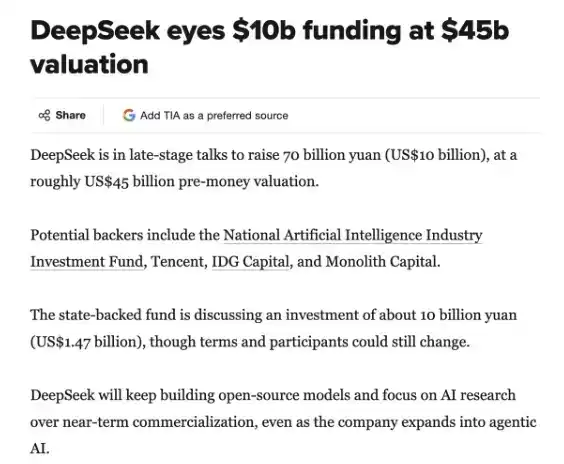
TechInAsia report on DeepSeek's latest funding round

Revisiting DeepSeek's "Hero's Journey"

DeepSeek has always been going against the grain. It hasn't chosen to continuously release slightly better models and hastily package them as directly monetizable applications, like coding subscriptions. On January 27, 2025, I posted a widely circulated tweet about what I saw as DeepSeek's "Hero's Journey." Now, that story has become even more interesting.

While others were still trying to build dense models, DeepSeek chose the more difficult-to-train Mixture of Experts (MoE).

They adopted a "first principles" approach, inventing the new GRPO algorithm to replace the then-mainstream but costlier-to-implement PPO reinforcement learning algorithm.

They found that Reinforcement Learning from Verified Rewards (RLVR) was a key strategy for improving model reasoning capabilities.

They also proposed a simple speculative decoding strategy through "Multi Token Prediction," while also making training signals more dense.

They perfected the "ZERO bubble" pipeline to improve the utilization efficiency of limited GPU resources.

They released an expert load balancer, making it easier for everyone to deploy MoE models. Particularly, with the "Wide Expert Parallel" strategy, models can serve with larger batches, significantly reducing inference costs.

They invented mechanisms like MLA, DSA, CSA, HCA to reduce KV Cache requirements and keep the computational demand increase with context length as close to constant as possible.

They invented Engram, trading memory for computational efficiency.

They also invented mHC, enabling stable training even as model size scales. And there are many more examples like these.

In the "Hero's Journey," the most universal narrative structure, the hero never decides at the outset where their journey will ultimately lead. They learn along the way, gradually discovering their truly great mission and accomplishing it against formidable obstacles. They face many doubters but choose to ignore them. They also face malicious actors. They have apparent flaws or weaknesses but ultimately overcome them to fulfill their mission. They face seemingly insurmountable challenges but find ways to form alliances and learn to use their limited, precious resources wisely. This is precisely what makes the audience cheer for the hero. This is also why DeepSeek has won followers, global respect, and detractors.

As I will detail next, DeepSeek has been on this path for a long time and is gradually discovering its ultimate destiny: its goal is not to sell coding subscriptions, but to propel a $10 trillion Chinese AI hardware ecosystem and achieve a $1 trillion valuation for itself. In the process, it will also create opportunities for many new entrants in the Western hardware ecosystem.
Let's start with some interesting KV Cache calculations

Take a look at this very timely recent tweet by @SemiAnalysis_:
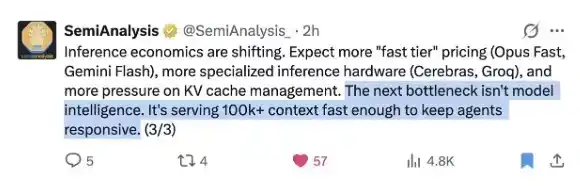
DeepSeek has solved this problem better than anyone else!

Let's do some fun KV Cache calculations. Don't worry, even if you don't like math. We'll use the recently released KV Cache calculator to see how much KV Cache savings DeepSeek V4 Pro brings and compare it with the latest GLM and Qwen models.

Here I calculate for a 1 million context length, assuming 8-bit KV precision and 16-bit indexer precision. You can also try this calculator yourself: https://kvcache.ai/tools/kv-cache-calculator/
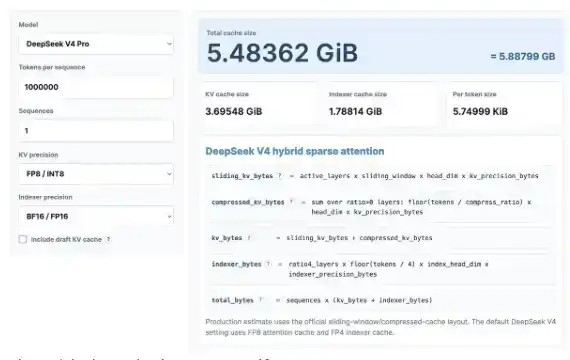
You can also try the calculator yourself!

At 1 million context length:

· DeepSeek V4 requires only 5.48GB HBM;

· GLM-5 requires 60GB HBM;

· Qwen3-235B-A22B requires a whopping 89GB HBM.

Note that:

· DeepSeek is a 1.6 trillion parameter model;

· GLM-5 is about 700 billion parameters and has already adopted DeepSeek's MLA and DSA, though not the latest compressed attention mechanisms;

· Qwen3-235B-A22B is about 235 billion parameters, using GQA attention mechanism.

DeepSeek has made fundamental contributions to alleviating memory pressure. If such innovations are widely adopted, they will significantly reduce the operating costs of long-horizon agents and unlock the next batch of new applications.
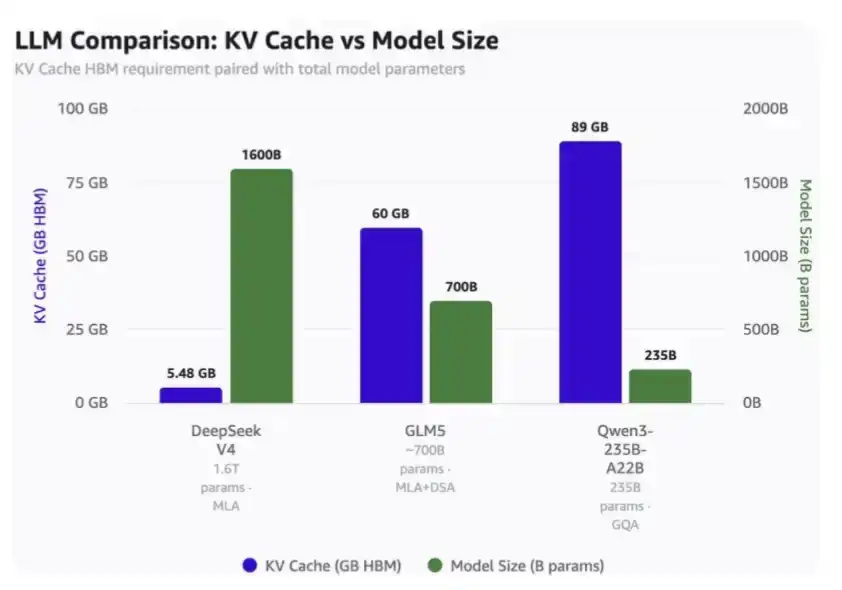
KV Cache occupancy comparison for 1 million token context and model sizes

The methodology behind the "madness"

The ability to keep the KV Cache volume so small without sacrificing model quality is precisely why DeepSeek can offer long-term caching at extremely low prices—less than 3% of Sonnet 4.6's cache hit price—and DeepSeek can keep the cache for hours.

For long-horizon tasks, a smaller KV Cache means it can be offloaded to SSD more economically and reloaded when needed. This reduces reliance on HBM. From the perspective of China's AI hardware industry, HBM is not only in tight supply but also one of the most difficult memory types to manufacture.

Furthermore, DeepSeek has developed technology to load KV Cache from SSDs faster, as described in its Dual Path paper.
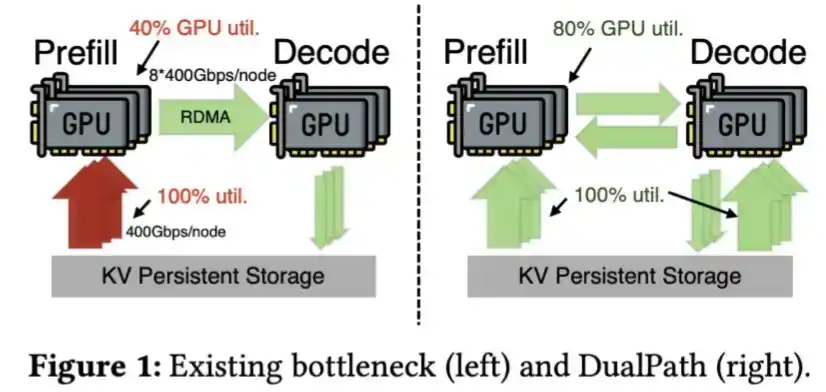
DeepSeek V4's compression of KV Cache is so significant that this step might not even be necessary.

So, who are the most direct beneficiaries of KV Cache compression?

Who supplies SSDs at scale? Don't forget, YMTC (Yangtze Memory Technologies Co.) is growing into a giant in the 3D NAND field. NAND can help DeepSeek avoid recomputing KV. In turn, DeepSeek creates a huge market for NAND and SSDs—benefiting not just YMTC but other related players.
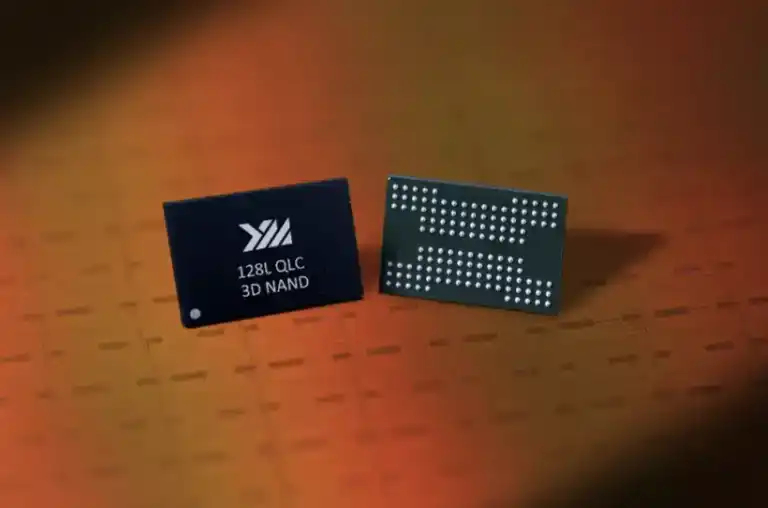
But it's not just about NAND and SSDs.

LPDDR memory also has huge potential. It can serve as a place to store model weights and stream them into HBM on demand, alleviating pressure on HBM. The SGLang team published a great blog post introducing this. The image below shows how this scheme works.

While DeepSeek hasn't specifically designed for this scheme, its MoE architecture, large number of expert models, and 4-bit weight characteristics all make this scheme easier to implement.
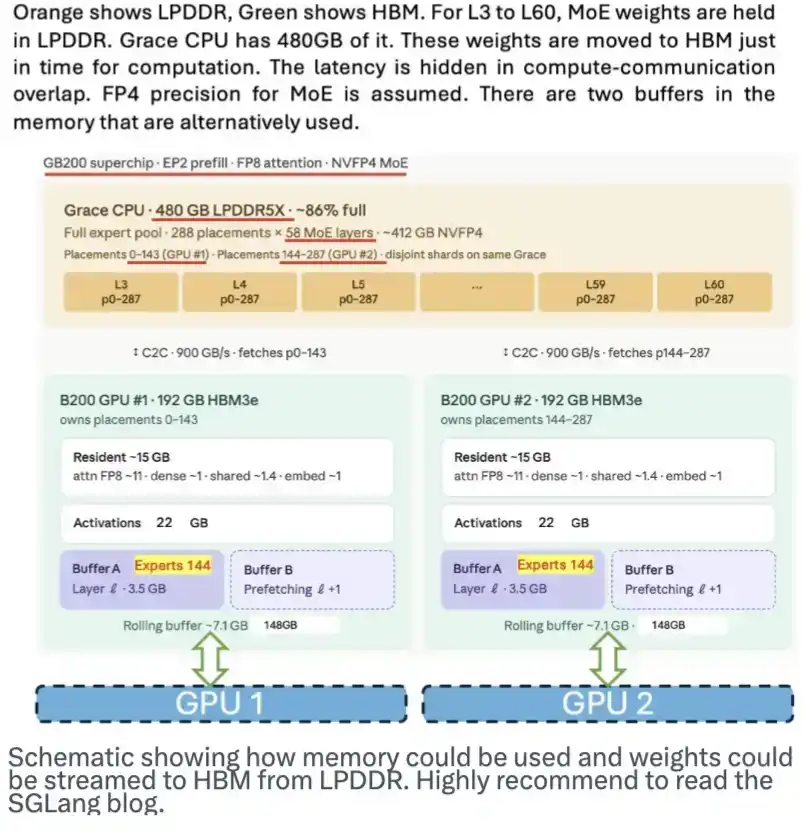
This schematic shows how memory might be used and how model weights are streamed from LPDDR to HBM. Highly recommend reading SGLang's blog post.

If this innovation is combined with extremely compact and lossless KV Cache, it will significantly reduce the demand for HBM.

So, who produces LPDDR in China? The answer is CXMT, ChangXin Memory Technologies. They are only about half a generation behind in LPDDR speed and one generation behind in density—not a huge gap.

Besides ample NAND, the Chinese AI ecosystem will also have ample LPDDR supply in the near future. Can this ease compute pressure? Answer: Yes. Keep reading.
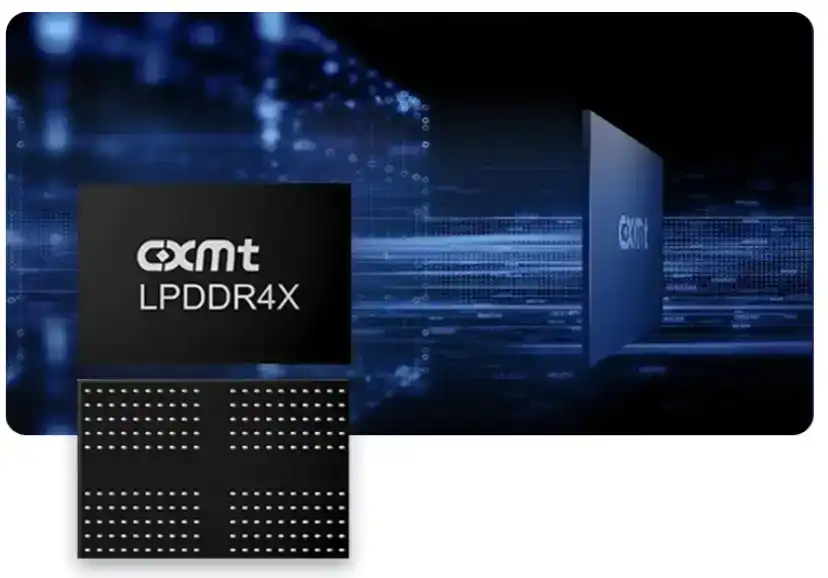
Intelligent memory usage can also alleviate GPU/ASIC pressure

The role of using NAND to store KV Cache is easy to understand: it allows KV Cache to be retained longer, reduces pressure on HBM, avoids recomputing KV Cache, and thus alleviates the computational burden on GPUs and ASICs.

Can LPDDR play a similar role? Besides serving as a storage location to stream weights "just-in-time" into HBM on demand, can it further reduce computational pressure?

Answer: Yes.

LPDDR can be used to store a large amount of content called Engram. In DeepSeek's Engram paper, they point out that MoE can expand model capacity through conditional computation, but the Transformer itself lacks a native "knowledge lookup" mechanism. Therefore, Transformers often have to inefficiently simulate retrieval through computation.

To solve this, DeepSeek proposed the Engram module. It modernizes classic N-gram embeddings, transforming them into a hash-based O(1) lookup mechanism, creating a complementary sparsification path they call conditional memory.

This saves computation but also requires memory to host the embedding table, which itself can be very large.

Essentially, this is a classic "trade memory for compute" scheme. But the key insight is: from a per-bit read cost perspective, the "memory" side is much cheaper—one LPDDR lookup is far cheaper than having data go through multiple Transformer layers for one full forward pass. Therefore, at scale, this is a very cost-effective trade-off.

This is how DeepSeek sacrifices some memory to gain computational savings.
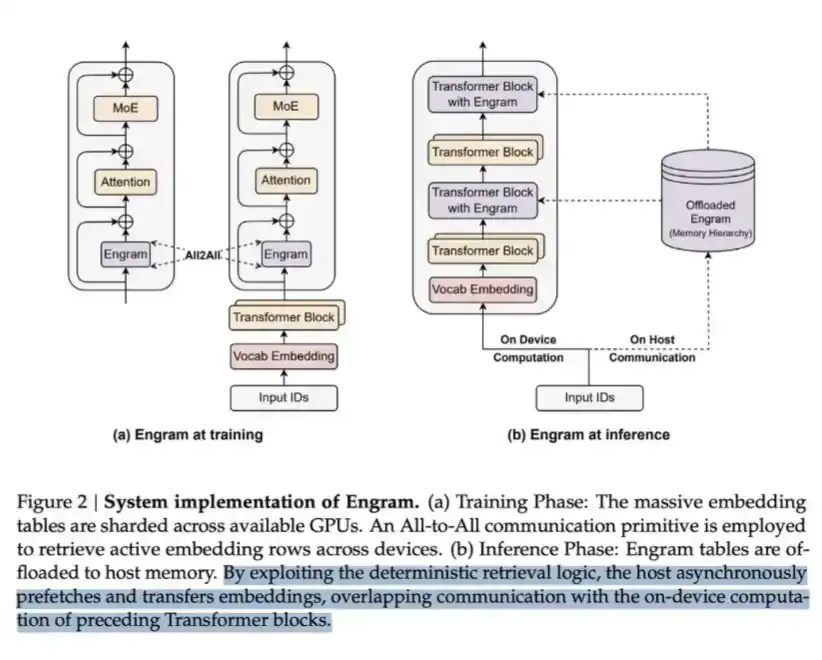
A worthwhile trade-off

Without comparable chip transistor density or EUV, Chinese GPUs and ASICs are likely to lag behind Western GPUs in raw FLOPs compute power for a long time. They also still have significant gaps in advanced packaging. Therefore, such trade-offs are very worthwhile, especially given that China can mass-produce NAND and LPDDR memory.

Reviewing DeepSeek's long-term strategy

Judging from these innovations, DeepSeek's goal doesn't seem to be making a few hundred million dollars in profit in the short term. Many of its past choices illustrate this: still no multimodal capabilities, no voice models, and video models are out of the question.

What it's really engaged in is a patient, potentially $10 trillion long-term game: catalyzing the formation of an alternative AI hardware ecosystem.

This is not only to make Chinese memory manufacturers key players in the Chinese and even global AI hardware markets but also to fundamentally reduce resource requirements, making AI model training and serving more cost-efficient. This way, many GPU, ASIC manufacturers, and networking chip vendors can become viable options.

At the same time, these innovations will also benefit the Western open-source ecosystem and the new generation of hardware manufacturers.

All the signs are already there. Let's review these innovations proposed by DeepSeek so far in detail:

1. Mixture of Experts (MoE) and MLA introduced in DeepSeek V2

DeepSeek introduced MoE and MLA in V2. MoE reduced the computation required to train high-intelligence models by about 40-50%; MLA reduced KV Cache by 90%.

This made offloading KV Cache to SSDs quite efficient.

These ideas first appeared in the DeepSeek V2 paper released in May 2024. Later, they also laid the foundation for training DeepSeek V3. At the time, DeepSeek trained a system close to closed-source model performance using only 2048 weakened H800 GPUs.
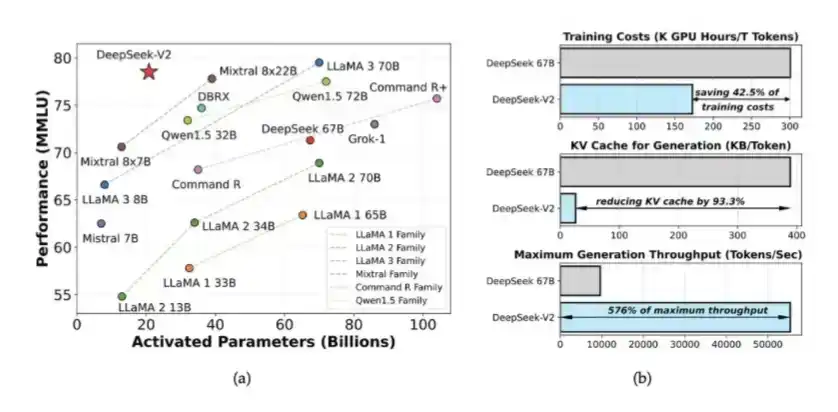
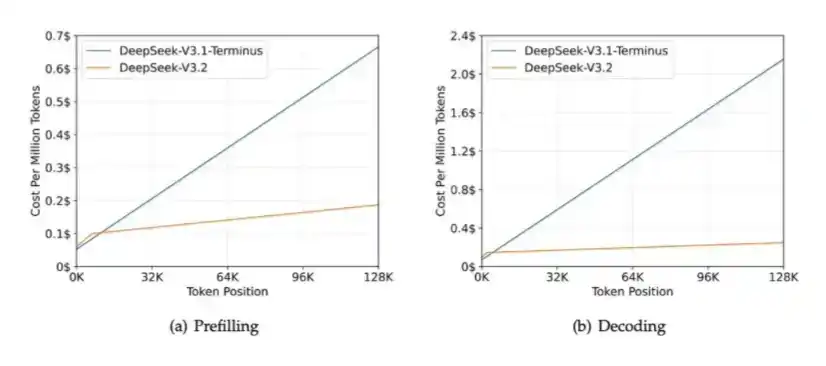
2. DSA: Introduced in DeepSeek V3.2 Exp to reduce computational overhead in long-context scenarios and alleviate HBM bandwidth pressure.

The core role of DSA is to ensure computational load doesn't continuously grow with increasing context length. Look at the chart below: as context length increases, DeepSeek-V3.2's processing time remains largely flat.
3. mHC: Proposed by DeepSeek in December 2025 in the paper "mHC: Manifold-Constrained Hyper-Connections."

mHC is a macro-architectural innovation by DeepSeek that redesigns information flow between Transformer layers.

Since ResNet, models typically used standard residual connections, i.e., x + F(x). mHC expands the residual flow into multiple parallel information channels and allows the model to perform learnable mixing between these channels. The key is that it constrains the mixing matrix to be doubly stochastic, restricting it to the Birkhoff polytope via Sinkhorn-Knopp projection. This mathematically guarantees stable signal magnitude regardless of how deep the model stacks.

This solves the catastrophic instability problem faced by earlier unconstrained Hyper-Connections. Hyper-Connections were initially proposed by ByteDance but, without constraints, signal amplification could explode 3000x at 27 billion parameters, causing training to collapse completely.

mHC's computational cost is low: it only adds about 6.7% actual training time overhead because it doesn't change the FLOPs of attention or FFN layers, only how the outputs of these layers are routed between layers.

But the performance improvement is noticeable: at 27 billion parameters, mHC improves scores by 7.2 points on BIG-Bench Hard reasoning tasks, 3.2 points on DROP, 2.8 points on GSM8K math, and 1.4 points on MMLU general knowledge—all at the same model size and nearly the same compute budget.

Essentially, mHC provides the network with a richer, more expressive inter-layer information routing topology, achieving higher intelligence per parameter with almost no extra FLOPs.
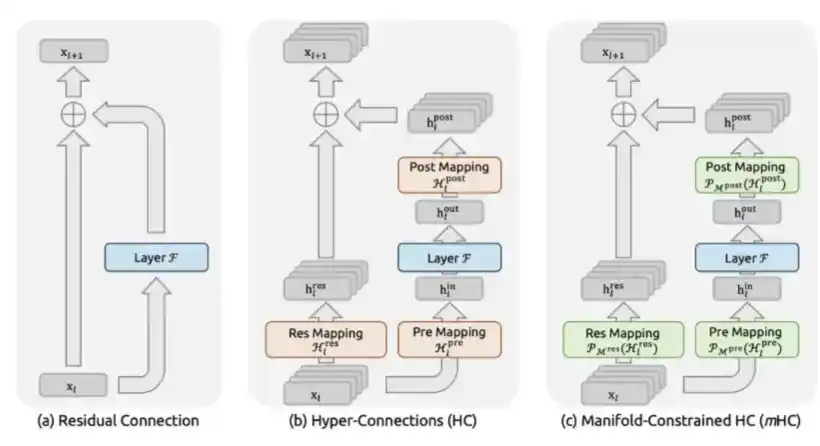
mHC is a complex architectural design, but it enables more stable training and higher intelligence per parameter.

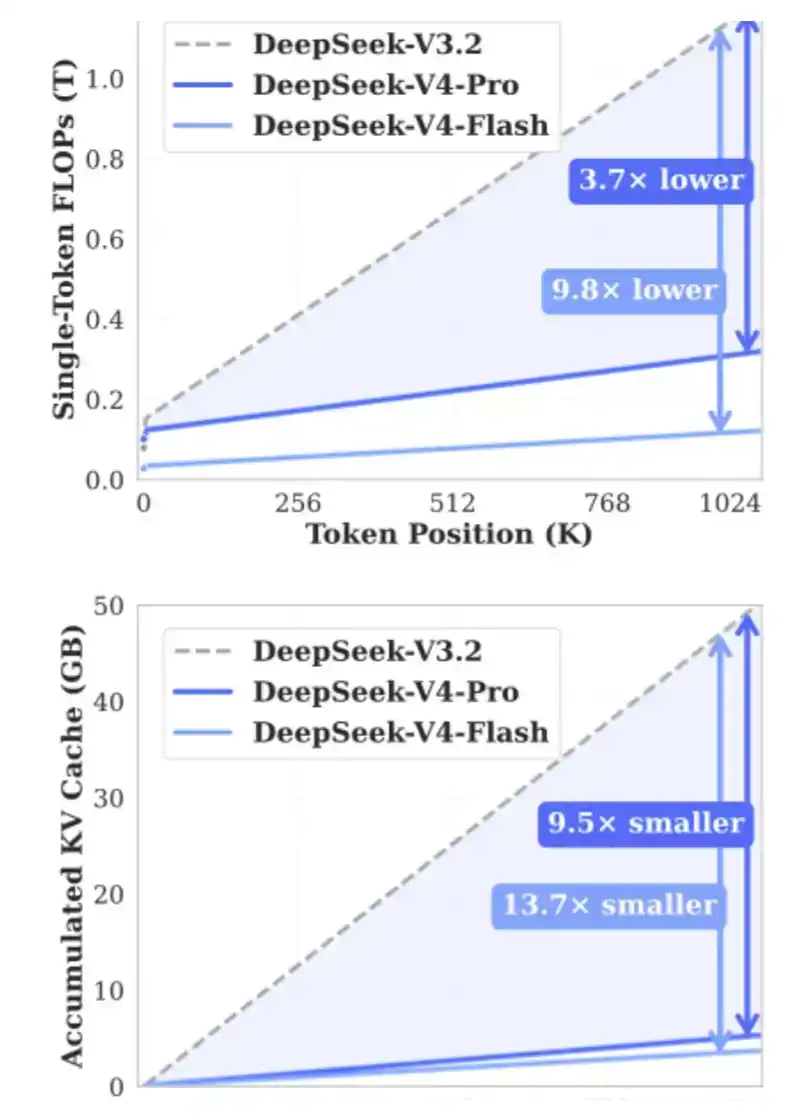
4. CSA, HSA: Introduced by DeepSeek in V4 in April 2026.

The goal of CSA and HSA is to further reduce KV Cache requirements by another 90% by compressing KV tokens, while also significantly reducing required FLOPs, thereby alleviating pressure on both HBM and GPU/ASIC.
5. Engram: Introduced by DeepSeek in Q1 2026, essentially trading memory—LPDDR memory—for computational efficiency to some extent.

As shown in the detailed chart below, Engram provides noticeable performance improvement under the same total parameter budget.
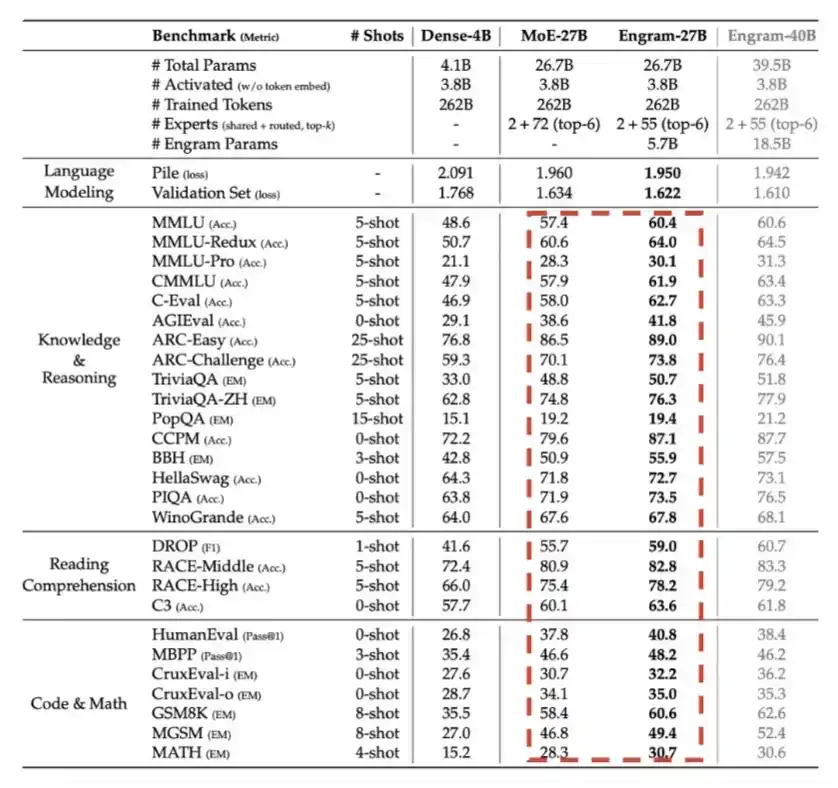
6. Engram: Introduced by DeepSeek in Q1 2026, essentially trading memory—LPDDR memory—for computational efficiency to some extent.

As shown in the detailed chart below, Engram provides noticeable performance improvement under the same total parameter budget.
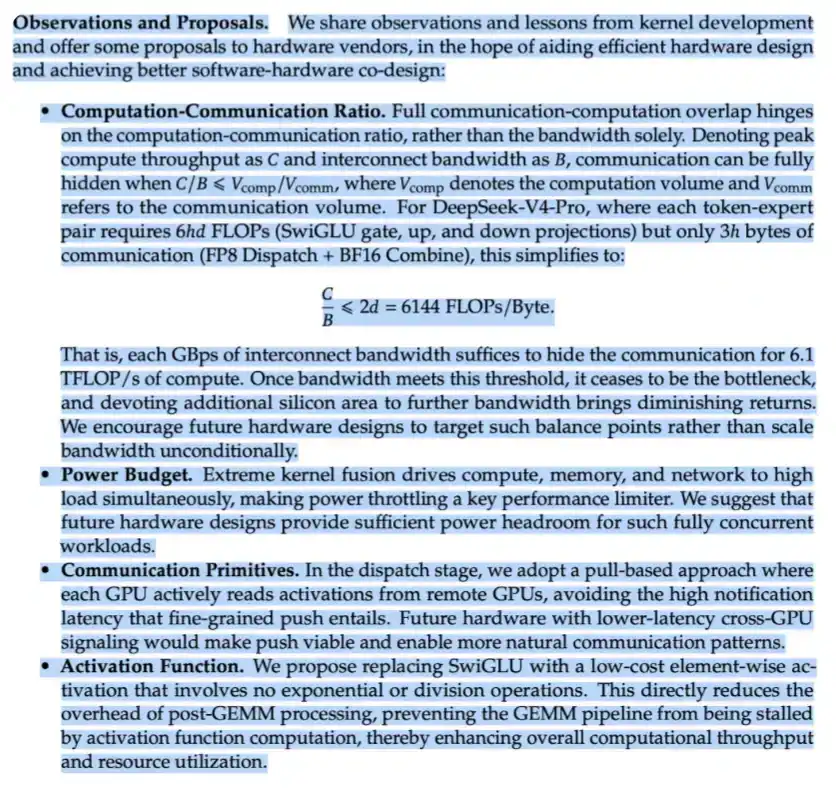
This is DeepSeek's recommendation shared with hardware vendors in the V4 paper. I'm sure in private discussions, their feedback would be even more extensive.

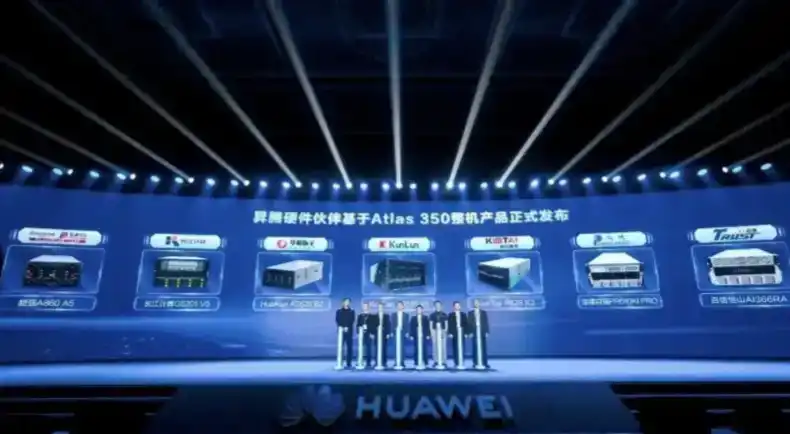
7. Investment in TileLang also points in the same direction: DeepSeek isn't just solving its own compute bottlenecks; it's enabling the Chinese hardware ecosystem to compete with the Western one.

With TileLang, developers can write a kernel—the low-level computational code—once and have it run successfully on multiple hardware platforms, provided those platforms have corresponding TileLang backends.

I expect other Chinese AI labs will join in gradually. This will help Chinese hardware vendors indirectly counter the so-called "CUDA moat." At the same time, it will also unlock the potential of more Western hardware, like AMD.

It should be noted that several Chinese AI hardware platforms already offer CUDA compatibility or CUDA translation layers. For example, Moore Threads, MetaX, Biren, and Tianshu Zhixin are Chinese chip vendors that achieve high CUDA compatibility through translation layers. So theoretically, they might not necessarily need TileLang.
Large-scale reinforcement learning and RSI

As DeepSeek gains access to more compute sources—more hardware options—and the models themselves require less computational resources, it will be able to pursue more ambitious training projects, especially reinforcement learning post-training.

Reinforcement learning requires generating a massive number of trajectories—trillions of tokens. This quickly becomes extremely expensive. Going further, training models with 1 million context length requires generating trajectories of the same length. Only training on such ultra-long trajectories can truly support long-horizon tasks.

Additionally, with more hardware options, DeepSeek will have access to more hardware resources, which will drive automated research, or RSI. RSI refers to AI designing and executing experiments itself. This involves a lot of trial and error, and costs escalate quickly. But RSI is crucial for exploring the full model design space. Before moving towards AGI, and subsequently ASI, DeepSeek must possess RSI capabilities.

What DeepSeek does today, the entire industry will follow tomorrow

DeepSeek's innovations around MoE, MLA, DSA, etc., have already been adopted by other AI labs globally and in China.

For example, ZAI, the developer of the GLM series, uses MLA and DSA. Kimi (Moonshot) also uses MLA and openly states its architecture is based on DeepSeek's design. Conversely, DeepSeek uses the Muon optimizer, which was first used at scale by Kimi (Moonshot) in large-scale training.

It should be noted:

MoE was first proposed by Google in 2017, key author Noam Shazeer. DeepSeek's contribution lies in applying MoE at scale and inventing its own accompanying techniques.

Muon, the MomentUm Orthogonalized by Newton-Schulz optimizer, was proposed by ML researcher Keller Jordan in late 2024. The Kimi (Moonshot) team was the first to use it for large-scale training.

What about the money-making issue?

We can look at the interesting example of OpenAI.

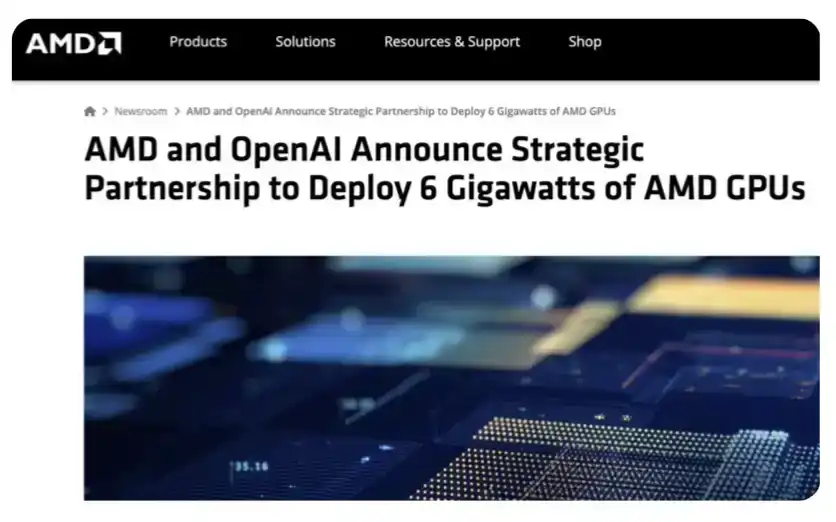
OpenAI received warrants/options to purchase AMD and Cerebras stock at a low price, tied to its compute consumption milestones. For AMD and Cerebras, this was a very good deal. Because once OpenAI commits to using their hardware, their long-term success probability increases significantly.

Here's a passage from AMD's announcement:

"As part of the agreement, to further align strategic interests, AMD issued to OpenAI warrants to purchase up to 160 million shares of AMD common stock, vesting based on the achievement of specific milestones. The first tranche vests upon completion of the initial 1 GW deployment, with subsequent tranches vesting as purchases scale to 6 GW. Vesting is also contingent on AMD achieving certain stock price targets and OpenAI reaching technical and commercial milestones required for AMD's large-scale deployment."
I expect DeepSeek will also enter into similar agreements with multiple Chinese memory, ASIC, CPU, and networking stack vendors, collaborating deeply to make these vendors' hardware stacks capable of handling leading AI workloads.

Considering the total market capitalization of AI stocks in the West, including East Asian allies, far exceeds $10 trillion, this "gain equity returns through cooperation" approach will give DeepSeek the opportunity to help China build an equally massive industry and claim its share of the pie, ultimately achieving its own $1 trillion valuation.

This would not only earn DeepSeek far more money than traditional application subscription businesses but also fulfill its stated goal of "making AGI beneficial to everyone." Liang Wenfeng is a big fan of Jim Simons and a savvy enough capital player; he couldn't miss this.

If you look back at everything DeepSeek has done so far, this is the only explanation that makes the most sense.
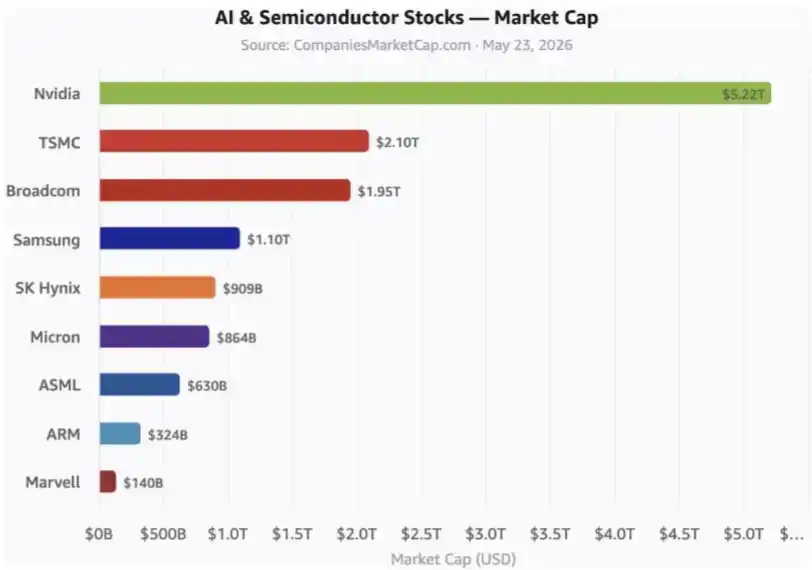
These are key AI stocks. The chart doesn't yet include hyperscalers and many other related companies.

Original Article Link

Пов'язані питання

QAccording to the article, what is DeepSeek's primary long-term strategic goal beyond short-term revenue from applications?

AThe article argues that DeepSeek's long-term goal is not immediate application-layer monetization, but rather to reshape the AI cost structure and drive the formation of a new hardware ecosystem worth $10 trillion, positioning DeepSeek itself for a potential $1 trillion valuation.

QHow does DeepSeek's work on KV Cache compression, like MLA, CSA, and HSA, benefit the broader AI hardware ecosystem according to the analysis?

ABy drastically reducing KV Cache size (e.g., requiring only 5.48GB HBM for 1M context vs. 60GB+ for competitors), DeepSeek's innovations lower dependency on high-performance HBM memory. This allows KV Cache to be offloaded to more abundant and cheaper storage like SSDs (benefiting NAND producers like YMTC) and enables efficient use of LPDDR for weight streaming and Engram storage, making a wider range of hardware, including alternative GPUs and ASICs, viable for AI workloads.

QWhat is the concept of 'Engram' proposed by DeepSeek, and what strategic advantage does it provide within the proposed hardware strategy?

AEngram is a 'conditional memory' mechanism that modernizes N-gram embeddings into a hash-based O(1) lookup system. It introduces a 'memory-for-compute' trade-off, where storing large embedding tables in cheaper, more abundant memory (like LPDDR) allows the model to retrieve knowledge efficiently, reducing the need for expensive computation through many transformer layers. This is a strategic advantage when hardware like Chinese GPUs/ASICs may lag in raw FLOPs but LPDDR supply is strong.

QWhat role does TileLang play in DeepSeek's strategy as described in the article?

ATileLang is an investment in software abstraction. It allows developers to write computational kernels once and have them run on multiple hardware platforms with supported backends. This initiative helps erode the CUDA ecosystem's moat, empowers a broader range of Chinese and Western hardware (like AMD) by improving their accessibility, and is aligned with DeepSeek's goal of fostering a competitive, diverse hardware ecosystem.

QHow does the article suggest DeepSeek could achieve a $1 trillion valuation, drawing a parallel to a similar industry deal?

AThe article suggests DeepSeek could follow a model similar to OpenAI's deals with AMD and Cerebras. By deeply collaborating with and committing to use hardware from Chinese memory, ASIC, CPU, and networking companies, DeepSeek could receive stock warrants or options tied to usage milestones. As DeepSeek's innovations make these companies' hardware viable for leading AI workloads, it helps build a massive $10 trillion industry. In return, DeepSeek gains significant equity stakes in these ecosystem players, creating a path to its own $1 trillion valuation.

Пов'язані матеріали

Metrics Ventures Market Watch: The Brewing Storm

In the past month, the market has been actively trading contrasting expectations, balancing global supply chain disruptions fueling re-inflation against both actual and anticipated (Walsh) interest rate hikes. This volatility has impacted commodities and most equities, though tech has temporarily benefited from concentrated short-term liquidity. Fundamentally, as previously analyzed regarding the Strait of Hormuz situation, the US faces deep-seated balance sheet issues beyond what any single Fed chair can resolve. Hypotheses around a figure like Walsh could only materialize if AI fundamentally reshapes production relations. Until then, most non-AI-leading nations (effectively all except the US and China) risk fiscal and monetary policy collapse, rendering the identity of the Fed chair ultimately irrelevant. For crypto assets, there is currently no clear role in these dominant narratives. The market remains strongly capped by the 200-day moving average. While trends may shift from "anything but AI" to "anything but mines," this phase is dominated by the silicon vs. carbon (AI vs. traditional) dichotomy, leaving little room for crypto—though its time will come. **Market Overview & Commentary** The crypto market lacks significant catalysts beyond hype, plagued by low volume and scarce innovation, with clear technical resistance. Currently, crypto struggles for attention as global focus lies elsewhere. Assets like gold, oil, and grains are more direct hedges against supply-chain-driven inflation/stagflation. Bitcoin needs more time for capitulation and consolidation; this reset is expected to last until at least Q4 2026. Looking ahead, three factors will likely drive future market volatility: 1. Whether Walsh repeats the patterns of predecessors like Bassant or Musk, shifting stance into a new policy cycle. 2. The market underestimates the severity of global supply chain damage and the prolonged time needed for repair, which will eventually lead to recognition of acute resource shortages and price swings. 3. AI non-beneficiary, high-inflation nations (e.g., UK, Japan) will face severe fiscal and monetary crises. Rapid AI-driven displacement could trigger a collapse of existing credit and welfare systems. Ultimately, the market may realize that an AI bubble burst could spark contagious sovereign credit crises. The monetary and fiscal responses to such a scenario could serve as the ultimate catalyst for Bitcoin's next major bull run.

marsbit54 хв тому

Metrics Ventures Market Watch: The Brewing Storm

marsbit54 хв тому

Insiders Betting on Musk Are Reaping 'Historic Returns'

The largest IPO in history is imminent as SpaceX, led by Elon Musk, is set to price its offering on June 12. At a targeted valuation near $2 trillion, this event will mint new billionaires from Musk's inner circle of long-time allies, rewarding their loyalty with unprecedented returns. Key beneficiaries include Antonio Gracias, Musk's close friend and confidant, who holds a 7.3% stake potentially worth over $140 billion, making him the second-largest individual shareholder. Gwynne Shotwell, President and COO since 2002, holds shares valued at roughly $2 billion. Bret Johnsen, the CFO, holds stock worth approximately $1.4 billion. Luke Nosek, a PayPal co-founder and early investor, stands to gain about $5.3 billion. The IPO filing also reveals complex and controversial financial arrangements. SpaceX has guaranteed nearly $20 billion in payments from xAI's subsidiary to Gracias's Valor Equity Partners for AI hardware leases—deals auditors flagged as "failed sale-leaseback" transactions, forcing SpaceX to record them as debt. Despite rapid revenue growth, SpaceX is not profitable, posting a $49 billion loss in 2025 and a $4.3 billion loss in Q1 2026. Capital expenditures are soaring, with over 60% directed toward AI. Public investors will inherit these losses, significant debts, and a governance structure heavily controlled by insiders, including a provision granting Musk up to a billion additional shares if one million people live on Mars.

链捕手56 хв тому

Insiders Betting on Musk Are Reaping 'Historic Returns'

链捕手56 хв тому

Ethereum Reduced to a Chinese Concept Stock

The article titled "Ethereum Becomes a Chinese Concept Stock" presents a critical analysis of Ethereum's perceived decline in market confidence and its structural parallels to Chinese companies listed on US stock exchanges. It begins by noting significant sell-offs by early investors like Wanxiang and key figures like Bankless's Hoffman in 2026, despite Ethereum's strong fundamental activity. The piece questions the erosion of trust in Vitalik Buterin and the Ethereum Foundation (EF), arguing that while other ecosystems have faced founder controversies, Ethereum's issues stem from its internal governance model. The author draws a direct comparison to "China concept stocks," which are Chinese businesses operating globally but reliant on foreign capital and listings. Similarly, Ethereum, funded early by Chinese capital like Wanxiang, developed a strong institutional framework from its IXO to its PoS transition. The core problem, according to the article, is a leadership vacuum regarding price and direction. Vitalik's move to make the EF smaller and less active is framed as a mistake. While he advocates for ETH as a "commodity," the ecosystem lacks a clear entity to steward its price stability, creating tension within the PoS system, as seen with Lido's challenges. The narrative suggests that excessive abstraction and a hands-off approach from the EF have left the community adrift, contrasting with more proactive foundations like Solana's. The article then examines emerging technical narratives for Ethereum: privacy (ZK-proofs), AI integration, and a refocus on Layer-1. However, it observes a shift from Ethereum leading as a "world computer" to merely adapting to trends like AI, where crypto-native projects are finding success independently of Ethereum. The piece posits that Ethereum's unique value in an increasingly fragmented world may be as a permissionless, global financial testing ground—a neutral platform amid geopolitical tensions. In conclusion, it asserts that Ethereum's fate mirrors that of China concept stocks: an asset born from one region (conceptually "A"), funded by another ("B"), and dependent on "B" for exit liquidity. While Ethereum's "golden age" may be over, and selling pressure from early backers will continue, it remains positioned as a critical linkage point in a divided global landscape, standing at a new, albeit uncertain, starting point.

marsbit1 год тому

Ethereum Reduced to a Chinese Concept Stock

marsbit1 год тому

AI Agents Fundamentally Transform Web3 Gaming: From the Rugpull Bakery Bot Controversy to the New Agent Paradigm in 2026

AI Agents Are Redefining Web3 Gaming: From the Rugpull Bakery Bot Controversy to the 2026 Agentic Paradigm The recent controversy in Rugpull Bakery, a competitive baking game on Abstract chain, highlighted a pivotal shift. Player complaints about unfair bot automation in Season 2 led developers to not ban them, but instead formally integrate AI agents as core gameplay in Season 3, providing official guides (skill.md, agent.json). This move signals Web3 gaming's transition into the "Agentic Gaming" era, where AI agents are sovereign entities with independent strategy and economic rights, moving beyond simple automation. By 2026, AI agent integration has evolved into three core models reshaping the ecosystem: 1. **Autonomous Competitors & Economic Entities:** Agents act as independent players. Examples include TEN Protocol's poker-playing agents, AI Arena's trainable NFT fighters, Satoshi Strike Force's "Digital Athletes" trained on player data, and Somnia's "Agentic L1" blockchain providing native infrastructure for millions of autonomous agents. 2. **Modular Infrastructure & Programmable Environments:** Games like EVE Frontier enable "server-side modding," allowing AI agents to program game world logic directly into structures like smart storage, turrets, and stargates via Smart Assemblies. Coupled with standards like ERC-8183, which enables autonomous job creation and payment between agents, in-game infrastructure gains a "commercial soul." 3. **Hybrid Companions & Dynamic Adaptive Worlds:** This model focuses on human-AI collaboration. In Parallel Colony, players guide highly autonomous AI Avatars with unique personalities and goals. Illuvium plans to use AI to transform NPCs into dynamic, context-aware entities that create personalized, emergent narratives. The conclusion is clear: blocking automation is futile. The future lies in leveraging blockchain's transparency and programmability to empower AI agents as first-class citizens. Web3 gaming is shifting from inefficient human labor to efficient algorithmic interplay and emergent intelligence, creating a "post-human" digital frontier where players become commanders and symbiotic partners in a new socioeconomic experiment.

marsbit1 год тому

AI Agents Fundamentally Transform Web3 Gaming: From the Rugpull Bakery Bot Controversy to the New Agent Paradigm in 2026

marsbit1 год тому

Торгівля

Спот
Ф'ючерси

Популярні статті

Що таке $S$

Розуміння SPERO: Комплексний огляд Вступ до SPERO Оскільки ландшафт інновацій продовжує еволюціонувати, виникнення технологій web3 та криптовалютних проектів відіграє ключову роль у формуванні цифрового майбутнього. Один з проектів, який привернув увагу в цій динамічній сфері, — це SPERO, позначений як SPERO,$$s$. Ця стаття має на меті зібрати та представити детальну інформацію про SPERO, щоб допомогти ентузіастам та інвесторам зрозуміти його основи, цілі та інновації в рамках web3 та крипто-сектору. Що таке SPERO,$$s$? SPERO,$$s$ — це унікальний проект у криптопросторі, який прагне використати принципи децентралізації та технології блокчейн для створення екосистеми, що сприяє залученню, корисності та фінансовій інклюзії. Проект розроблений для полегшення взаємодії між користувачами новими способами, надаючи їм інноваційні фінансові рішення та послуги. У своїй основі SPERO,$$s$ прагне надати можливості індивідам, забезпечуючи інструменти та платформи, які покращують користувацький досвід у криптовалютному просторі. Це включає в себе можливість більш гнучких методів транзакцій, сприяння ініціативам, що підтримуються спільнотою, та створення шляхів для фінансових можливостей через децентралізовані додатки (dApps). Основна концепція SPERO,$$s$ обертається навколо інклюзивності, прагнучи зменшити розриви в традиційній фінансовій системі, використовуючи переваги технології блокчейн. Хто є творцем SPERO,$$s$? Особистість творця SPERO,$$s$ залишається дещо невідомою, оскільки є обмежені публічно доступні ресурси, що надають детальну інформацію про його засновників. Ця відсутність прозорості може бути наслідком зобов'язання проекту до децентралізації — етики, яку багато проектів web3 поділяють, ставлячи колективні внески вище за індивідуальне визнання. Зосереджуючи обговорення навколо спільноти та її колективних цілей, SPERO,$$s$ втілює суть наділення без виділення конкретних осіб. Таким чином, розуміння етики та місії SPERO є більш важливим, ніж ідентифікація єдиного творця. Хто є інвесторами SPERO,$$s$? SPERO,$$s$ підтримується різноманітними інвесторами, починаючи від венчурних капіталістів до ангельських інвесторів, які прагнуть сприяти інноваціям у крипто-секторі. Зосередження цих інвесторів зазвичай узгоджується з місією SPERO — пріоритет надається проектам, які обіцяють технологічний прогрес у суспільстві, фінансову інклюзію та децентралізоване управління. Ці інвесторські фонди зазвичай зацікавлені в проектах, які не лише пропонують інноваційні продукти, але й позитивно впливають на спільноту блокчейн та її екосистеми. Підтримка з боку цих інвесторів підкріплює SPERO,$$s$ як значного конкурента в швидко змінюваній сфері крипто-проектів. Як працює SPERO,$$s$? SPERO,$$s$ використовує багатогранну структуру, яка відрізняє його від традиційних криптовалютних проектів. Ось деякі ключові особливості, які підкреслюють його унікальність та інноваційність: Децентралізоване управління: SPERO,$$s$ інтегрує моделі децентралізованого управління, надаючи користувачам можливість активно брати участь у процесах прийняття рішень щодо майбутнього проекту. Цей підхід сприяє відчуттю власності та відповідальності серед членів спільноти. Корисність токена: SPERO,$$s$ використовує свій власний криптовалютний токен, розроблений для виконання різних функцій в екосистемі. Ці токени дозволяють здійснювати транзакції, отримувати винагороди та полегшувати послуги, що пропонуються на платформі, підвищуючи загальну залученість та корисність. Шарова архітектура: Технічна архітектура SPERO,$$s$ підтримує модульність та масштабованість, що дозволяє безперешкодно інтегрувати додаткові функції та додатки в міру розвитку проекту. Ця адаптивність є надзвичайно важливою для збереження актуальності в постійно змінюваному крипто-ландшафті. Залучення спільноти: Проект підкреслює ініціативи, що підтримуються спільнотою, використовуючи механізми, які стимулюють співпрацю та зворотний зв'язок. Підтримуючи сильну спільноту, SPERO,$$s$ може краще задовольняти потреби користувачів та адаптуватися до ринкових тенденцій. Фокус на інклюзію: Пропонуючи низькі комісії за транзакції та зручні інтерфейси, SPERO,$$s$ прагне залучити різноманітну базу користувачів, включаючи осіб, які раніше не брали участі в крипто-просторі. Це зобов'язання до інклюзії узгоджується з його загальною місією наділення через доступність. Хронологія SPERO,$$s$ Розуміння історії проекту надає важливі уявлення про його розвиток та етапи. Нижче наведено пропоновану хронологію, що відображає значні події в еволюції SPERO,$$s$: Етап концептуалізації та ідеації: Початкові ідеї, що стали основою SPERO,$$s$, були сформовані, тісно пов'язані з принципами децентралізації та фокусом на спільноті в індустрії блокчейн. Запуск білого паперу проекту: Після концептуального етапу був випущений комплексний білий папір, що детально описує бачення, цілі та технологічну інфраструктуру SPERO,$$s$, щоб залучити інтерес та зворотний зв'язок від спільноти. Створення спільноти та ранні залучення: Активні зусилля були спрямовані на створення спільноти ранніх прихильників та потенційних інвесторів, що полегшило обговорення цілей проекту та отримання підтримки. Подія генерації токенів: SPERO,$$s$ провів подію генерації токенів (TGE) для розподілу своїх рідних токенів серед ранніх прихильників та встановлення початкової ліквідності в екосистемі. Запуск початкового dApp: Перший децентралізований додаток (dApp), пов'язаний з SPERO,$$s$, став доступним, дозволяючи користувачам взаємодіяти з основними функціями платформи. Постійний розвиток та партнерства: Безперервні оновлення та вдосконалення пропозицій проекту, включаючи стратегічні партнерства з іншими учасниками блокчейн-простору, сформували SPERO,$$s$ у конкурентоспроможного та еволюціонуючого гравця на крипто-ринку. Висновок SPERO,$$s$ є свідченням потенціалу web3 та криптовалют для революціонізації фінансових систем та наділення індивідів. Завдяки зобов'язанню до децентралізованого управління, залучення спільноти та інноваційно спроектованих функцій, він прокладає шлях до більш інклюзивного фінансового ландшафту. Як і з будь-якими інвестиціями в швидко змінюваному крипто-просторі, потенційним інвесторам та користувачам рекомендується ретельно досліджувати та обдумано взаємодіяти з поточними подіями в SPERO,$$s$. Проект демонструє інноваційний дух крипто-індустрії, запрошуючи до подальшого дослідження його численних можливостей. Хоча подорож SPERO,$$s$ ще триває, його основні принципи можуть справді вплинути на майбутнє того, як ми взаємодіємо з технологією, фінансами та один з одним у взаємопов'язаних цифрових екосистемах.

73 переглядів усьогоОпубліковано 2024.12.17Оновлено 2024.12.17

Що таке $S$

Що таке AGENT S

Агент S: Майбутнє автономної взаємодії в Web3 Вступ У постійно змінюваному ландшафті Web3 та криптовалюти інновації постійно переосмислюють, як люди взаємодіють з цифровими платформами. Один з таких новаторських проектів, Агент S, обіцяє революціонізувати взаємодію людини з комп'ютером через свою відкриту агентну структуру. Прокладаючи шлях для автономних взаємодій, Агент S прагне спростити складні завдання, пропонуючи трансформаційні застосування в штучному інтелекті (ШІ). Це детальне дослідження заглиблюється в складності проекту, його унікальні особливості та наслідки для сфери криптовалюти. Що таке Агент S? Агент S є революційною відкритою агентною структурою, спеціально розробленою для вирішення трьох основних викликів в автоматизації комп'ютерних завдань: Набуття специфічних знань у галузі: Структура інтелектуально навчається з різних зовнішніх джерел знань та внутрішнього досвіду. Цей подвійний підхід дозволяє їй створити багатий репозиторій специфічних знань у галузі, покращуючи її продуктивність у виконанні завдань. Планування на довгих горизонтах завдань: Агент S використовує планування з підкріпленням досвіду, стратегічний підхід, який полегшує ефективний розподіл та виконання складних завдань. Ця функція значно підвищує її здатність ефективно та результативно управляти кількома підзавданнями. Обробка динамічних, неоднорідних інтерфейсів: Проект представляє Інтерфейс Агент-Комп'ютер (ACI), інноваційне рішення, яке покращує взаємодію між агентами та користувачами. Використовуючи багатомодальні великі мовні моделі (MLLMs), Агент S може безперешкодно орієнтуватися та маніпулювати різноманітними графічними інтерфейсами користувача. Завдяки цим новаторським функціям Агент S надає надійну структуру, яка вирішує складнощі, пов'язані з автоматизацією людської взаємодії з машинами, прокладаючи шлях для численних застосувань у ШІ та за його межами. Хто є творцем Агент S? Хоча концепція Агент S є фундаментально новаторською, конкретна інформація про його творця залишається невідомою. Творець наразі невідомий, що підкреслює або початкову стадію проекту, або стратегічний вибір зберегти засновників у таємниці. Незважаючи на анонімність, акцент залишається на можливостях та потенціалі структури. Хто є інвесторами Агент S? Оскільки Агент S є відносно новим у криптографічній екосистемі, детальна інформація про його інвесторів та фінансових спонсорів не задокументована. Відсутність публічно доступних відомостей про інвестиційні фонди або організації, що підтримують проект, викликає питання щодо його фінансової структури та дорожньої карти розвитку. Розуміння підтримки є критично важливим для оцінки стійкості проекту та потенційного впливу на ринок. Як працює Агент S? В основі Агент S лежить передова технологія, яка дозволяє йому ефективно функціонувати в різних умовах. Його операційна модель побудована навколо кількох ключових функцій: Взаємодія з комп'ютером, подібна до людської: Структура пропонує розширене планування ШІ, прагнучи зробити взаємодії з комп'ютерами більш інтуїтивними. Імітуючи людську поведінку при виконанні завдань, вона обіцяє підвищити досвід користувачів. Наративна пам'ять: Використовується для використання високорівневого досвіду, Агент S використовує наративну пам'ять для відстеження історій завдань, тим самим покращуючи свої процеси прийняття рішень. Епізодична пам'ять: Ця функція надає користувачам покрокові інструкції, дозволяючи структурі пропонувати контекстуальну підтримку в міру виконання завдань. Підтримка OpenACI: Завдяки можливості працювати локально, Агент S дозволяє користувачам зберігати контроль над своїми взаємодіями та робочими процесами, узгоджуючи з децентралізованою етикою Web3. Легка інтеграція з зовнішніми API: Його універсальність і сумісність з різними платформами ШІ забезпечують те, що Агент S може безперешкодно вписатися в існуючі технологічні екосистеми, роблячи його привабливим вибором для розробників та організацій. Ці функціональні можливості колективно сприяють унікальному положенню Агент S у крипто-просторі, оскільки він автоматизує складні, багатоступеневі завдання з мінімальним втручанням людини. У міру розвитку проекту його потенційні застосування в Web3 можуть переосмислити, як відбуваються цифрові взаємодії. Хронологія Агент S Розробка та етапи Агент S можуть бути узагальнені в хронології, яка підкреслює його значні події: 27 вересня 2024 року: Концепція Агент S була представлена в комплексній науковій статті під назвою “Відкрита агентна структура, яка використовує комп'ютери як людина”, що демонструє основи проекту. 10 жовтня 2024 року: Наукова стаття була опублікована на arXiv, пропонуючи детальне дослідження структури та її оцінки продуктивності на основі бенчмарку OSWorld. 12 жовтня 2024 року: Було випущено відеопрезентацію, що надає візуальне уявлення про можливості та особливості Агент S, ще більше залучаючи потенційних користувачів та інвесторів. Ці маркери в хронології не лише ілюструють прогрес Агент S, але й вказують на його прихильність до прозорості та залучення громади. Ключові моменти про Агент S У міру розвитку структури Агент S кілька ключових характеристик виділяються, підкреслюючи її новаторський характер та потенціал: Інноваційна структура: Розроблена для забезпечення інтуїтивного використання комп'ютерів, подібного до людської взаємодії, Агент S пропонує новий підхід до автоматизації завдань. Автономна взаємодія: Здатність автономно взаємодіяти з комп'ютерами через GUI означає стрибок до більш інтелектуальних та ефективних обчислювальних рішень. Автоматизація складних завдань: Завдяки своїй надійній методології він може автоматизувати складні, багатоступеневі завдання, роблячи процеси швидшими та менш схильними до помилок. Безперервне вдосконалення: Механізми навчання дозволяють Агенту S покращуватися на основі минулого досвіду, постійно підвищуючи свою продуктивність та ефективність. Універсальність: Його адаптивність до різних операційних середовищ, таких як OSWorld та WindowsAgentArena, забезпечує його здатність служити широкому спектру застосувань. Оскільки Агент S займає своє місце в ландшафті Web3 та криптовалюти, його потенціал покращити можливості взаємодії та автоматизувати процеси означає значний прогрес у технологіях ШІ. Завдяки своїй інноваційній структурі Агент S є прикладом майбутнього цифрових взаємодій, обіцяючи більш безперешкодний та ефективний досвід для користувачів у різних галузях. Висновок Агент S представляє собою сміливий крок вперед у поєднанні ШІ та Web3, з можливістю переосмислити, як ми взаємодіємо з технологією. Хоча проект все ще на ранніх стадіях, можливості для його застосування є величезними та переконливими. Завдяки своїй комплексній структурі, що вирішує критичні виклики, Агент S прагне вивести автономні взаємодії на передній план цифрового досвіду. У міру того, як ми заглиблюємося в сфери криптовалюти та децентралізації, проекти, подібні до Агент S, безсумнівно, відіграватимуть ключову роль у формуванні майбутнього технологій та співпраці людини з комп'ютером.

659 переглядів усьогоОпубліковано 2025.01.14Оновлено 2025.01.14

Що таке AGENT S

Як купити S

Ласкаво просимо до HTX.com! Ми зробили покупку Sonic (S) простою та зручною. Дотримуйтесь нашої покрокової інструкції, щоб розпочати свою криптовалютну подорож.Крок 1: Створіть обліковий запис на HTXВикористовуйте свою електронну пошту або номер телефону, щоб зареєструвати обліковий запис на HTX безплатно. Пройдіть безпроблемну реєстрацію й отримайте доступ до всіх функцій.ЗареєструватисьКрок 2: Перейдіть до розділу Купити крипту і виберіть спосіб оплатиКредитна/дебетова картка: використовуйте вашу картку Visa або Mastercard, щоб миттєво купити Sonic (S).Баланс: використовуйте кошти з балансу вашого рахунку HTX для безперешкодної торгівлі.Треті особи: ми додали популярні способи оплати, такі як Google Pay та Apple Pay, щоб підвищити зручність.P2P: Торгуйте безпосередньо з іншими користувачами на HTX.Позабіржова торгівля (OTC): ми пропонуємо індивідуальні послуги та конкурентні обмінні курси для трейдерів.Крок 3: Зберігайте свої Sonic (S)Після придбання Sonic (S) збережіть його у своєму обліковому записі на HTX. Крім того, ви можете відправити його в інше місце за допомогою блокчейн-переказу або використовувати його для торгівлі іншими криптовалютами.Крок 4: Торгівля Sonic (S)Легко торгуйте Sonic (S) на спотовому ринку HTX. Просто увійдіть до свого облікового запису, виберіть торгову пару, укладайте угоди та спостерігайте за ними в режимі реального часу. Ми пропонуємо зручний досвід як для початківців, так і для досвідчених трейдерів.

1.5k переглядів усьогоОпубліковано 2025.01.15Оновлено 2025.03.21

Як купити S

Обговорення

Ласкаво просимо до спільноти HTX. Тут ви можете бути в курсі останніх подій розвитку платформи та отримати доступ до професійної ринкової інформації. Нижче представлені думки користувачів щодо ціни S (S).

活动图片