DeepSeek V4 Finally Released, Breaking the Strongest Closed-Source Monopoly, Explicitly Partnering with Huawei Chips

marsbitОпубліковано о 2026-04-24Востаннє оновлено о 2026-04-24

Анотація

DeepSeek AI has officially released DeepSeek-V4, available in two versions: the high-performance **DeepSeek-V4-Pro** (49B activated parameters, 1.6T total) and the more efficient **DeepSeek-V4-Flash** (13B activated parameters, 284B total). Both support a 1M context length, making long-context capability a baseline feature rather than a premium offering. The Pro version rivals top closed-source models in agent capabilities, world knowledge, and reasoning performance. It outperforms Claude Sonnet 4.5 in agentic coding and approaches Claude Opus 4.6 (non-thinking mode) in quality. The Flash version offers competitive performance at a lower cost, though it lags in highly complex tasks. A key technical innovation is a new attention mechanism that reduces computational and memory demands for long contexts. The models are optimized for agent frameworks like Claude Code and OpenClaw. API services are available with support for both OpenAI and Anthropic-style interfaces. DeepSeek also announced upcoming support for Huawei’s computing hardware in the second half of the year. The models are open-sourced on Hugging Face and ModelScope.

Just now, DeepSeek-V4 is here!

The preview version is officially launched and simultaneously open-sourced.

There are two versions in total:

DeepSeek-V4-Pro: Comparable to top closed-source models, 1.6T, 49B activated, 1M context length;

DeepSeek-V4-Flash: A smaller and faster economical version, 284B, 13B activated, 1M context length.
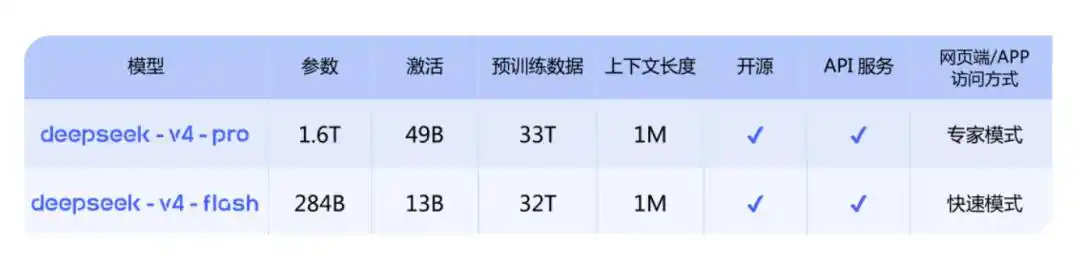
The official statement is: It leads domestically and in the open-source field in Agent capabilities, world knowledge, and reasoning performance.

And:

Currently, DeepSeek-V4 has become the Agentic Coding model used by company employees. According to evaluation feedback, the user experience is better than Sonnet 4.5, and the delivery quality is close to Opus 4.6 non-thinking mode. However, there is still a certain gap compared to the Opus 4.6 thinking model.
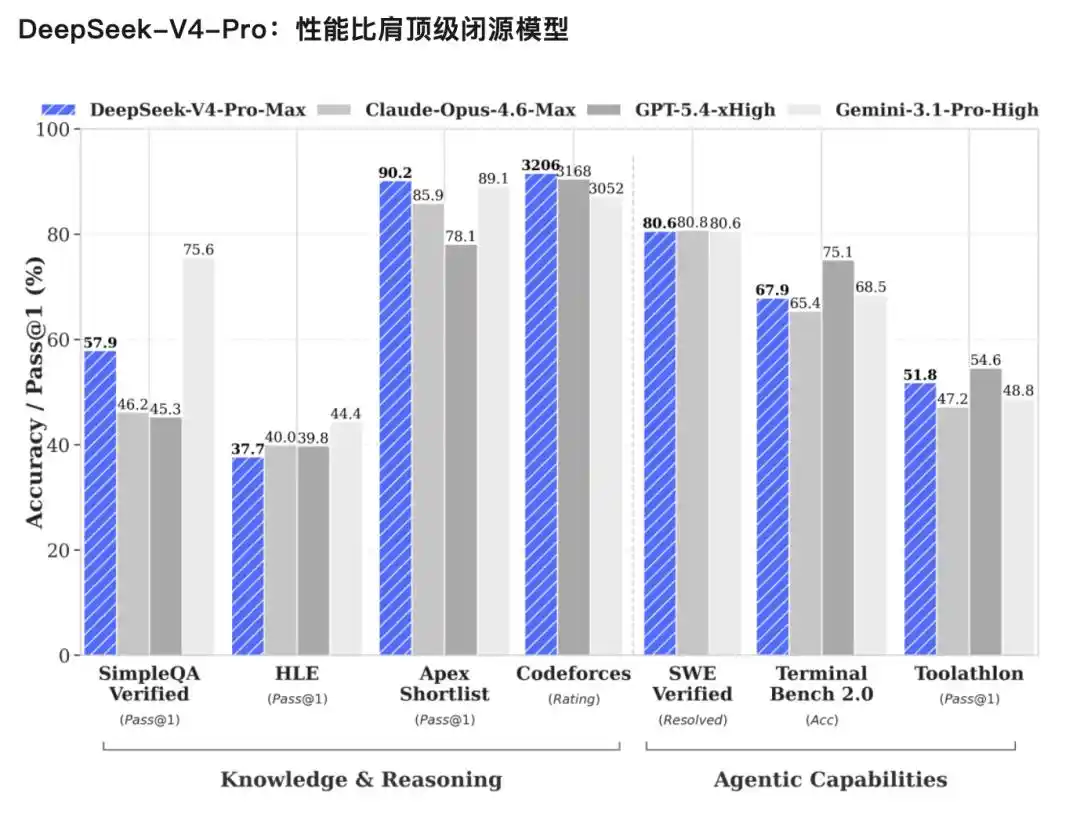
Currently, both the official website and the app have been updated, and the API service has also been synchronized.

Regarding the much-concerned domestic computing power, the key point is: Support for Huawei computing power in the second half of the year.

Top-Tier and Cost-Effective Choices, Two Versions Launched Together

This time, V4 releases two versions at once.

V4-Pro, performance comparable to top closed-source models.

The official judgment has three points:

Significantly improved Agent capabilities: In the Agentic Coding evaluation, V4-Pro has reached the best level among current open-source models and also performed excellently in other Agent-related evaluations. In internal evaluations, in Agent Coding mode, the V4 experience is better than Sonnet 4.5, and the delivery quality is close to Opus 4.6 non-thinking mode, but there is still a certain gap compared to the Opus 4.6 thinking mode.

Rich world knowledge: In world knowledge evaluations, DeepSeek-V4-Pro significantly leads other open-source models, only slightly inferior to the top closed-source model Gemini-Pro-3.1.

World-class reasoning performance: In evaluations of mathematics, STEM, and competitive code, DeepSeek-V4-Pro surpasses all currently publicly evaluated open-source models and achieves excellent results comparable to the world's top closed-source models.
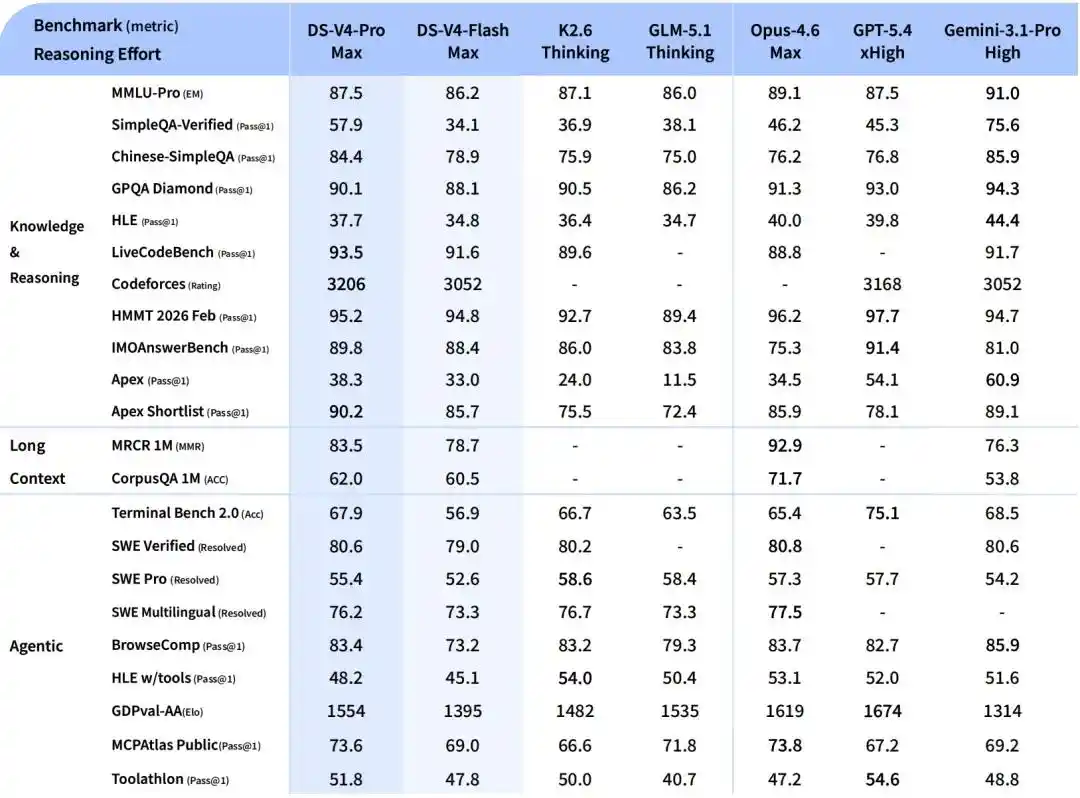
V4-Flash, a smaller and faster economical version. Reasoning ability is close to Pro, world knowledge reserve is slightly inferior, but with smaller parameters and activation, and cheaper API.

In Agent tasks, DeepSeek-V4-Flash is on par with DeepSeek-V4-Pro in simple tasks, but there is still a gap in high-difficulty tasks.

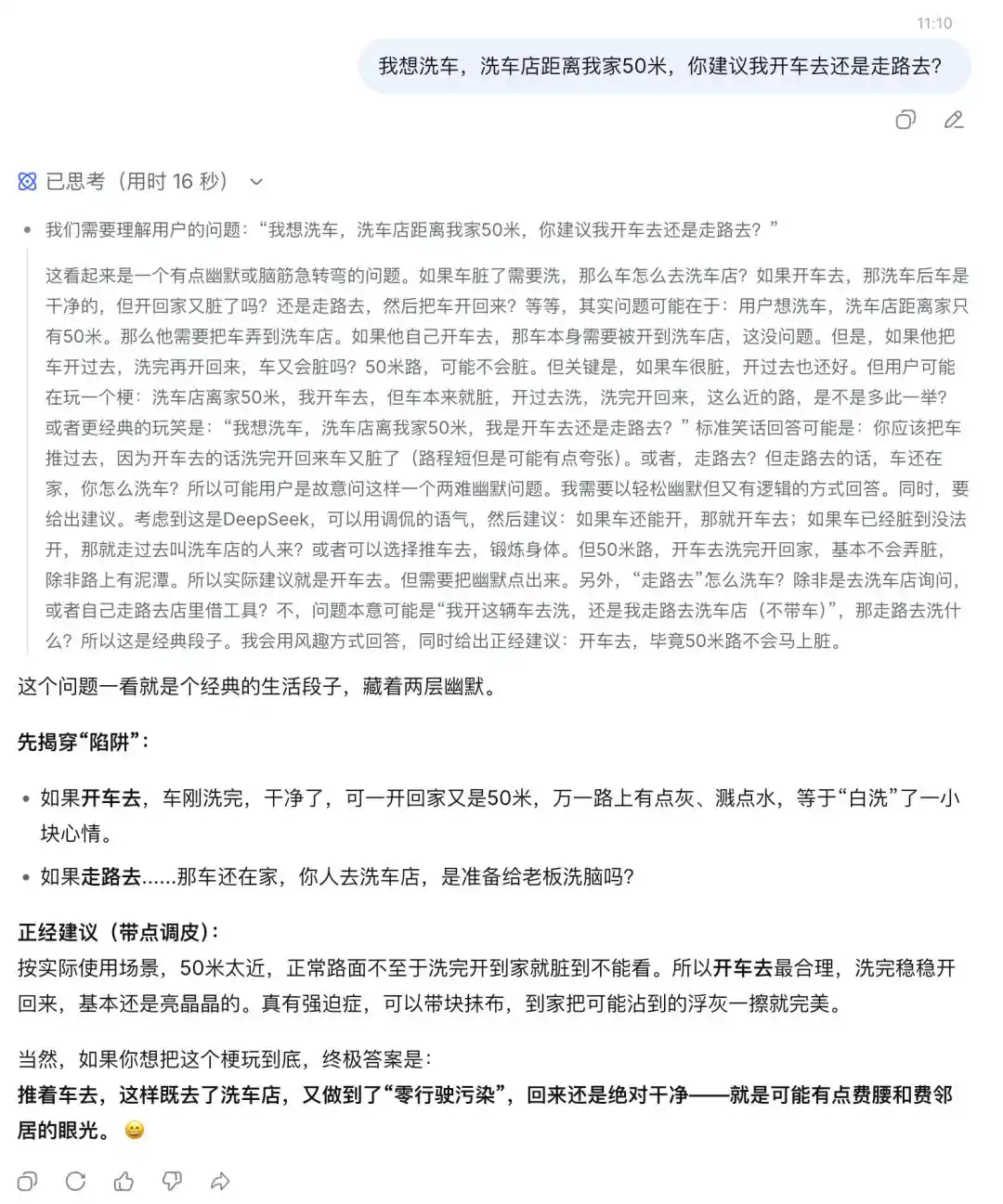
In the car wash test, V4 also passed quickly.
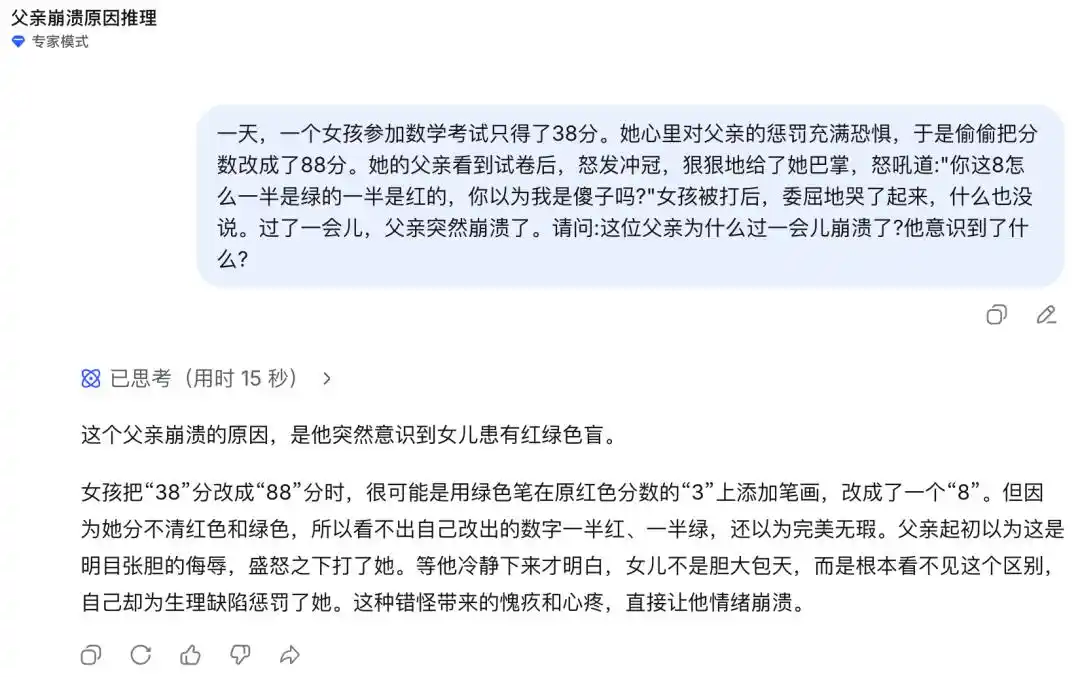
In the classic biological scenario "Desperate Father," DeepSeek-V4 did not immediately grasp the key point of red-green color blindness in one round (according to genetic rules, if a female is red-green color blind, her biological father must be as well).
Million Context Length Becomes Standard

It is worth mentioning that from today, 1M context length is standard for all DeepSeek official services.

A year ago, 1M context length was Gemini's exclusive trump card; all other closed-source models were either 128K or 200K; on the open-source side, almost no one could afford this level.

DeepSeek directly moved the million context length from a "high-end feature" to "basic infrastructure."

And it's open source. How did they do it? The release directly gave the answer—

V4 has created a new attention mechanism that compresses at the token dimension and is used in combination with DSA sparse attention. Compared to traditional methods, the demand for computation and memory is significantly reduced.
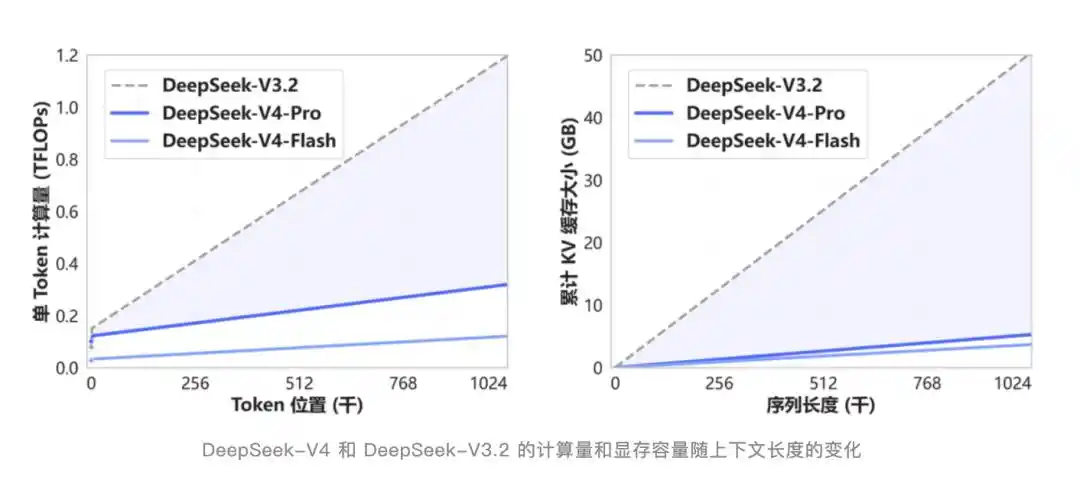
DSA is not a new term. It was first introduced in the V3.2-Exp update half a year ago. At that time, external attention was low because the benchmark scores were almost the same as V3.1-Terminus, making it seem like an insignificant intermediate version.

Looking back now, that was the foundation of V4.

Special Optimization for Agent Capabilities

On the Agent side, V4 has been adapted and optimized for mainstream Agent products such as Claude Code, OpenClaw, OpenCode, CodeBuddy, etc., with improvements in code tasks and document generation tasks.

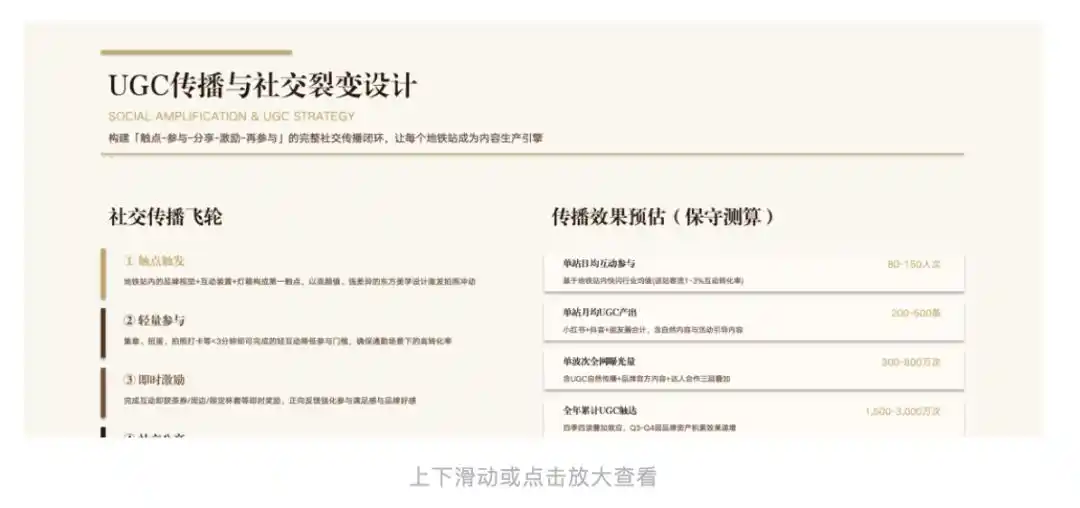
The release also included an example of a PPT inner page generated by V4-Pro under a certain Agent framework.
API Pricing

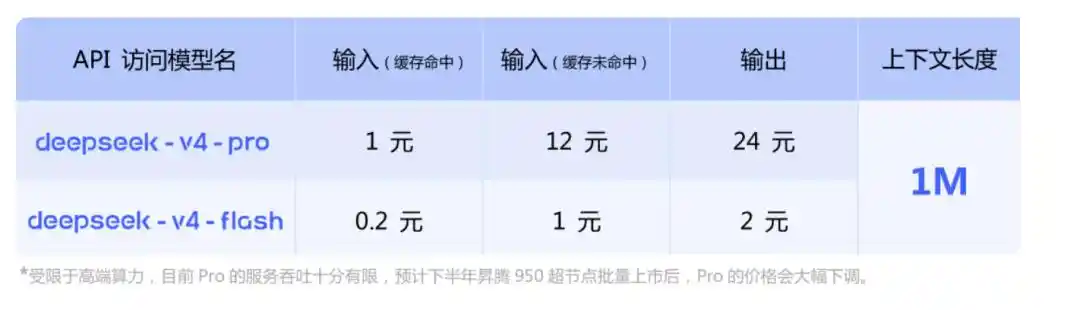
On the API side, V4-Pro and V4-Flash are simultaneously launched, supporting both OpenAI ChatCompletions interface and Anthropic interface.

The base_url remains unchanged, just change the model parameter to deepseek-v4-pro or deepseek-v4-flash to call.

Both versions have a maximum context length of 1M and support both non-thinking mode and thinking mode. In thinking mode, the intensity can be adjusted through the reasoning_effort parameter, with two levels: high and max. The official recommendation is to directly use max for complex Agent scenarios.
Here is a key point—Support for Huawei computing power in the second half of the year.

In addition, old model names will be discontinued.

deepseek-chat and deepseek-reasoner will be discontinued three months later (July 24, 2026). During the current phase, these two names point to the non-thinking and thinking modes of V4-Flash, respectively.

It has little impact on individual developers; just change one model parameter. Companies with production environments need to migrate during these three months.

One more thing

At the end of the release, DeepSeek quoted a sentence.

"Not tempted by praise, not frightened by slander, follow the path and act,端正自己端正自己 (correct oneself)."

This is a sentence from Xunzi's "Non-Twelve Masters." The literal meaning is: not tempted by praise, not frightened by slander, move forward according to the path one believes in, and correct oneself.

In today's context, it's somewhat interesting.

Over the past six months, rumors about when V4 would be released, whether it was delayed, whether it had been surpassed by others, whether it had been compromised by Claude's distilled data, etc., have circulated back and forth in both Chinese and English AI circles. At the beginning of the year, some even confidently said that V4 would be released before the Spring Festival, but it wasn't until the end of April.

They never responded once.

Then, on a Friday afternoon, they released V4, simultaneously open-sourced it, simultaneously launched it on the official website and app, simultaneously updated the API, and even wrote into the release that internal employees have already abandoned Claude.

No roadmap, no live stream, no interviews.

The four words "率道而行" (follow the path and act) sound like a slogan. But if you look at the path over the past six months: the V3.2 "unremarkable" Exp version, the DSA sparse attention that paved the way for V4 for half a year, and the path of making 1M context length from a trump card to a standard feature.

DeepSeek has already done it.

DeepSeek-V4 model open-source links:

[1]https://huggingface.co/collections/deepseek-ai/deepseek-v4

[2]https://modelscope.cn/collections/deepseek-ai/DeepSeek-V4

DeepSeek-V4 Technical Report: https://huggingface.co/deepseek-ai/DeepSeek-V4-Pro/blob/main/DeepSeek_V4.pdf

This article is from the WeChat public account "QbitAI", author: QbitAI

Пов'язані питання

QWhat are the two versions of DeepSeek-V4 that were released, and what are their key specifications?

ADeepSeek-V4 was released in two versions: DeepSeek-V4-Pro and DeepSeek-V4-Flash. The Pro version has 1.6T parameters with 49B activated and a 1M context length. The Flash version is a smaller, faster, and more economical model with 284B parameters, 13B activated, and also a 1M context length.

QAccording to the article, how does DeepSeek-V4-Pro's performance compare to top closed-source models like Anthropic's Opus 4.6?

AAccording to internal evaluations, DeepSeek-V4-Pro's performance in Agent Coding mode is better than Sonnet 4.5 and its delivery quality is close to Opus 4.6 in non-thinking mode, but it still has a gap compared to Opus 4.6 in thinking mode.

QWhat major technical achievement is highlighted for the DeepSeek-V4 models regarding context length?

AA major technical achievement is that a 1M context length has become the standard for all DeepSeek official services. This was achieved through a novel attention mechanism that compresses at the token dimension and is combined with DSA sparse attention, significantly reducing computational and memory requirements.

QWhat significant partnership or hardware support is announced for the future of DeepSeek's models?

AThe article announces that DeepSeek will support Huawei's computing power in the second half of the year.

QWhere can users find the open-source models and the technical report for DeepSeek-V4?

AThe open-source models can be found on Hugging Face and ModelScope collections under 'deepseek-ai/deepseek-v4'. The technical report is available at: https://huggingface.co/deepseek-ai/DeepSeek-V4-Pro/blob/main/DeepSeek_V4.pdf

Пов'язані матеріали

ETH Bull and Bear Views Compilation: Can Ethereum's Value Flow Back to ETH?

Titled "ETH Bull and Bear Views: Can Ethereum's Value Flow Back to ETH?", this article synthesizes the current heated debate around Ethereum's native token, ETH, following Bankless co-founder David Hoffman's decision to sell his entire ETH holdings. The **bullish case**, represented by figures like Tom Lee (BitMine CEO) and Raoul Pal, argues that ETH's core thesis remains intact. They contend Ethereum is the essential, secure, and neutral foundational layer for future finance—encompassing stablecoins, RWA, DeFi, L2s, and Agentic AI. Bulls bet on ETH's long-term revaluation as institutional adoption of on-chain finance grows, with significant buying activity from entities like BitMine and Consensys cited as evidence. Conversely, the **bearish perspective**, led by Hoffman and analysts like Markus Thielen, questions ETH's value capture mechanism. They acknowledge Ethereum's network success but argue that the value created by L2s, DeFi, and applications does not sufficiently accrue to the ETH token itself. Bears point to ETH's prolonged underperformance versus the broader crypto market, lack of traditional cash flows, weakening "ultrasound money" narrative, and apparent institutional retreat (e.g., Harvard Management Company exiting its ETH ETF position) as key concerns. The debate highlights a pivotal shift: ETH is no longer just a community belief asset. The central question is whether ETH can transition from being a "**used infrastructure**" to a "**continuously bought and held core asset**" as more value enters the Ethereum ecosystem. The market is now critically examining the direct link between network growth and ETH's value.

marsbit45 хв тому

ETH Bull and Bear Views Compilation: Can Ethereum's Value Flow Back to ETH?

marsbit45 хв тому

Crypto is dead, Perps are forever

The crypto industry is shifting from a focus on creating native assets (like altcoins and protocol tokens) to becoming a "global asset pipeline." Native cryptocurrencies, except for Bitcoin, are seen as failing in their value storage and utility promises, with demand driven largely by speculation. Attention and liquidity are now moving toward real-world assets (RWAs) like U.S. stocks, bonds, gold, and oil traded on-chain via perpetual contracts (Perps). Stablecoins like USDT and USDC set the precedent, proving blockchain's core strength is efficient global settlement and transfer, not inventing new monetary systems. Meanwhile, assets like Ethereum and many DeFi tokens struggle as their narratives weaken against tangible traditional assets and the rapid real-world progress of AI. Perpetual contracts have emerged as a pivotal innovation. They simplify trading by offering pure price exposure to any asset, bypassing complexities of ownership, custody, and traditional market hours. Projects like Hyperliquid gained traction by combining CEX-like efficiency with on-chain transparency, capitalizing on post-FTX distrust, macroeconomic volatility, and the surge in demand for 24/7 stock trading. In conclusion, while the era of speculative native "crypto assets" may be over, perpetual contracts persist as the industry's most potent financial instrument—transforming all assets into globally accessible, constantly tradable instruments centered on price speculation.

marsbit50 хв тому

Crypto is dead, Perps are forever

marsbit50 хв тому

Tencent, Alibaba, ByteDance in a Battle for the Skill Store

Skill is becoming a key concept in the AI field, essentially serving as a structured "instruction manual" for AI Agents that specifies tool calls, decision logic, and output standards. This allows Agents to execute predefined tasks. As the number of Skills grows, distribution platforms have emerged. Major tech companies are swiftly entering this space. In March, Tencent, Alibaba, and ByteDance launched Skill stores within their respective Agent platforms. Subsequently, players like Zhipu AI, Meituan, and Xiaohongshu joined the fray. This competition for the "Skill store" is fundamentally a battle for the AI-era user entry point; whoever controls distribution controls the users. While ByteDance's Coze has experimented with paid Skills, most platforms offer them for free. The real value lies not in the stores themselves but in using them to attract and retain users within an ecosystem, driving revenue from services like cloud computing, model calls, or advertising. The landscape features three main player types: 1) **Internet giants** (e.g., Alibaba, ByteDance, Tencent, Meituan), leveraging Skills to drive traffic and monetize through their broader ecosystems (cloud services, transactions, ads). 2) **Large model companies** (e.g., Zhipu AI, Moonshot AI), using Skill stores to increase user engagement and monetize model API calls. 3) **Content platforms** (e.g., Xiaohongshu), treating Skills as a new content format to generate traffic and ad revenue. However, transforming Skill stores into a sustainable business faces significant hurdles. Key challenges include: the **difficulty in pricing Skills** due to inconsistent outputs across different models and contexts; **lack of cost transparency** (varying token consumption); **security risks** like Skill poisoning; and the **absence of standardized protocols** for development and evaluation. Unlike standardized mobile apps, Skills are often personalized workflows resistant to uniformity, which hinders the establishment of a reliable review and monetization system akin to the App Store. While there is genuine user demand for paid Skills—particularly in enterprise (e.g., contract review) and certain personal productivity scenarios—current platforms offer developers limited and unpredictable distribution. The future of Skill stores depends on overcoming these standardization, evaluation, and safety challenges to make acquiring a Skill as straightforward as downloading an app. For now, the stores function more as display shelves than robust marketplaces.

marsbit50 хв тому

Tencent, Alibaba, ByteDance in a Battle for the Skill Store

marsbit50 хв тому

The Crypto Scene Is Dead, Perpetual Swaps Are Eternal

The crypto industry is undergoing a fundamental shift. The era defined by minting novel, native digital assets (altcoins) is fading. These assets, lacking real-world cash flows or clear value, are losing relevance as attention and capital flow elsewhere. Two powerful external forces are reshaping the space. First, traditional assets like U.S. stocks, bonds, gold, and oil are being tokenized and traded on-chain. Second, the explosive growth of AI, with its tangible products, has overshadowed crypto's once-dominant "future narrative." This marks a critical pivot: crypto is transitioning from being a "factory for new assets" to becoming a "global conduit for existing assets." Its validated utility is not complex financial reinvention but efficient global settlement, transfer, and trading—the original promise of blockchain. Stablecoins like USDT and USDC exemplify this, offering faster dollar movement rather than replacing it. Consequently, native ecosystems like Ethereum face profound challenges. While still crucial infrastructure, ETH struggles to capture value as users interact with Layer 2s or trade traditional assets without needing to hold it. DeFi's grand narrative of rebuilding finance has narrowed to core needs like cheap transfers and deep liquidity. The true breakout innovation is the perpetual contract (Perp). It brilliantly bypasses the complexities of direct asset ownership (custody, compliance, dividends) by creating pure price exposure. Users can speculate on the price movement of *any* asset—NVIDIA, gold, oil—24/7, globally, and with leverage. This "price casino" model, while risky and ethically fraught, delivers unmatched liquidity and accessibility. Projects like Hyperliquid succeeded not by inventing new mechanics but by perfecting the timing and execution of this model. Key drivers included making on-chain Perps feel like centralized exchanges, post-FTX trust migration towards transparency, and rising demand to trade macro assets and equities round-the-clock. In conclusion, the crypto world's most enduring successes are the dollar (via stablecoins), Bitcoin, and trading. Its new frontier is not creating alternative assets but providing a seamless, perpetual trading layer—a new API—for the world's existing financial system. The age of native altcoins is over; the age of perpetual synthetic exposure has begun.

Odaily星球日报59 хв тому

The Crypto Scene Is Dead, Perpetual Swaps Are Eternal

Odaily星球日报59 хв тому

Торгівля

Спот
Ф'ючерси
活动图片





