Deciphering Aave V4: A Transformation from Product to "Bank"

marsbitОпубліковано о 2026-03-31Востаннє оновлено о 2026-03-31

Анотація

On March 30, Aave V4 officially launched on the mainnet, introducing a major architectural redesign centered around a unified liquidity model called "Hub and Spoke." The core change replaces isolated lending markets with a centralized liquidity pool (Hub) per chain or L2, which manages global liquidity, credit limits, and system constraints. Different Hubs (Core, Prime, Plus) cater to varying risk profiles and user needs. Spokes function as independent markets with custom parameters, allowing borrowers to access assets from the shared pool under specific rules. V4 improves capital efficiency by introducing risk-based interest rates—where borrowers using volatile collateral pay higher rates—and a refined liquidation mechanism that only restores positions to a target health factor. Additionally, idle liquidity in Hubs can be automatically deployed to governance-approved yield strategies, boosting returns for suppliers and DAO revenue. While the update doesn’t radically change the lending experience for users with high-quality collateral, it transforms Aave from a product into a bank-like financial infrastructure. This sets the stage for future expansions into services like structured products, credit facilities, and investment banking operations.

On the evening of March 30th, Beijing time, the long-planned Aave V4 officially launched on the mainnet, bringing the first piece of good news since the Aave DAO governance debates began in 2024.
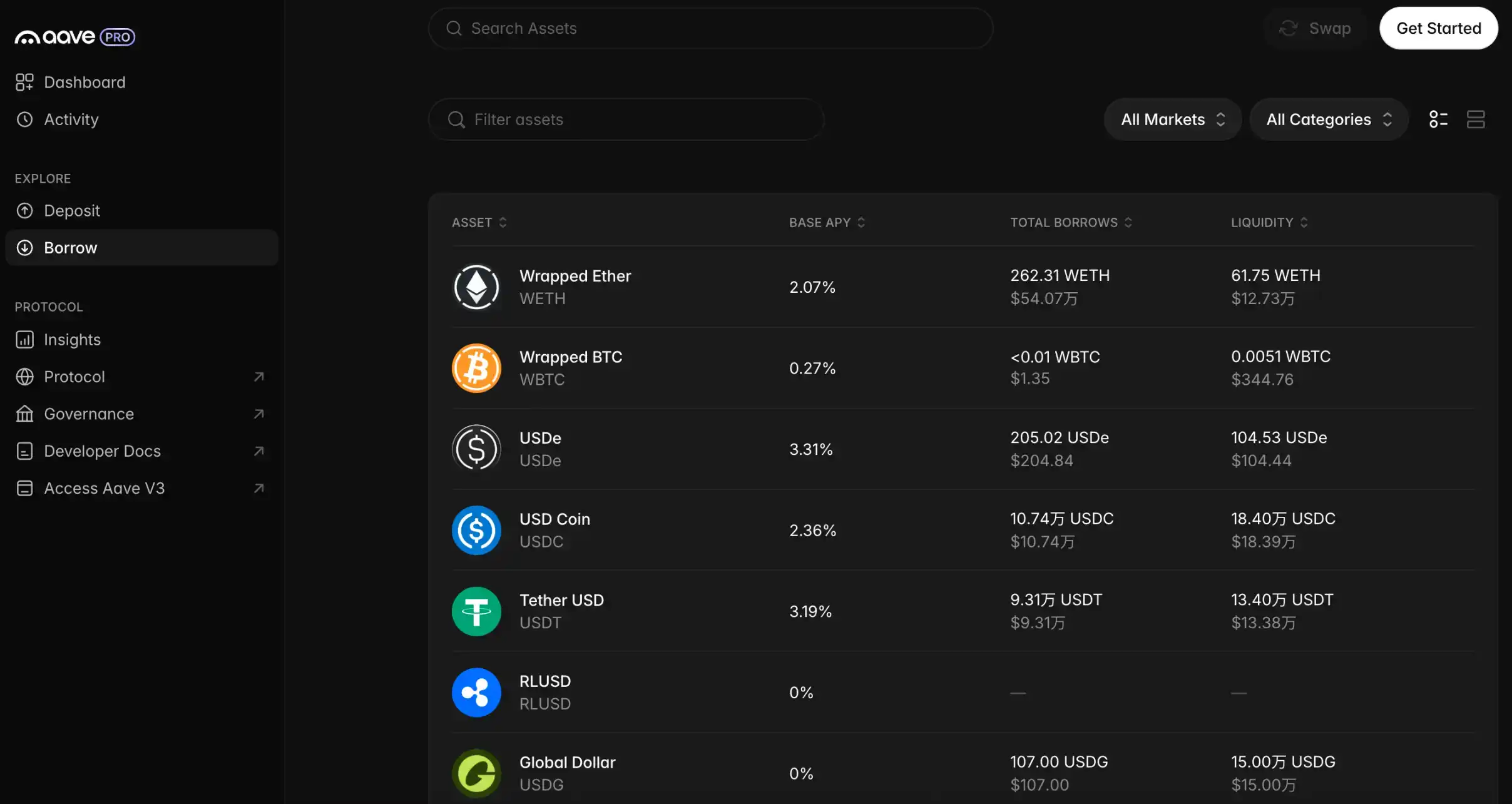
V4 can be described as a complete overhaul of Aave, with the most core change being the integration of previously independent lending markets into a unified liquidity pool architecture: the Hub and Spoke model.

In V4, each chain or L2 has a unified liquidity center (the Hub), where all assets deposited by users for lending are pooled into a single liquidity pool. The Hub is responsible for global coordination, credit limit control, system-level constraints (such as "Total Borrows ≤ Total Supply"), and emergency pauses. The Hub does not interface directly with users; it manages liquidity in the background.

It is worth noting that there is not just one Hub per chain, but different Hubs are designed based on different needs, which is essentially a form of risk isolation. For example, V4 has currently launched the Core Hub, Prime Hub, and Plus Hub. The Core Hub contains mainstream assets and is open to all users, the Prime Hub is designed for suppliers seeking more "controllable" collateral, and the Plus Hub is designed for strategic stablecoins, with its parameters needing to consider the project's scale.
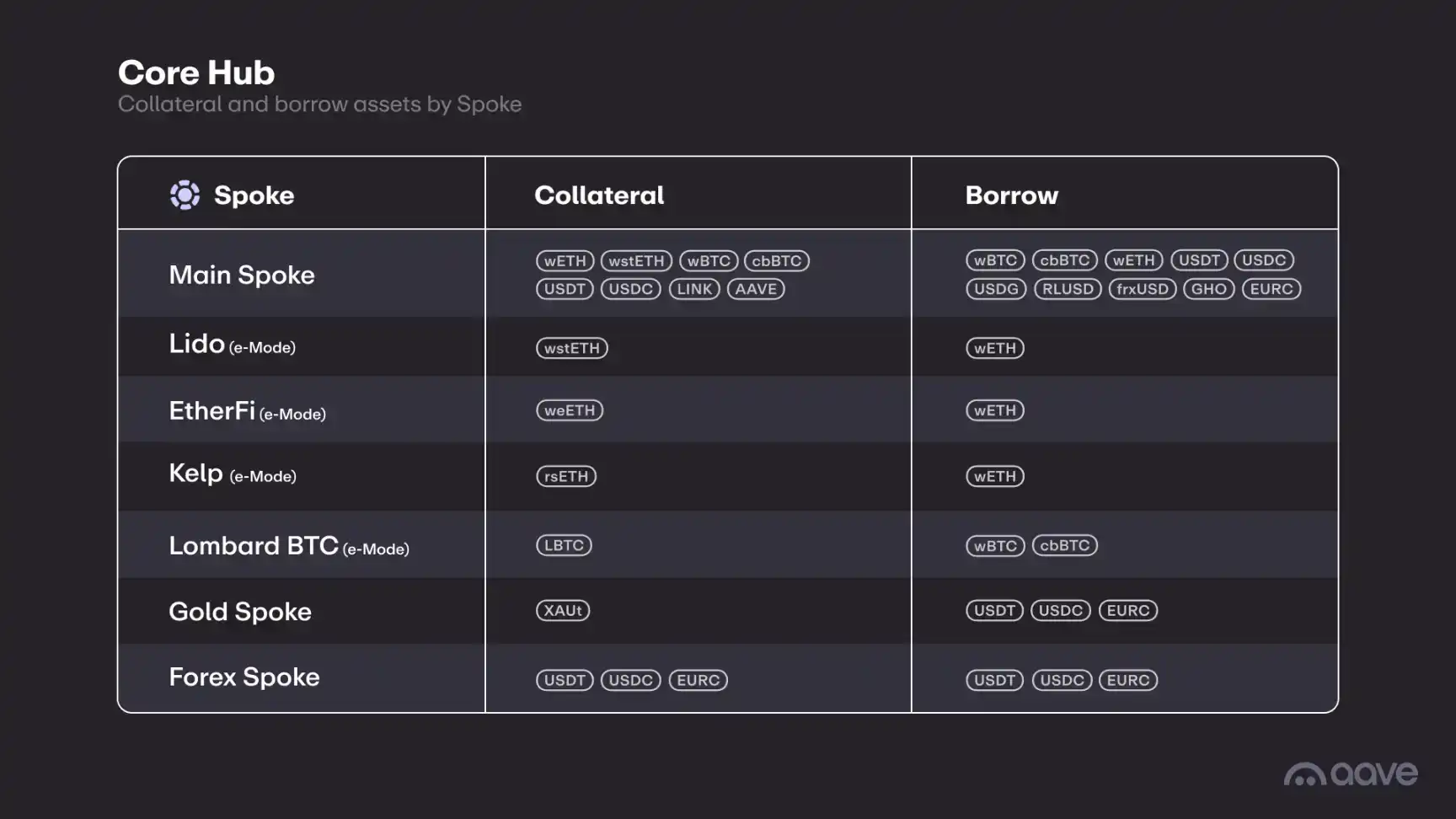
As for the Spoke, you can think of it as an independent market, each with its own lending functions, risk parameters, and collateral rules. Within a single Hub, user assets reside in the same liquidity pool, and borrowers choose different Spokes based on their needs. For example, as shown in the diagram above, a user can deposit WETH as a borrowable asset. Borrowers can borrow WETH from the first four Spokes, but only the EtherFi Spoke allows weETH to be used as collateral.

Although the official claim is that this integrates fragmented liquidity, in practice, the difference is not significant for users borrowing against high-quality collateral. For instance, if you want to抵押 ETH to borrow assets, the operation in V3 and V4 is not fundamentally different, as long as you ensure the health factor does not drop too low.

So, regarding the integration of liquidity, V4 indeed offers more精细 management than independent markets, but it's not a qualitative leap. The real differences come from the customizable parameters of the Spokes and the new liquidation engine.

In V4, a borrower's interest rate depends on the base rate and a risk premium. The base rate, like in V3, uses a utilization curve—rising slowly below optimal utilization and steeply above it. The risk premium depends on the nature of the collateral asset. If the collateral is more stable assets like USDT, ETH, or WBTC, the risk premium will be very low or even 0. However, high-risk altcoins will have a high risk premium, avoiding the situation where "good assets subsidize bad assets."

To give a simple example, in V3, the interest rate depended solely on supply and demand. When borrowing USDT, even though the loan-to-value (LTV) and liquidation threshold might differ, the interest rate for collateralizing ETH and LINK would be the same under the same supply and demand conditions, even though LINK's volatility is higher than ETH's. If the rates are the same, borrowers using LINK as collateral drive up the utilization rate, potentially causing borrowing costs for users collateralizing ETH to rise instead of fall.

V4 optimizes this flaw. Users borrowing against high-risk collateral need to pay a higher cost, while fund providers can earn higher yields. Simultaneously, the higher interest rate curbs borrowing demand, giving users borrowing against优质资产 a more明显的 cost advantage.

Regarding the liquidation mechanism, liquidators will only restore the health factor to the target value preset by the Spoke, and the lower the health factor, the higher the liquidation bonus. This design not only gives borrowers more room for maneuver but also reduces the platform's overall bad debt risk. Additionally, the new liquidation engine includes a "anti-dust mechanism," meaning if the remaining debt or collateral falls below a threshold (e.g., $1000), the liquidator must fully liquidate the position, preventing the accumulation of small残留 amounts that reduce capital efficiency.

Finally, idle liquidity in the Hub can be automatically deployed into low-risk yield strategies approved by governance (such as short-term government bonds, stablecoin LPs, money market instruments, etc.). This increases the income for fund suppliers while also boosting DAO revenue, which is perhaps one of the few advantages of "unified liquidity."

Overall, the advantages of Aave V4's unified liquidity for lending are not显著. The so-called composability—allowing borrowers to manage positions across different Spokes uniformly—is also not much more convenient than V3. But as the title suggests, V4 transforms Aave from a product into a financial infrastructure resembling a "bank."

Setting aside various complex operations, the core business of a bank is to accept deposits, retain a portion as reserves for daily user payments, transfers, etc., and earn the spread between deposits and loans through lending. As for idle funds, the bank can also allocate them to different investments within its risk tolerance.

The Bank of Saint George, established in 1407 in Genoa, Italy, is often considered the world's first bank. It not only provided deposit and loan services but also handled government debt management, currency exchange, and fund transfers, meeting the commercial needs of Genoa as a major European trade center at the time.

From the launch of ETHLend in 2017 to the mainnet release of Aave V4 in 2026, in less than 10 years, Aave has built what the earliest banks looked like. Of course, there are significant differences between Aave and a bank; this is just an analogy. Compared to P2P, the bank model, tempered by centuries of black swan events, is naturally a better choice, just as V4 is an improvement over V3.

If you look closely, you'll find that a vast amount of "innovation" in the DeFi sector has almost become历史尘埃, such as the hot DeFi 2.0 trend in the second half of 2021. Instead, projects like Aave, with simple business logic that has been成熟 in traditional finance for centuries, have survived and thrived. After years of exploration, many DeFi projects have likely discovered this truth: the ceiling for DeFi is high, but not a single step of the path taken by traditional finance can be skipped.

Aave V4's centralized liquidity opens up numerous future possibilities. For example, assets idle for a certain period (e.g., one year) could be allocated to relatively higher-risk investments, such as providing ETH/USDT liquidity on Uniswap. It could operate entirely in the mode of a commercial bank, gradually adding other commercial banking services, such as credit cards (referencing Ethfi's model of spending stablecoins borrowed against collateral), and so on.

Going a step further, Aave could expand into "investment banking." For instance, launching an ICO platform allowing users earning interest on deposited assets to borrow USDT or USDC to participate in investments, eliminating the need to withdraw and sell assets for stablecoins. This way, it could charge fees from projects on one side and collect interest on the other.

Although the Hub & Spoke mechanism doesn't bring massive innovation to lending itself, it paves the way for the next crucial steps.

Пов'язані питання

QWhat is the core architectural change introduced in Aave V4?

AThe core architectural change in Aave V4 is the shift to a unified liquidity pool structure called 'Hub and Spoke'. This consolidates previously isolated lending markets into a single liquidity pool per chain or L2, with a central Hub managing global liquidity, credit limits, and system constraints, while Spokes function as independent markets with their own borrowing features and risk parameters.

QHow does Aave V4's new interest rate model differ from V3?

AIn Aave V4, a borrower's interest rate is determined by a base rate and a risk premium. The base rate, similar to V3, uses a utilization curve. The key difference is the addition of a risk premium based on the collateral asset's quality. Stable assets like ETH or USDT have a low or zero risk premium, while riskier altcoins carry a higher premium, preventing 'good assets from subsidizing bad assets'.

QWhat is the purpose of the new liquidation engine in Aave V4?

AThe new liquidation engine is designed to only restore a borrower's health factor to a Spoke's preset target value, with the liquidation bonus increasing as the health factor decreases. This gives borrowers more operational flexibility and reduces the platform's bad debt risk. It also includes a 'dust prevention mechanism' that forces a full liquidation of positions if the remaining debt or collateral falls below a certain threshold.

QHow does the V4 upgrade transform Aave's business model according to the article?

AThe article posits that the V4 upgrade transforms Aave from a mere product into a 'bank-like' financial infrastructure. By centralizing liquidity, it can operate similarly to a traditional bank: taking deposits, setting aside reserves, lending to earn interest, and automatically deploying idle funds into governance-approved, low-risk yield strategies, paving the way for future banking services.

QWhat future banking-like services does the article suggest Aave could explore after V4?

AThe article suggests Aave could explore services like using long-term idle assets for higher-risk investments (e.g., providing liquidity on Uniswap), offering credit card-like products (using抵押借贷 for spending), and even expanding into investment banking activities such as launching an ICO platform where users can borrow stablecoins to participate without selling their deposited assets.

Пов'язані матеріали

AI Giants Enter the Dark Forest

In the AI industry's "dark forest," major players like Anthropic, OpenAI, and DeepSeek are strategically withholding their most advanced models to avoid becoming targets in a high-stakes competitive landscape. Anthropic released Claude Opus 4.7 but admitted it underperforms compared to their unreleased model Mythos, citing safety concerns. They delayed addressing user complaints about performance regression until OpenAI’s GPT-5.5 launch, highlighting a tactic of controlled disclosure aligned with competitors’ moves. OpenAI’s GPT-5.5, though a full retrain since GPT-4.5, was seen as incremental rather than revolutionary. Leaks revealed internal models like Glacier and Heisenberg, indicating significant unreleased capabilities. OpenAI acknowledges a "capability overhang," where real model power exceeds what users experience, often due to infrastructure-driven throttling. DeepSeek launched V4 Preview, a cost-efficient model, but its full potential (V4 Pro Max) awaits Huawei’s Ascend 950 super-nodes量产 in late 2026. Their strategy focuses on affordability and scalability, aiming to democratize AI access globally, a move noted even by NVIDIA’s CEO as a disruptive threat. Together, these actions reflect a broader trend: leading AI labs are deliberately pacing releases, hiding strengths, and aligning disclosures with competitive dynamics—each avoiding the risk of exposure in a forest where first movers become targets.

marsbit1 год тому

AI Giants Enter the Dark Forest

marsbit1 год тому

Naval Steps Into the Arena: A Historic Collision Between Ordinary People and Venture Capital

Naval Ravikant, co-founder of AngelList and a prominent Silicon Valley thinker, has taken a hands-on role as the chairman of the investment committee at USVC—a new SEC-registered fund allowing non-accredited investors to access high-growth private tech companies with a minimum investment of $500. The fund’s initial portfolio includes leading AI firms like OpenAI, Anthropic, xAI, and others. This move represents a significant shift in democratizing access to venture capital, a space traditionally dominated by institutional investors and high-net-worth individuals. USVC aims to let ordinary investors participate in the high-alpha, pre-IPO growth phase of tech companies—a stage where much of the value creation now occurs before public listings. However, the fund is not without complexities. It offers limited liquidity, with potential quarterly redemptions capped at 5%, and charges an all-in fee of 2.5% in its first year. While this is higher than traditional ETFs, it is positioned as a more accessible alternative to conventional VC fee structures. Ultimately, USVC symbolizes a broader movement toward financial inclusion in high-stakes tech investing—not through crypto or Web3 mechanisms, but via regulated, retail-friendly investment vehicles. It offers a ticket to early-stage innovation, though risks typical of venture capital remain.

marsbit1 год тому

Naval Steps Into the Arena: A Historic Collision Between Ordinary People and Venture Capital

marsbit1 год тому

Торгівля

Спот
Ф'ючерси

Популярні статті

Що таке $BANK

Bank AI: Революційний крок у майбутнє банківської справи Вступ В епоху, що характеризується швидкими технологічними змінами, Bank AI знаходиться на перетині штучного інтелекту (ШІ) та банківських послуг. Цей інноваційний проєкт прагне переосмислити фінансовий ландшафт, підвищуючи ефективність роботи, заходи безпеки та досвід клієнтів завдяки потужності ШІ. Розпочинаючи дослідження Bank AI, ми заглибимося в суть проєкту, його операційні динаміки, історичний контекст і значущі етапи. Що таке Bank AI? У своїй основі Bank AI представляє собою трансформаційну ініціативу, спрямовану на інтеграцію штучного інтелекту в різні банківські операції. Цей проєкт використовує можливості ШІ для автоматизації процесів, покращення протоколів управління ризиками та підвищення взаємодії з клієнтами через персоналізовані послуги. Основні цілі Bank AI включають: Автоматизація банківських функцій: Використовуючи технології ШІ, Bank AI прагне автоматизувати рутинні завдання, зменшуючи навантаження на людські ресурси та підвищуючи ефективність. Покращене управління ризиками: Проєкт використовує алгоритми ШІ для прогнозування та виявлення ризиків, тим самим зміцнюючи заходи безпеки проти шахрайства та інших загроз. Персоналізація банківських послуг: Bank AI зосереджується на пропозиції індивідуальних фінансових продуктів і послуг, аналізуючи дані і поведінку клієнтів. Покращення досвіду клієнтів: Впровадження рішень на основі ШІ, таких як чат-боти та віртуальні асистенти, має на меті забезпечити користувачам більш природну взаємодію, революціонізуючи спосіб, яким клієнти спілкуються з банками. З цими цілями Bank AI займає важливу роль в робленні банківської справи більш ефективною, безпечною та орієнтованою на користувача. Хто є творцем Bank AI? Деталі стосовно творця Bank AI залишаються невідомими. Таким чином, жодна конкретна особа або організація не були ідентифіковані в доступній інформації. Анонімність навколо створення проєкту піднімає питання, але це не зменшує його амбітного бачення та цілей. Хто є інвесторами Bank AI? Аналогічно творцеві проєкту, конкретна інформація стосовно інвесторів або організацій, що підтримують Bank AI, не була розкрито. Без цієї інформації важко окреслити фінансову підтримку та інституційну підтримку, які могли б сприяти розвитку проєкту. Тим не менше, важливість наявності міцної інвестиційної бази є вирішальною для забезпечення розвитку в такій інноваційній сфері. Як працює Bank AI? Bank AI функціонує на кількох інноваційних фронтах, фокусуючись на унікальних факторах, які відрізняють його від традиційних банківських структур. Нижче наведено ключові операційні характеристики: Автоматизація: Застосовуючи алгоритми машинного навчання, Bank AI автоматизує різні ручні процеси в банках. Це призводить до зниження операційних витрат і дозволяє працівникам перенаправити свої зусилля на більш стратегічні завдання. Покращене управління ризиками: Інтеграція ШІ в практики управління ризиками забезпечує банки інструментами для точного прогнозування потенційних загроз, таких як шахрайство, забезпечуючи при цьому безпеку інформації і активів клієнтів. Індивідуальні фінансові рекомендації: Завдяки безперервному навчанню з інтерaktionen з клієнтами, системи ШІ розвивають тонке розуміння потреб користувачів, що дозволяє їм пропонувати персоналізовані поради щодо фінансових рішень. Покращені взаємодії з клієнтами: Використовуючи чат-ботів і віртуальних асистентів на базі ШІ, Bank AI дозволяє створити більш залучений досвід для клієнтів, дозволяючи користувачам швидше отримувати відповіді на свої запитання, зменшуючи час очікування та підвищуючи рівень задоволеності. Разом ці операційні характеристики позиціонують Bank AI як піонера в банківському секторі, встановлюючи нові стандарти для надання послуг і операційної досконалості. Хронологія Bank AI Для розуміння траєкторії Bank AI необхідно ознайомитися з його історичним контекстом. Нижче наведено хронологію, що підкреслює важливі етапи та розробки: Ранні 2010-ті: Концептуалізація інтеграції ШІ в банківські послуги почала привертати увагу, коли банківські установи визнали потенційні переваги. 2018: Відбулося помітне збільшення впровадження технологій ШІ, коли банки почали використовувати інструменти ШІ, такі як чат-боти для базового обслуговування клієнтів та системи управління ризиками для покращення безпеки. 2023: Софістикація ШІ продовжувала розвиватися, з введенням генеративного ШІ для більш складних завдань, таких як обробка документів і аналіз інвестицій в реальному часі. Цей рік став важливим стрибком у можливостях, які забезпечує технологія ШІ для банків. 2024-актуальний статус: Станом на цей рік, Bank AI знаходиться на зростаючій траєкторії, з постійними дослідженнями та розробками, які готові подальше покращити можливості в банківських операціях. Продовження дослідження застосувань ШІ натякає на захоплюючі події, які ще попереду. Ключові моменти про Bank AI Інтеграція ШІ в банківську справу: Bank AI зосереджується на прийнятті штучного інтелекту для оптимізації банківських процесів та покращення досвіду користувачів. Автоматизація та фокус на управлінні ризиками: Проєкт сильного підкреслює ці сфери, прагнучи зshift тягар рутинних завдань, водночас підвищуючи безпеку через прогнозну аналітику. Персоналізовані банківські рішення: Завдяки використанню даних клієнтів, Bank AI забезпечує персоналізовані банківські послуги, що відповідають потребам окремих користувачів. Прихильність до розвитку: Bank AI залишається відданим постійним дослідженням і розробкам, що забезпечують його адаптацію та постійну актуальність у міру того, як технології продовжують розвиватися. Висновок Підсумовуючи, Bank AI є важливим кроком вперед у банківській індустрії, використовуючи штучний інтелект для переформатування операційних парадигм, підвищення безпеки та сприяння задоволеності клієнтів. Незважаючи на прогалини в інформації щодо творця та інвесторів, чіткі цілі і функціональні механізми Bank AI забезпечують міцну основу для його подальшої еволюції. Оскільки технологія ШІ продовжує розвиватися та інтегруватися в банківський сектор, Bank AI має всі шанси суттєво вплинути на майбутнє фінансових послуг, покращуючи спосіб, яким ми розуміємо та взаємодіємо з банківською справою.

146 переглядів усьогоОпубліковано 2024.04.06Оновлено 2024.12.03

Що таке $BANK

Як купити BANK

Ласкаво просимо до HTX.com! Ми зробили покупку Lorenzo Protocol (BANK) простою та зручною. Дотримуйтесь нашої покрокової інструкції, щоб розпочати свою криптовалютну подорож.Крок 1: Створіть обліковий запис на HTXВикористовуйте свою електронну пошту або номер телефону, щоб зареєструвати обліковий запис на HTX безплатно. Пройдіть безпроблемну реєстрацію й отримайте доступ до всіх функцій.ЗареєструватисьКрок 2: Перейдіть до розділу Купити крипту і виберіть спосіб оплатиКредитна/дебетова картка: використовуйте вашу картку Visa або Mastercard, щоб миттєво купити Lorenzo Protocol (BANK).Баланс: використовуйте кошти з балансу вашого рахунку HTX для безперешкодної торгівлі.Треті особи: ми додали популярні способи оплати, такі як Google Pay та Apple Pay, щоб підвищити зручність.P2P: Торгуйте безпосередньо з іншими користувачами на HTX.Позабіржова торгівля (OTC): ми пропонуємо індивідуальні послуги та конкурентні обмінні курси для трейдерів.Крок 3: Зберігайте свої Lorenzo Protocol (BANK)Після придбання Lorenzo Protocol (BANK) збережіть його у своєму обліковому записі на HTX. Крім того, ви можете відправити його в інше місце за допомогою блокчейн-переказу або використовувати його для торгівлі іншими криптовалютами.Крок 4: Торгівля Lorenzo Protocol (BANK)Легко торгуйте Lorenzo Protocol (BANK) на спотовому ринку HTX. Просто увійдіть до свого облікового запису, виберіть торгову пару, укладайте угоди та спостерігайте за ними в режимі реального часу. Ми пропонуємо зручний досвід як для початківців, так і для досвідчених трейдерів.

613 переглядів усьогоОпубліковано 2025.05.09Оновлено 2025.05.09

Як купити BANK

Обговорення

Ласкаво просимо до спільноти HTX. Тут ви можете бути в курсі останніх подій розвитку платформи та отримати доступ до професійної ринкової інформації. Нижче представлені думки користувачів щодо ціни BANK (BANK).

活动图片