Decentralization at risk as 100 wallets hold 80% of DeFi supply: Report

ambcryptoОпубліковано о 2026-03-29Востаннє оновлено о 2026-03-29

Анотація

DeFi's decentralization is under threat as new data reveals extreme concentration of governance power. A report from the ECB shows the top 100 wallets control over 80% of the token supply across major protocols, while just 10-20 voters hold up to 96% of delegated voting power in some cases. With participation rates as low as 4-12%, decision-making is effectively controlled by a small group of entities, including founders, treasuries, and centralized exchanges. This makes regulators' jobs easier, as they can now identify clear control points, increasing DeFi's regulatory exposure under frameworks like MiCA. Consequently, markets are repricing DAO tokens, with a growing premium placed on protocols that demonstrate broader participation and transparency, while those with concentrated control face valuation pressures.

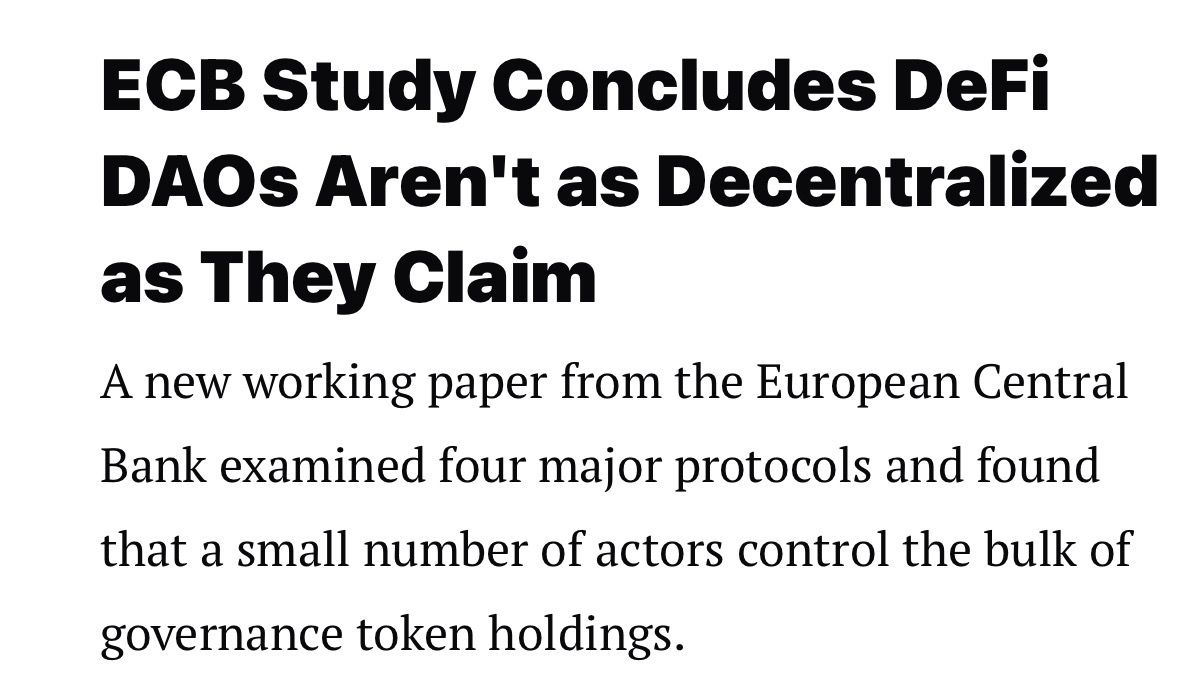
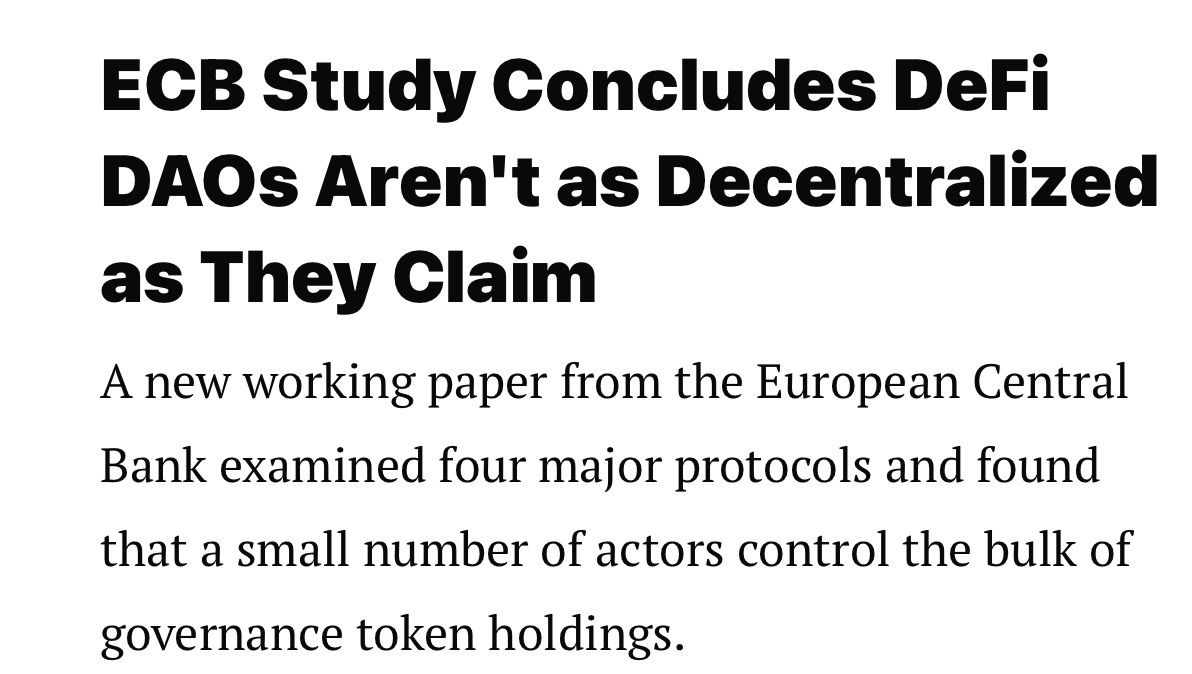
DeFi’s decentralization narrative is now being tested, as governance data reveals power is not widely distributed. The ECB’s March 2026 paper shows the top 100 holders control over 80% of tokens across major protocols, forming a clear concentration.

As this structure persists, decision-making shifts toward a small group, often including treasuries, founders, and centralized exchanges. Delegation intensifies this effect, as just 10–20 voters control up to 96% of delegated power.
Source: X

Participation remains low at 5–12%, which means most holders do not influence outcomes, leaving control in fewer hands. This imbalance matters because regulators can now identify who shapes protocol decisions.

As frameworks like MiCA tighten, these visible control points increase regulatory exposure. This shift suggests DeFi may face oversight similar to traditional finance structures.

DeFi governance narrows, but who is in control?

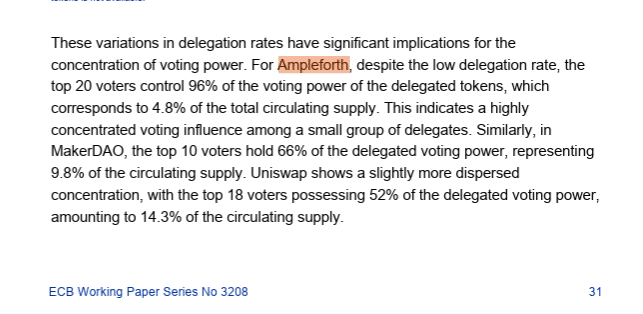
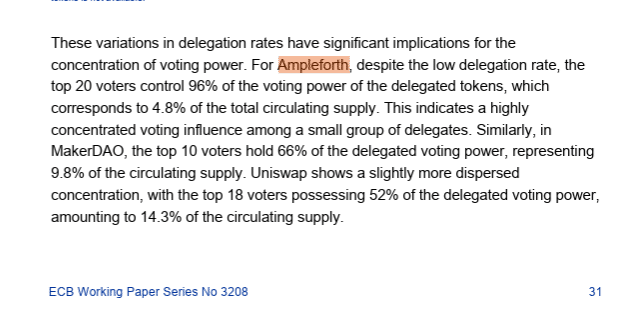
DeFi governance is shifting from broad ownership to concentrated control, as delegation hands decision power to a small group. The ECB’s March 2026 paper shows the trend clearly, with the top 20 voters in Ampleforth controlling 96.04% of delegated votes.
Source: ECB.Europa.eu

As this structure develops, the results rely more on a small number of active delegates than on the larger holder base. Influence clusters quickly, as seen by the fact that Uniswap’s top 18 hold 52% and MakerDAO’s top 10 control 66%.

Nevertheless, since one-third to almost 50% of the top voters cannot be identified, this focus does not translate into obvious accountability. Delegation separates traceable ownership from influence, which is why this occurs.

This creates a market where control is concentrated but partially hidden. As a result, DeFi’s decentralization weakens, while regulatory pressure rises without fully resolving enforceability.

DAO tokens reprice as decentralization weakens

Such a concentration of delegated voting power is now affecting DAO token prices, as markets reassess how decentralized these systems really are. Decision-making remains limited to a small group, with participation staying at 4–12%.

Due to the lack of widespread control, the decentralization premium decreases as the trend continues. Investors start to doubt the true worth of governance tokens, which makes this trend significant.

Perceived risk rises when regulators highlight distinct control groups, which puts further pressure on tokens with lax governance. At the same time, protocols that are more transparent and involve more people are becoming more popular.

This shift suggests DAO tokens will be priced based on governance quality, where broader participation supports value, while concentrated control leads to weaker performance.


Final Summary

  • DeFi governance shows concentrated control, weakening decentralization and increasing regulatory exposure.
  • DeFi governance concentration pressures DAO token valuations, as markets favor stronger transparency and broader participation.


Пов'язані питання

QWhat percentage of tokens across major DeFi protocols are controlled by the top 100 holders, according to the ECB's report?

AThe top 100 holders control over 80% of tokens across major DeFi protocols.

QHow does delegation intensify the concentration of power in DeFi governance?

ADelegation intensifies this effect, as just 10–20 voters control up to 96% of delegated power.

QWhat is the typical participation rate in DeFi governance, and what does this imply for decision-making?

AParticipation remains low at 5–12%, which means most holders do not influence outcomes, leaving control in fewer hands.

QHow is the market reassessing the value of DAO tokens in light of governance concentration?

AMarkets are reassessing how decentralized these systems really are, and the decentralization premium decreases. DAO tokens are being priced based on governance quality, where broader participation supports value, while concentrated control leads to weaker performance.

QWhat regulatory risk arises from the visible concentration of control in DeFi protocols?

AAs regulatory frameworks like MiCA tighten, these visible control points increase regulatory exposure, suggesting DeFi may face oversight similar to traditional finance structures.

Пов'язані матеріали

Within Strategy's Framework, STRC's Dividend Yield Remains at 12% as Share Price Stays Below Par Value

Michael Saylor, Executive Chairman of Strategy (MSTR), confirmed that the dividend rate for its STRC perpetual preferred shares will remain at 12.00% through August 2026. The rate has increased from 9% at its July 2025 launch to the current high via a "ratchet" mechanism, which permanently raises the rate by 0.5% whenever the share price falls below $95. This mechanism is intended to push the price back toward its $100 par value and support Strategy's "at-the-market" (ATM) program for issuing new shares to fund Bitcoin purchases. However, the mechanism has not worked as intended. STRC shares closed at $89.46 on July 31, remaining about 10-11% below par value despite the record-high dividend. Competition from rival Strive's higher-yielding SATA securities has pressured demand. The persistent discount has forced Strategy to suspend new STRC issuances via its ATM program, limiting this funding channel for Bitcoin acquisitions. STRC's struggles reflect Bitcoin's own volatility, as the preferred shares historically move in tandem. Analysts have warned the ratchet structure carries long-term, one-way risk. A law firm is investigating Strategy's ability to maintain dividend payments if Bitcoin's price stays low. Retail investors own roughly 83% of outstanding STRC shares, a group seen as prone to panic selling during downturns. In response, Strategy has established financial reserves, including a liquidity cushion covering about 26 months of dividend/interest obligations, and a $2 billion share buyback program alongside a Bitcoin monetization framework, though the company emphasized it is not obligated to sell any Bitcoin.

cryptonews.ru30 хв тому

Within Strategy's Framework, STRC's Dividend Yield Remains at 12% as Share Price Stays Below Par Value

cryptonews.ru30 хв тому

Analyst: Bitcoin's Price Will Drop to $60k in August, Then Rebound to $70k

Financial analyst Andrey Poroshin has provided a new forecast for Bitcoin's price dynamics in August. Poroshin, an analyst at the Bitbanker exchange, expects the cryptocurrency market to experience a downturn this month, with prices retesting the $60,000 level due to a lack of supportive macroeconomic catalysts. He noted that the recent US Federal Reserve decision to hold interest rates did not significantly impact the market, while inflation remains above the 2% target. Poroshin stated that Bitcoin is ending July under pressure from moderate volatility and a lack of new macroeconomic stimuli, leading to continued market caution. According to his base scenario, Bitcoin will drop to a range of $60,000 to $62,000 before recovering to $70,000. He pointed out that even $70,000 remains below the cost of mining in the US, which has prompted some miners to shift towards AI data center operations. Poroshin cited the winding down of BitMEX's operations as a potential catalyst for a price rebound, suggesting the exit of weaker players often coincides with market reversals and reduced short-term selling pressure. He believes Bitcoin is currently less susceptible to geopolitical shocks, such as the Iran-US conflict, and does not expect significant market changes in August related to the pending CLARITY Act. Looking ahead, Poroshin forecasts that September will bring more active price fluctuations driven by potential Fed rate decisions and possible discussions or approval of the CLARITY Act.

cryptonews.ru31 хв тому

Analyst: Bitcoin's Price Will Drop to $60k in August, Then Rebound to $70k

cryptonews.ru31 хв тому

Торгівля

Спот
活动图片




