Decentralization at risk as 100 wallets hold 80% of DeFi supply: Report

ambcryptoОпубліковано о 2026-03-29Востаннє оновлено о 2026-03-29

Анотація

DeFi's decentralization is under threat as new data reveals extreme concentration of governance power. A report from the ECB shows the top 100 wallets control over 80% of the token supply across major protocols, while just 10-20 voters hold up to 96% of delegated voting power in some cases. With participation rates as low as 4-12%, decision-making is effectively controlled by a small group of entities, including founders, treasuries, and centralized exchanges. This makes regulators' jobs easier, as they can now identify clear control points, increasing DeFi's regulatory exposure under frameworks like MiCA. Consequently, markets are repricing DAO tokens, with a growing premium placed on protocols that demonstrate broader participation and transparency, while those with concentrated control face valuation pressures.

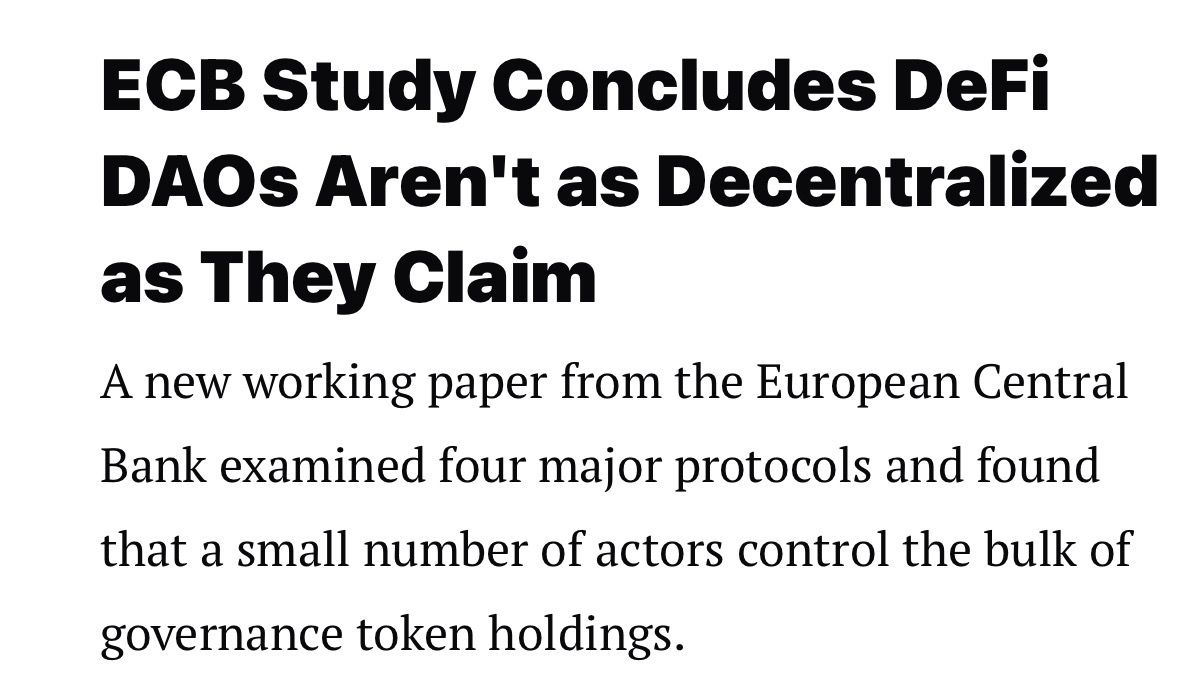
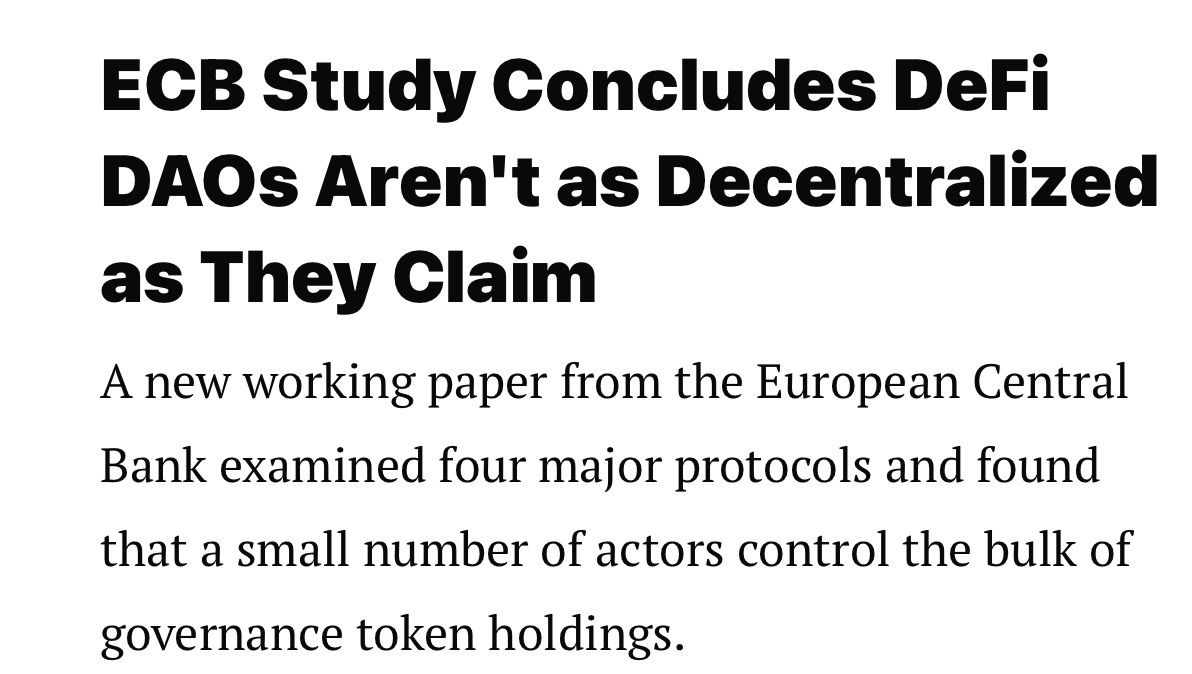
DeFi’s decentralization narrative is now being tested, as governance data reveals power is not widely distributed. The ECB’s March 2026 paper shows the top 100 holders control over 80% of tokens across major protocols, forming a clear concentration.

As this structure persists, decision-making shifts toward a small group, often including treasuries, founders, and centralized exchanges. Delegation intensifies this effect, as just 10–20 voters control up to 96% of delegated power.
Source: X

Participation remains low at 5–12%, which means most holders do not influence outcomes, leaving control in fewer hands. This imbalance matters because regulators can now identify who shapes protocol decisions.

As frameworks like MiCA tighten, these visible control points increase regulatory exposure. This shift suggests DeFi may face oversight similar to traditional finance structures.

DeFi governance narrows, but who is in control?

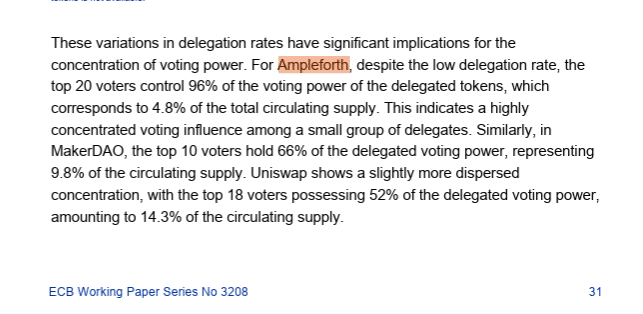
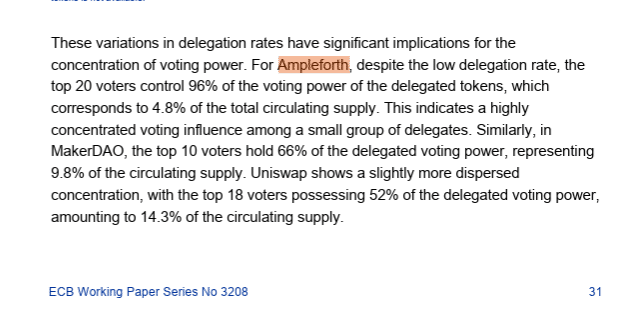
DeFi governance is shifting from broad ownership to concentrated control, as delegation hands decision power to a small group. The ECB’s March 2026 paper shows the trend clearly, with the top 20 voters in Ampleforth controlling 96.04% of delegated votes.
Source: ECB.Europa.eu

As this structure develops, the results rely more on a small number of active delegates than on the larger holder base. Influence clusters quickly, as seen by the fact that Uniswap’s top 18 hold 52% and MakerDAO’s top 10 control 66%.

Nevertheless, since one-third to almost 50% of the top voters cannot be identified, this focus does not translate into obvious accountability. Delegation separates traceable ownership from influence, which is why this occurs.

This creates a market where control is concentrated but partially hidden. As a result, DeFi’s decentralization weakens, while regulatory pressure rises without fully resolving enforceability.

DAO tokens reprice as decentralization weakens

Such a concentration of delegated voting power is now affecting DAO token prices, as markets reassess how decentralized these systems really are. Decision-making remains limited to a small group, with participation staying at 4–12%.

Due to the lack of widespread control, the decentralization premium decreases as the trend continues. Investors start to doubt the true worth of governance tokens, which makes this trend significant.

Perceived risk rises when regulators highlight distinct control groups, which puts further pressure on tokens with lax governance. At the same time, protocols that are more transparent and involve more people are becoming more popular.

This shift suggests DAO tokens will be priced based on governance quality, where broader participation supports value, while concentrated control leads to weaker performance.


Final Summary

  • DeFi governance shows concentrated control, weakening decentralization and increasing regulatory exposure.
  • DeFi governance concentration pressures DAO token valuations, as markets favor stronger transparency and broader participation.


Пов'язані питання

QWhat percentage of tokens across major DeFi protocols are controlled by the top 100 holders, according to the ECB's report?

AThe top 100 holders control over 80% of tokens across major DeFi protocols.

QHow does delegation intensify the concentration of power in DeFi governance?

ADelegation intensifies this effect, as just 10–20 voters control up to 96% of delegated power.

QWhat is the typical participation rate in DeFi governance, and what does this imply for decision-making?

AParticipation remains low at 5–12%, which means most holders do not influence outcomes, leaving control in fewer hands.

QHow is the market reassessing the value of DAO tokens in light of governance concentration?

AMarkets are reassessing how decentralized these systems really are, and the decentralization premium decreases. DAO tokens are being priced based on governance quality, where broader participation supports value, while concentrated control leads to weaker performance.

QWhat regulatory risk arises from the visible concentration of control in DeFi protocols?

AAs regulatory frameworks like MiCA tighten, these visible control points increase regulatory exposure, suggesting DeFi may face oversight similar to traditional finance structures.

Пов'язані матеріали

Apple Finally Admits, Siri Is Getting Old

In a significant shift, Apple has rebranded Siri to "Siri AI" at WWDC 2026, acknowledging the assistant's limitations after years of stagnation. The company announced a deep partnership with Google, leveraging Gemini's model capabilities to train its new Apple Foundation Models. This collaboration extends Apple's Private Cloud Compute to Google Cloud and Nvidia GPUs for the first time. The article traces Siri's history from its groundbreaking 2011 debut to its subsequent confinement within Apple's closed ecosystem, prioritizing control and privacy over expansive functionality. While Apple integrated AI into its hardware and systems over the years (e.g., Neural Engine, Core ML), it missed the paradigm shift brought by generative AI models like ChatGPT. Facing pressure, Apple restructured its AI leadership and opted to license Google's Gemini technology—reportedly paying around $1 billion annually—to power the revamped Siri. The strategy involves "distilling" knowledge from the large Gemini model into smaller, on-device models. Apple also plans to use Google Cloud's Nvidia GPUs for complex cloud inference tasks. The core vision for "Apple Intelligence" is a system-level assistant that reduces cognitive load: summarizing notifications and emails, drafting context-aware replies, and retrieving relevant information across apps. Siri gains a dedicated app with memory and cross-device sync. However, this AI push comes with hardware requirements, potentially excluding older iPhones. A major challenge is China, where Apple Intelligence will likely be a different product due to local regulations, requiring partnership with a domestic AI provider. The article concludes by questioning the future of personal AI, noting that true understanding involves more than data access—it requires knowing where to stop. Apple's partnership marks a humble beginning in its quest to build a genuinely helpful, yet respectful, personal assistant.

marsbit27 хв тому

Apple Finally Admits, Siri Is Getting Old

marsbit27 хв тому

Торгівля

Спот
Ф'ючерси
活动图片




