DDC Enterprise Increases Bitcoin Holdings by 200, Advancing Steadiness in Treasury Strategy

marsbitОпубліковано о 2026-01-22Востаннє оновлено о 2026-01-22

Анотація

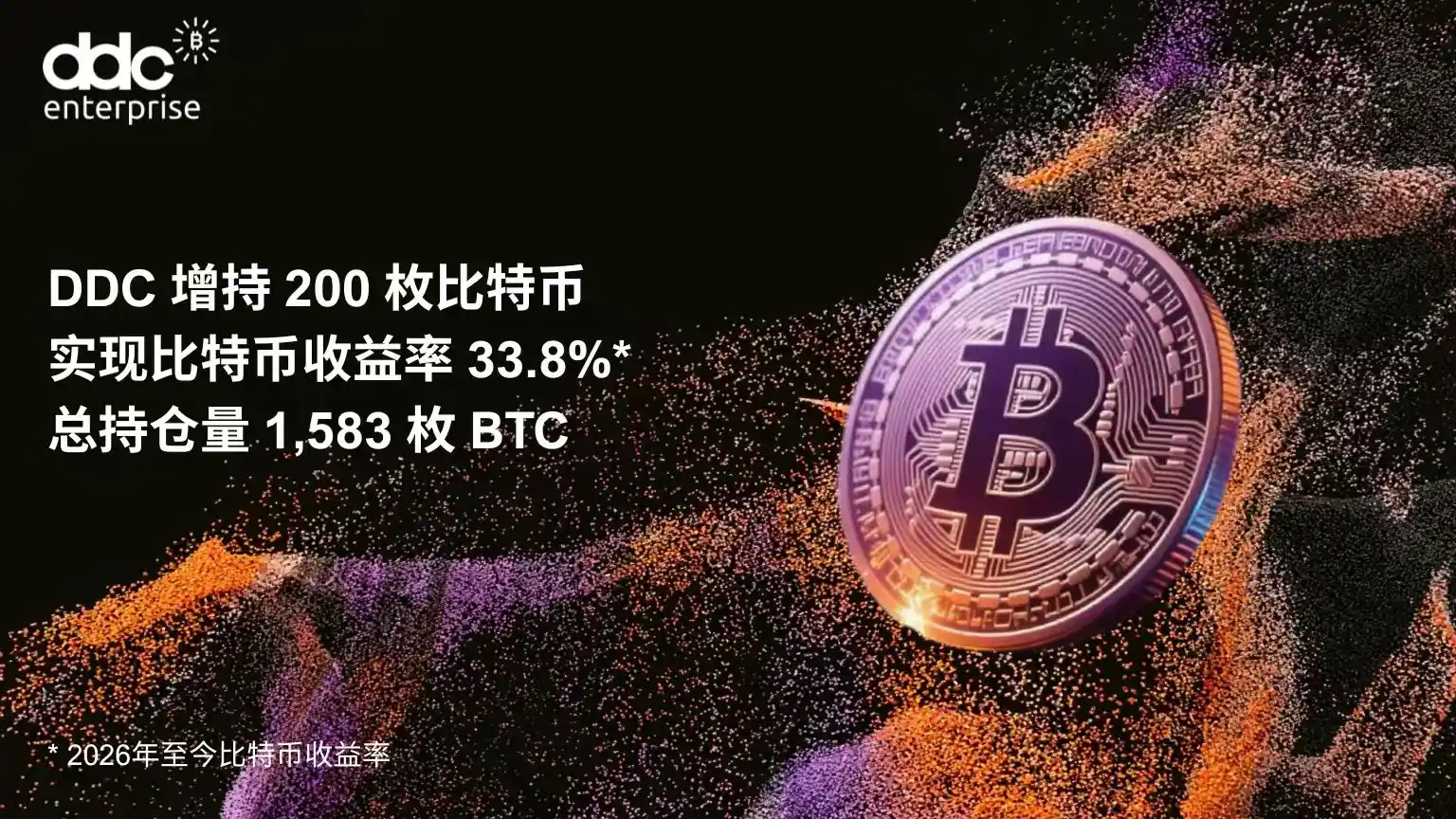
DDC Enterprise Limited (NYSEAMERICAN: DDC), a global Asian food platform and digital asset management company, announced on January 22, 2026, that it has purchased an additional 200 Bitcoin as part of its established Bitcoin reserve strategy. This acquisition brings the company’s total Bitcoin holdings to 1,583. The move reflects DDC’s disciplined capital allocation approach, emphasizing steady accumulation across market cycles with strong governance and risk controls. The purchase was made during a market correction, underscoring the company’s long-term value focus rather than short-term volatility. Key highlights include: - Total Bitcoin held: 1,583 - Average purchase price: $88,085 per Bitcoin - Year-to-date return on Bitcoin holdings: 33.8% - Bitcoin per 1,000 shares: 0.053203 Norma Chu, Founder, Chairwoman, and CEO, stated in the 2026 Shareholder Letter that companies prepared for the long term can identify opportunities amid volatility. DDC continues to strengthen its Bitcoin reserve under a clear governance framework as part of its treasury strategy.

NEW YORK, January 22, 2026 – DDC Enterprise Limited (NYSEAMERICAN: DDC, hereinafter referred to as "DDC" or the "Company"), a global Asian food platform and digital asset treasury management company, today announced that, as part of its established Bitcoin reserve plan, it has completed a new round of accumulation, purchasing an additional 200 Bitcoin.

Following this transaction, DDC's total Bitcoin holdings have increased to 1,583.

The Company stated that this acquisition continues its consistent principle of prudent capital allocation, emphasizing the orderly advancement of its treasury strategy under a clear governance framework and risk control mechanisms. This purchase was timed with a phase of correction in the crypto asset market, reflecting the Company's strategic judgment based on long-term value rather than being overly influenced by short-term market fluctuations.

DDC pointed out that the core philosophy of its treasury management includes: maintaining a steady pace of gradual accumulation across different market cycles, strictly controlling capital costs, and managing risks throughout the entire process.

Key Highlights of This Acquisition

• Reserve Growth: Bitcoin holdings increased by 200

• Holding Milestone: Total Bitcoin holdings reach 1,583

• Average Holding Cost: $88,085 per Bitcoin

• Year-to-Date Return on Bitcoin Holdings: 33.8%

• Holdings per Share: 0.053203 Bitcoin per 1,000 shares of DDC stock

Norma Chu, Founder, Chairperson of the Board, and Chief Executive Officer of DDC, stated in the "2026 Letter to Shareholders": "Market volatility is inevitable in the early stages of institutional participation. However, we believe that companies truly prepared for the long term can identify and seize opportunities within this volatility. The Company's core direction remains steadily advancing reserve expansion, continuously building a competitive Bitcoin treasury with long-term potential, supported by a robust governance system."

The Company indicated that more details regarding its long-term capital allocation strategy and Bitcoin reserve management framework are provided in the newly released "2026 Letter to Shareholders".

About DDC Enterprise Limited

DDC Enterprise Limited (NYSEAMERICAN: DDC), while maintaining its position as a leading global Asian food platform, is methodically advancing its corporate Bitcoin treasury strategy. The Company has strategically established Bitcoin as a core reserve asset and continues to expand its portfolio of restaurant concepts. DDC is at the forefront of exploration among public companies integrating Bitcoin into their financial architecture.


Пов'язані матеріали

Is AI Creating a New Class of 'Information Poor'?

AI is generating a new kind of "information poverty." The core issue isn't that AI denies answers to the poor; it's that it provides abundant, cheap, and plausible-sounding answers to everyone. This availability shifts the true scarcity from obtaining answers to possessing the **judgment to evaluate them** and the access to turn them into real-world opportunities. New information poverty thus describes those who have AI tools and outputs, but lack the complementary skills, authorization, and contextual experience to critically assess and act on them. Research reveals a multi-layered divide: access to AI is stratified by income and platform design (e.g., premium vs. free, embedded tools). In workplaces, usage heavily favors higher-paid, more experienced, or formally trained employees, with AI often automating entry-level tasks that were traditional stepping stones. Crucially, the heaviest users are often mid-career professionals whose existing expertise allows them to effectively judge and leverage AI outputs, while novices risk over-relying on them without building judgment. While controlled experiments show AI can significantly boost low-skilled workers' performance, real-world adoption and benefit are constrained by unequal social and organizational structures. Historically, general-purpose technologies first reward those with existing complementary capital. AI, by affecting judgment-based work, may accelerate and deepen this initial inequality gap, even if it narrows over decades. The danger lies in the illusion of competence it creates, potentially stunting the very critical thinking needed in an era where judgment is paramount.

marsbit5 хв тому

Is AI Creating a New Class of 'Information Poor'?

marsbit5 хв тому

Jensen Huang 'Saves' South Korean Stock Market: Locks In SK Hynix Memory, Chip Shortage to Continue

On June 5th, South Korea's stock market experienced a sharp decline, with major chipmakers like Samsung and SK Hynix dropping nearly 10%. Amidst the turmoil, NVIDIA CEO Jensen Huang's visit to Seoul played a dramatic role in boosting market sentiment. Following a dinner meeting with SK Group Chairman Chey Tae-won and SK Hynix CEO Kwak Noh-Jung, Huang confirmed that NVIDIA's new Vera CPU will utilize SK Hynix DRAM. The companies announced a multi-year technical partnership to co-develop next-generation memory for NVIDIA's AI infrastructure, covering products from data centers to personal AI and robotics. This collaboration extends beyond memory supply. SK Hynix is integrating NVIDIA's AI and Omniverse platform into its own semiconductor design and manufacturing processes, including computational lithography and creating digital twins of its fabrication plants for autonomous operation. While strengthening ties with SK Hynix, NVIDIA is diversifying its supply chain for the upcoming HBM4 memory, with Samsung, SK Hynix, and Micron all certified as suppliers for its Vera Rubin platform. Despite this, Huang warned that the global chip shortage, driven by relentless demand from AI factory construction, is expected to persist for several years across the entire supply chain. His visit underscores NVIDIA's systematic effort to deepen integration with South Korea's broader tech industry.

marsbit57 хв тому

Jensen Huang 'Saves' South Korean Stock Market: Locks In SK Hynix Memory, Chip Shortage to Continue

marsbit57 хв тому

Nasdaq Plunges 4.2% in a Single Day: Does "Black Friday" Burst the U.S. Stock Market Bubble?

The Nasdaq plunged 4.18% on June 5, 2026, its worst single-day drop in over a year, as a much stronger-than-expected US jobs report triggered fears of economic overheating and delayed Federal Reserve interest rate cuts. The selloff, centered on high-valuation tech and AI stocks like Nvidia and Broadcom, spread across major indices. The article examines whether this signals a market top. The strong May non-farm payrolls data, nearly double expectations, pushed bond yields higher, directly hurting rate-sensitive tech stocks. This exposed vulnerabilities in the crowded AI trade, where valuations had soared on narratives of infinite growth, despite emerging signs of slowing order momentum and corporate AI monetization challenges. Prior to the drop, market indicators flashed warning signs: historically high valuations (e.g., Shiller CAPE ratio near 39.5), extreme bullish sentiment, and high levels of leverage. Technical charts showed key support levels being breached. Wall Street is divided on the outlook. Bears, citing risks of "stagflation" and AI bubble comparisons to the dot-com era, warn of a potential significant correction. Bulls view the drop as a healthy correction within a bull market, underpinned by a strong economy and expected corporate earnings growth of around 7% in 2026. The immediate future hinges on upcoming key events: the May CPI inflation data and the mid-June FOMC meeting. Their outcomes will critically shape market expectations for the Fed's rate path. The article concludes that conditions for a major market top are aligning, marking a fragile transition from narrative-driven gains to a phase demanding validation from macroeconomic data and corporate fundamentals. Caution is advised.

marsbit1 год тому

Nasdaq Plunges 4.2% in a Single Day: Does "Black Friday" Burst the U.S. Stock Market Bubble?

marsbit1 год тому

Nasdaq Plunges 4.2% in a Single Day, Did 'Black Friday' Pop the U.S. Stock Bubble?

The Nasdaq Composite plummeted 4.18% on June 5, its biggest single-day drop since April 2025, triggering widespread debate over whether the U.S. stock market has peaked. The sell-off was sparked by a stronger-than-expected U.S. non-farm payrolls report, which fueled fears of economic overheating and pushed back market expectations for Federal Reserve rate cuts, leading to a sharp rise in Treasury yields. The AI sector, the primary driver of the recent bull market, suffered severe losses, with the Philadelphia Semiconductor Index crashing over 10%. Stocks like Nvidia, Broadcom, and Micron led the decline. Concerns are mounting about the sustainability of AI capital expenditures and high valuations, with signs of order cuts for next-generation chips emerging. Analyses point to several warning signs: historically high market valuations (e.g., elevated Shiller CAPE ratio, Buffett Indicator), extreme bullish sentiment indicators, and significant insider selling. The sell-off also caused a key technical breakdown, with the S&P 500 breaking below its short-term moving average and testing its 200-day moving average. Wall Street is divided on the outlook. Bears warn this could be the start of a bubble deflation or a "stagflation" scenario, while bulls view it as a healthy, overdue correction within a bull market driven by solid corporate earnings growth. A more moderate view suggests the easy liquidity-driven rally is over, and markets are entering a phase of fundamental stock-picking with potential for consolidation. The immediate future hinges on key upcoming events: the May CPI report and the mid-June FOMC meeting. Their outcomes will be critical in determining whether this is a temporary pullback or the beginning of a more significant trend reversal. The consensus is that the era of one-directional market gains may be ending, requiring increased investor caution.

Odaily星球日报1 год тому

Nasdaq Plunges 4.2% in a Single Day, Did 'Black Friday' Pop the U.S. Stock Bubble?

Odaily星球日报1 год тому

The First Case on AI Agents: What Was Adjudicated?

"The First 'Agent' Ruling: What Was Decided?" On April 30, the Guangzhou Internet Court issued a ruling—China's first behavior preservation order in the intelligent agent (AI agent) field. The defendant, an open-source AI agent software, was ordered to stop downloads, cease actions that bypassed a platform's technical protection measures, and delete related tutorials and data. The core issue: the software used the operating system's "accessibility service" permissions to automate user interactions within other apps without those platforms' authorization. This mirrors a recent US case where Amazon sued Perplexity for similar reasons—bypassing Amazon's API to directly scrape and interact with its pages—and won a preliminary injunction. Both rulings establish a crucial legal boundary for the AI agent era: agents cannot operate unchecked. The article argues the fundamental legal principle emerging is one of **dual authorization**. An AI agent requires both **user consent** AND **platform consent** to operate legitimately within that platform's ecosystem. Bypassing platform rules through system-level permissions, even with user permission, undermines platform responsibilities for content moderation, data security, and user privacy, creating liability issues. The piece uses the evolution of "Doubao Phone" (an AI-integrated smartphone) as a case study. Its initial, aggressive version that bypassed platform controls faced roadblocks. Its upcoming 2.0 version is reportedly pivoting to negotiate API access and authorization deals with major platforms (like Alibaba's ecosystem), seen as a strategic adaptation to the new regulatory reality. A global trend is identified: the era of unregulated, "wild west" growth for AI agents is ending, replaced by a **compliance race**. This raises barriers to entry, as securing platform authorizations becomes a new cost. Open-source status is also not a legal shield if the code facilitates bypassing technical protections. In conclusion, these first rulings target not the largest, but the most **aggressive and representative** cases. By setting precedent with them, regulators are efficiently steering the entire industry towards a new, more regulated operating paradigm defined by dual authorization and platform cooperation.

marsbit1 год тому

The First Case on AI Agents: What Was Adjudicated?

marsbit1 год тому

Торгівля

Спот
Ф'ючерси
活动图片