DAT: The Evolution of Digital Asset Treasuries as Strategic Assets for Crypto Enterprises

marsbitОпубліковано о 2025-12-22Востаннє оновлено о 2025-12-22

Анотація

By the end of 2025, the Digital Asset Treasury (DAT) remains a significant corporate trend in the crypto industry, evolving from passive market participation to a strategic resource integrated into long-term enterprise planning. Companies are increasingly incorporating digital assets like Bitcoin and Ethereum into their balance sheets, shifting focus from mere accumulation to rational asset allocation, risk management, and strategic engagement with blockchain ecosystems. DAT strategies now emphasize diversification, cash flow stability, and participation in on-chain governance, staking, and lending, transforming digital assets into tools for operational resilience and ecosystem influence. Market structure is maturing, with indices like MSCI raising standards for transparency and governance, moving from asset-driven to capability-driven evaluations. Enterprises demonstrating robust risk controls, diversified portfolios, and synergistic business-ecosystem integration show greater resilience. The industry is experiencing differentiation: firms with clear strategic frameworks and sustainable practices are gaining competitive edges, while those reliant on single assets or market sentiment face constraints. Ultimately, DAT's value lies not in the volume of assets held but in the ability to embed them within a coherent strategy, sound governance, and active ecological participation, marking a shift from financial instruments to key strategic resources in corporate growth.

By the end of 2025, Digital Asset Treasuries (DAT) remain one of the most noteworthy corporate behaviors in the crypto industry. An increasing number of enterprises are choosing to incorporate digital assets into their balance sheets. This move is no longer merely a passive participation in market trends but an attempt to transform digital assets into long-term strategic resources. As market conditions and regulatory expectations gradually evolve, the DAT industry is undergoing structural optimization and capability screening. Its core value has shifted from单纯的 asset holding to a test of corporate strategic execution.

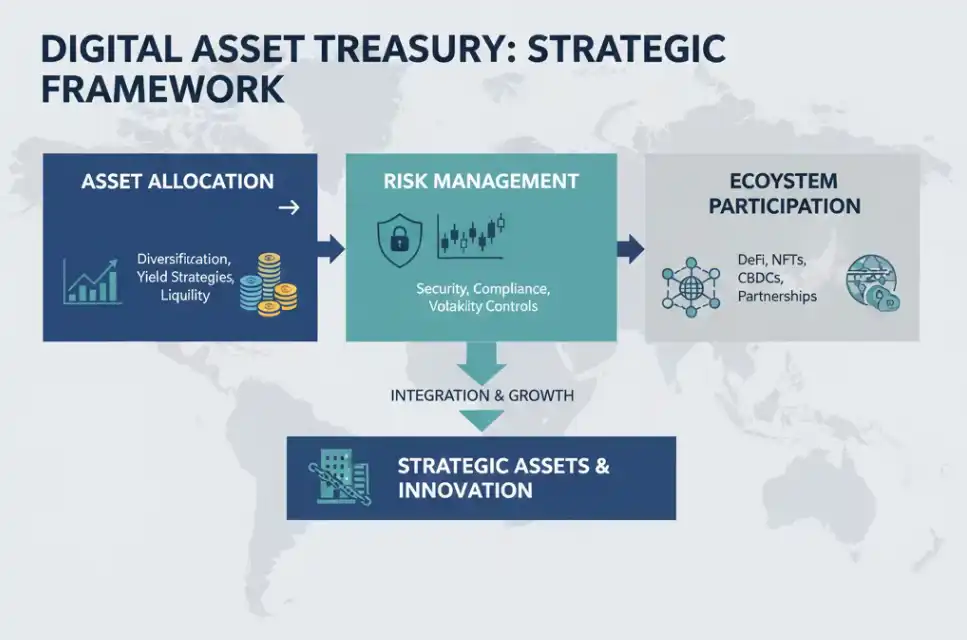
Typical DAT enterprises typically raise funds through stock financing, bond issuance, or private placements and allocate them to mainstream digital assets like Bitcoin and Ethereum. Compared to the early strategy of primarily "hoarding coins," companies now place greater emphasis on the rationality of asset allocation, risk control systems, and strategic linkages with the blockchain ecosystem. On one hand, digital assets provide enterprises with asset diversification and long-term value potential; on the other hand, companies must simultaneously establish cash flow management and risk constraint mechanisms to ensure operational sustainability. Furthermore, holding digital assets means enterprises can participate in on-chain governance, staking, and lending, thereby gaining deeper participation rights and influence at the ecosystem level. This change indicates that DAT has gradually become part of the corporate strategic management system, rather than just a book asset.
Market Structure and Corporate Performance

From recent industry performance, DAT enterprises are entering a clear phase of structural adjustment. Some companies are stabilizing market expectations and improving shareholder structure through share buybacks and asset portfolio optimization; others are gradually returning to more稳健 operational paths through strategic contraction or asset adjustments. At the same time, index agencies like MSCI are beginning to重新审视 the inclusion criteria for DAT-related companies, with significantly increased attention to corporate information disclosure, governance structure, and operational stability. This means the market is weakening its reliance on asset size and short-term price performance,转而 assessing enterprises' operational capabilities and risk management levels in complex environments.

It is worth noting that some companies with Ethereum-related assets as core allocations have shown relative resilience in recent market adjustments. This is not a reflection of a single asset's advantage but rather更多地反映了 the important role of asset diversification, business synergy, and governance capabilities in long-term corporate performance. Overall, changes in market structure are driving the DAT industry from "asset-driven" to "capability-driven."

Corporate Behavior and Strategic Choices

Starting from specific corporate behaviors, the strategic logic behind DAT can be understood more clearly.

At the asset level, enterprises no longer view digital assets as isolated investment targets but incorporate them into a long-term capital allocation framework to support future business expansion and ecosystem布局.

At the risk and stability level, companies balance market expectations and internal robustness through asset diversification, share buybacks, and operational structure improvements. The significance of such operations lies not in short-term market feedback but in securing greater strategic maneuvering space for the enterprise.

At the ecosystem level, holding digital assets enables enterprises to participate in on-chain governance and ecosystem building, transforming financial behavior into actual influence and voice. This shift from "asset management" to "ecosystem participation" is becoming an important path for DAT enterprises to build long-term competitiveness.

Overall, DAT has evolved from simple coin-holding behavior to a comprehensive practice integrating asset strategy, risk control, and ecosystem participation.

Industry Trends and Corporate Divergence

Observing from a longer cycle, the evaluation criteria of the DAT industry are undergoing substantive changes. Market focus is gradually shifting from asset size and short-term price fluctuations to corporate operational capabilities, cash flow stability, and governance transparency. This change directly promotes divergence among enterprises: those with clear asset strategies, diversified allocations, and robust governance structures are more likely to establish advantages in long-term competition; while those highly reliant on single assets or market sentiment see their strategic flexibility and sustainability significantly limited.

More importantly, some enterprises have already begun to transform digital assets into sustainable strategic resources through the combination of business synergy, ecosystem participation, and asset management. This path does not rely on a single market phase but is built on long-term capability building, constituting the core direction for the future development of the DAT industry.

Conclusion

The true value of DAT enterprises is not reflected in how many digital assets they hold, but in whether the enterprise can incorporate these assets into a clear strategic framework, establish a robust operational system and governance structure, and form sustained participation capabilities at the ecosystem level. By observing corporate behavior and industry structural changes, it can be seen that the DAT industry is moving towards a competitive stage centered on strategic capability and long-term execution.

Understanding DAT essentially means understanding how digital assets are transforming from a financial tool into a key resource within the corporate strategic system. This transformation not only reshapes how enterprises manage assets but also provides new judgment coordinates for investors and industry participants. In the future, enterprises that can form良性 synergy between asset strategy, risk management, and ecosystem participation are more likely to establish long-term, stable competitive advantages within the DAT system.


Пов'язані матеріали

Podcast Notes | Conversation with GSR Asset Management Head: To Determine if This Crypto Rally is Real, Just Watch the Lending Rates on Aave

Podcast Summary: Dialogue with GSR's Head of Asset Management: To Determine if This Crypto Rally is Real, Just Check Lending Rates on Aave Andy Baehr, Managing Director of Asset Management at GSR, discusses the current crypto market, characterizing it as stuck in a state of "ambivalence" with short-lived, unsustainable rallies. He outlines a simple framework: the market moves between "ambivalence" and "conviction" (sustained upward momentum). Currently, every rally resembles a single-stage rocket booster that quickly fizzles out. Baehr identifies three key signals to watch: 1) DeFi lending rates, 2) the potential passage of the CLARITY Act, and 3) the market forming a consensus on the "Fed hawkish peak." He emphasizes that the most immediate indicator for the sustainability of the recent CPI-triggered rally is the USDC borrowing rate on Aave, currently around 3.75%—close to U.S. Treasury yields. The absence of a credit spread indicates low leverage demand and a lack of market energy. He explains that a healthy, sustained rally requires layered buying pressure. Last year's rally progressed from an ETH short squeeze to crypto-native trader influx and finally to ETF inflows. Currently, this structure is missing. Other potential structural buyers like Digital Asset Treasury (DAT) companies are absent, and ETF flows have proven transient. Baehr notes that while small-cap crypto tokens outperformed large caps in Q2—a potential sign of capitation in major assets—capital is also flowing to more exciting opportunities like AI stocks and tech IPOs, leaving crypto sidelined. Regarding DeFi, he highlights that platforms like Aave provide a clear, real-time signal of leverage demand through their supply/demand-driven interest rates. A significant, sustained rate increase would signal genuine market conviction. He also observes the quiet emergence of fixed-income-like products and vaults in DeFi. On regulation, the probability of the CLARITY Act passing before the August 7th deadline has dropped linearly from 75% to below 40% on Polymarket. Baehr suggests its passage would be treated as a bullish surprise, a potent driver for price movement. However, political hurdles, including ethical clause debates and disclosures about the First Family's crypto profits, remain significant obstacles. Ultimately, the market awaits clarity on the Fed's terminal rate under Chair Warsh. Until the "Fed Solstice"—the point where the market collectively understands the peak of hawkish policy—sustained conviction will be difficult to achieve.

marsbit33 хв тому

Podcast Notes | Conversation with GSR Asset Management Head: To Determine if This Crypto Rally is Real, Just Watch the Lending Rates on Aave

marsbit33 хв тому

7 Months After the Collapse of Huiwang, Southeast Asia's Escrow Platforms Undergo a Major Reshuffle

Following the collapse of Huione Pay—dubbed the "Alipay of Southeast Asia"—seven months ago, the region's underground financial guarantee platform sector is undergoing a significant reshuffle. This power vacuum has been swiftly filled by emerging platforms such as XinBi, Tiger/Navigator, JinBei (renamed JinBo), Dali/Tiancheng, and FullyLight. These platforms, operating largely via Telegram and offering services like escrow for illicit transactions, have absorbed the vast user base and markets left behind by Huione. While positioning themselves as "trust intermediaries," their primary clientele consists of networks involved in online scams, money laundering, illegal gambling, and even human trafficking. For instance, the Tiger/Navigator platform explicitly provides "escrow" services for kidnapping-for-ransom operations ("强押车交易"). Data underscores the immense scale: Huione alone processed over $103 billion in cryptocurrency payments and facilitated over $31 billion through its escrow market before its downfall, linking it to Cambodia's notorious Prince Group. Since its collapse, competitors have seen explosive growth. For example, the XinBi platform has accumulated over $1.6 billion in total USDT revenue, while platforms like NewPay, OkPay (under Dali), and FullyLight Wallet collectively processed over $4.8 billion in USDT in a single year. This ecosystem thrives in regions like Cambodia and Myanmar, where regulatory gaps allow these platforms to act as critical financial infrastructure for sprawling cybercrime industries, from scam compounds to online casinos. The article concludes that the moniker "Southeast Asian Alipay" is a misnomer, obscuring the platforms' fundamental role in enabling serious criminal enterprises rather than representing legitimate financial innovation.

Odaily星球日报1 год тому

7 Months After the Collapse of Huiwang, Southeast Asia's Escrow Platforms Undergo a Major Reshuffle

Odaily星球日报1 год тому

Торгівля

Спот
活动图片



