Dark Pools Prevail, Whales Vanish: How Credible Are Public Market Signals?

marsbitОпубліковано о 2026-08-07Востаннє оновлено о 2026-08-07

Анотація

Institutional cryptocurrency trading is increasingly shifting towards dark pools and over-the-counter (OTC) desks, with data from sFOX showing such venues accounted for 15% of total monthly volume by June, up from negligible levels in April. In July, 77.7% of institutional capital on sFOX's platform was routed through OTC desks, while only 18.4% went to public exchanges. A key driver is institutions' need to conceal large orders to avoid revealing trading patterns, preventing front-running and minimizing price impact. Firms like Jane Street and Citadel use dark pools and order-splitting across multiple venues to execute trades discreetly. This structural shift mirrors earlier developments in equities and forex markets. As a result, public order books now reflect only a fraction of actual market activity, eroding the once-significant advantage retail traders had in tracking large wallets and exchange flows. The proliferation of prime brokers and aggregation platforms is also rapidly closing simple arbitrage opportunities. The market may evolve toward a brokerage model for retail, similar to traditional stocks. Two scenarios emerge: an optimistic one where retail gains from narrower spreads and better order routing, and a pessimistic one where transparency declines faster than benefits trickle down, leaving smaller investors in the dark. Regardless, traders must adapt by not relying solely on exchange volume, comparing total execution costs, and using limit orders in thin marke...

Original Author: Gino Matos

Original Compilation: Saoirse, Foresight News

Data from sFOX shows that cryptocurrency dark pool trading volume continues to climb, growing from negligible levels in April to account for 15% of total monthly volume by June. The firm's July 30th report also noted that 77.7% of institutional capital on its platform was matched through OTC desks, with only 18.4% flowing to public exchanges. In May alone, dark pool transaction volume reached $147 million.

In an interview with CryptoSlate, sFOX's Diana Pires described this as a structural shift, similar to the industry transformation experienced by stock and foreign exchange markets years ago.

Why Institutions Choose Crypto Dark Pools

Large orders placed on public order books leave clear footprints. Other traders can identify these trading patterns, execute trades ahead of the order, or push prices in the opposite direction before the order is filled, thereby increasing trading slippage.

Pires gave an example: institutions like Jane Street and Citadel have strong incentives to hide their trading trails. Once trading patterns are identified by the market, other participants will conduct targeted reverse trades.

This is also the fundamental reason why more and more crypto orders are choosing dark pools, OTC desks, and platforms that can route single orders to over a dozen trading venues simultaneously.

sFOX alone is connected to over 40 exchanges and OTC desks, and its institutional clients typically use 14 to 19 of these channels to complete trades each month on average.

OTC desks that receive large orders typically break them down into smaller orders before distributing them to avoid single transactions from causing severe market fluctuations.

Pires summarized the core logic of crypto dark pools as follows: trading platforms privately take on large positions, then split them into small orders to be sent to exchanges; these small orders hardly disturb the order book. She believes that this type of capital inflow into the public market helps deepen the order book and further narrow the bid-ask spread.

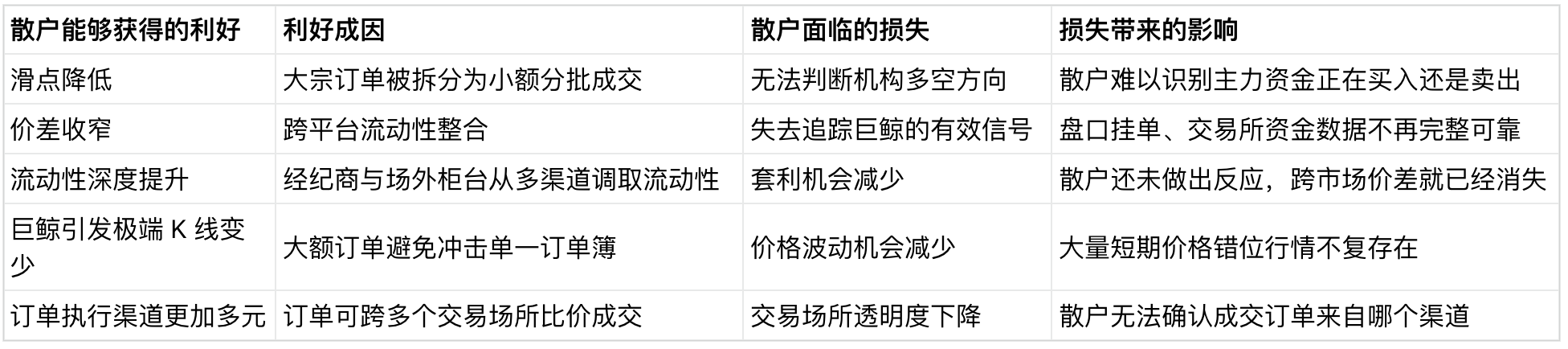
In the past, public order books could reflect the vast majority of real market trading activity, but now they only represent a small fraction of it. Quiet exchange order books do not mean institutions are not trading. Large buyers can accumulate positions over weeks without posting any visible buy orders; large sellers can complete significant reductions in holdings without massive sell pressure appearing on the order book.
The Information Advantage of Tracking Whales Is Being Actively Diminished

Bitcoin and crypto traders once had a natural advantage over participants in other markets: everyone could continuously monitor exchange fund balances, large orders on the order book, and large on-chain holdings.

Pires pointed out that dark pools, by design, eliminate this advantage. Trading platforms, OTC desks, and brokers can see the underlying fund flows. This information is protected by regulatory rules and client agreements, preventing retail traders from knowing whether institutions are buying or selling.

Simple cross-market arbitrage opportunities are also disappearing. Information once spread slower than capital flows, allowing investors to buy low on one exchange and sell high on another for profit. Pires stated that as prime brokers and aggregation platforms simultaneously scan dozens of trading venues, completing arbitrage and closing price gaps before retail traders can capture them, such opportunities are shrinking year by year.

She predicts the crypto trading market will eventually evolve towards a structure similar to the stock market: individual investors will no longer connect directly to exchanges but will instead go through brokers, who will seek the best prices across major trading venues on their behalf.

Retail account trading volumes typically struggle to meet the minimum fee tier thresholds set by exchanges, while brokers aggregating massive institutional orders can easily meet them. Pires believes this disparity will continue to drive ordinary traders towards brokers, although this shift won't be mandated by regulation as it was in the stock market.

Two Market Outlook Scenarios

Optimistic Scenario

Order aggregation platforms and mainstream trading venues handle retail orders in the same way they handle institutional orders. Market spreads continue to narrow, slippage decreases further, and instances of large orders piercing thin order books diminish.

Trading opportunities lost from public exchanges shift to other arenas. On-chain and DeFi markets still maintain public data on large holdings, providing channels for traders wanting to speculate on price volatility; regulated, compliant trading markets will exhibit more stable trends.

Pessimistic Scenario

For traders with ordinary capital sizes, the loss of trading transparency outpaces the realization of expected trading optimization benefits. Retail and medium-sized investors completely lose the ability to discern institutional capital movements.

Spread optimization and premium order routing services remain exclusively for large clients with sufficient capital to access prime brokers and aggregation platforms. Public exchange price signals continue to weaken, with participants relying on monitoring exchange order books being the first to feel the change.

Regardless of the market's direction, traders need to adjust their habits: do not treat the trading volume of a single exchange as a reflection of the entire market; compare total trading costs across different channels before referencing exchange-listed fee rates; when order book depth is insufficient, use limit orders as much as possible to guard against market orders impacting prices.

Beneath seemingly calm order books may lurk large-scale institutional trading.

As the crypto market matures and trading experiences continuously optimize, the difficulty of interpreting the market increases. Retail traders encounter fewer sudden price shocks from whales, but they also find it harder to observe the movements of the most influential capital.


Трендові криптовалюти

Пов'язані питання

QWhat is the main trend highlighted in the sFOX report regarding cryptocurrency trading?

AThe sFOX report highlights a significant structural shift, showing that dark pool and OTC trading volumes are rising sharply. In April, dark pool volume was negligible, but by June it accounted for 15% of the total monthly volume. In May alone, dark pool transaction volume reached $147 million.

QWhy are institutional players increasingly using crypto dark pools according to the article?

AInstitutions use dark pools to hide their trading patterns. Large orders on public order books leave clear traces, allowing other traders to front-run them or push prices against them before execution, increasing slippage. Dark pools and OTC desks allow them to break large orders into smaller ones executed across multiple venues, minimizing market impact.

QHow does the rise of dark pools affect the information advantage previously held by crypto traders?

AIt actively dismantles that advantage. Dark pools are designed to obscure large trade flows. Information on institutional buying or selling is protected by regulations and client agreements, making it inaccessible to retail traders. Furthermore, opportunities for simple cross-exchange arbitrage are disappearing as prime brokers and aggregators execute trades faster than retail can.

QWhat are the two potential future scenarios for the crypto market outlined in the article?

AThe article outlines one optimistic and one pessimistic scenario. The optimistic scenario envisions benefits like tighter spreads and lower slippage trickling down to retail traders via aggregators. The pessimistic scenario predicts that transparency will erode faster than benefits materialize for retail, leaving them unable to gauge institutional moves, with premium services remaining exclusive to large clients.

QWhat practical adjustments does the article suggest for traders in light of the rising use of dark pools?

ATraders should adjust by: 1) Not treating a single exchange's volume as representative of the whole market. 2) Comparing comprehensive transaction costs across different channels before referencing exchange-listed fees. 3) Using limit orders over market orders when order book depth is insufficient to prevent price impact.

Пов'язані матеріали

AMD acquires Taalas: hardware AI manages without scarce HBM memory

AMD has agreed to acquire Toronto-based startup Taalas, which tackles a key bottleneck in AI inference: the constant need to transfer model weights from memory to the processor for each generated token. Taalas's chips eliminate this operation by permanently embedding the model weights into the transistors themselves. This data transfer is what currently limits inference speed and has made high-bandwidth memory (HBM) a scarce commodity. Taalas's first test chip, fabricated on TSMC's 6nm process, reportedly generated tokens for Meta's Llama 3.1 8B model at speeds 48 times faster than comparable Nvidia GPUs. Its architecture features a mask ROM section for fixed weights and SRAM for adaptable components. However, this design comes with a significant trade-off: each chip is permanently dedicated to a single model. Switching models requires a partial redesign and fabrication, a process taking about two months. While the acquisition is seen as part of AMD's rivalry with Nvidia in inference, its broader implication lies in challenging the assumption of a permanent HBM memory shortage. The AI memory market is currently booming, with HBM supply sold out through 2026. Yet, Taalas's technology demonstrates that the memory bottleneck is an engineering challenge, not an absolute physical constraint. This aligns with industry-wide efforts from companies like Nvidia (through model compression) and memory makers like Samsung and SK hynix (developing new packaging and storage technologies) to reduce dependency on scarce HBM. AMD's move suggests that the current high prices for memory, driven by AI demand, may not be sustainable. It highlights a growing engineering push against the premise of perpetual memory scarcity, reminding investors that memory has historically been a cyclical business.

cryptonews.ru23 хв тому

AMD acquires Taalas: hardware AI manages without scarce HBM memory

cryptonews.ru23 хв тому

Vance says US-Iran conflict remains in 'midgame', US military 'seeks exit', Iran sets 'six conditions for reopening the strait'

U.S. Vice President Vance described the U.S.-Iran conflict as being in the "mid-game," stating the U.S. is utilizing diplomatic, economic, and military tools, with a focus on increasing oil and gas shipments through the Strait of Hormuz. Meanwhile, U.S. Chairman of the Joint Chiefs of Staff Gen. Dan Caine is reportedly seeking an "exit" privately, expressing concerns that airstrikes alone are insufficient to achieve objectives and that further escalation carries significant risks. He highlighted critical ammunition shortages for key missile defense systems. In response, Iran’s Supreme National Security Council Secretary, Zolgadr, presented six conditions for reopening the Strait of Hormuz: a U.S. pledge never to threaten Iran, an end to aggression against Iran and its allies, withdrawal of forces from the region, war reparations, lifting of all sanctions, and the unconditional unfreezing of Iranian assets. These demands, seen as a high bar set by hardliners, contrast with more pragmatic requests made in backchannel talks, which focus on lifting the blockade, restoring oil sanctions waivers, and accessing frozen funds. While Iran and Oman are close to a technical agreement on a temporary shipping lane, Iran clarified this does not equate to a full reopening of the strait, which remains contingent on U.S. meeting its conditions. Attacks on commercial vessels in the area continue, with recent incidents attributed to Iran. Despite pauses in military action and expressions of openness to talks from both sides, negotiations are currently stalled over Iran's economic demands and U.S. insistence on freedom of navigation.

marsbit42 хв тому

Vance says US-Iran conflict remains in 'midgame', US military 'seeks exit', Iran sets 'six conditions for reopening the strait'

marsbit42 хв тому

$20k Signing Fee + $30k Monthly Salary: The Story Behind Pump.fun Poaching FOMO's Corner

The meme market has become increasingly fragmented, with a significant divide between overseas and Chinese users in terms of ecosystem and trading tools. Recently, a piece of gossip spread within overseas meme communities: Pump.fun, the largest token launch platform, is allegedly offering lucrative incentives to poach users from its competitor FOMO. According to a leaked agreement, eligible users are reportedly offered a one-time $20,000 signing bonus plus a $30,000 monthly salary to migrate their funds and trading activity exclusively to Pump.fun, close their FOMO accounts, and meet specific trading volume requirements. This aggressive move highlights FOMO's rapid rise. Launched just over a year ago, FOMO has secured $94 million in funding and, crucially, its revenue over the past 30 days has surpassed that of Uniswap and Phantom. Its market share in trading bots has even overtaken GMGN to become the leader. FOMO's success is attributed to its "social-first" product design, featuring a profit leaderboard and a feed tracking top traders' activities—effectively creating "trading celebrities" that users follow. In response, Pump.fun has recently upgraded its app to replicate these social features, shifting its homepage focus to trader activity feeds. The platform's founder has actively welcomed prominent meme traders. This competition underscores a major shift in the overseas meme market: the battleground has moved from launch tools and liquidity to a fight for attention and influence. The market is now dominated by a "网红带货模式" (influencer-driven model), where platforms compete to sign the most influential trading Key Opinion Leaders (KOLs), who have become the new carriers of market consensus. While this mirrors early competition in livestreaming platforms, it signals a potential risk for the meme space: losing the organic, community-driven vitality that originally fueled its growth, as competition centers increasingly on a concentrated group of trading influencers.

marsbit1 год тому

$20k Signing Fee + $30k Monthly Salary: The Story Behind Pump.fun Poaching FOMO's Corner

marsbit1 год тому

Торгівля

Спот

Популярні статті

Як купити DATA

Ласкаво просимо до HTX.com! Ми зробили покупку DATA Network (DATA) простою та зручною. Дотримуйтесь нашої покрокової інструкції, щоб розпочати свою криптовалютну подорож.Крок 1: Створіть обліковий запис на HTXВикористовуйте свою електронну пошту або номер телефону, щоб зареєструвати обліковий запис на HTX безплатно. Пройдіть безпроблемну реєстрацію й отримайте доступ до всіх функцій.ЗареєструватисьКрок 2: Перейдіть до розділу Купити крипту і виберіть спосіб оплатиКредитна/дебетова картка: використовуйте вашу картку Visa або Mastercard, щоб миттєво купити DATA Network (DATA).Баланс: використовуйте кошти з балансу вашого рахунку HTX для безперешкодної торгівлі.Треті особи: ми додали популярні способи оплати, такі як Google Pay та Apple Pay, щоб підвищити зручність.P2P: Торгуйте безпосередньо з іншими користувачами на HTX.Позабіржова торгівля (OTC): ми пропонуємо індивідуальні послуги та конкурентні обмінні курси для трейдерів.Крок 3: Зберігайте свої DATA Network (DATA)Після придбання DATA Network (DATA) збережіть його у своєму обліковому записі на HTX. Крім того, ви можете відправити його в інше місце за допомогою блокчейн-переказу або використовувати його для торгівлі іншими криптовалютами.Крок 4: Торгівля DATA Network (DATA)Легко торгуйте DATA Network (DATA) на спотовому ринку HTX. Просто увійдіть до свого облікового запису, виберіть торгову пару, укладайте угоди та спостерігайте за ними в режимі реального часу. Ми пропонуємо зручний досвід як для початківців, так і для досвідчених трейдерів.

484 переглядів усьогоОпубліковано 2026.07.01Оновлено 2026.07.01

Як купити DATA

Обговорення

Ласкаво просимо до спільноти HTX. Тут ви можете бути в курсі останніх подій розвитку платформи та отримати доступ до професійної ринкової інформації. Нижче представлені думки користувачів щодо ціни DATA (DATA).

活动图片