Cyber Godfather Tibo Reveals: Google Had ChatGPT a Year Earlier but Dared Not Release It

marsbitОпубліковано о 2026-08-03Востаннє оновлено о 2026-08-03

Анотація

In a recent revelation, Thibault "Tibo" Sottiaux, the Codex lead at OpenAI, confirmed that Google developed a ChatGPT-like chatbot called "LMChat" a full year before OpenAI's launch. According to Tibo, who was part of the Google team at the time, the company was too cautious to release it, fearing it might disrupt its core search and advertising business. DeepMind, where the project was housed, was also restricted from launching products that could compete with Google's existing services. This account aligns with past statements from former Google Brain head Jeff Dean, who mentioned an internal chatbot that was deemed inferior to Google Search at the time. The article highlights this as a classic case of "innovator's dilemma," comparing Google's hesitation to Xerox's failure to commercialize groundbreaking technologies like the graphical user interface in the 1970s. The piece further notes a recent wave of high-profile departures from Google's AI teams to rivals like OpenAI and Anthropic, including key figures such as Transformer co-author Noam Shazeer and AlphaFold lead John Jumper. It concludes that Google's excessive caution and internal constraints, driven by the need to protect its lucrative search business, ultimately cost it a pioneering position in the generative AI revolution, allowing OpenAI to seize the initiative with ChatGPT's public release in November 2022.

What, Google really made ChatGPT a year earlier than OpenAI?

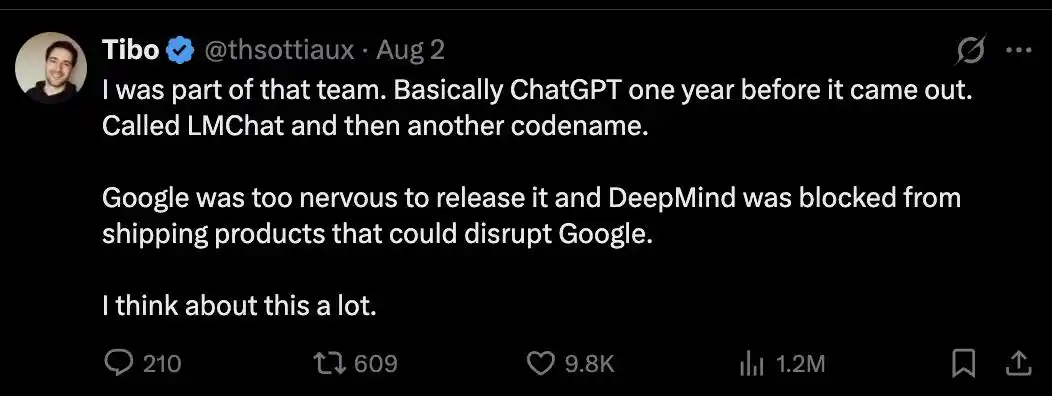
This isn't Google making excuses after the fact. This time, it's confirmed by an OpenAI insider, Codex lead Tibo:

That was basically ChatGPT a year early. It was initially called LMChat, and later had another codename.

Google was too nervous to release it, and DeepMind was prohibited from launching products that could impact Google's business.
But why does Tibo know such an old story so well?

The answer: He was on that Google team at the time.

I was a member of that team back then.

Yes, the Tibo who is now building "Infinite Tokens" for OpenAI was a firsthand participant in that Google project.

Netizens were shocked that Tibo had such a history:

No way, I thought you were just a reset button for Codex (just kidding).

Jeff Dean: I'm Not Convinced!!

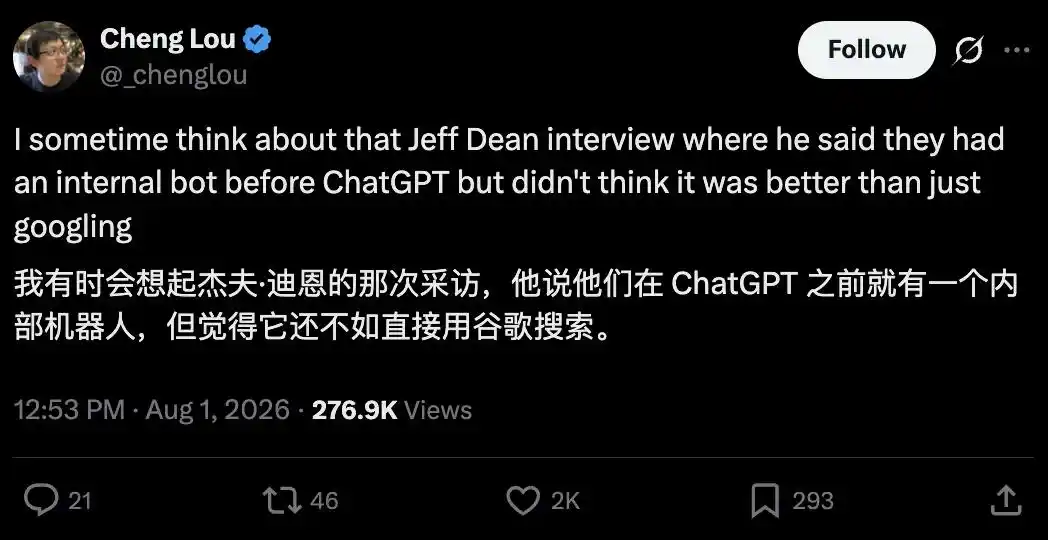
Here's how it happened. A Midjourney engineer recently dug up an old interview with former Google Brain head Jeff Dean on X:

I sometimes think about that Jeff Dean interview where he said they had an internal Chatbot before ChatGPT, but felt using it was worse than just using Google Search.
Unexpectedly, Tibo personally responded, engaging in a cross-air dialogue with Jeff Dean:

The project Jeff mentioned did exist. It was initially called LMChat and was almost exactly ChatGPT a year earlier.

As for why it wasn't released, Tibo helplessly stated that DeepMind didn't have the authority. LLMs would impact Google Search, and the bosses were too nervous to greenlight it.

After recounting this past event, Tibo left only a sigh:

Sigh, I often think about this.

Netizens were speechless upon hearing it...

Your former boss at Google absolutely should not touch anything business-related ever again.

Coincidentally, Google's AI lead Demis Hassabis also said in a biography that OpenAI didn't do anything revolutionary. Many people at the time realized the power of LLMs, but Sam Altman had the guts to release it without considering safety at all.

But you can't really blame Google. "Google Search" set a very high bar as a benchmark. If it was just for search, Google Search was already very mature.

And what about the 2023 large models? They got almost everything wrong, full of hallucinations whenever it involved timely content.

But now, Scaling has solved everything.

"Better than Google Search" – this acceptance criteria Google set for itself ultimately cost it an unprecedented price.

The Unfinished Google Journey

Tibo, real name Thibault Sottiaux, Codex lead, possessor of Infinite Token capability, aka "Cyber Godfather".

(ps: Reset reset o(╥_╥)o, I accidentally used them all up over the weekend!!!)

In 2015, Tibo joined Google, initially working on Google Maps-related projects, then transferred to DeepMind.

At the time, DeepMind was still a fairly pure research lab, with AlphaGo, reinforcement learning, and AGI research at its peak of attention.

At DeepMind, Tibo was mainly responsible for building the AI and machine learning infrastructure used by researchers.

According to Tibo's recollection, DeepMind internally developed a chat product called LMChat, which later had another codename. Its experience was already very similar to ChatGPT.

But Google was extremely cautious, given the direct impact on existing business, and DeepMind didn't have enough authority. Ultimately, the product never truly reached the public.

November 2022, ChatGPT exploded onto the scene.

Tibo saw it and was floored.

In 2024, he ended his nearly nine-year Google career and officially joined OpenAI.

As it turned out, Tibo's choice was correct.

This kind of abortion of projects like LMChat wasn't a one-off; like Vibe Coding, it's either zero times or countless times (just kidding).

This small story ultimately became a microcosm of Google's situation throughout the AI era.

Now, falling behind in the coding battlefield is triggering an even more brutal talent exodus within Google.

June 18th, Noam Shazeer announced joining OpenAI.

This name needs no introduction. One of the core authors of the 2017 Transformer paper "Attention Is All You Need" that ignited the entire AI era. He left Google in 2021 to found Character.AI. In 2024, Google spent $2.7 billion to buy back him and his company, having him co-lead Gemini.

Result: The person bought back for $2.7 billion, didn't even stay two years.

June 19th, John Jumper announced moving to Anthropic.

DeepMind VP, a core general handpicked by Hassabis himself – tasked with leading the AlphaFold team just six months after earning his PhD.

In 2024, he and Hassabis jointly won the Nobel Prize in Chemistry for their groundbreaking work on AlphaFold in protein structure prediction.

But now, the Nobel laureate has chosen a competitor.

After these two heavy blows, Google continues to bleed talent.

June 24th, two new names appeared on Google's talent "wanted list": Jonas Adler and Alexander Pritzel.

Both are core contributors to Gemini. Adler leads Google's AI coding direction, Pritzel works on pre-training. Both were involved in AlphaFold research, colleagues of John Jumper.

Destination: also Anthropic.

One More Thing

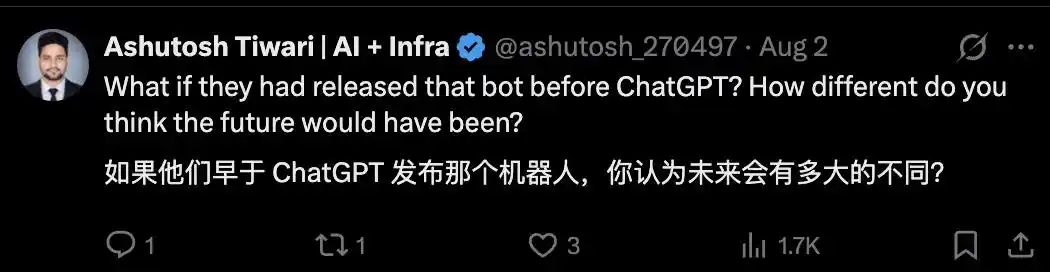
In the comments of the post, someone asked a very interesting question:

If Google had released GPT first, how would things be different now?

Unfortunately, hardly anyone replied.
But I know this one!!

Isn't this just the tech world's most classic old story.

In the 1970s, Xerox PARC developed the graphical user interface, mouse, and Ethernet. These guys basically held all the cards for the PC era, a pure royal flush.

And the result? Xerox didn't take it seriously at all.

Because Xerox sales did the math: Can this fancy interface help me sell two more toner cartridges, two more packs of A4 paper? No. Then why bother?

...

And so, Xerox watched as Steve Jobs visited, went back, created the Macintosh, and ascended to the throne.

Ever since, Xerox became Silicon Valley's "scapegoat." Every time the industry undergoes a paradigm shift, big shots drag Xerox out for a whipping:

See, this is big company disease! (piapiapia, whip sounds)

But seriously, anyone sitting in that position, looking at billions in annual printer profits, who would be willing to disrupt themselves...

Replace "toner and A4 paper" with "search and ads," replace "graphical interface" with "ChatGPT" –

That Google, which wrote Transformer in 2017 and held a full set of god-tier gear, ultimately in the AGI marathon...

Earned the title of "America's Doubao."

Reference link:[1]https://x.com/thsottiaux/status/2083596911060324570

This article is from the WeChat public account "QbitAI" (ID: QbitAI), author: Jay

Трендові криптовалюти

Пов'язані питання

QWho is Tibo and what role does he play in this story about Google's early chatbot?

ATibo, whose real name is Thibault Sottiaux, is the Codex lead at OpenAI and is referred to as the 'Cyber Godfather.' He is a former Google employee who was part of the team that developed an early ChatGPT-like product called LMChat within DeepMind. He personally confirmed that Google had created this technology about a year before ChatGPT was released.

QAccording to the article, why did Google decide not to release its early chatbot, LMChat?

AAccording to Tibo's account, Google did not release its early chatbot (LMChat, and later another project) because the company was too cautious and nervous. The leadership was concerned that large language models (LLMs) would disrupt Google's core search and advertising business. Additionally, DeepMind did not have the authority to launch products that could impact Google's existing operations.

QWhat historical parallel does the article draw to explain Google's missed opportunity with AI?

AThe article draws a parallel to the 1970s when Xerox PARC invented foundational technologies like the graphical user interface, mouse, and Ethernet but failed to commercialize them effectively because they were focused on their profitable printer and copier business (selling toner and paper). Similarly, Google, with its hugely profitable search and ads business, hesitated to launch a disruptive AI product, allowing others like OpenAI to seize the initiative.

QWhich high-profile AI researchers recently left Google, as mentioned in the article?

AThe article mentions several high-profile departures from Google: Noam Shazeer, a co-author of the 'Attention Is All You Need' paper, left for OpenAI. John Jumper, a DeepMind VP and Nobel laureate for AlphaFold, left for Anthropic. Additionally, core Gemini contributors Jonas Adler and Alexander Pritzel also left for Anthropic.

QWhat was Jeff Dean's reported view on Google's internal chatbot before ChatGPT's release?

AJeff Dean, the former head of Google Brain, reportedly stated in an old interview that Google had an internal chatbot before ChatGPT but felt that using it was not better than simply using Google Search. This view reflects the high internal benchmark Google set for itself, which ultimately contributed to its hesitation to release the product.

Пов'язані матеріали

Soaring 20% Then Dropping 5%: When Will the Bottom of the Korean Stock Market Be?

"South Korean stocks face a turbulent period as the KOSPI index, after a 20% surge, fell 5% to 6257 points. The market is grappling with severe issues: over 500,000 leveraged retail accounts have been liquidated, and more than 24 trillion won has flowed from stocks into bank deposits for safety. This reflects a significant loss of market liquidity and shaken investor confidence. In response, Korean financial regulators are taking action. They have tripled the minimum保证金 (margin) requirement for single-stock leveraged ETF trades to 30 million won and are considering granting themselves "emergency intervention" powers. These could include capping leverage ratios and setting investment limits on these ETFs, seen by many as amplifying market volatility. Initial results show a 75% drop in these products' trading volume post-regulation. The market downturn has political repercussions, pushing President Yoon Suk-yeol's approval rating to a new low. Meanwhile, foreign investors made a record net purchase of 7.18 trillion won during a recent rebound, while domestic retail investors sold off massively. Morgan Stanley has upgraded South Korean stocks to "overweight," citing the ongoing "leverage unwinding" and potential for a 36% upside, with giants like Samsung Electronics and SK Hynix providing valuation support. However, analysts caution that the market's structure remains vulnerable to foreign capital flows, and the current low may not be the bottom."

marsbit4 хв тому

Soaring 20% Then Dropping 5%: When Will the Bottom of the Korean Stock Market Be?

marsbit4 хв тому

Goldman Sachs Stakes a Clear Position: This Is the Largest Capital Demand Cycle in Human History, and the Fed Is Just an Observer

Goldman Sachs argues that the world is entering the most capital-intensive investment cycle in history, driven by concurrent massive demands from AI infrastructure, reindustrialization, defense reinvestment, power grid rebuilding, supply chain realignment, and sovereign debt financing. This structural competition for capital is pushing its cost higher, fundamentally altering investment paradigms. Goldman's Mark Wilson states that the Federal Reserve is merely a "passenger, not the driver" in this shift, with rising yields rooted in these real economy demands rather than just monetary policy. While major indices appeared calm in July, underlying market movements were historic, featuring extreme stock dispersion and a severe momentum factor crash, leading to significant de-risking by fund managers. Wilson cautions against expecting a quick reversal in August, citing ongoing digestion of higher rates, disrupted risk models, and typically muted market performance ahead of US midterm elections. Corporate fundamentals remain robust with strong earnings, though growth rates are peaking in the US while accelerating in Europe. Notably, hyperscale cloud companies like Amazon and Microsoft are announcing staggering capital expenditure projections for 2027-2028, justified by explosive AI-related revenue growth and high returns. Amazon revealed its AI revenue run-rate exceeds $25 billion, growing triple-digits annually, and expressed confidence that AWS could become a trillion-dollar revenue business. The report concludes that a transitional period is underway, marked by a growing tension between aggressively investing private tech giants and increasingly capital-constrained sovereign governments. The AI super-cycle continues, with August likely being a consolidation phase.

marsbit9 хв тому

Goldman Sachs Stakes a Clear Position: This Is the Largest Capital Demand Cycle in Human History, and the Fed Is Just an Observer

marsbit9 хв тому

Outflow of Stablecoins from South Korea Continues for 18 Consecutive Months, Exceeding $360 Million in June

In June 2026, South Korea experienced a net outflow of stablecoins to overseas crypto exchanges, amounting to 560.3 billion won ($367 million). This represents approximately 78% of the net value of foreign stocks purchased by Korean investors in the same period. According to the Financial Supervisory Service (FSS), this marks the 18th consecutive month of net outflows, a trend ongoing since January 2025. The FSS reported that 2.76 trillion won ($1.8+ billion) in stablecoins were withdrawn from the country's five major exchanges to foreign platforms in June, while 2.2 trillion won ($1.4 billion) flowed back in. The second quarter of 2026 saw a significant net outflow of 1.69 trillion won (~$1.1 billion), surpassing net sales of foreign stocks in the same period. Analysts cite access to unavailable domestic financial instruments as a primary driver. Foreign platforms offer crypto derivatives, spot and futures products tied to major Korean stocks like Samsung and Hyundai, along with RWA tokenization, DeFi, staking, and leveraged products. Lawmaker Lee Jong-wook warned that the stablecoin outflows constitute capital flight, exposing investors to risks on unregulated foreign platforms. He called for accelerated regulatory reform and enhanced investor protection measures. The government is reportedly working on a digital assets law to foster the blockchain sector.

cryptonews.ru14 хв тому

Outflow of Stablecoins from South Korea Continues for 18 Consecutive Months, Exceeding $360 Million in June

cryptonews.ru14 хв тому

Торгівля

Спот

Популярні статті

Що таке DOGE M

Doge Matrix ($doge m): Нова порода криптовалюти, що керується спільнотою Вступ У постійно змінюваному ландшафті криптовалюти нові проекти постійно з'являються, кожен з яких прагне привернути увагу інвесторів та ентузіастів. Одним з останніх учасників цього домену є Doge Matrix, представлений тикером $doge m. Цей проект привернув увагу завдяки своїм корінням у популярній культурі мемів навколо Dogecoin, закріплюючи своє місце в просторі web3. Ця стаття має на меті надати всебічний аналіз Doge Matrix, охоплюючи його огляд, творця, інвесторів, функціональність, хронологію та помітні аспекти. Що таке Doge Matrix ($doge m)? Doge Matrix — це проект криптовалюти, що керується спільнотою, який, здається, будує на широкій привабливості Dogecoin, цифрової валюти, відомої своїм маскотом Shiba Inu та мем-походженням. Хоча загальні цілі Doge Matrix не є детально визначеними, він характеризується зобов'язанням залучати участь та підтримку спільноти. На відміну від традиційних криптовалют, які часто підкреслюють корисність або внутрішню цінність через підлягаючі технології, Doge Matrix позиціонує себе в просторі, що охоплює культурне явище криптовалют, особливо приваблюючи тих, хто резонує з етикою активів на основі мемів. Спираючись на сильні сторони спільноти Dogecoin, Doge Matrix працює як частина більш широкої екосистеми, запрошуючи участь та залучення користувачів, які поділяють інтерес до криптовалюти та цифрового простору. Хто є творцем Doge Matrix ($doge m)? Особистість творця Doge Matrix залишається невідомою. Ця відсутність прозорості не є рідкісним явищем у сфері криптовалют, де деякі проекти запускаються без розкриття ідентичностей своїх засновників. Відсутність інформації про засновницьку команду може викликати питання серед потенційних інвесторів щодо відповідальності та напрямку проекту. Хто є інвесторами Doge Matrix ($doge m)? На даний момент немає публічно доступної інформації про інвесторів або інвестиційні фонди, які підтримують Doge Matrix. Проект, здається, покладається переважно на підтримку спільноти, а не на інституційні інвестиції. Ця модель узгоджується з природою ініціативи, що керується спільнотою, сприяючи середовищу, де напрям проекту формується його учасниками, а не диктується вибраними фінансовими спонсорами. Як працює Doge Matrix ($doge m)? Специфіка операційних механізмів Doge Matrix є дещо розмитою, відображаючи ширшу тенденцію проектів у просторі мем-коінів, де інноваційні функціональності не завжди чітко сформульовані. Проте Doge Matrix, здається, розроблений для того, щоб використовувати існуючу екосистему криптовалют, заохочуючи участь користувачів, одночасно використовуючи знайомі культурні посилання, пов'язані з Dogecoin. Його потенційно унікальні характеристики походять від взаємодій у спільноті, а не від технологічних досягнень, підкреслюючи спільний досвід та співпрацю серед власників токенів. Хоча точні інновації не були чітко окреслені, проект, здається, створює простір, де члени спільноти можуть взаємодіяти, ділитися ідеями та просувати потенціал проекту вперед. Хронологія Doge Matrix ($doge m) Розглядаючи хронологію проекту, можна виявити помітні події, які визначили його шлях до цього часу: 25 листопада 2024: Doge Matrix досяг свого історичного максимуму, що стало значною віхою в його ранній історії. 1 січня 2025: Навпаки, Doge Matrix досяг свого історичного мінімуму, ілюструючи волатильність, яка часто асоціюється з криптовалютами, особливо на ранніх етапах життєвого циклу проекту. Триває: Проект продовжує активно торгуватися та підтримуватися своєю спільнотою, хоча конкретні майбутні віхи або цілі ще не були розкриті. Ключові моменти про Doge Matrix ($doge m) Орієнтація на спільноту У центрі Doge Matrix лежить зобов'язання до залучення спільноти. Проект процвітає на основі співпраці та спільних цілей серед своїх учасників, підкреслюючи важливість колективних зусиль. На відміну від централізованих проектів, які часто мають визначену структуру керівництва, Doge Matrix наразі демонструє більш гнучкий підхід до управління, де голос кожного члена спільноти має значення. Волатильність Ринок криптовалют відомий своєю волатильністю, і Doge Matrix не є винятком. Його історія цін відображає значні коливання між високими та низькими значеннями, що є типовим для багатьох нових криптовалют, але підкреслює ризики, пов'язані з інвестиціями в нові токени. Відсутність детальної інформації Однією з найпомітніших рис Doge Matrix є брак детальної інформації щодо його технологічних основ та операційних механізмів. Ця невизначеність вимагає від потенційних інвесторів провести ретельну перевірку перед залученням до проекту. Висновок Підсумовуючи, Doge Matrix ($doge m) ілюструє нову хвилю проектів криптовалюти, які сильно покладаються на залучення спільноти та культурну значущість. Хоча йому бракує певних специфікацій — таких як чітке керівництво, визначені цілі та детальна функціональність — проект зміг викликати інтерес у криптоспільноті, використовуючи вже встановлену привабливість культури мемів. Як і з будь-якими інвестиціями в сфері криптовалют, розуміння вроджених ризиків і проведення всебічного дослідження є важливими для потенційних учасників. Doge Matrix слугує нагадуванням про динамічну, іноді непередбачувану природу криптоіндустрії, що відзначається постійною еволюцією та ентузіазмом щодо ініціатив, що керуються спільнотою.

531 переглядів усьогоОпубліковано 2025.02.03Оновлено 2025.02.03

Що таке DOGE M

Що таке $M

Розуміння Mantis ($M): Нова ера в кросчейн-інтероперабельності У постійно змінюваному ландшафті Web3 та криптовалют нові проекти прагнуть запропонувати інноваційні рішення, спрямовані на покращення користувацького досвіду та розширення функціональних можливостей у рамках децентралізованої фінансової екосистеми. Один з таких проектів, що привертає увагу, - це Mantis ($M), піонерський протокол, заснований на принципах кросчейн-інтероперабельності та угод на основі намірів. Ця стаття розглядає основні аспекти Mantis, включаючи його основну функціональність, творців, інвестиційну підтримку, інноваційні особливості та ключові етапи. Що таке Mantis ($M)? Mantis описується як протокол врегулювання намірів у кількох доменах, який спрощує кросчейн-взаємодії, дозволяючи користувачам безперешкодно виконувати складні фінансові транзакції на різних блокчейн-платформах. Протокол працює через три основні шари: Вираження намірів: Користувачі можуть формулювати свої цілі транзакцій, використовуючи природну мову, що забезпечується DISE LLM, передовою мовною моделлю штучного інтелекту. Наприклад, користувач може висловити бажання обміняти Ethereum (ETH) на Solana (SOL) з певною допустимою похибкою в 1%. Виконання: Цей шар використовує мережу розв'язувачів, які змагаються за виконання намірів користувачів. Транзакції виконуються за допомогою механізмів, таких як Coincidence of Wants (CoWs) та Order Flow Auctions (OFAs), які забезпечують оптимальне задоволення запитів користувачів. Врегулювання: Використовуючи протокол міжблокчейн-комунікації (IBC), Mantis дозволяє атомарні кросчейн-транзакції, що дозволяє користувачам працювати на різних підтримуваних ланцюгах, включаючи Ethereum, Solana та Cosmos. Mantis розроблений для впровадження рідної генерації доходу для бездіяльних активів, використовуючи криптографічні докази для підтримки цілісності транзакцій протягом усього процесу. Творці та команда розробників Mantis був задуманий Composable Foundation, дослідницькою організацією, відомою своїм акцентом на рішеннях для блокчейн-інтероперабельності. Ця організація співпрацює з відомими академічними установами, такими як Гарвардський університет та Університет Лісабона, сприяючи широким дослідженням та розробкам, які формують архітектуру та функціональність Mantis. Зобов'язання Composable Foundation сприяти інноваціям у сфері блокчейн-технологій позиціонує Mantis як надійне рішення для зростаючого попиту на інтероперабельність між кількома блокчейн-мережами. Інвестори та підтримка Хоча конкретні деталі про окремих інвесторів не були публічно розкриті, Mantis користується значною підтримкою від різних суб'єктів, включаючи: Гранти екосистеми від ланцюгів, що підтримують IBC, які підтримують зростання протоколу та інтеграцію в децентралізовані фінансові екосистеми. Стратегічні партнерства з постачальниками інфраструктури, які покращують мережеві можливості Mantis та стратегії впровадження. Фінансування через казну Composable Foundation, що забезпечує стабільну фінансову підтримку для поточних розробок та операційних витрат. Ці спільні зусилля відображають консенсус серед зацікавлених сторін щодо важливості покращення кросчейн-функціональності та потенційної корисності інфраструктурних інновацій Mantis. Ключові інновації Mantis вирізняється кількома піонерськими інноваціями, які покращують його функціональність та корисність: Незалежні від ланцюга наміри: Користувачі можуть ініціювати транзакції з будь-якого підтримуваного ланцюга, при цьому врегулюючи їх на іншому. Ця гнучкість надає користувачам більше можливостей, стимулюючи взаємодію між різними платформами. Інтерфейс на базі штучного інтелекту: Інтеграція DISE LLM дозволяє користувачам виконувати складні DeFi-операції, використовуючи природну мову, що спрощує взаємодію та робить технологію блокчейн доступною для ширшої аудиторії. Захоплення MEV у кросдоменному середовищі: Mantis створює внутрішній ринок для максимального екстракційного значення (MEV) через конкуренцію серед розв'язувачів. Цей інноваційний підхід дозволяє досягати більшої ефективності та екстракції вартості в складних транзакціях. Модульний шар врегулювання: Протокол підтримує різні методи верифікації, включаючи нульові знання та оптимістичні роллапи, забезпечуючи універсальну структуру, яка може адаптуватися до нових блокчейн-технологій. Історична хронологія Розвиток Mantis відзначений кількома критичними етапами, які окреслюють його траєкторію та зростання: | Рік | Етап | |————|————————————————————————-| | 2022 | Початкова розробка концепції в дослідницькому підрозділі Composable Foundation. | | Q3 2024 | Запуск тестової мережі з можливостями мосту між Solana та Ethereum. | | Q1 2025 | Очікувана подія генерації токенів (TGE) разом із запуском основної мережі. | | Q2 2025 | Очікувана інтеграція DISE LLM та розширення кросчейн-можливостей. | | 2025 H2 | Запланована підтримка понад 15 ланцюгів через подальші оновлення IBC. | Ця хронологія окреслює еволюцію Mantis, від концептуальних обговорень до активної реалізації та майбутніх етапів зростання. Стратегія зростання екосистеми Стратегія Mantis щодо зростання екосистеми включає кілька ініціатив, спрямованих на заохочення участі користувачів та залучення розробників: Система кредитів: Користувачі можуть заробляти кредити протоколу, надаючи ліквідність та беручи участь у реферальних програмах. Ці кредити можна буде обміняти на винагороди в майбутньому, сприяючи формуванню сильної спільноти користувачів. Модульний набір для розробки програмного забезпечення (SDK): Цей набір інструментів надає розробникам можливість створювати додатки на основі моделей, що керуються намірами, використовуючи інфраструктуру Mantis, тим самим сприяючи інноваціям у його екосистемі. Модель управління: У міру розвитку протоколу, власники токенів $M отримають можливість брати участь в управлінні протоколом, що дозволить їм голосувати за запропоновані оновлення та зміни, підвищуючи залученість спільноти та децентралізацію. Mantis представляє собою значний прогрес у сфері кросчейн-архітектури. Завдяки безперешкодній інтеграції передових алгоритмів штучного інтелекту з надійною структурою врегулювання, Mantis прагне вирішити проблеми фрагментації в багатоланцюгових екосистемах. Його інноваційний підхід ставить на перше місце покращення користувацького досвіду, дотримуючись основоположних принципів децентралізації та безпеки, встановлюючи новий стандарт для майбутньої інтероперабельності блокчейн-технологій. Оскільки Mantis продовжує свій шлях зростання та реалізації, він обіцяє стати проектом, за яким варто уважно стежити в конкурентному середовищі Web3 та децентралізованих фінансів. Зосереджуючись на подоланні кордонів та підвищенні залученості користувачів, Mantis готовий стати невід'ємною частиною майбутніх розробок у сфері криптовалют.

87 переглядів усьогоОпубліковано 2025.03.18Оновлено 2025.03.18

Що таке $M

Як купити M

Ласкаво просимо до HTX.com! Ми зробили покупку MemeCore (M) простою та зручною. Дотримуйтесь нашої покрокової інструкції, щоб розпочати свою криптовалютну подорож.Крок 1: Створіть обліковий запис на HTXВикористовуйте свою електронну пошту або номер телефону, щоб зареєструвати обліковий запис на HTX безплатно. Пройдіть безпроблемну реєстрацію й отримайте доступ до всіх функцій.ЗареєструватисьКрок 2: Перейдіть до розділу Купити крипту і виберіть спосіб оплатиКредитна/дебетова картка: використовуйте вашу картку Visa або Mastercard, щоб миттєво купити MemeCore (M).Баланс: використовуйте кошти з балансу вашого рахунку HTX для безперешкодної торгівлі.Треті особи: ми додали популярні способи оплати, такі як Google Pay та Apple Pay, щоб підвищити зручність.P2P: Торгуйте безпосередньо з іншими користувачами на HTX.Позабіржова торгівля (OTC): ми пропонуємо індивідуальні послуги та конкурентні обмінні курси для трейдерів.Крок 3: Зберігайте свої MemeCore (M)Після придбання MemeCore (M) збережіть його у своєму обліковому записі на HTX. Крім того, ви можете відправити його в інше місце за допомогою блокчейн-переказу або використовувати його для торгівлі іншими криптовалютами.Крок 4: Торгівля MemeCore (M)Легко торгуйте MemeCore (M) на спотовому ринку HTX. Просто увійдіть до свого облікового запису, виберіть торгову пару, укладайте угоди та спостерігайте за ними в режимі реального часу. Ми пропонуємо зручний досвід як для початківців, так і для досвідчених трейдерів.

564 переглядів усьогоОпубліковано 2025.07.02Оновлено 2026.06.02

Як купити M

Обговорення

Ласкаво просимо до спільноти HTX. Тут ви можете бути в курсі останніх подій розвитку платформи та отримати доступ до професійної ринкової інформації. Нижче представлені думки користувачів щодо ціни M (M).

活动图片