Custodia renews bid for Fed master account in rehearing push at Tenth Circuit

cointelegraphОпубліковано о 2025-12-16Востаннє оновлено о 2025-12-16

Анотація

Custodia Bank, a crypto-focused institution, has filed a new petition with the U.S. Court of Appeals for the Tenth Circuit, seeking a rehearing after the court upheld the Federal Reserve's denial of its application for a master account. The bank argues that the decision misinterprets the Monetary Control Act, which it claims entitles eligible banks to such an account, and raises constitutional concerns by effectively allowing the Fed to veto state-approved bank charters. A master account is crucial as it enables direct access to the Fed's payment systems, avoiding the need for intermediary banks and reducing costs and delays. Despite being chartered in Wyoming, Custodia has been unable to secure an account since 2020, highlighting ongoing debanking challenges in the crypto industry.

Custodia Bank, a crypto‐focused bank founded by Bitcoin advocate Caitlin Long, is doubling down on efforts to obtain a master account at the US Federal Reserve by filing a new petition in the United States Court of Appeals for the Tenth Circuit.

On Monday, the Wyoming-chartered company filed a petition asking all active judges of the Tenth Circuit to reconsider its October decision upholding the Federal Reserve’s denial of a master account for Custodia.

Through the petition, formally termed a “rehearing en banc,” Custodia argued that the panel had misread the Monetary Control Act, which it asserts entitles any eligible bank to a master account, and in doing so, undermines state banking authority.

“When the Fed denies a master account to a state-chartered financial institution, it effectively vetoes a bank charter that state regulators have approved,” the petition noted, adding that the issue raises “serious constitutional questions” about the Fed’s structure.

Why is a Fed master account so important?

Issued by the Fed, a master account is a key account that allows a financial institution to hold balances directly with the US central bank and access its core payment systems.

For companies like Custodia, having a master account is crucial, as it enables them to settle payments and clear transactions directly in central bank money, rather than relying on another bank as an intermediary. Without it, they must use correspondent banks to access the Fed’s systems, which can add cost, risk and delay.
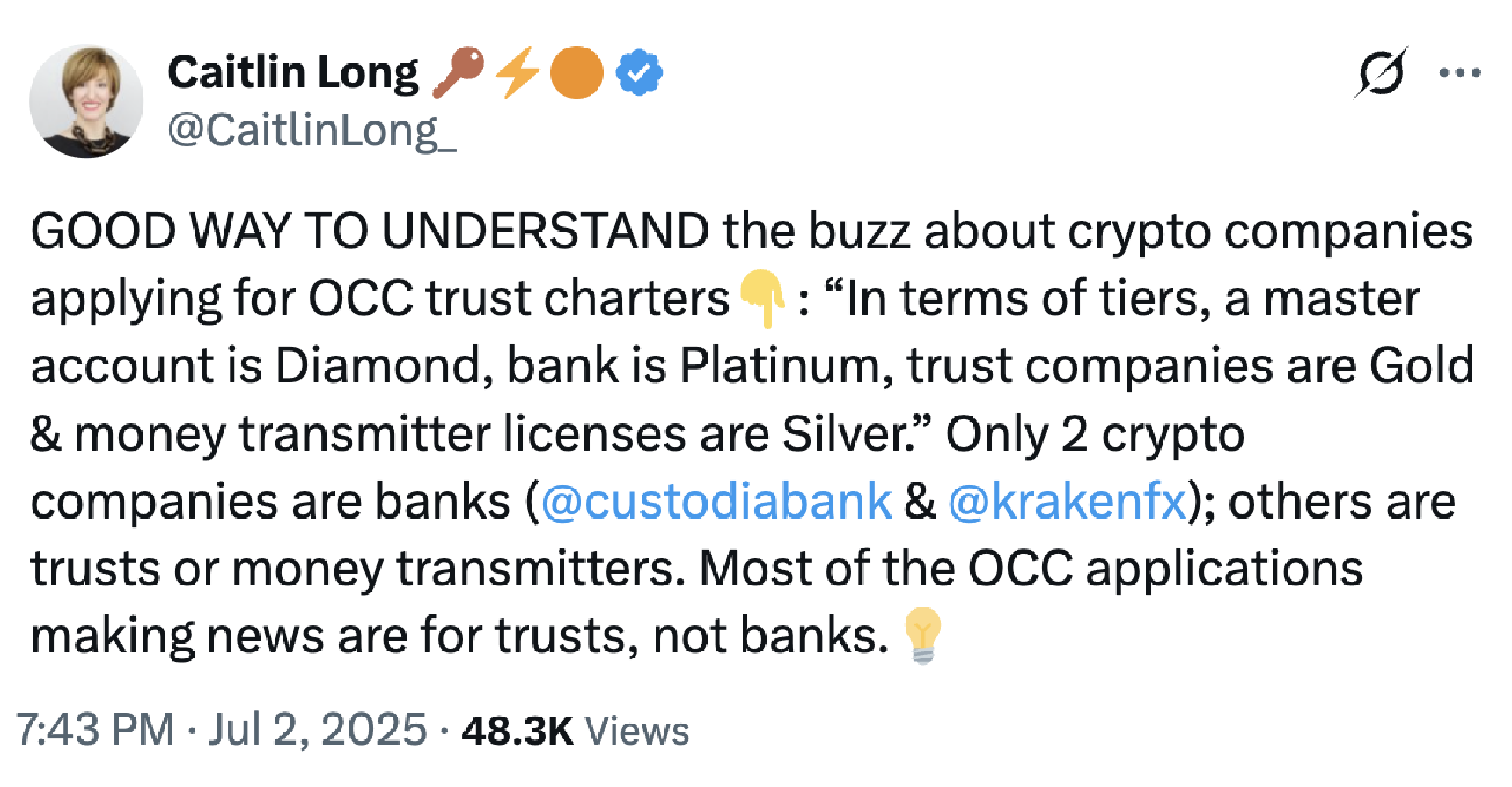
Source: Custodia Bank founder and CEO Caitlin Long

“In terms of tiers, a master account is Diamond, bank is Platinum, trust companies are Gold and money transmitter licenses are Silver,” Custodia Bank founder and CEO Long said in an X post in July, adding that Custodia and Kraken are the “only two crypto companies” that are banks.

Custodia has been trying to get a Fed master account since it launched in 2020, but the Kansas City Fed denied its master account application in January 2023, and the Federal Reserve also rejected its bid to become a member of the Federal Reserve System.

Related: Crypto among sectors ‘debanked’ by 9 major banks: US regulator

Custodia’s long fight for a Fed master account highlights ongoing crypto debanking issues, even though the Trump administration had expressed support for crypto.

In March, Long said the US government has done “nothing” to address crypto debanking issues since President Donald Trump returned to office, highlighting one of the crypto industry’s biggest unresolved challenges.


Трендові криптовалюти

Пов'язані матеріали

Bitcoin Withdrawals Continue: 8 Years of Storage in a Coldcard Cold Wallet Ended in Zero

Coldcard Hardware Wallet Hacked: Losses Mount Due to Vulnerable Seed Generation A critical vulnerability in Coldcard hardware wallets has led to a continued wave of fund thefts. According to Galaxy Research, the total stolen has reached 1,367.05 BTC (approx. $88.6 million) from 4,585 addresses, a significant increase from the initial 594.5 BTC reported on July 30, 2026. Most of the stolen funds remain on the attackers' addresses. The issue is not with the current firmware, which Coinkite has updated, but with seed phrases generated on vulnerable devices between March 2021 and the release of fixed firmware versions. Due to a programmer error, devices switched from using a hardware random number generator to the software-based Yasmarang generator, which was initialized with publicly accessible data like the chip's serial number. This made the seed phrases predictable through offline brute-force attacks, meaning wallets remain at risk until funds are moved to a new wallet generated with the patched firmware. Affected devices include Mk2/Mk3 with firmware 4.0.1–4.1.9 (and up to 5.0.3), Mk4/Mk5 up to version 5.6.0, and Q models up to 1.5.0Q. The only exceptions are seeds created with a high-entropy method like at least 50 independent dice rolls or a strong unique BIP-39 passphrase. All other owners must generate a new seed on the fixed firmware and transfer their assets. A case highlighting the human impact involves a 39-year-old long-term investor who lost 2 BTC (approx. $130,000) in minutes. He had accumulated the Bitcoin over eight years through physical labor, viewing it as a financial lifeline and a retirement plan in a country suffering from hyperinflation. His story underscores that even conservative "buy and hold in cold storage" strategies can be compromised by such underlying technical flaws. From a technical perspective, this incident echoes historical failures where weak random number generators undermined cryptographic security, challenging the assumption that offline storage is automatically foolproof.

cryptonews.ru11 хв тому

Bitcoin Withdrawals Continue: 8 Years of Storage in a Coldcard Cold Wallet Ended in Zero

cryptonews.ru11 хв тому

Торгівля

Спот

Популярні статті

Як купити PUSH

Ласкаво просимо до HTX.com! Ми зробили покупку Push Protocol (PUSH) простою та зручною. Дотримуйтесь нашої покрокової інструкції, щоб розпочати свою криптовалютну подорож.Крок 1: Створіть обліковий запис на HTXВикористовуйте свою електронну пошту або номер телефону, щоб зареєструвати обліковий запис на HTX безплатно. Пройдіть безпроблемну реєстрацію й отримайте доступ до всіх функцій.ЗареєструватисьКрок 2: Перейдіть до розділу Купити крипту і виберіть спосіб оплатиКредитна/дебетова картка: використовуйте вашу картку Visa або Mastercard, щоб миттєво купити Push Protocol (PUSH).Баланс: використовуйте кошти з балансу вашого рахунку HTX для безперешкодної торгівлі.Треті особи: ми додали популярні способи оплати, такі як Google Pay та Apple Pay, щоб підвищити зручність.P2P: Торгуйте безпосередньо з іншими користувачами на HTX.Позабіржова торгівля (OTC): ми пропонуємо індивідуальні послуги та конкурентні обмінні курси для трейдерів.Крок 3: Зберігайте свої Push Protocol (PUSH)Після придбання Push Protocol (PUSH) збережіть його у своєму обліковому записі на HTX. Крім того, ви можете відправити його в інше місце за допомогою блокчейн-переказу або використовувати його для торгівлі іншими криптовалютами.Крок 4: Торгівля Push Protocol (PUSH)Легко торгуйте Push Protocol (PUSH) на спотовому ринку HTX. Просто увійдіть до свого облікового запису, виберіть торгову пару, укладайте угоди та спостерігайте за ними в режимі реального часу. Ми пропонуємо зручний досвід як для початківців, так і для досвідчених трейдерів.

627 переглядів усьогоОпубліковано 2024.12.13Оновлено 2026.06.02

Як купити PUSH

Обговорення

Ласкаво просимо до спільноти HTX. Тут ви можете бути в курсі останніх подій розвитку платформи та отримати доступ до професійної ринкової інформації. Нижче представлені думки користувачів щодо ціни PUSH (PUSH).

活动图片












