Recently, the pessimistic sentiment in the crypto market has continued to spread. The "2026 Crypto Industry Dead Project Collection" released by RootData has thoroughly ignited a concentrated discussion within the industry about the wave of project closures, becoming a core reflection of current market sentiment and providing direct evidence that the crypto industry is entering a new round of deep consolidation.
After its release, this collection quickly gained widespread dissemination and interpretation by industry media and top KOLs both domestically and internationally. Mainstream crypto media outlets such as Coindesk, Cointelegraph, CryptoSlate, ChainCatcher, Wu Blockchain, PAnews, and Techflow, along with dozens of top crypto KOLs like Block Sir, BITWU, Ai Yi, alvin617, Crypto Little Sister, Lone Crane, Cheshire Cat, Benjieming, and Bi Shi Wang, have all published articles on X platform and their own channels, sharing insights and engaging in in-depth discussions. This has made "crypto dead projects" one of the core industry topics across the internet.
In the face of such a high level of market attention, RootData believes it is necessary to disclose the statistical methodology behind this "death list" and share our data-based thoughts on the current shakeout in the crypto industry.
I. Criteria for Determining Dead Projects
In data statistics, clear standards and rigorous logic are prerequisites for ensuring the reference value of data.
Unlike the subjective market approach of determining project death based solely on "rumors" or "sentiment," RootData has established a standardized determination system combining automated tracking and manual verification. Taking official project announcements and objective operational behaviors as the core basis, we have defined three major death determination criteria. All projects included in the list undergo dual verification to minimize misjudgments and errors. The specific determination rules are as follows:
-
The project team announces the cessation of operations or complete bankruptcy on its official website or social media.
-
The project has not had any updates on its official website and social media platforms like X or Discord for over six months.
-
The project's official website and X (or other social media) accounts are inaccessible or have been deleted.
Among these, projects determined via the first method account for no more than 20% of the statistics; those via the third method account for no more than 10%. Since there is no exact date of death for the latter, we only mark their status as "ceased operations" and do not include them in a specific year's dead project collection. Projects determined via the second method account for over 70%, representing the mainstream form of project exit in the industry.
For projects exhibiting prolonged silence, RootData has established a routine monitoring mechanism: the system automatically tracks the update times of project X accounts across the network. For projects suspected of not updating for over 6 months, it automatically triggers a manual review process. We thoroughly check the operational status across all dimensions, including official website activity, blog announcements, Github code commits, and community maintenance, to rule out special circumstances like "temporary hiatus" or "silence during version iteration," ensuring precise determination.
This tracking method is also the primary reason why the number of projects in the 2026 dead project collection is significantly lower than those for 2025 and 2024: many projects that stopped updating social media from February to June of this year have not yet exceeded the 6-month threshold, and therefore have not been included in the dead project scope.
As of now, the number of dead projects for 2026 is 124, while the numbers for 2024 and 2025 both exceed 400. However, it is foreseeable that as time progresses, a large wave of projects will be included in the dead project category by the end of the year, potentially setting a new record for the number of dead projects in any given year.
Furthermore, some situations commonly perceived as project death do not actually meet the determination criteria. For example, in late July this year, Movement Labs (MVMT), the original core development company behind the Movement blockchain, announced filing for Chapter 11 bankruptcy protection in a Delaware court. This was interpreted by the public as the death of Movement, but the company filing for bankruptcy is now substantively unrelated to the Movement blockchain, as the development responsibilities were transferred to Move Industries half a year ago.
The decentralized storage protocol Storj also filed for Chapter 11 reorganization in a West Virginia federal bankruptcy court in July this year, but this does not mean the project has ceased operations. Its primary goal is to resolve early legacy debts, and the company itself continues to operate.
The former Polkadot parachain Moonbeam blockchain announced its official shutdown in July this year, but the Moonbeam project itself has not ceased operations. Instead, it has pivoted to become a decentralized AI Agent communication and settlement network. The GLMR token will migrate to Base at a 1:1 ratio, becoming a native ERC-20 token. Therefore, Moonbeam also does not meet the criteria to be labeled as ceased operations.
In short, RootData's core criteria for a dead project are: the project's ecosystem has completely stalled, the team has terminated operations, and there are no ongoing iterative activities. Mere changes in legal entity, business pivots, or debt restructuring are not considered project death.
II. Observations and Thoughts Derived from Dead Projects
Among the over 20,000 crypto projects currently recorded by RootData, approximately 12,000 have an X account that has not been deleted. If we take posting tweets in August as the criterion for determining project activity, then the current number of active projects in the crypto market is roughly 2,200. If we extend the timeframe to June-August, the number of active projects is about 3,400.
However, some projects not updating tweets promptly may simply be reducing their posting frequency due to market conditions. Some crypto projects not updating X may still be active on other social media platforms like Github, LinkedIn, or their blogs. There are also crypto projects without X accounts. Therefore, this statistical indicator cannot accurately reflect the total number of active projects in the crypto market, but it still constitutes a highly referential metric—it at least outlines the contraction of the industry's "vocal participants," and the willingness to communicate is often positively correlated with team confidence and resource investment.
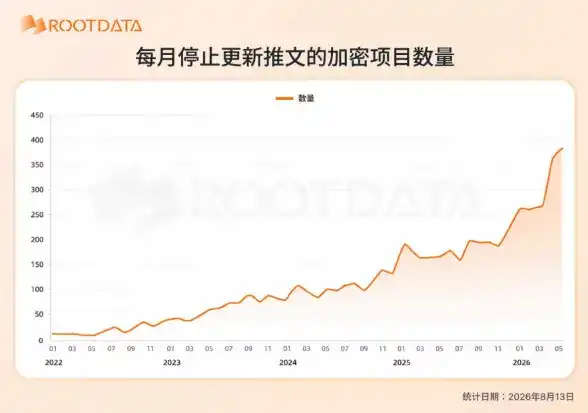
Further statistics on the number of projects ceasing X updates each month show this number is rapidly climbing month by month, consistently above 200 since the beginning of this year.
Meanwhile, the number of new projects recorded monthly by RootData this year ranges between 70 and 100. By comparing the two data sets, it is evident that since mid-2025, the number of active crypto projects has entered a state of "net decline," with the scale of new project entrants far from covering the scale of old project exits.
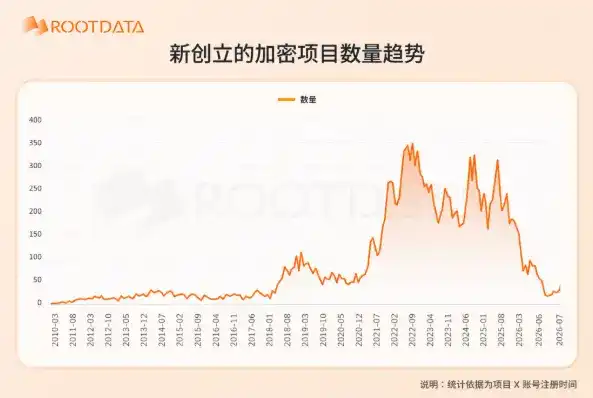
Undoubtedly, with the increasing merger and expansion of crypto giants and the entry of various internet and financial giants, the golden era for crypto startups has passed. Compared to the number of dead projects, we should pay more attention to the quality and quantity of new projects.
The batch clearance of dead projects is a passive purification of the industry cycle, whereas the continuous emergence of high-quality new projects and the implementation and iteration of new narratives are the core drivers for the industry to break through the bear market and achieve a new round of growth.
Among the newly recorded projects by RootData, the proportion of infrastructure projects has significantly decreased to less than 10%. This indicates that the new batch of crypto projects will increasingly focus on the application layer or distribution layer, rather than directly competing with existing infrastructure.
Data shows that prediction markets and their tools, RWA cards, tokenized stocks, perpetual contracts, AI agents, and memecoin projects now account for over 65% of new projects.
With the sharp decline in VC investment, more and more early-stage ventures need to rely on founders' own funds or business-driven cash flow to survive. This may force new projects to be more pragmatic in their business models—shifting from "burning cash for growth first" to "validating unit economics before scaling," and from chasing narrative hype to delving deep into niche demands.
Although short-term pain is inevitable, this "forced discipline" may filter out teams with genuine business resilience, preparing healthier seeds for the next cycle.
The crypto industry has never been short of cyclical booms and busts. Death is part of the life cycle and a catalyst for ecosystem evolution. RootData will continue to uphold objective, neutral, and data-driven principles, recording and witnessing every iteration and evolution of the Web3 industry.