Crypto’s CLARITY Act Sits At 50-50 For 2026 Passage, Galaxy Says

bitcoinistОпубліковано о 2026-04-23Востаннє оновлено о 2026-04-23

Анотація

Galaxy Digital estimates a 50-50 chance that the CLARITY Act, a key U.S. crypto market structure bill, will be passed into law in 2026. The bill, which passed the House with bipartisan support, is now in the Senate Banking Committee. A planned markup was delayed until May, and Galaxy warns that if it slips past mid-May, the odds of passage drop sharply. Key unresolved issues include stablecoin rewards language, protections for software developers, and SEC commissioner vacancies. The report emphasizes that the bill is strong on policy but faces a tight legislative calendar and significant procedural steps. Failure to pass it by May could delay crypto legislation indefinitely, especially with midterm elections potentially shifting priorities.

The crypto industry’s most important US market structure bill is entering a narrowing window in Washington, with Galaxy Digital putting the odds of the CLARITY Act becoming law this year at roughly 50-50. The firm’s central argument is not that one issue alone threatens the bill, but that too many unresolved questions still need to be settled in sequence, on a calendar that is quickly tightening.

In a research note published April 22, Galaxy said the Digital Asset Market Clarity Act of 2025 is now in “endgame stage” after passing the House in July 2025 with bipartisan support and spending months in Senate negotiations. The immediate focus is the Senate Banking Committee, which had been expected to announce a markup for the last week of April. But that timeline appears to be slipping. According to Galaxy, Sen. Thom Tillis, a key negotiator on stablecoin rewards language, called on Monday for delaying the markup until May.

May Could Be The Last Chance For Crypto’s CLARITY Act

Galaxy framed the bill’s prospects in unusually blunt terms: “In our view, the odds of CLARITY being signed into law in 2026 are roughly 50-50, and possibly lower, though others at Galaxy are more optimistic. The uncertainty stems not from any single issue but from the number of unresolved questions that must be settled, in sequence, under severe time pressure.”

The report argues that a markup in early or mid-May would still leave a viable path, but not much margin for error. “If the markup slips past mid-May, the probability of enactment in 2026 drops sharply,” Galaxy wrote. “The remaining legislative calendar simply does not easily accommodate the full five-step process described above, particularly given the competing demands on floor time.” In the firm’s view, a July floor vote is still theoretically possible, but only with “extraordinary political will and coordination.”

The procedural burden is significant. From committee markup, the bill would still need to clear a 60-vote Senate floor threshold, then be reconciled with the Agriculture Committee’s version, then reconciled again with the House-passed CLARITY Act, before reaching the president’s desk. Galaxy said each step consumes time that the Senate may not have in abundance, especially with Iran military authorization debates, the unresolved DHS funding standoff, and a backlog of nominations competing for floor space.

The best-known sticking point remains stablecoin rewards language, where banks and crypto firms have been fighting over whether exchanges can offer incentives tied to stablecoin holdings and usage. Galaxy said a compromise being negotiated by Tillis and Sen. Angela Alsobrooks would still ban rewards paid “solely for holding” a stablecoin while allowing narrower, activity-based incentives tied to payments, transfers, or platform usage. But the text has not yet been released, and until it is, the committee’s 48-hour notice clock cannot start.

Galaxy also made clear that stablecoin yield is only part of the problem. The note highlighted several other live issues in Senate negotiations, including the Blockchain Regulatory Certainty Act’s protections for noncustodial software developers, ethics provisions related to government officials’ crypto holdings, concerns over Section 505’s impact on SEC exemptive relief for tokenization, and the political question of SEC commissioner vacancies. None of those is necessarily fatal on its own. Together, they create a far more fragile timeline.

Notably, US Senator Bernie Moreno is sharing a similar position like Galaxy Digital. When was asked about the timeline for crypto market structure legislation, he said: “I think we’re going to get it done by the end of May.” But the Ohio Republican also warned last month that if the Clarity Act isn’t passed by May, crypto legislation could be off the table for the foreseeable future.

The report is broadly favorable on the substance of the legislation. Galaxy called CLARITY “a strong bill both on technical terms and as a policy matter,” arguing that it would establish jurisdictional boundaries between the SEC and CFTC, define pathways for tokens to be treated as non-securities once sufficiently decentralized, and create the kind of durable legal framework that institutional capital has long lacked.

It also warned that the post-midterm outlook could be materially worse. A change in control of either chamber, Galaxy said, would likely produce different committee chairs, different priorities, and a much less hospitable path for crypto legislation.

That is why the near-term milestones now matter so much. Galaxy said the next signals to watch are the release of Tillis’s revised stablecoin text, Chairman Tim Scott’s markup announcement, the size and bipartisan character of any committee vote, and whether Senate leadership allocates floor time before the July 4 recess.

At press time, the total crypto market cap stood at $2.58 trillion.
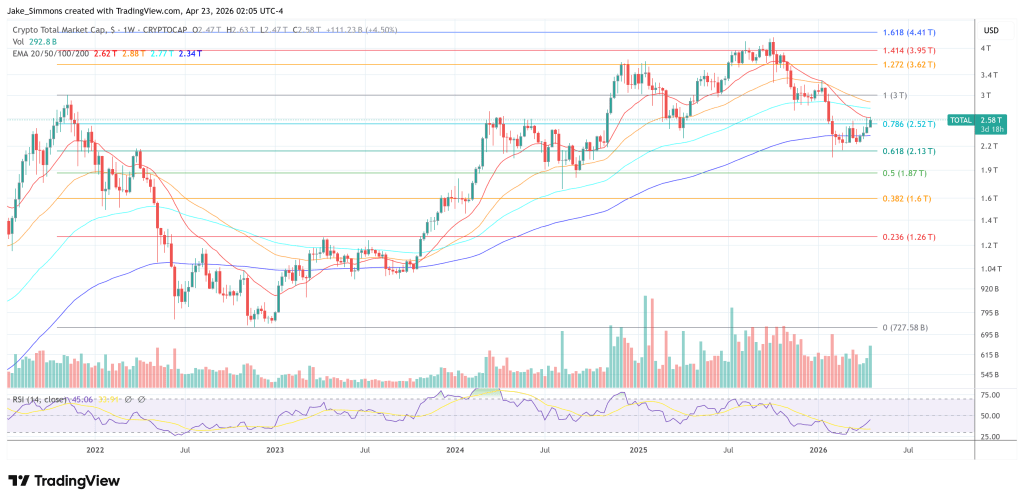
Total crypto market cap rises above the 0.786 Fib, 1-week chart | Source: TOTAL on TradingView.com

Пов'язані питання

QWhat are the odds of the CLARITY Act being signed into law in 2026 according to Galaxy Digital?

AGalaxy Digital puts the odds of the CLARITY Act becoming law in 2026 at roughly 50-50.

QWhich Senate committee is the immediate focus for the CLARITY Act's progress?

AThe immediate focus is the Senate Banking Committee.

QWhat is the key sticking point in the negotiations, as mentioned by Galaxy?

AThe key sticking point is the stablecoin rewards language, specifically whether exchanges can offer incentives tied to stablecoin holdings and usage.

QAccording to the report, what is the consequence if the committee markup slips past mid-May?

AIf the markup slips past mid-May, the probability of the CLARITY Act being enacted in 2026 drops sharply.

QWhat did Senator Bernie Moreno say about the timeline for passing the crypto market structure legislation?

ASenator Bernie Moreno said, 'I think we’re going to get it done by the end of May,' but also warned that if it isn't passed by May, crypto legislation could be off the table for the foreseeable future.

Пов'язані матеріали

Google's Decade-Long AI Power Struggle Concludes, Pichai Gracefully Consolidates Control

A decade of internal AI rivalry at Google has concluded with CEO Sundar Pichai consolidating power through a masterful, bloodless reorganization. The key moves saw Demis Hassabis, DeepMind's visionary founder, step down as CEO of Google DeepMind to become Alphabet's Chief Scientist, focusing on long-term AGI. Concurrently, Google's legendary technical leader Jeff Dean departed with his team to start a new venture, in which Google invested. This restructuring marks the end of a long-standing divide between the research-focused DeepMind and the product-oriented Google Brain. Pichai's strategy, beginning with their 2023 merger under Hassabis, gradually centralized control. While Hassabis gained public acclaim for Gemini's progress and a Nobel Prize, Pichai quietly elevated Koray Kavukcuoglu, a pragmatic engineering veteran, to oversee daily operations. The catalyst was mounting pressure in 2026 as Gemini's development timelines slipped, causing stock declines. Hassabis, more passionate about pure research and his AI drug discovery company Isomorphic Labs, grew weary of the commercial grind. His graceful "promotion" effectively removed him from operational control. Pichai handled both transitions with characteristic finesse: granting Hassabis a prestigious, future-focused role to prevent a defection to rivals (as happened with former DeepMind co-founder Mustafa Suleyman), and investing in Dean's new company to keep his pioneering work within Google's orbit. The outcome is a fundamental shift: control of Google's AI future has passed from brilliant scientist-visionaries to professional managers and engineers like Kavukcuoglu and Pichai himself. It signals Pichai's bet that the AI race has entered an industrial phase won by systemic execution, organizational efficiency, and stable delivery, rather than lone genius. The era of scientists directly managing core AI is over at Google, replaced by a machine-like division of labor where the CEO decides who decides.

marsbit2 год тому

Google's Decade-Long AI Power Struggle Concludes, Pichai Gracefully Consolidates Control

marsbit2 год тому

OpenAI Executive: Tools Like Codex, Only Two Months Left to Shine

In a candid statement, OpenAI's product and platform lead, Thibault Sottiaux, predicts that tools like Codex will become "primitive" within 2-3 months. He highlights that the current paradigm of running AI agents (Harness frameworks) locally on laptops is hitting fundamental limits as next-generation models demand more from their environments. The core limitations are threefold: 1) Local hardware constraints on compute and memory when agents handle concurrent subtasks; 2) The impracticality of requiring machines to stay online for long-duration tasks; and 3) The inability of lightweight local setups to manage the massive parallel context and toolchains of advanced models. The solution, Sottiaux suggests, is a shift towards "cloud-native infrastructure." The future lies in "light local command, heavy cloud execution," where developers use their devices as control panels. Complex tasks like code refactoring, testing, and automation will be offloaded to dynamic, parallel cloud clusters (e.g., isolated sandbox containers), with results streamed back. This evolution is already underway, with examples like Anthropic orchestrating 16 Claude instances across 2000 cloud sessions to build a C compiler. The competition will thus move from raw model capability to which platform can most effectively unlock a model's full potential through sophisticated, system-level Harness engineering.

marsbit3 год тому

OpenAI Executive: Tools Like Codex, Only Two Months Left to Shine

marsbit3 год тому

Торгівля

Спот
活动图片