Crypto Watchlist: 5 Things To Monitor This Week

bitcoinistОпубліковано о 2026-03-02Востаннє оновлено о 2026-03-02

Анотація

Crypto markets face a mix of geopolitical and product catalysts this week. Bitcoin remains the key macro watch, rebounding after an initial dip from U.S.-Iran tensions, with traders assess whether the conflict will escalate or fade. Oil price movements are being monitored for inflation and rate implications. On the product side, Starknet is launching strkBTC, a privacy-optional wrapped Bitcoin. Polygon’s March 4 upgrade will recycle gas fees to subsidize machine-to-machine payments. Avalanche begins its Retro9000 incentive round on March 2, shifting focus to rewarding most-used projects. The week concludes with the U.S. jobs report on March 6, which could reset interest rate expectations. Overall, macro factors like geopolitical risk and economic data may drive sharp market swings. The total crypto market cap stood at $2.25 trillion.

Crypto heads into the week of March 2 with five clear catalysts on deck: a worsening US-Iran conflict under President Donald Trump, a privacy-focused Bitcoin wrapper from Starknet, Polygon’s March 4 agentic-payments gas upgrade, Avalanche’s new incentive round, and Friday’s US jobs report.

Crypto Watchlist For This Week

Bitcoin is still the biggest macro watch this week, but the setup has already changed. The initial war shock over the weekend pushed BTC down toward $63,000, yet that move did not hold. The token rebounded as high as $68,196 on Sunday and was back around $65,807 by European Monday morning, while broader reporting showed traders were already reassessing whether the conflict would become a lasting macro shock or a violent but temporary headline event.

Oil followed a similar pattern: Brent briefly surged to $82.37 before giving back part of the move and easing back into the upper-$70s, which matters because crypto traders are now watching inflation risk and rate expectations more than the initial geopolitical headline itself.

What matters now is not simply that Washington and Tehran are in open conflict, but that the political signals are mixed. Trump has said he is willing to talk to Iran’s “new leadership,” while the White House has also made clear that military operations are continuing.

At the same time, AP’s live coverage says Iranian leaders are publicly rejecting negotiations. For markets, that creates a more nuanced watch item than a straight risk-off story: if diplomacy starts to look credible and oil keeps fading from its highs, Bitcoin’s rebound may hold; if the war widens and energy markets tighten again, crypto is likely to trade under macro pressure first and narrative second.

On the product side, Starknet is preparing to roll out strkBTC, a wrapped Bitcoin asset issued on Starknet and redeemable for native BTC, with optional shielding for balances and transfers. The design matters because Starknet is not pitching privacy as mandatory. In its own words, “Privacy is available when needed. Transparency remains available when required for compliance.”

Polygon’s catalyst lands on March 4, when the Lisovo/LisovoPro hardfork is scheduled around block 83,756,500, with implementation of PIP-82 included in the release. The proposal would recycle up to $1 million in gas base fees spent on agentic-commerce transactions, a direct subsidy aimed at machine-to-machine payments. Polygon’s own proposal says the chain has attracted 20.3% of x402 transactions and 10.4% of total volume since the start of the year.

Avalanche’s watch item is the Retro9000 C-Chain Round, which starts on March 2 and draws from the Foundation’s $40 million Retro9000 funding pool. The key shift is methodological. Avalanche says the program is moving from rewarding who built to rewarding what gets used, with projects ranked by AVAX burned through smart-contract activity and the top 40 becoming eligible for rewards.

The cleanest scheduled macro event arrives on Friday, March 6, when the Bureau of Labor Statistics releases the February US employment report at 8:30 a.m. ET. Reuters expects payroll growth of 60,000 after January’s 130,000 gain, making the release an important test of whether the prior month was a false signal or the start of a firmer labor backdrop. For crypto, that report matters because it can quickly reset rate-cut expectations just as markets are trying to price geopolitical stress.

This leaves crypto focused mainly on macro. If Middle East risk keeps oil, the dollar and broader risk sentiment in motion, Bitcoin and the wider altcoin market could remain exposed to sharp headline-driven swings. But if US-Iran tensions cool, Friday’s jobs report may become the next major trigger, with markets likely to judge it through one question above all: whether it strengthens or weakens the case for Fed easing.

At press time, the total crypto market cap stood at $2.25 trillion.
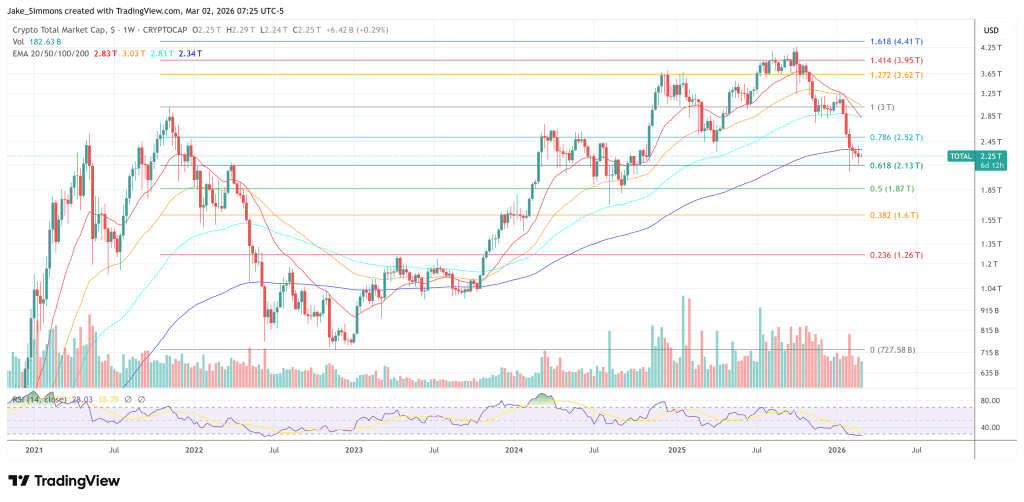
Total crypto market cap remains above the 0.618 Fib, 1-week chart | Source: TOTAL on TradingView.com

Пов'язані питання

QWhat are the five key catalysts for the crypto market this week as mentioned in the article?

AThe five catalysts are: a worsening US-Iran conflict, the launch of Starknet's strkBTC, Polygon's gas upgrade on March 4, Avalanche's new incentive round, and the US jobs report on Friday.

QHow did Bitcoin initially react to the US-Iran conflict over the weekend, and what was its price by European Monday morning?

AThe initial war shock pushed Bitcoin down toward $63,000, but it rebounded to as high as $68,196 on Sunday and was trading around $65,807 by European Monday morning.

QWhat is the key feature of Starknet's new strkBTC product?

AstrkBTC is a wrapped Bitcoin asset issued on Starknet that is redeemable for native BTC, with optional privacy shielding for balances and transfers, meaning privacy is available when needed but transparency remains for compliance.

QWhat is the purpose of Polygon's March 4 upgrade, and what specific feature does it implement?

AThe purpose of the upgrade is to implement agentic-payments through the Lisovo hardfork, which includes PIP-82. This proposal recycles up to $1 million in gas base fees spent on agentic-commerce transactions to directly subsidize machine-to-machine payments.

QHow does the Avalanche Retro9000 C-Chain Round differ from previous incentive programs?

AThe key methodological shift is that it moves from rewarding 'who built' to rewarding 'what gets used.' Projects are ranked by the amount of AVAX burned through smart-contract activity, with the top 40 becoming eligible for rewards from the $40 million funding pool.

Пов'язані матеріали

Will MicroStrategy Fall Into a Death Spiral? How Will the Macro Outlook Evolve in the Second Half of the Year?

**Summary:** The discussion centers on recent Bitcoin price declines and the evolving financial strategy of MicroStrategy (MSTR). The core argument is that the primary pressure is not from one-off Bitcoin sales by MSTR, but from the market's new expectation that MSTR may need to engage in *sustained, small-scale* Bitcoin sales to cover cash flow obligations for its growing portfolio of preferred shares and debt instruments (like STRC). This shift is driven by its stated goal of maintaining "bitcoins per share neutrality." The market is now testing whether it can absorb this potential ongoing selling pressure without entering a severe "death spiral" with Bitcoin's price. A resolution may involve MSTR softening its approach to avoid damaging both its stock and Bitcoin. The conversation then explores the parallel rise of AI-related stocks. The guest posits that AI is fundamentally restructuring labor, with "tokens" (representing access to AI models/compute) becoming a new form of capital and a substitute for human execution. This drives corporate efficiency and profits, benefiting upstream hardware providers (semiconductors, data centers), which explains the sustained rally. This represents the early stages of a "machine economy." Regarding crypto exchanges offering US stock trading, this is seen as a natural evolution. With few crypto-native assets generating lasting value, exchanges are pivoting to distribute valuable real-world assets (RWAs). This doesn't necessarily harm crypto's long-term prospects, as blockchain infrastructure may become crucial for future machine-to-machine economies. The analysis concludes that the era of rampant altcoin speculation is likely over, heavily damaged by the liquidity shock of the "1011" event (likely referring to a major market crash). Meme-driven capital has largely migrated to US equities. Looking ahead, macroeconomic uncertainty is rising due to potential large IPOs (e.g., SpaceX) and the US elections. While short-term market corrections are possible, the long-term trends of AI-driven productivity gains and the maturation of blockchain towards real-world utility and institutional adoption remain intact.

marsbit3 хв тому

Will MicroStrategy Fall Into a Death Spiral? How Will the Macro Outlook Evolve in the Second Half of the Year?

marsbit3 хв тому

Will MicroStrategy Fall into a Death Spiral? What Will the Macro Trend Be in the Second Half of the Year?

The podcast features investor Didier discussing the recent Bitcoin downturn and the evolving strategy of MicroStrategy (MSTR). He argues the core pressure is not macro factors or ETF outflows, but the market pricing in an expectation that MSTR will engage in continuous, small-scale Bitcoin sales to fund its increasing preferred stock and debt obligations under its "bitcoin-per-share neutrality" principle. This creates a structural headwind. However, he is cautiously optimistic a "death spiral" is avoidable without new major shocks, as market support is likely to emerge at a certain price point. Didier then posits that the AI-driven bull market in US stocks (semiconductors, data centers) is fundamentally driven by AI agents and tokens becoming the "new labor force," displacing human roles and boosting corporate margins. This shift toward a machine economy is still in its early stages. He comments on crypto exchanges adding US stock trading, viewing it as a natural move toward valuable real-world assets as truly valuable crypto-native assets remain scarce. For crypto-native traders, he suggests existing strategies (e.g., meme-chasing or value investing) can translate to similar assets in US markets. The discussion notes the severe liquidity damage from the "1011 event" (likely referring to a major market crash) has essentially ended the altcoin cycle, with speculative momentum shifting to the more liquid US stock market. Regarding the macroeconomic outlook for H2 2024, Didier expresses increased caution due to potential market pressure from upcoming mega-IPOs (e.g., SpaceX) and US midterm election risks. Long-term, he remains bullish on AI's productivity gains and its convergence with blockchain/Web3, which he sees maturing into a more institutional, real-asset-focused phase.

链捕手6 хв тому

Will MicroStrategy Fall into a Death Spiral? What Will the Macro Trend Be in the Second Half of the Year?

链捕手6 хв тому

Dylan Patel: Founder of SemiAnalysis, Praised by Jensen Huang, is a 'Beekeeper' and 'Forum Enthusiast'

Dylan Patel, founder of the independent research firm SemiAnalysis, has an unconventional background. A former beekeeper from rural Georgia, he entered the semiconductor world as a self-taught "forum warrior," discussing chip technology anonymously online from a young age. He launched the SemiAnalysis blog in May 2020, which later transitioned to a paid subscription model. The firm has grown from a one-person operation to a global team of around 60, with a dedicated teardown lab. Its detailed, technically-focused analysis on semiconductor supply chains, AI infrastructure, and products has earned significant industry recognition. Notably, NVIDIA founder Jensen Huang has publicly cited their reports. In a landmark case, a critical 2024 report on AMD's MI300X GPU software stack led to a 90-minute call with AMD CEO Lisa Su, who thanked him for the constructive feedback. SemiAnalysis later acknowledged AMD's improvements. The firm's influence on markets was seen when a report on NVIDIA's Rubin memory configuration was partially shared, affecting memory stock prices. Dylan Patel emphasized the importance of context, contrasting the shared excerpt with the report's actual title. SemiAnalysis, now a multi-faceted consultancy with revenue projected to reach $100 million, is known for its deep technical insights that influence major industry players and investment decisions.

marsbit56 хв тому

Dylan Patel: Founder of SemiAnalysis, Praised by Jensen Huang, is a 'Beekeeper' and 'Forum Enthusiast'

marsbit56 хв тому

Dylan Patel: SemiAnalysis, Praised by Jensen Huang, is Founded by a 'Beekeeper and Forum Warrior'

Dylan Patel, founder of the independent research firm SemiAnalysis, has an unconventional background. Growing up in rural Georgia, he later worked as a beekeeper in Minnesota. His entry into semiconductors began as a self-taught "forum warrior," engaging anonymously in online tech communities from a young age. In May 2020, he started the SemiAnalysis blog on WordPress, later moving it to Substack as a paid subscription service. The firm has since evolved from a one-person operation into a global company with around 60 employees, featuring a dedicated chip teardown lab. Its revenue, reaching $20 million last year, is projected to surpass $100 million this year. SemiAnalysis is highly regarded in the AI and semiconductor industry for its deep technical analysis. NVIDIA founder Jensen Huang has publicly praised its reports. In a notable instance, a critical report on AMD's MI300X GPU software shortcomings prompted a 90-minute call with CEO Lisa Su, who thanked Patel for the "constructive feedback." A later report acknowledged AMD's subsequent improvements. The firm's analyses have significant market impact. For example, a June report discussing potential memory configuration changes in NVIDIA's next-generation servers was cited as a factor in pressure on memory-related stocks. Patel plans to establish a venture capital firm, having already made personal investments in about 20 startups. SemiAnalysis combines roles as a consultancy, model platform, and tech lab, focusing on the practical bottlenecks in AI infrastructure.

Odaily星球日报1 год тому

Dylan Patel: SemiAnalysis, Praised by Jensen Huang, is Founded by a 'Beekeeper and Forum Warrior'

Odaily星球日报1 год тому

Ethereum Q1 Report: On-chain Activity Hits Record High, Tokenized Assets Lead the Industry

Ethereum Q1 2026 Report: On-chain activity hits record high, tokenized assets lead the industry. In Q1 2026, Ethereum's network experienced a unique divergence: on-chain activity soared while USD-denominated metrics declined. Monthly active users reached 13.2 million, transactions hit 200.4 million, and TPS averaged 25.78, all setting new highs. However, total value locked (TVL) fell 11.0% to $316.2B, DEX volume dropped 24.0% to $134.5B, and ETH's fully diluted market cap fell 30.3% to $290B. A key driver was the Blob Parameter Fork (BPO#2) in January, which increased data capacity and caused a sharp 47.9% drop in layer-1 transaction fees despite higher usage. Etherean's tokenized asset market cap reached $203.4B, up 42.9% year-over-year. While stablecoins ($178.9B) saw a slight dip, tokenized funds ($19.4B, +73.1% YoY), commodities ($4.7B, +325.9% YoY), and stocks ($365.1M) grew strongly. Ethereum dominates cross-chain comparisons, holding 71% of TVL, 79.2% of active loans, 61.8% of stablecoins, and 73% of tokenized funds among top chains. The report highlights a "Jevons Paradox" scenario: network expansion reduces per-transaction costs but unleashes latent demand, driving long-term growth. Ethereum's strategy mirrors Amazon's early focus on scale over profit. Its open, neutral foundation is seen as critical for institutional adoption, as evidenced by growing activity from firms like BlackRock and JPMorgan. The roadmap targets further scalability, aiming for thousands of TPS by 2029 to solidify its role as a global financial settlement layer.

marsbit1 год тому

Ethereum Q1 Report: On-chain Activity Hits Record High, Tokenized Assets Lead the Industry

marsbit1 год тому

Торгівля

Спот
Ф'ючерси
活动图片