Crypto Warning: Bonk.fun Domain Hack Exposes Solana Traders To Wallet Drain

bitcoinistОпубліковано о 2026-03-14Востаннє оновлено о 2026-03-14

Анотація

Crypto platform Bonk.fun suffered a domain hijacking attack on March 12, 2026, exposing users to a wallet-draining exploit. Hackers injected a malicious script on the website, prompting users to sign a fake "Terms of Service" agreement, which, when approved, allowed the attackers to steal funds. The team confirmed that only users who interacted with the fraudulent prompt after the hack were affected, and losses were reported as minimal. The breach was attributed to a Web2 infrastructure failure rather than a smart contract exploit. This incident highlights the growing threat of approval-phishing and domain hijacking attacks in the crypto space, underscoring the need for heightened user caution and improved security practices.

A Crypto platform confirmed that their main domain website had been hacked, which exposed its users to a wallet draining exploit.

A No-Fun Crypto Hijack

It is a truth universally acknowledge that, no matter the size of a global geopolitical crisis, hackers will continue to ravage through the crypto market. This time, the victim was memecoin issuance platform Bonk.fun. In a March 12 post on the social network X, Tom (@SolportTom), one of its operators, warned the users not to interact with the domain “until further notice”, as hackers had injected a crypto wallet drainer on it:

The official X account of the Solana token launchpad, backed by Raydium and the BONK community, also announced the hack and echoed Tom’s striking warning:

Who Is Affected And How

Tom explained that the phishing scam set up a fake “Terms of Services” (TOS) signature prompt which, when signed, allowed the drainer to move the unaware user’s funds. According to Tom, the only users compromised were the ones who interacted with the fake TOS. He clarified that neither previously connected users nor traders of bonk fun tokens on third-party terminals were affected. He also assured that the security breach was spotted early so “the losses are minimal to date”:

This is not a Raydium or BONK smart contract exploit, but the case of a Web2 infrastructure failure that bled directly into Web3. This type of domain hijacking and phishing drainer scripts work by the attackers taking over the frontend and presenting normal-looking prompts that abuse wallet approvals.

A Pattern Of Exploited Vulnerabilities

In recent years, approval-phishing and “fake UI” attacks have stolen billions of dollars: one Chainalysis investigation reported the amount of $14 billion in on-chain scam inflows in 2025, with projections pointing above the $17 billion as more wallets continued to be identified.

As scam revenues grow and AI‐driven impersonation scales, crypto security in 2026 is less about the perfect code and more about defending everything around it: from domains to social accounts, employees and users decision-making. In February last year, attackers hijacked Pump.fun’s X account to push a fake PUMP token, as covered by our sister website NewsBTC. Not too long ago, OG trader Sillytuna was drove out of the crypto market after a multimillion-dollar theft that combined online address poisoning and offline violent actions.

The times are testing traders online and offline, both inside and outside the bloc. As the crypto landscape grows more complex, traders would do well to heighten their caution: prefer direct contract interaction or trusted aggregators, and use tools to monitor and regularly revoke token approvals.
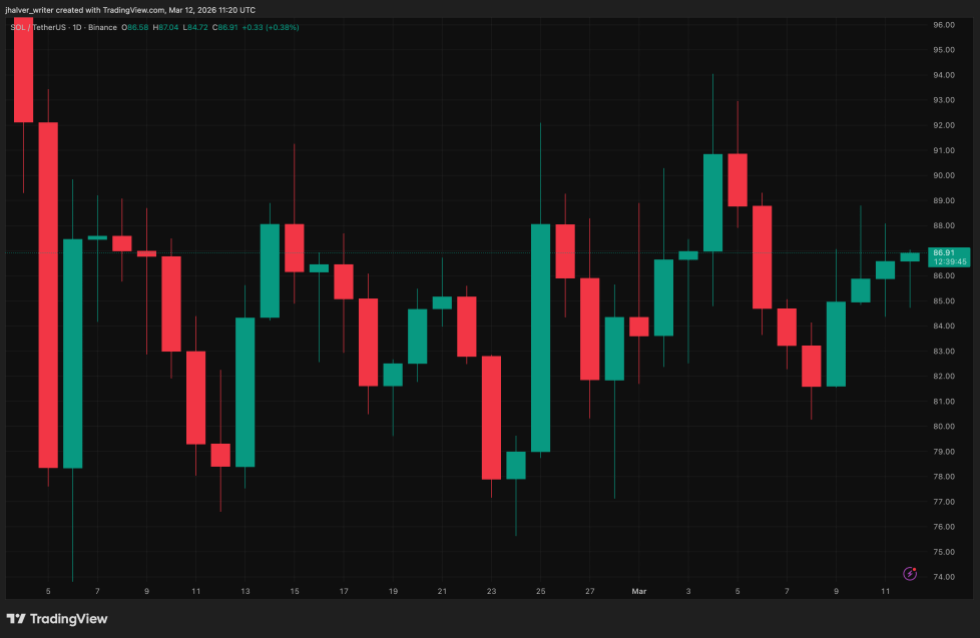
SOL’s price trends to the upside on the daily chart. Source: SOLUSDT on Tradingview

Cover image from Perplexity, SOLUSDT chart from Tradingview

Пов'язані питання

QWhat was the main security incident that occurred with Bonk.fun?

AThe main domain of Bonk.fun was hacked, and a wallet drainer was injected into the website, exposing users to a phishing scam.

QHow did the wallet drainer on Bonk.fun's compromised domain work?

AThe drainer set up a fake 'Terms of Services' (TOS) signature prompt. When users signed this prompt, it allowed the attacker to move their funds.

QAccording to the article, which users were affected by this security breach?

AOnly users who interacted with the fake TOS message on the compromised Bonk.fun domain after the hack were affected. Previously connected users and those trading on third-party terminals were not compromised.

QWhat type of exploit was this incident classified as, and what was its root cause?

AThis was not a smart contract exploit. It was a Web2 infrastructure failure (domain hijacking) that led to a Web3 phishing attack, where the frontend was compromised to present malicious prompts.

QWhat broader trend in crypto scams does the article mention, and what was a key statistic provided?

AThe article mentions that approval-phishing and 'fake UI' attacks have become a major trend. A Chainalysis investigation reported $14 billion in on-chain scam inflows in 2025, with projections exceeding $17 billion.

Пов'язані матеріали

Annual Salary of Millions Competing for Electricians, Meta Rushes to Open Its Own Technical School

The AI boom is facing an unexpected bottleneck: a severe shortage of skilled construction workers and electricians. As tech giants like Meta, OpenAI, and Alphabet race to build massive data centers—such as OpenAI's $16 billion "Stargate" project—they are hitting a critical labor wall. The U.S. needs an estimated 130,000 more electricians, 240,000 construction workers, and 150,000 supervisors by 2030 for AI infrastructure alone, but tens of thousands of electrician jobs go unfilled each year. While AI companies offer high premiums, with electricians earning up to $280,000 annually, worker scarcity still causes massive losses—delays on a single project can cost $14.2 million per month. The complexity of building AI data centers, which require immense power (equivalent to powering hundreds of thousands of homes), sophisticated electrical systems, and advanced liquid cooling solutions, demands highly skilled technicians who are in short supply. To combat this, companies are investing heavily in training. Meta has committed $115 million to a free training school offering tuition, housing, and stipends, targeting 5,000 new workers. OpenAI is partnering with unions to secure skilled labor. These efforts are paying off, with a significant rise in Gen Z interest in trade schools over college. However, the power demands are staggering. AI data centers are driving a rapid surge in electricity consumption, projected to account for up to 12% of U.S. power use by 2028 and raising costs for consumers. Furthermore, the construction boom is project-based, leading to a potential future glut of trained workers once building peaks, which could depress wages industry-wide. The race for AI supremacy now depends as much on skilled hands as on advanced chips.

marsbit1 год тому

Annual Salary of Millions Competing for Electricians, Meta Rushes to Open Its Own Technical School

marsbit1 год тому

OpenAI No Longer Sells Its Most Expensive Model for Profit

OpenAI is shifting its business strategy away from promoting its most expensive, flagship models for every task. Recent price cuts—80% for GPT-5.6 Luna and 20% for Terra—signal a deeper change: the company now actively advises users that many tasks don't require the most powerful model. Instead, OpenAI recommends a tiered approach: use the high-end GPT-5.6 Sol for complex planning and analysis, then delegate execution to cheaper models like Luna. This mirrors moves by Anthropic, which recently launched Claude Opus 5 at half the price of its top model, Fable 5. Both companies are de-emphasizing flagship models as primary revenue drivers, using them instead for brand prestige and technological showcases. The industry is entering a "mass-market" phase, similar to automotive, where high-volume, cost-effective models handle daily operations and drive scale. OpenAI's price reductions are partly enabled by AI models themselves optimizing underlying code and infrastructure, creating a self-reinforcing cycle of efficiency gains and cost reduction. Competition is shifting from "who is smartest" to "who offers the best value." The goal is no longer selling individual models but fostering widespread API adoption and ecosystem lock-in. By making AI calls cheap and ubiquitous, companies like OpenAI aim to become the indispensable, utility-like infrastructure powering automated workflows—the "water and electricity" of software, quietly embedded everywhere.

marsbit1 год тому

OpenAI No Longer Sells Its Most Expensive Model for Profit

marsbit1 год тому

Торгівля

Спот
活动图片





