Crypto Warning: Bonk.fun Domain Hack Exposes Solana Traders To Wallet Drain

bitcoinistОпубліковано о 2026-03-14Востаннє оновлено о 2026-03-14

Анотація

Crypto platform Bonk.fun suffered a domain hijacking attack on March 12, 2026, exposing users to a wallet-draining exploit. Hackers injected a malicious script on the website, prompting users to sign a fake "Terms of Service" agreement, which, when approved, allowed the attackers to steal funds. The team confirmed that only users who interacted with the fraudulent prompt after the hack were affected, and losses were reported as minimal. The breach was attributed to a Web2 infrastructure failure rather than a smart contract exploit. This incident highlights the growing threat of approval-phishing and domain hijacking attacks in the crypto space, underscoring the need for heightened user caution and improved security practices.

A Crypto platform confirmed that their main domain website had been hacked, which exposed its users to a wallet draining exploit.

A No-Fun Crypto Hijack

It is a truth universally acknowledge that, no matter the size of a global geopolitical crisis, hackers will continue to ravage through the crypto market. This time, the victim was memecoin issuance platform Bonk.fun. In a March 12 post on the social network X, Tom (@SolportTom), one of its operators, warned the users not to interact with the domain “until further notice”, as hackers had injected a crypto wallet drainer on it:

The official X account of the Solana token launchpad, backed by Raydium and the BONK community, also announced the hack and echoed Tom’s striking warning:

Who Is Affected And How

Tom explained that the phishing scam set up a fake “Terms of Services” (TOS) signature prompt which, when signed, allowed the drainer to move the unaware user’s funds. According to Tom, the only users compromised were the ones who interacted with the fake TOS. He clarified that neither previously connected users nor traders of bonk fun tokens on third-party terminals were affected. He also assured that the security breach was spotted early so “the losses are minimal to date”:

This is not a Raydium or BONK smart contract exploit, but the case of a Web2 infrastructure failure that bled directly into Web3. This type of domain hijacking and phishing drainer scripts work by the attackers taking over the frontend and presenting normal-looking prompts that abuse wallet approvals.

A Pattern Of Exploited Vulnerabilities

In recent years, approval-phishing and “fake UI” attacks have stolen billions of dollars: one Chainalysis investigation reported the amount of $14 billion in on-chain scam inflows in 2025, with projections pointing above the $17 billion as more wallets continued to be identified.

As scam revenues grow and AI‐driven impersonation scales, crypto security in 2026 is less about the perfect code and more about defending everything around it: from domains to social accounts, employees and users decision-making. In February last year, attackers hijacked Pump.fun’s X account to push a fake PUMP token, as covered by our sister website NewsBTC. Not too long ago, OG trader Sillytuna was drove out of the crypto market after a multimillion-dollar theft that combined online address poisoning and offline violent actions.

The times are testing traders online and offline, both inside and outside the bloc. As the crypto landscape grows more complex, traders would do well to heighten their caution: prefer direct contract interaction or trusted aggregators, and use tools to monitor and regularly revoke token approvals.
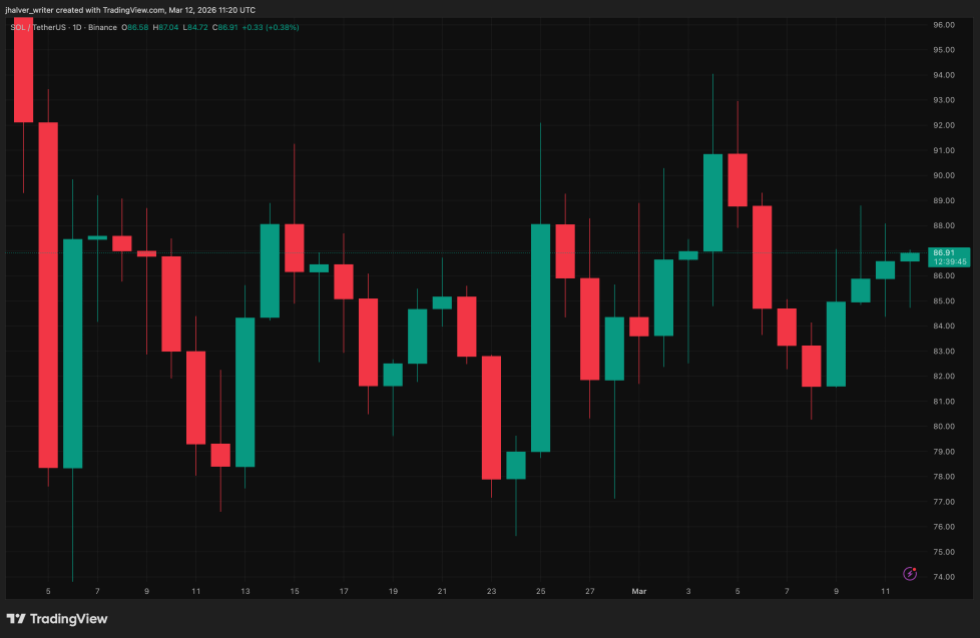
SOL’s price trends to the upside on the daily chart. Source: SOLUSDT on Tradingview

Cover image from Perplexity, SOLUSDT chart from Tradingview

Пов'язані питання

QWhat was the main security incident that occurred with Bonk.fun?

AThe main domain of Bonk.fun was hacked, and a wallet drainer was injected into the website, exposing users to a phishing scam.

QHow did the wallet drainer on Bonk.fun's compromised domain work?

AThe drainer set up a fake 'Terms of Services' (TOS) signature prompt. When users signed this prompt, it allowed the attacker to move their funds.

QAccording to the article, which users were affected by this security breach?

AOnly users who interacted with the fake TOS message on the compromised Bonk.fun domain after the hack were affected. Previously connected users and those trading on third-party terminals were not compromised.

QWhat type of exploit was this incident classified as, and what was its root cause?

AThis was not a smart contract exploit. It was a Web2 infrastructure failure (domain hijacking) that led to a Web3 phishing attack, where the frontend was compromised to present malicious prompts.

QWhat broader trend in crypto scams does the article mention, and what was a key statistic provided?

AThe article mentions that approval-phishing and 'fake UI' attacks have become a major trend. A Chainalysis investigation reported $14 billion in on-chain scam inflows in 2025, with projections exceeding $17 billion.

Пов'язані матеріали

Has the 'Digital Gold' Narrative for BTC Failed?

**Title: Has the "Digital Gold" Narrative for Bitcoin Failed?** The article argues that Bitcoin's "digital gold" narrative remains valid despite a recent sharp price decline (from a peak near $126k in Oct 2025 to briefly under $61k in Feb 2026). It presents a long-term investment framework based on three core points: **1. Viewing Bitcoin as an Asset:** Bitcoin is presented as a superior potential store of value compared to gold. Key arguments are its absolute scarcity (21 million cap), superior portability, and transparent auditability via its public ledger. While acknowledging its current use in early, volatile stages (~3-4% global adoption), the author draws parallels to the early, disruptive phases of the internet and e-commerce. **2. Understanding the Recent Downturn:** The current ~50% correction is framed as a predictable, consensus-driven cycle following its post-halving peak (the 2024 halving preceded the Oct 2025 high). A crucial factor is a historic "changing of hands": the influx of new institutional buyers via ETFs allowed early, low-cost holders (miners, OG believers) to take profits. The author notes that while severe, Bitcoin's historical drawdowns (e.g., 93% in 2011, 77% in 2021-22) have been progressively smaller, suggesting maturing holder structure and decreasing volatility over time. **3. The Long-Term Perspective:** The long-term thesis hinges on Bitcoin capturing a portion of gold's market value. With Bitcoin's market cap at ~$1.4 trillion (at $70k) versus gold's ~$20 trillion, significant upside potential exists if the "digital gold" narrative is partially realized. However, the author strongly cautions that short-term risks remain, the bottom is unpredictable, and high volatility is inherent. The real risk is not Bitcoin failing but poor personal position management (over-leverage, wrong capital) and a lack of deep understanding, which can force investors out during severe downturns. The conclusion uses Amazon's 95% crash post-2000 dot-com bubble and subsequent 42x recovery as an analogy. The ultimate question is not if Bitcoin's price will rise, but if an investor's strategy and conviction can withstand the volatility to see the long-term play out. The recent divergence (gold up, Bitcoin down) is posed not as a narrative failure, but as potential evidence of this ongoing, painful transition from a speculative asset to a mainstream allocation.

marsbit8 год тому

Has the 'Digital Gold' Narrative for BTC Failed?

marsbit8 год тому

Has BTC's 'Digital Gold' Narrative Failed?

The article discusses Bitcoin's "digital gold" narrative, its recent price drop, and long-term outlook through the perspective of "Jason". It argues the narrative is not a failure but that Bitcoin represents a superior, new asset class due to its fixed supply (21 million), portability, and auditability. The piece compares its current ~3-4% global adoption rate to early internet/e-commerce, suggesting significant growth potential. Regarding the 2025-2026 price decline (from ~$126k to briefly under $61k), the author views it as a predictable, consensus-driven sell-off within Bitcoin's ~4-year cycle post-halving, exacerbated by a major "handover" from early, low-cost holders to new institutional buyers via ETFs. A key observation is that historical peak-to-trough drawdowns have lessened over time (e.g., 93% in 2011 to ~50% in 2026), indicating maturing volatility as holder structure changes. For the long term, the author uses a simple framework: Bitcoin's total market cap (~$1.4T at $70k) is only about 7% of gold's (~$20T). Even capturing 30-50% of gold's value would imply substantial upside. However, the article strongly cautions against viewing this as investment advice, emphasizing extreme volatility and the critical importance of risk management, position sizing, and deep fundamental understanding to survive severe drawdowns. It concludes by drawing a parallel to Amazon's 95% crash in 2000 and subsequent 42x recovery, stressing that the key is surviving market cycles to realize long-term potential.

链捕手8 год тому

Has BTC's 'Digital Gold' Narrative Failed?

链捕手8 год тому

From Code to Cognition: A Ten-Thousand-Word Guide to the Evolution of the Robot Brain

"From Code to Cognition: The Evolution of Robot Brains" The journey of robotic intelligence has shifted dramatically from manually coded systems to AI-driven brains. For decades, robots relied on layered software stacks—perception, state estimation, planning, control—each handcrafted. While predictable, they lacked adaptability. The 2010s saw deep learning revolutionize perception (e.g., object detection) and control (via reinforcement learning), but learned skills remained narrow. The arrival of Large Language Models (LLMs) marked a turning point. LLMs acted as high-level planners, interpreting natural language instructions and generating sequences of actions for traditional robotic systems to execute. However, true integration came with Visual-Language-Action (VLA) models, which fused vision, language, and motion prediction into a single network. Pioneered by models like RT-2 and open-source projects like OpenVLA, VLAs enable robots to reason and act directly from visual input and commands. The most advanced humanoid robots now employ a "dual-brain" architecture: a slow-thinking, large VLA (System 2) for reasoning and planning, and a fast-reacting, small network (System 1) for high-frequency motion control, sometimes with an even lower-level System 0 for balance. This split balances cognition with the physics of real-time movement. Computation is split between onboard hardware (e.g., NVIDIA Jetson) for safety-critical control loops and cloud/edge servers for non-critical tasks like learning and interfaces. A crucial driver is the open-source ecosystem—models like GR00T and OpenVLA allow startups to build upon pre-trained brains and fine-tune them with their own data, accelerating development. Despite progress, current systems struggle with recovery from errors, sample inefficiency, and long-horizon tasks. This has spurred the rise of **World Models**—neural networks that predict the consequences of actions. By simulating possible futures before acting (like NVIDIA Cosmos or Meta V-JEPA), robots can plan, recover, and generalize better. This represents the next frontier: shifting intelligence from learned reactions to an internal model of physics and cause-and-effect. The field is rapidly evolving. While not yet at its "ChatGPT moment," the convergence of cheaper hardware, scalable simulation, and world models points toward robots that are increasingly capable, adaptive, and useful. The question is shifting from "what can robots do?" to "what *should* they do?"

marsbit9 год тому

From Code to Cognition: A Ten-Thousand-Word Guide to the Evolution of the Robot Brain

marsbit9 год тому

Торгівля

Спот
Ф'ючерси
活动图片