Crypto Warning: Bonk.fun Domain Hack Exposes Solana Traders To Wallet Drain

bitcoinistОпубліковано о 2026-03-14Востаннє оновлено о 2026-03-14

Анотація

Crypto platform Bonk.fun suffered a domain hijacking attack on March 12, 2026, exposing users to a wallet-draining exploit. Hackers injected a malicious script on the website, prompting users to sign a fake "Terms of Service" agreement, which, when approved, allowed the attackers to steal funds. The team confirmed that only users who interacted with the fraudulent prompt after the hack were affected, and losses were reported as minimal. The breach was attributed to a Web2 infrastructure failure rather than a smart contract exploit. This incident highlights the growing threat of approval-phishing and domain hijacking attacks in the crypto space, underscoring the need for heightened user caution and improved security practices.

A Crypto platform confirmed that their main domain website had been hacked, which exposed its users to a wallet draining exploit.

A No-Fun Crypto Hijack

It is a truth universally acknowledge that, no matter the size of a global geopolitical crisis, hackers will continue to ravage through the crypto market. This time, the victim was memecoin issuance platform Bonk.fun. In a March 12 post on the social network X, Tom (@SolportTom), one of its operators, warned the users not to interact with the domain “until further notice”, as hackers had injected a crypto wallet drainer on it:

The official X account of the Solana token launchpad, backed by Raydium and the BONK community, also announced the hack and echoed Tom’s striking warning:

Who Is Affected And How

Tom explained that the phishing scam set up a fake “Terms of Services” (TOS) signature prompt which, when signed, allowed the drainer to move the unaware user’s funds. According to Tom, the only users compromised were the ones who interacted with the fake TOS. He clarified that neither previously connected users nor traders of bonk fun tokens on third-party terminals were affected. He also assured that the security breach was spotted early so “the losses are minimal to date”:

This is not a Raydium or BONK smart contract exploit, but the case of a Web2 infrastructure failure that bled directly into Web3. This type of domain hijacking and phishing drainer scripts work by the attackers taking over the frontend and presenting normal-looking prompts that abuse wallet approvals.

A Pattern Of Exploited Vulnerabilities

In recent years, approval-phishing and “fake UI” attacks have stolen billions of dollars: one Chainalysis investigation reported the amount of $14 billion in on-chain scam inflows in 2025, with projections pointing above the $17 billion as more wallets continued to be identified.

As scam revenues grow and AI‐driven impersonation scales, crypto security in 2026 is less about the perfect code and more about defending everything around it: from domains to social accounts, employees and users decision-making. In February last year, attackers hijacked Pump.fun’s X account to push a fake PUMP token, as covered by our sister website NewsBTC. Not too long ago, OG trader Sillytuna was drove out of the crypto market after a multimillion-dollar theft that combined online address poisoning and offline violent actions.

The times are testing traders online and offline, both inside and outside the bloc. As the crypto landscape grows more complex, traders would do well to heighten their caution: prefer direct contract interaction or trusted aggregators, and use tools to monitor and regularly revoke token approvals.
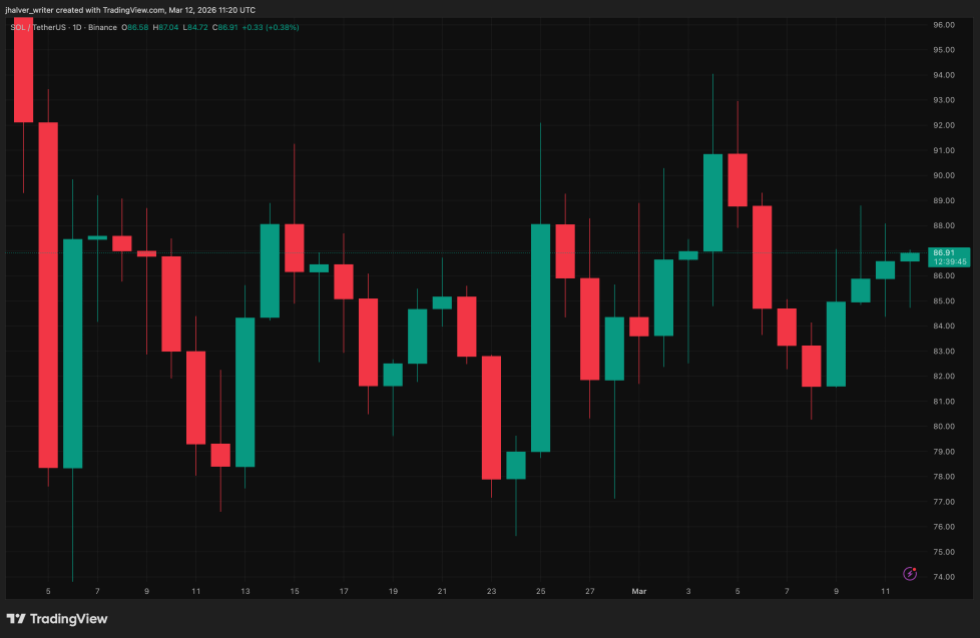
SOL’s price trends to the upside on the daily chart. Source: SOLUSDT on Tradingview

Cover image from Perplexity, SOLUSDT chart from Tradingview

Пов'язані питання

QWhat was the main security incident that occurred with Bonk.fun?

AThe main domain of Bonk.fun was hacked, and a wallet drainer was injected into the website, exposing users to a phishing scam.

QHow did the wallet drainer on Bonk.fun's compromised domain work?

AThe drainer set up a fake 'Terms of Services' (TOS) signature prompt. When users signed this prompt, it allowed the attacker to move their funds.

QAccording to the article, which users were affected by this security breach?

AOnly users who interacted with the fake TOS message on the compromised Bonk.fun domain after the hack were affected. Previously connected users and those trading on third-party terminals were not compromised.

QWhat type of exploit was this incident classified as, and what was its root cause?

AThis was not a smart contract exploit. It was a Web2 infrastructure failure (domain hijacking) that led to a Web3 phishing attack, where the frontend was compromised to present malicious prompts.

QWhat broader trend in crypto scams does the article mention, and what was a key statistic provided?

AThe article mentions that approval-phishing and 'fake UI' attacks have become a major trend. A Chainalysis investigation reported $14 billion in on-chain scam inflows in 2025, with projections exceeding $17 billion.

Пов'язані матеріали

Platform Token Soars 15x in Half a Month, Pons Tops Robinhood Chain Charts for Both Token Launches and Trading

In just half a month, the Pons platform token (PONS) surged over 15x in value as Pons solidified its position as the leading token launch and trading platform on Robinhood Chain, capturing both the highest daily token creation volume and transaction volume. Following the exit of previous leader NOXA, competition initially favored Flap before Pons emerged dominant around mid-July. By July 26th, Pons accounted for 77.1% of total trading volume across all Robinhood Chain launchpads. Pons's success is attributed to its streamlined, one-transaction process for deploying a token contract and its corresponding Uniswap V3 liquidity pool simultaneously, eliminating the need for bonding curves or complex migrations. This simplicity, combined with low creation costs and immediate tradability, attracted significant creation activity and speculative trading. The meteoric rise of its native token, PONS, further fueled platform growth. A tokenomics model directing 80% of protocol fees to buy back and burn PONS created a reinforcing cycle: platform usage boosted PONS value, which in turn attracted more users. Looking ahead, Pons V2 aims to expand beyond meme tokens by integrating support for paying fees in stablecoins (USDG) and RWA assets, aligning with Robinhood Chain's broader focus on on-chain finance and stock tokens.

Odaily星球日报43 хв тому

Platform Token Soars 15x in Half a Month, Pons Tops Robinhood Chain Charts for Both Token Launches and Trading

Odaily星球日报43 хв тому

Qualcomm Chip Price Hike Deals a Blow to Android Phones

Qualcomm has officially announced a new round of price increases for its entire chip portfolio, effective September 1. The hikes, reaching up to 18% for the flagship Snapdragon 8 Elite Gen 6 Pro, follow similar moves by MediaTek, intensifying cost pressures on the already strained smartphone industry. CEO Cristiano Amon confirmed the plan, citing the need to offset rising industry-wide costs and restore declining profit margins. Qualcomm's Q3 FY2026 results showed a 25% drop in net profit, with mobile revenue plunging 20% year-over-year, hitting its lowest level since 2021. The surge in AI computing demand has led memory manufacturers to prioritize HBM production, creating a shortage in general-purpose DRAM and NAND Flash chips. Their prices soared by 93%-98% and 55%-60% respectively in Q1 2026, causing the memory cost share in smartphones to jump from 10%-15% to over 30%. Coupled with the soaring cost of advanced nodes like TSMC's 2nm and packaging, overall chip costs have reached historic highs. These upstream pressures are forcing downstream smartphone brands like Xiaomi, OPPO, and vivo to cut orders for mid-to-low-end models by up to 20% and use cost-saving measures like older chipsets. Reportedly, the Snapdragon 8E5 will be repurposed as a "long-lasting" chip for sub-brand phones in H2 2026. Amid this cost crisis, the Android market remains sluggish. Q2 2026 smartphone shipments in China fell 4.3% year-over-year, marking five consecutive quarters of decline. Major Android brands saw market share drop, while Huawei and Apple, with their in-house chip advantages, gained share. Qualcomm is diversifying into automotive and IoT sectors to reduce reliance on smartphones, but these new segments cannot yet fill the mobile revenue gap. Industry observers warn that the full impact of component cost hikes will hit in the second half of 2026, likely leading to higher-than-expected price increases for Android flagships and a further contraction in the Chinese smartphone market.

marsbit53 хв тому

Qualcomm Chip Price Hike Deals a Blow to Android Phones

marsbit53 хв тому

Breaking: GPT-5.6 Prices Slashed Effective Today

OpenAI has announced significant price cuts for its GPT-5.6 model API, effective immediately. The entry-level **GPT-5.6 Luna** sees the most drastic reduction, with input prices dropping 80% to $0.20 per million tokens and output prices falling to $1.20 per million tokens. The mid-tier **GPT-5.6 Terra** is reduced by 20%, now costing $2.00 (input) and $12.00 (output) per million tokens. The flagship **GPT-5.6 Sol** maintains its original price but introduces a new **Fast mode**, offering speeds up to 2.5 times faster for double the cost. The company attributes these price reductions to efficiency gains achieved through **GPT-5.6 Sol's own involvement in optimizing its production systems**. The model assisted in rewriting GPU kernels and improving speculative decoding, leading to a 20% reduction in end-to-end service costs and over 15% improvement in token generation efficiency. OpenAI emphasizes this process remained human-led. A key focus of the降价 is to lower the barrier for running **AI agent workflows**. By making the capable, tool-calling Luna model significantly cheaper, OpenAI aims to enable more frequent use in cost-sensitive, high-volume tasks like code review and monitoring. This creates a potential feedback loop: model-assisted efficiency gains lead to lower costs, which enables broader agent deployment, which in turn drives further optimization. The new pricing and features will also apply to Codex and ChatGPT Work subscriptions. The changes intensify competition in the large language model market, with OpenAI directly challenging rivals like Anthropic to respond.

marsbit1 год тому

Breaking: GPT-5.6 Prices Slashed Effective Today

marsbit1 год тому

Торгівля

Спот
活动图片