Crypto Users Hit By 1,400% Surge In Impersonation Scams, Research Shows

bitcoinistОпубліковано о 2026-01-14Востаннє оновлено о 2026-01-14

Анотація

Impersonation scams surged by 1,400% in 2025, causing billions in losses as criminals used AI tools, voice cloning, and fake customer-support schemes. The average scam amount increased by over 600%, with AI-enabled methods proving several times more profitable. Scammers impersonated exchange staff and celebrities using deepfakes and sophisticated social engineering, making operations more efficient and harder to trace. One high-profile case stole nearly $16 million. Total on-chain crypto scam losses for 2025 are estimated between $14 billion and $17 billion.

Impersonation scams exploded in 2025, growing by about 1,400% and driving some of the biggest losses seen in crypto fraud to date. According to analysis by Chainalysis, scammers used AI tools, voice cloning and fake customer-support schemes to scale up attacks, pushing total scam losses on chain into the low-double-digit billions.

Impersonation Scams Jump Dramatically

Reports have disclosed that the rise was not just in the number of cases but in how much each case cost victims. The average amount taken in impersonation schemes rose by over 600% compared with the prior year, a jump that turned many small cons into large heists. Chainalysis highlights the role of automated tooling and commercially available phishing services that let scammers run scams like factories.
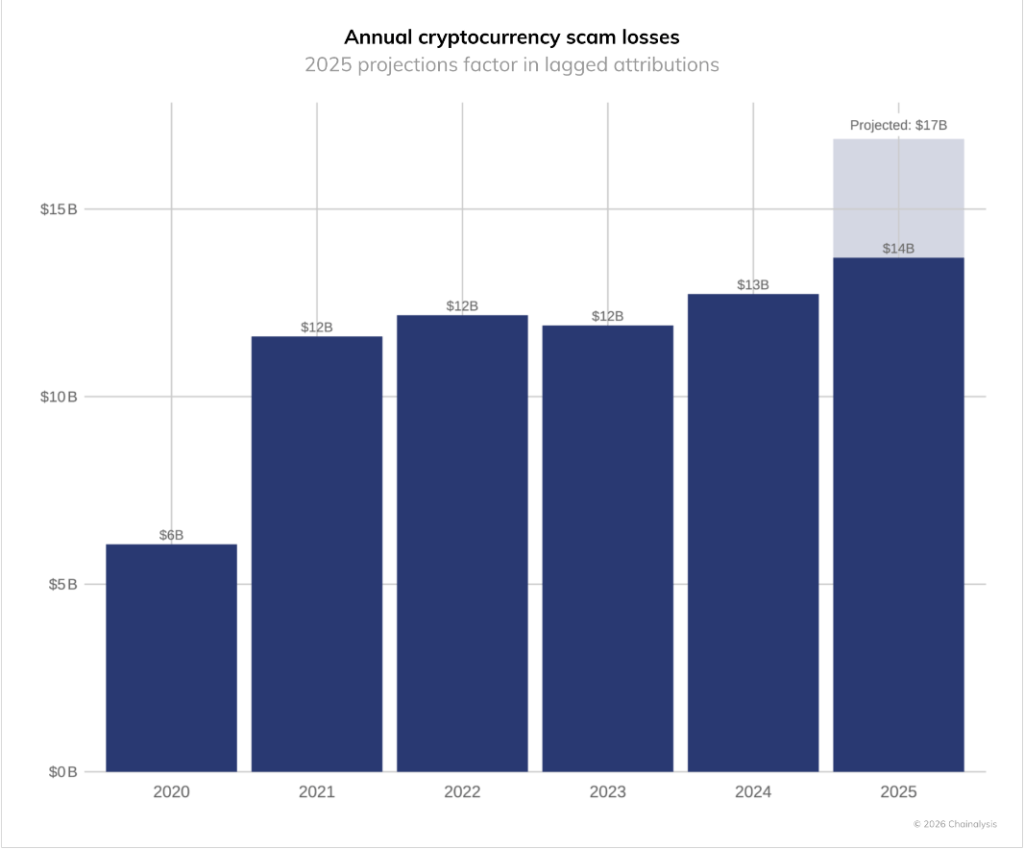
Source: Chainalysis

Criminals Used AI And Deepfakes

Fraudsters leaned heavily on AI techniques in 2025. Based on reports, AI-generated voice and face clones, paired with very believable messages, helped criminals impersonate exchange staff, celebrities or close contacts. These methods increased both reach and success rates. Industry writeups and analysts show that AI-enabled scams were several times more profitable than older approaches.

BTCUSD currently trading at $94,929. Chart: TradingView

A High-Profile Example Shows The Risk

One public example involved scammers posing as a major exchange and clearing nearly $16 million from victims in a single operation. That case became a headline because it showed how quickly an impersonation scam can turn into a mass theft when it uses polished fake identities and coordinated social engineering. Financial news outlets and industry trackers used that case to illustrate the shift in tactics.

Operations Became Industrialized

Based on Chainalysis data, scam groups now resemble small businesses. They outsource parts of the fraud chain — writing scripts, buying deepfake clips, and hiring money movers. This setup made fraud more efficient and harder to disrupt. One analysis found AI-assisted schemes were about 4.5 times more profitable than traditional scams, a gap that attackers exploited to level up operations quickly.

Estimates of total crypto scam losses for 2025 vary by outlet, but multiple sources put the number well into the billions. Some trackers reported $14 billion in funds stolen on chain, while Chainalysis noted the figure could be as high as $17 billion once more data is tallied. The difference reflects how quickly new incidents were discovered and how some thefts moved off public rails.

Featured image from Unsplash, chart from TradingView

Пов'язані питання

QWhat was the percentage increase in impersonation scams in 2025 according to the research?

AImpersonation scams grew by about 1,400% in 2025.

QWhich company provided the analysis on the surge in crypto impersonation scams?

AThe analysis was provided by Chainalysis.

QWhat technologies did scammers heavily rely on to scale up their attacks in 2025?

AScammers heavily relied on AI tools, voice cloning, and fake customer-support schemes to scale up their attacks.

QHow much more profitable were AI-enabled scams compared to traditional approaches according to one analysis?

AOne analysis found that AI-assisted schemes were about 4.5 times more profitable than traditional scams.

QWhat is the estimated range of total crypto scam losses for 2025 as mentioned in the article?

AEstimates vary, with some sources reporting $14 billion and Chainalysis noting the figure could be as high as $17 billion once more data is tallied.

Пов'язані матеріали

Can Japan Buy Growth with AI? Will the Bond Market Believe It?

Japan's cabinet has introduced the 2026 Basic Policy on Economic and Fiscal Management and Reform, shifting its primary fiscal target. The new framework moves away from the traditional annual primary balance goal and instead prioritizes a stable reduction of the debt-to-GDP ratio. This change is tied to a strategy of increased "responsible proactive fiscal" spending, aiming to boost long-term growth through investments in strategic sectors like AI, semiconductors, energy, and robotics. The government estimates total public and private investment in 62 key technologies could exceed 370 trillion yen by 2040. The market reaction has been mixed and cautious. While equity markets may respond to policy signals, bond markets are focused on fiscal credibility. Concerns center on whether the weakening of the clear primary balance anchor could lead to looser fiscal discipline. If investors doubt that these strategic investments will generate sufficient productivity gains, tax revenue, and nominal growth to outpace rising interest costs, they may demand higher yields on Japanese Government Bonds (JGBs). Recent volatility in the yen and JGB yields, with the 10-year yield briefly reaching 2.9%, reflects this skepticism. The success of this new framework hinges on two factors: whether Japan can achieve a nominal growth rate consistently higher than its long-term interest rates, and whether future budgets demonstrate disciplined control over bond issuance. The government's narrative is that strategic investment is essential to break Japan's cycle of low growth, aging, and labor shortages. However, the bond market will continuously assess the credibility of this plan, pricing the risk that it may represent fiscal expansion rather than a viable growth strategy.

marsbit29 хв тому

Can Japan Buy Growth with AI? Will the Bond Market Believe It?

marsbit29 хв тому

Misjudged A-Shares: Resilience, Expectations, and Confidence

China's A-share market recently faced selling pressure, especially in tech sectors, initially triggered by a global tech sell-off that began in South Korea. However, the article argues this is a case of "mistaken injury" and highlights the market's underlying resilience. This resilience stems from three main pillars: **1) Tech Sector Fundamentals:** Unlike Korea's market dominated by a few memory chip stocks, China's tech sector is diversified across computing, communications, electronics, and semiconductors, supported by dual narratives of global AI supply chains and domestic substitution. Core areas like optical modules and fiber optics continue to show strong earnings growth. **2) "National Team" Support:** State-backed institutions and large corporations have made significant market purchases and announced buybacks, providing liquidity and signaling confidence. This is seen as a stabilizing policy signal, often associated with market bottoms. **3) Broader Market Pillars:** Other major sectors are showing endogenous recovery momentum. Consumer stocks benefit from stabilizing CPI and signs of sector recovery (e.g., liquor price hikes). Cyclical sectors like aluminum have high earnings, potential price increases due to tight supply, and low valuations. The financial sector offers stable dividends and low valuations. The conclusion is that the sell-off was driven by external contagion, not a collapse in fundamentals. With strong policy support and recovering momentum across key sectors, the A-share market possesses the toughness to regain stability.

marsbit1 год тому

Misjudged A-Shares: Resilience, Expectations, and Confidence

marsbit1 год тому

Торгівля

Спот
活动图片





