Crypto Rules Are Changing—But Congress Still Decides The Endgame

bitcoinistОпубліковано о 2026-03-20Востаннє оновлено о 2026-03-20

Анотація

Republican senators met with a White House crypto adviser in a closed-door session, signaling progress on digital asset oversight legislation. A key sticking point—stablecoin yield—is nearly resolved, moving the Senate’s CLARITY Act forward. Simultaneously, SEC Chair Paul Atkins announced a major policy shift, stating that most cryptocurrencies are not securities. Only tokenized traditional securities remain under SEC jurisdiction. The SEC’s new interpretive guidance, described as a temporary bridge, aligns with a recent agreement with the CFTC, which is poised to take a larger regulatory role once Congress passes comprehensive legislation.

Republican senators huddled with a White House crypto adviser Thursday in a closed-door session that participants called “very productive” — a sign that Washington’s push to rewrite the rules of digital asset oversight may be gaining real momentum.

Stablecoin Sticking Point Nears Resolution

A spokesperson for Wyoming Sen. Cynthia Lummis confirmed the meeting with White House crypto adviser Patrick Witt, saying lawmakers are now “99% of the way there on stablecoin yield” — the thorny issue that has held up a broader market structure bill in the Senate Banking Committee for months.

Concerns over how stablecoin yield should be treated across the crypto and banking industries had effectively frozen progress. Based on reports from Lummis’ office, negotiations on the digital assets portion of the bill are also in good shape.

The bill, known as the CLARITY Act, cleared the House of Representatives back in July 2025. As of Thursday, it had not been scheduled for a markup hearing in the Senate Banking Committee. The Senate Agriculture Committee had already advanced its own version of the legislation in January.
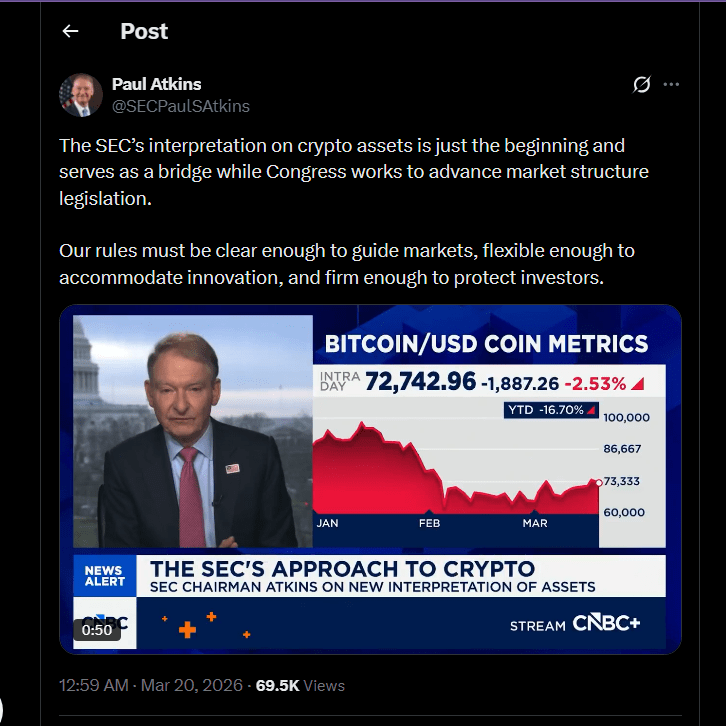
Source: Paul Atkins

SEC Draws A New Line On What Counts As A Security

The closed-door meeting came the same day SEC Chair Paul Atkins delivered prepared remarks at the Practising Law Institute in which he outlined a sharp departure from how his agency has handled crypto in the past.

Gone, he said, is the “regulation by enforcement” approach that defined the previous administration’s posture toward digital assets.

Earlier in the week, the agency published an interpretive notice laying out which crypto assets it considers securities and which it does not. The answer, under the new framework, is that most cryptocurrencies are not securities.

Total crypto market cap currently at $2.39 trillion. Chart: TradingView

Only one category remains under SEC oversight: traditional securities that have been converted into token form. Digital commodities, digital tools, non-fungible tokens, and stablecoins were all identified as falling outside the agency’s reach.

Atkins was direct about the limits of what the agency had done. The interpretation, he said, is a “beginning, not an end.”

A Bridge Until Congress Acts

The SEC’s move follows a memorandum of understanding signed last week between the agency and the Commodity Futures Trading Commission.

Under the expected market structure legislation, the CFTC would take on a larger role in regulating and overseeing digital assets — a shift the SEC appears willing to accept.

Atkins framed the interpretive notice as a necessary bridge while Congress works toward a permanent statutory framework. Administrative interpretations can be revised or reversed.

A law cannot be undone as easily. That distinction is why the Thursday meeting between senators and the White House carries weight beyond the usual Washington optics.

For an industry that spent years under threat of enforcement action, the week’s developments represent a visible change in direction from the country’s top securities regulator.

Featured image from Unsplash, chart from TradingView

Трендові криптовалюти

Пов'язані питання

QWhat was the main purpose of the closed-door meeting between Republican senators and the White House crypto adviser?

AThe meeting was held to discuss and advance the push to rewrite the rules of digital asset oversight, specifically making progress on the stablecoin yield issue that had been holding up broader market structure legislation.

QWhich specific sticking point in the Senate Banking Committee's crypto bill is reportedly close to being resolved?

AThe issue of 'stablecoin yield' is reportedly 99% resolved, according to a spokesperson for Senator Cynthia Lummis.

QHow did SEC Chair Paul Atkins describe the agency's new approach to crypto regulation, contrasting it with the past?

AAtkins stated that the 'regulation by enforcement' approach of the previous administration is gone, and the SEC has now published a new interpretive framework that clarifies which crypto assets are considered securities.

QAccording to the new SEC framework, which category of crypto assets remains under its oversight?

AOnly traditional securities that have been converted into token form remain under SEC oversight. Digital commodities, digital tools, NFTs, and stablecoins are considered outside the agency's reach.

QWhat role did SEC Chair Atkins say the agency's interpretive notice plays while Congress works on legislation?

AAtkins framed the interpretive notice as a 'necessary bridge' to provide guidance until Congress can establish a permanent statutory framework for digital asset regulation.

Пов'язані матеріали

Annual Salary of Millions Competing for Electricians, Meta Rushes to Open Its Own Technical School

The AI boom is facing an unexpected bottleneck: a severe shortage of skilled construction workers and electricians. As tech giants like Meta, OpenAI, and Alphabet race to build massive data centers—such as OpenAI's $16 billion "Stargate" project—they are hitting a critical labor wall. The U.S. needs an estimated 130,000 more electricians, 240,000 construction workers, and 150,000 supervisors by 2030 for AI infrastructure alone, but tens of thousands of electrician jobs go unfilled each year. While AI companies offer high premiums, with electricians earning up to $280,000 annually, worker scarcity still causes massive losses—delays on a single project can cost $14.2 million per month. The complexity of building AI data centers, which require immense power (equivalent to powering hundreds of thousands of homes), sophisticated electrical systems, and advanced liquid cooling solutions, demands highly skilled technicians who are in short supply. To combat this, companies are investing heavily in training. Meta has committed $115 million to a free training school offering tuition, housing, and stipends, targeting 5,000 new workers. OpenAI is partnering with unions to secure skilled labor. These efforts are paying off, with a significant rise in Gen Z interest in trade schools over college. However, the power demands are staggering. AI data centers are driving a rapid surge in electricity consumption, projected to account for up to 12% of U.S. power use by 2028 and raising costs for consumers. Furthermore, the construction boom is project-based, leading to a potential future glut of trained workers once building peaks, which could depress wages industry-wide. The race for AI supremacy now depends as much on skilled hands as on advanced chips.

marsbit6 хв тому

Annual Salary of Millions Competing for Electricians, Meta Rushes to Open Its Own Technical School

marsbit6 хв тому

OpenAI No Longer Sells Its Most Expensive Model for Profit

OpenAI is shifting its business strategy away from promoting its most expensive, flagship models for every task. Recent price cuts—80% for GPT-5.6 Luna and 20% for Terra—signal a deeper change: the company now actively advises users that many tasks don't require the most powerful model. Instead, OpenAI recommends a tiered approach: use the high-end GPT-5.6 Sol for complex planning and analysis, then delegate execution to cheaper models like Luna. This mirrors moves by Anthropic, which recently launched Claude Opus 5 at half the price of its top model, Fable 5. Both companies are de-emphasizing flagship models as primary revenue drivers, using them instead for brand prestige and technological showcases. The industry is entering a "mass-market" phase, similar to automotive, where high-volume, cost-effective models handle daily operations and drive scale. OpenAI's price reductions are partly enabled by AI models themselves optimizing underlying code and infrastructure, creating a self-reinforcing cycle of efficiency gains and cost reduction. Competition is shifting from "who is smartest" to "who offers the best value." The goal is no longer selling individual models but fostering widespread API adoption and ecosystem lock-in. By making AI calls cheap and ubiquitous, companies like OpenAI aim to become the indispensable, utility-like infrastructure powering automated workflows—the "water and electricity" of software, quietly embedded everywhere.

marsbit6 хв тому

OpenAI No Longer Sells Its Most Expensive Model for Profit

marsbit6 хв тому

Will the Fed Definitely Raise Interest Rates in September? How Will Crypto and U.S. Stocks Withstand the Pressure?

The market's expectation for a September Fed rate hike surged dramatically in early August, jumping from under 50% to over 80% within a week. This shift followed a contentious July FOMC meeting, where a 9-3 vote to hold rates revealed growing dissent from hawkish members advocating for an immediate hike to combat persistent inflation. The primary catalyst for this repricing is rising oil prices, driven by renewed geopolitical tensions around the Strait of Hormuz, which threaten global supply. Energy costs directly influence inflation metrics, making the upcoming July CPI report (due August 12th) a critical data point. If it shows inflation reaccelerating, the probability of a September hike will solidify. For Bitcoin and crypto assets, this is typically bearish news. Bitcoin continues to behave as a high-beta, liquidity-sensitive risk asset. A rate hike raises the opportunity cost of holding non-yielding assets and could drive capital toward money markets, pressuring crypto prices in the short term. However, historical patterns suggest that if a hike is perceived as the end of a tightening cycle rather than the start, any negative price impact may be brief. U.S. stocks, particularly crypto-linked equities like Coinbase and growth-oriented tech stocks, are also vulnerable. Higher rates increase discount rates in valuation models, putting pressure on high-multiple companies. This coincides with a pivotal tech earnings season where investor focus has shifted from massive AI capital expenditure to tangible revenue and cash flow generation. Companies with negative cash flow and weak growth narratives could face heightened volatility if borrowing costs rise in September. In summary, a September Fed hike has evolved into a mainstream market scenario. Key factors to watch are oil prices, the July CPI report, and Fed communications, which will determine the final decision and its impact on volatile crypto and equity markets.

marsbit17 хв тому

Will the Fed Definitely Raise Interest Rates in September? How Will Crypto and U.S. Stocks Withstand the Pressure?

marsbit17 хв тому

Торгівля

Спот

Популярні статті

Як купити HOUSE

Ласкаво просимо до HTX.com! Ми зробили покупку Housecoin (HOUSE) простою та зручною. Дотримуйтесь нашої покрокової інструкції, щоб розпочати свою криптовалютну подорож.Крок 1: Створіть обліковий запис на HTXВикористовуйте свою електронну пошту або номер телефону, щоб зареєструвати обліковий запис на HTX безплатно. Пройдіть безпроблемну реєстрацію й отримайте доступ до всіх функцій.ЗареєструватисьКрок 2: Перейдіть до розділу Купити крипту і виберіть спосіб оплатиКредитна/дебетова картка: використовуйте вашу картку Visa або Mastercard, щоб миттєво купити Housecoin (HOUSE).Баланс: використовуйте кошти з балансу вашого рахунку HTX для безперешкодної торгівлі.Треті особи: ми додали популярні способи оплати, такі як Google Pay та Apple Pay, щоб підвищити зручність.P2P: Торгуйте безпосередньо з іншими користувачами на HTX.Позабіржова торгівля (OTC): ми пропонуємо індивідуальні послуги та конкурентні обмінні курси для трейдерів.Крок 3: Зберігайте свої Housecoin (HOUSE)Після придбання Housecoin (HOUSE) збережіть його у своєму обліковому записі на HTX. Крім того, ви можете відправити його в інше місце за допомогою блокчейн-переказу або використовувати його для торгівлі іншими криптовалютами.Крок 4: Торгівля Housecoin (HOUSE)Легко торгуйте Housecoin (HOUSE) на спотовому ринку HTX. Просто увійдіть до свого облікового запису, виберіть торгову пару, укладайте угоди та спостерігайте за ними в режимі реального часу. Ми пропонуємо зручний досвід як для початківців, так і для досвідчених трейдерів.

548 переглядів усьогоОпубліковано 2025.04.27Оновлено 2026.06.02

Як купити HOUSE

Обговорення

Ласкаво просимо до спільноти HTX. Тут ви можете бути в курсі останніх подій розвитку платформи та отримати доступ до професійної ринкової інформації. Нижче представлені думки користувачів щодо ціни HOUSE (HOUSE).

活动图片













