Crypto Project Pudgy Penguins Appears on the Sphere Dome in Las Vegas

RBK-cryptoОпубліковано о 2025-12-25Востаннє оновлено о 2025-12-25

Анотація

Popular NFT project Pudgy Penguins has achieved a major marketing milestone by placing its advertisement on the exterior of the Sphere in Las Vegas, the world's largest spherical LED media platform. The project, which began as a flagship NFT collection on Ethereum, has transformed into a global retail brand by 2025. It now boasts global sales of toys, partnerships with retailers like Walmart and Amazon, the release of animated content, and the launch of its PENGU token on the Solana network. The project has deliberately avoided crypto-themed advertising for this campaign, focusing instead on its physical goods and animated content without mentioning tokens or NFTs. This contrasts with a previous attempt by the Dogwifhat (WIF) meme coin community to run a similar campaign, which was rejected by Sphere despite raising $700,000. The floor price for a Pudgy Penguins NFT is currently around 4 ETH (approximately $12,000). The PENGU token was one of the top-performing major crypto assets in 2025, though it later corrected by more than 70% from its July peak alongside most altcoins. Its previous growth was accompanied by the launch of the Pengu Clash mini-game on Telegram and partnerships with Lufthansa and NASCAR. The project also gained significant attention when dozens of executives from major crypto companies temporarily changed their social media avatars to Pudgy Penguins images.

The team behind the popular NFT project became the first in the crypto industry to secure advertising placement on the world's largest LED screen

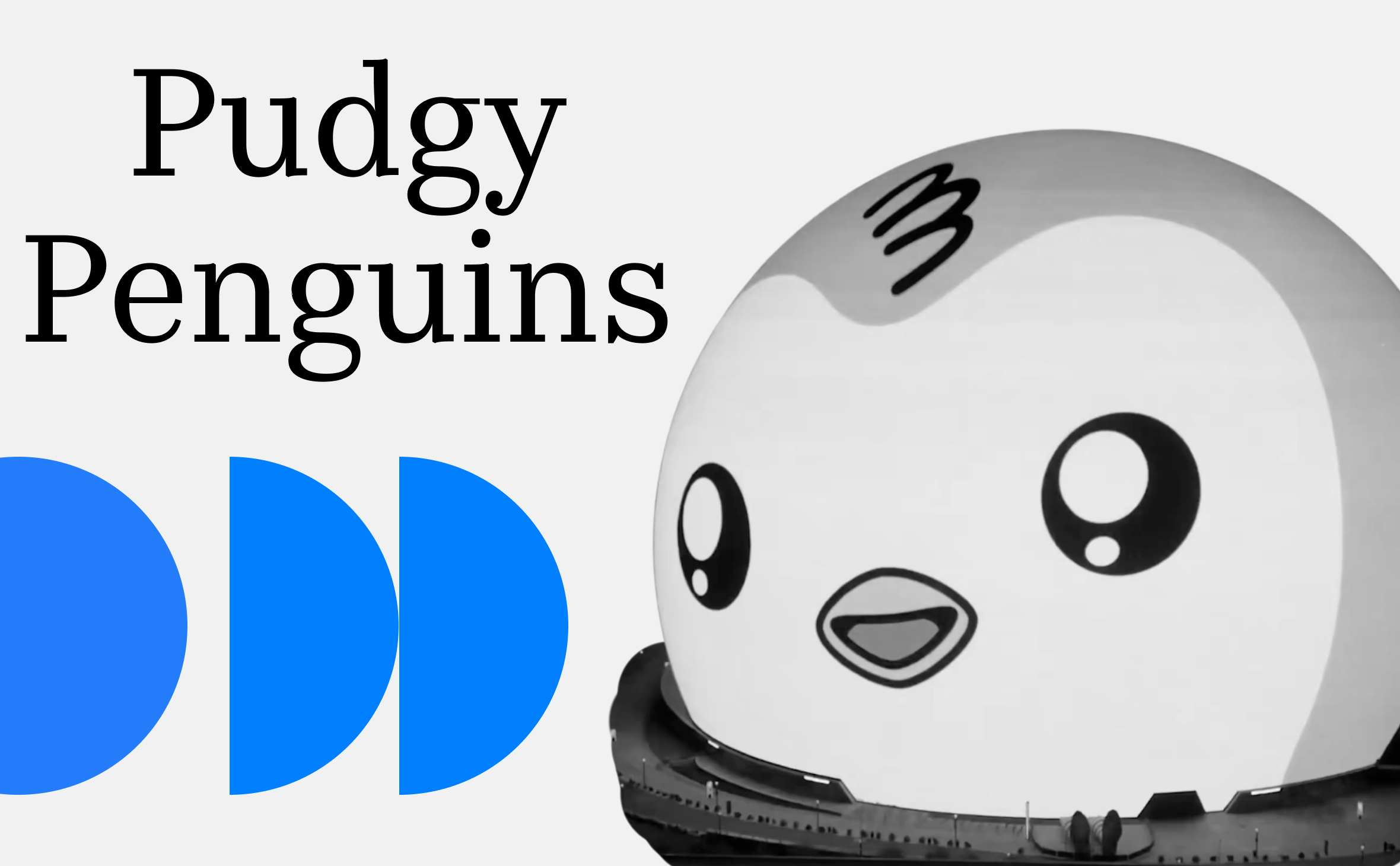
The characters of the Pudgy Penguins brand have become part of the outdoor advertising on the giant LED screen Sphere — the world's largest spherical media platform, located in Las Vegas.

Animation on the LED screen of the Sphere in Las Vegas. Source: pudgypenguins / X

The Pudgy Penguins project began as one of the flagship NFT collections on the Ethereum network, but by 2025 it had transformed into a retail brand with global sales of toys, partnerships with retailers Walmart and Amazon, the release of animated films, and the launch of the PENGU token on the Solana network.

NFT (non-fungible tokens) — these are unique digital objects with ownership confirmed on the blockchain. They became part of the crypto-mania of 2021-2022, when images, videos, and other collectible tokens on the Ethereum or Solana networks were sold for hundreds of thousands of dollars.

The project avoided a ban on crypto advertising from the sphere's operators by focusing on physical goods — toys, merchandise, and animated content, without mentioning tokens or NFTs. Earlier, an attempt by the Dogwifhat (WIF) meme coin community to run a similar campaign was rejected, despite raising $700 thousand for it.

The minimum price (floor price) for one NFT image from the collection is 4 ETH (about $12 thousand), according to CoinGecko data on December 25th.

RBC-Crypto Telegram channel — subscribe and stay up to date with the most important and current news about cryptocurrency.

Join the RBC-Crypto forum on Telegram to discuss news and trends in the crypto world.

The PENGU token showed one of the best growth results among major crypto assets in 2025, but by the end of the year, along with most altcoins, it corrected by more than 70% from its July peak.

That period of growth was accompanied by the launch of the game Pengu Clash as a mini-app on Telegram, a partnership of the project with the airline Lufthansa and the organizer of NASCAR auto races. The same period was marked by a mass flashmob when dozens of leaders and managers of large crypto companies temporarily changed their avatars on social network X to images of Pudgy Penguins.

Volatility interrupted. How the price of bitcoin changed over 10 years at Christmas

AI beat people in a crypto trading tournament. What were the results?

"Capitalization" of miners was called a bullish factor for bitcoin. Why?

Пов'язані матеріали

From Theft to Re-entry: How Was $292 Million "Laundered"?

A sophisticated crypto laundering operation was executed following the $292 million hack of Kelp DAO on April 18. The attack, attributed to the North Korean Lazarus group, began with anonymous infrastructure preparation using Tornado Cash to fund wallets untraceably. The hacker exploited a vulnerability in Kelp’s cross-chain bridge, stealing 116,500 rsETH. To avoid crashing the market, the attacker used Aave and Compound as laundering tools—depositing the stolen rsETH as collateral to borrow $190 million in clean, liquid ETH. This move triggered a bank run on Aave, causing an $8 billion drop in TVL. After consolidating funds, the attacker fragmented them across hundreds of wallets to evade detection. A major breakpoint was THORChain, where over $460 million in volume—30 times its usual activity—was processed in 24 hours, converting ETH into Bitcoin. This shift to Bitcoin’s UTXO model exponentially increased tracing complexity by shattering funds into countless untraceable fragments. The final destination was Tron-based USDT, the primary channel for illicit crypto flows. From there, funds were cashed out via OTC brokers in China and Southeast Asia, using unlicensed underground banks and UnionPay networks outside Western sanctions scope. Ultimately, the laundered money supports North Korea’s weapons programs, which rely heavily on crypto hacking for foreign currency. The incident underscores structural challenges in DeFi: its openness, composability, and lack of central control make such laundering not just possible, but inherently difficult to prevent.

marsbit1 год тому

From Theft to Re-entry: How Was $292 Million "Laundered"?

marsbit1 год тому

Google and Amazon Simultaneously Invest Heavily in a Competitor: The Most Absurd Business Logic of the AI Era Is Becoming Reality

In a span of four days, Amazon announced an additional $25 billion investment, and Google pledged up to $40 billion—both direct competitors pouring over $65 billion into the same AI startup, Anthropic. Rather than a typical venture capital move, this signals the latest escalation in the cloud wars. The core of the deal is not equity but compute pre-orders: Anthropic must spend the majority of these funds on AWS and Google Cloud services and chips, effectively locking in massive future compute consumption. This reflects a shift in cloud market dynamics—enterprises now choose cloud providers based on which hosts the best AI models, not just price or stability. With OpenAI deeply tied to Microsoft, Anthropic’s Claude has become the only viable strategic asset for Google and Amazon to remain competitive. Anthropic’s annualized revenue has surged to $30 billion, and it is expanding into verticals like biotech, positioning itself as a cross-industry AI infrastructure layer. However, this funding comes with constraints: Anthropic’s independence is challenged as it balances two rival investors, its safety-first narrative faces pressure from regulatory scrutiny, and its path to IPO introduces new financial pressures. Globally, this accelerates a "tri-polar" closed-loop structure in AI infrastructure, with Microsoft-OpenAI, Google-Anthropic, and Amazon-Anthropic forming exclusive model-cloud alliances. In contrast, China’s landscape differs—investments like Alibaba and Tencent backing open-source model firm DeepSeek reflect a more decoupled approach, though closed-source models from major cloud providers still dominate. The $65 billion bet is ultimately about securing a seat at the table in an AI-defined future—where missing the model layer means losing the cloud war.

marsbit7 год тому

Google and Amazon Simultaneously Invest Heavily in a Competitor: The Most Absurd Business Logic of the AI Era Is Becoming Reality

marsbit7 год тому

Торгівля

Спот
Ф'ючерси
活动图片