Crypto Project Pudgy Penguins Appears on the Sphere Dome in Las Vegas

RBK-cryptoОпубліковано о 2025-12-25Востаннє оновлено о 2025-12-25

Анотація

Popular NFT project Pudgy Penguins has achieved a major marketing milestone by placing its advertisement on the exterior of the Sphere in Las Vegas, the world's largest spherical LED media platform. The project, which began as a flagship NFT collection on Ethereum, has transformed into a global retail brand by 2025. It now boasts global sales of toys, partnerships with retailers like Walmart and Amazon, the release of animated content, and the launch of its PENGU token on the Solana network. The project has deliberately avoided crypto-themed advertising for this campaign, focusing instead on its physical goods and animated content without mentioning tokens or NFTs. This contrasts with a previous attempt by the Dogwifhat (WIF) meme coin community to run a similar campaign, which was rejected by Sphere despite raising $700,000. The floor price for a Pudgy Penguins NFT is currently around 4 ETH (approximately $12,000). The PENGU token was one of the top-performing major crypto assets in 2025, though it later corrected by more than 70% from its July peak alongside most altcoins. Its previous growth was accompanied by the launch of the Pengu Clash mini-game on Telegram and partnerships with Lufthansa and NASCAR. The project also gained significant attention when dozens of executives from major crypto companies temporarily changed their social media avatars to Pudgy Penguins images.

The team behind the popular NFT project became the first in the crypto industry to secure advertising placement on the world's largest LED screen

The characters of the Pudgy Penguins brand have become part of the outdoor advertising on the giant LED screen Sphere — the world's largest spherical media platform, located in Las Vegas.
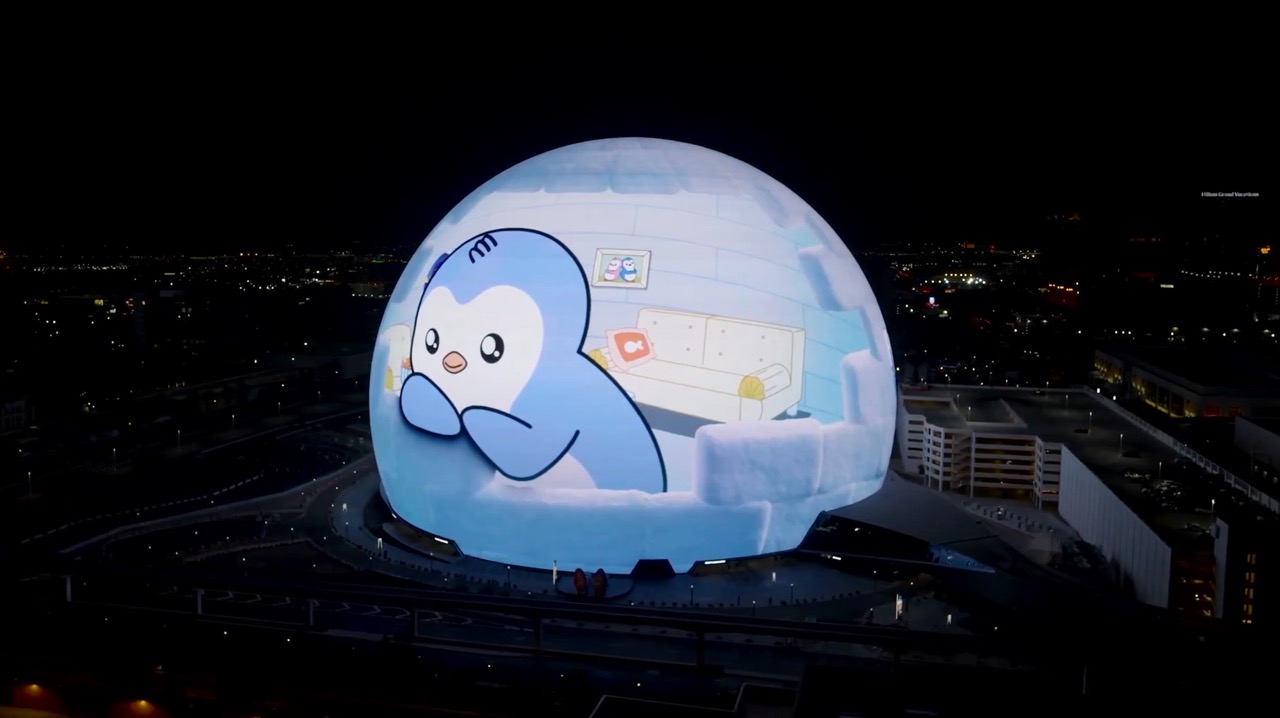
Animation on the LED screen of the Sphere in Las Vegas. Source: pudgypenguins / X

The Pudgy Penguins project began as one of the flagship NFT collections on the Ethereum network, but by 2025 it had transformed into a retail brand with global sales of toys, partnerships with retailers Walmart and Amazon, the release of animated films, and the launch of the PENGU token on the Solana network.

NFT (non-fungible tokens) — these are unique digital objects with ownership confirmed on the blockchain. They became part of the crypto-mania of 2021-2022, when images, videos, and other collectible tokens on the Ethereum or Solana networks were sold for hundreds of thousands of dollars.

The project avoided a ban on crypto advertising from the sphere's operators by focusing on physical goods — toys, merchandise, and animated content, without mentioning tokens or NFTs. Earlier, an attempt by the Dogwifhat (WIF) meme coin community to run a similar campaign was rejected, despite raising $700 thousand for it.

The minimum price (floor price) for one NFT image from the collection is 4 ETH (about $12 thousand), according to CoinGecko data on December 25th.

RBC-Crypto Telegram channel — subscribe and stay up to date with the most important and current news about cryptocurrency.

Join the RBC-Crypto forum on Telegram to discuss news and trends in the crypto world.

The PENGU token showed one of the best growth results among major crypto assets in 2025, but by the end of the year, along with most altcoins, it corrected by more than 70% from its July peak.

That period of growth was accompanied by the launch of the game Pengu Clash as a mini-app on Telegram, a partnership of the project with the airline Lufthansa and the organizer of NASCAR auto races. The same period was marked by a mass flashmob when dozens of leaders and managers of large crypto companies temporarily changed their avatars on social network X to images of Pudgy Penguins.

Volatility interrupted. How the price of bitcoin changed over 10 years at Christmas

AI beat people in a crypto trading tournament. What were the results?

"Capitalization" of miners was called a bullish factor for bitcoin. Why?

Пов'язані матеріали

AI Trading Cools, South Korean Stocks Plunge 1.8%, Spot Gold Rises 1%, Bitcoin Dives

A sell-off in AI-related stocks, triggered by Broadcom's disappointing earnings forecast, sent shockwaves through global markets. South Korea's KOSPI led Asia's decline, plunging 1.8% as the risks from concentrated chip stock gains and surging leveraged investments came to the fore. The tech-heavy Nasdaq 100 futures fell 0.5% following Broadcom's 14% after-hours plunge, which signaled a slower-than-expected transition to AI clients. This pullback extended Wall Street's weakness, halting the S&P 500's nine-day rally amid hawkish Fed signals and renewed Middle East tensions. South Korean authorities convened an emergency meeting, pledging "immediate measures" against market volatility and warning of record-high stock margin debt. The adjustment rippled across assets: Bitcoin fell to around $64,000, its lowest since February, while safe-haven gold rose 1% on bargain hunting. Oil prices dipped on Middle East ceasefire news. Market analysts noted the sell-off was driven by profit-taking after massive gains, particularly in chip stocks like Samsung and SK Hynix, which now dominate the KOSPI. Wall Street banks are divided on Korea's outlook, with Goldman Sachs raising its target while Citigroup and others warn of overvaluation and a potential bubble. Bridgewater's Ray Dalio noted that great technological shifts often create bubbles. Meanwhile, Fed officials' hints at potential future rate hikes added to the cautious mood ahead of key U.S. jobs data.

华尔街日报4 хв тому

AI Trading Cools, South Korean Stocks Plunge 1.8%, Spot Gold Rises 1%, Bitcoin Dives

华尔街日报4 хв тому

Seeking Alpha's Hot Article: Why Might the U.S. Stock Market Crash in June?

In a recent Seeking Alpha article, financial professor and analyst Damir Tokic argues that the US stock market may be poised for a significant crash in June 2026. The core thesis centers on a "mega-bubble" in equities, particularly within the technology sector, which has driven the S&P 500 to near-record valuations, with a Shiller P/E ratio exceeding 40—a level comparable to the 2000 dot-com bubble. Tokic identifies two primary catalysts for a potential collapse. First, he points to unsustainable market exuberance fueled by what he terms the "Trump Stimulus"—massive AI capital expenditure by tech giants, which he believes is politically driven and cannot last. Second, and more urgently, he highlights the escalating Iran war as a critical threat. The ongoing closure of the Strait of Hormuz has created a severe global energy supply crunch. Strategic petroleum reserves are projected to hit critically low operational levels by June, potentially causing oil prices to spike above $200 per barrel and triggering a severe, supply-driven inflationary shock. This scenario, Tokic warns, would force the Federal Reserve's hand. Despite currently maintaining a dovish bias, the Fed would likely be compelled to officially pivot to a hawkish stance at its June FOMC meeting to combat soaring inflation and bond yields. He contends that such a shift—or even a failure to act, which would destroy Fed credibility—could be the trigger that punctures the market bubble. The resulting downturn, he concludes, could rival the bear markets of 2000 and 2008, advising investors to prepare for a major correction.

marsbit27 хв тому

Seeking Alpha's Hot Article: Why Might the U.S. Stock Market Crash in June?

marsbit27 хв тому

AI PC Battle: Bet on the Toll Booth, Not the Camp

**Title:** The AI PC Battle: Don't Bet on Sides, Bet on the Tollbooth **Summary:** The AI PC competition is moving beyond simple "x86 vs. Arm" narratives. The core investment thesis should focus on identifying which players can sustain margins, cash flow, and pricing power throughout the upgrade cycle, rather than backing a particular architecture. The opportunity is analyzed in three layers: 1. **The Advanced Foundry Tollbooth:** TSMC is positioned to collect "tolls" regardless of which chip designer wins, due to its dominant ~70% share in advanced semiconductor manufacturing, which is essential for high-end AI PC chips. 2. **Compute & Platform Spillover:** AMD represents an offensive in the x86 CPU+GPU space, while NVIDIA leverages its GPU and CUDA software stack dominance. Both benefit from the demand for increased local AI compute. 3. **Architecture Diffusion & Turnaround Plays:** ARM and Intel offer potential for significant upside (elasticity), but investments here require stricter discipline due to higher execution risks and competitive challenges. The industry is transitioning from concept to shipment validation. While short-term forecasts for AI PC adoption have been revised down slightly due to tariffs and procurement delays, the long-term trend towards AI becoming a standard PC feature remains intact. The key driver for upgrade cycles will be whether compelling enterprise applications (e.g., privacy-sensitive computing, low-latency inference) emerge beyond consumer-focused features like meeting summarization. Investment strategy should prioritize companies with platform-level advantages and recurring revenue streams. TSMC offers high certainty as the foundational tollbooth. AMD presents a strong offensive play within the established ecosystem. ARM and Intel are higher-risk, higher-potential-reward turnaround bets. The report cautions against chasing short-term hype and emphasizes a disciplined, long-term approach focused on buying ecosystem strength and cash-flow certainty after market enthusiasm subsides. **Key Risks:** Underwhelming AI PC applications slowing upgrade cycles; slow improvement in Windows on Arm compatibility; macro/tariff impacts on PC demand; potential advanced node supply-demand mismatches affecting TSMC; high overall AI sector valuations making stocks vulnerable to a risk-off shift in markets.

marsbit41 хв тому

AI PC Battle: Bet on the Toll Booth, Not the Camp

marsbit41 хв тому

Ten-Thousand-Word Analysis: From $10 to $290, MRVL Wins the Entire AI Era by 'Not Making GPUs'

Marvell Technology's stock price surged from under $10 in 2016 to a record $290 in June 2026, fueled not by making GPUs, but by dominating AI infrastructure connectivity. This analysis argues the market misvalues MRVL as merely a smaller Broadcom in custom AI chips, overlooking its true, unique position. Marvell's core strength lies in enabling high-speed data flow for AI clusters through three interconnected businesses. First, it holds a commanding ~70% market share in high-speed optical DSPs (essential for data center light modules), a deep-moat business with accelerating growth. Second, its custom AI chip design business serves hyperscalers like AWS, Microsoft, and Google, with a significant revenue pipeline despite lower margins. Third, stable cash flows come from Ethernet switch chips and enterprise storage controllers. Together, they form a full-stack "AI data movement" platform. CEO Matt Murphy's transformative leadership since 2016, involving strategic divestments, key acquisitions (like Inphi for optical DSPs), and securing long-term agreements with major cloud providers, repositioned the company. A pivotal $2 billion strategic investment from NVIDIA in 2026 underscored Marvell's critical role in the AI ecosystem, particularly through collaborations like NVLink Fusion. While Marvell faces risks—including client concentration (losing the Amazon Trainium3 design), lower-margin business mix, competitive threats, insider selling, and complex supply chains—its fundamentals remain strong. The optical interconnect moat is widening with the acquisition of Celestial AI (photonics fabric), and financial metrics show accelerating revenue growth and operating leverage. With a PEG ratio suggesting undervaluation relative to its growth, the thesis is that the market undervalues Marvell's monopolistic position in AI "plumbing" while overemphasizing its competitive custom chip segment. The story transcends investing, symbolizing how in any complex system—from the internet to AI—the value of "connection" ultimately surpasses that of individual "nodes."

marsbit1 год тому

Ten-Thousand-Word Analysis: From $10 to $290, MRVL Wins the Entire AI Era by 'Not Making GPUs'

marsbit1 год тому

Торгівля

Спот
Ф'ючерси
活动图片